
The blanket advice to “always max your 401(k)” is wrong for many new attendings with massive med school debt.
Here’s the real answer: in your first 1–3 attending years, the right move is usually a hybrid strategy—grab the high‑value retirement benefits you cannot get back later, then throw the rest of your extra cash at the highest‑interest debt. But the exact mix depends on your loans, your employer match, and whether Public Service Loan Forgiveness (PSLF) is realistically on the table.
Let’s break it down like a decision tree, not a vague “it depends.”
Step 1: Figure Out What Game You’re Actually Playing
You’re not just choosing “401(k) vs loans.” You’re choosing between:
- Forgiveness strategy – PSLF or long‑term IDR forgiveness
- Aggressive payoff strategy – kill the loans in 3–7 years
- Middle-of-the-road mush – overpay a little and save a little, with no clear goal
That third category is where people waste the most money. Do not live there.
Start with three questions:
- Are you in (or will you soon be in) a qualifying PSLF job?
- 501(c)(3) hospital, academic center, VA, county/state facility? That’s usually qualifying.
- What are your weighted average interest rates?
- Federal Direct loans at 6–8%? Private refinance at 3–5%? MIX?
- What’s your realistic timeline at this employer type?
- “I’m 90% sure I’ll stay in academics for 10+ years” vs “I might go private in 2–3 years.”
Answer those and the path gets clearer.
Step 2: PSLF vs No PSLF – This Drives (Almost) Everything
If PSLF is clearly your path
If all the following are true:
- You’ve got federal Direct loans
- You’re in or going to a qualifying nonprofit/government employer
- You can see yourself doing 10 years total of qualifying payments (residency + attending)
Then your loans are not a classic “debt” problem. They’re a tax problem and a paperwork problem.
In a true PSLF strategy:
- You do not want to pay extra on loans
- You do want to minimize qualifying payments by using the right income‑driven repayment (IDR) plan
- You must keep your paperwork immaculate (annual recertification, employment certification forms, etc.)
What this means for the 401(k) vs debt question:
You should almost never aggressively crush loans if PSLF is real.
Instead:
- Make the minimum IDR payment that still qualifies for PSLF
- Max out tax‑advantaged retirement accounts as aggressively as your cash flow allows
- Build an emergency fund and protect yourself (disability & life insurance)
This is one of the few situations where I’ll say: if you’re truly PSLF‑bound, maxing your 401(k)/403(b) and Roth IRA usually beats prepaying loans.
Why? Because:
- Every extra dollar to loans is money you might have had forgiven
- Every pre‑tax retirement dollar can lower your IDR payment, which means:
- You pay less over 10 years
- You potentially get more forgiven
In PSLF land, the “obvious” move to throw everything at your loans is actually the wrong play.
If PSLF is off the table (or very shaky)
This is the majority of private practice attendings and many hospital-employed docs working for for‑profit systems.
Now your loans are exactly what they look like: high‑interest, unsecured, non-dischargeable debt. Ugly.
In this case, compare the guaranteed return from paying loans vs the expected return from investing.
Rough rule:
- If your loan rate is above 6–7%, aggressive payoff starts looking very attractive
- If you’ve refinanced to 3–4%, investing gets much more competitive
But it’s not just math. You also have risk, behavior, and lifetime tax planning to consider.
Step 3: The Non-Negotiables Before You Even Ask the Question
Before you start playing “max vs crush,” I’d treat these as mandatory for a new attending:
Grab the employer match. Always.
If your 401(k)/403(b) has a match (e.g., 3–6%), you collect every dollar of that.
That’s a 100% return on your contribution in year one. There is no student loan paying you 100% interest.Basic emergency fund.
Not 12 months of expenses. But at least 3 months in cash or cash‑like accounts.
You’re too exposed early on—any job change or health event with no cushion and your finances implode.Appropriate disability and term life insurance.
Own‑occupation disability. Term life only if someone depends on your income.
Without this, your whole plan is built on “I never get sick and nothing bad happens.” That’s not a plan.
Once these are covered, then you answer: “401(k) up to the max, or bigger payments on loans?”
Step 4: A Simple Framework – 3 Common Scenarios
Let’s walk through three realistic scenarios and the playbook for each.
| Scenario | PSLF? | Loan Rate | Primary Focus |
|---|---|---|---|
| Academic Hospitalist | Yes | 6–7% federal | Max tax-advantaged accounts, PSLF |
| Private Practice Specialist | No | 5–7% federal | Hybrid: match + aggressive payoff |
| Refi High Earner | No | 3–4% private | Heavy retirement + planned 5–7 yr payoff |
Scenario 1: New attending in academic medicine, strong PSLF path
Example: Hospitalist at a big academic center, $280k salary, $350k loans at 6.5%, all federal Direct, residency and fellowship were at 501(c)(3) hospitals.
Strategy:
- Confirm all your loans qualify for PSLF
- Get on an IDR plan that you can tolerate (SAVE, PAYE, or IBR depending on your specifics and timing)
- Certify employment every year like religion
- Do not overpay loans
Where does extra money go?
- Max 403(b)/401(k) (pre‑tax often best since it lowers IDR payment)
- Max Roth IRA or backdoor Roth IRA (depending on income limits and plan structure)
- Add HSA if you have a high‑deductible plan
- Build taxable brokerage if there’s more left
Here, “Should I max my 401(k) or crush debt?” is the wrong question. The right question is:
“How do I maximize forgiveness while building as much retirement wealth as possible?”
Answer: Max the retirement side.
Scenario 2: New private practice doc, high-interest federal loans, no PSLF
Example: Outpatient IM in a for‑profit group, $260k salary, $300k loans at 6.8%, no PSLF qualifying employer.
This is where the trade‑off is real.
What I’d do here (and have literally walked clients through):
- Get the employer retirement match. Non-negotiable.
- Build 3–6 months emergency fund.
- Refinance federal loans to a lower rate if:
- You’re not going back to nonprofit
- You do not need federal protections (IDR safety net, PSLF)
- Set a clear payoff window:
- 3 years? 5 years? 7 years? Pick one. Put it on paper.
Then:
- Contribute enough to 401(k) to get the match
- Decide how high you want your savings rate to be (e.g., 20–30% of gross)
- Once match + basic retirement goal are funded, shove the remaining extra into loan payoff until they’re gone
In many of these high‑rate cases, I would not recommend fully maxing the 401(k) ($23k+) at the expense of keeping 6.8% loans for 10–15 years. You’re locking in a high, guaranteed negative return.
If your all‑in savings rate is strong, a good split might look like:
- 10–15% gross to retirement (match + some extra)
- Everything above that to loans, with a 3–7 year payoff goal
Scenario 3: High-income specialist, refinanced loans to 3–4%
Example: Anesthesiologist, $450k salary, refinanced $350k loans to 3.4% with a 10-year term.
Now the math shifts. A 3–4% loan is annoying, but not financial cancer.
Here, I usually lean more aggressively toward maxing tax‑advantaged accounts, because:
- Long‑term expected stock returns (even after inflation) are well above 3–4%
- Tax deferral + tax‑free growth (Roth) are massively valuable over 20–30 years
- You can still target a 5–7 year payoff without starving retirement
Typical strategy:
- Max 401(k)/403(b) (and 457(b) if you have it and it’s not a sketchy non‑governmental plan)
- Max backdoor Roth IRA
- Consider extra to HSA
- Then allocate extra to loans with a defined timeline (e.g., “Loans gone by year 7”).
Notice the difference: at 3.4%, the urgency to “crush” is lower. You’re managing it strategically, not putting out a fire.
Step 5: Behavioral Reality – What Will You Actually Stick To?
On paper, you can run precise spreadsheets. In real life, you’re a new attending:
- Your spending tends to inflate fast after residency
- You’re exhausted and your willpower is limited
- You’ll get hit with big one‑off expenses (wedding, down payment, kids, etc.)
So be honest:
- Are you the type who needs the quick win of watching loans vanish in 4 years?
- Or will you sleep better knowing you’re stacking retirement accounts even while loans exist?
Both are valid. The worst outcome is no clarity. Vague goals lead to drifting.
I’d rather see:
“I’ll keep my lifestyle modest, put 20% of my gross toward retirement and 20% toward loans, and have these killed in 5 years.”
…than…
“I’ll kind of pay extra when I can and increase my 401(k) as I go.”
The first is a plan. The second is a wish.
Step 6: The Clear Priority Order for Most New Attendings
If you want a blunt checklist, here it is.
- Employer retirement match
- Emergency fund to 3 months
- Disability + (if needed) term life insurance
- Decide: PSLF path vs No-PSLF path
- If PSLF:
- Optimize IDR
- Max out pre‑tax and/or Roth accounts
- If No PSLF and high-interest loans (6%+):
- Modest but real retirement contributions (e.g., 10–15% gross)
- Aggressive loan payoff with a set timeline
- If No PSLF and low-interest refi (3–4%):
- Max tax-advantaged accounts
- Targeted, scheduled payoff within 5–7 years
That’s the skeleton. You can dress it with your details, but don’t reinvent the bones.
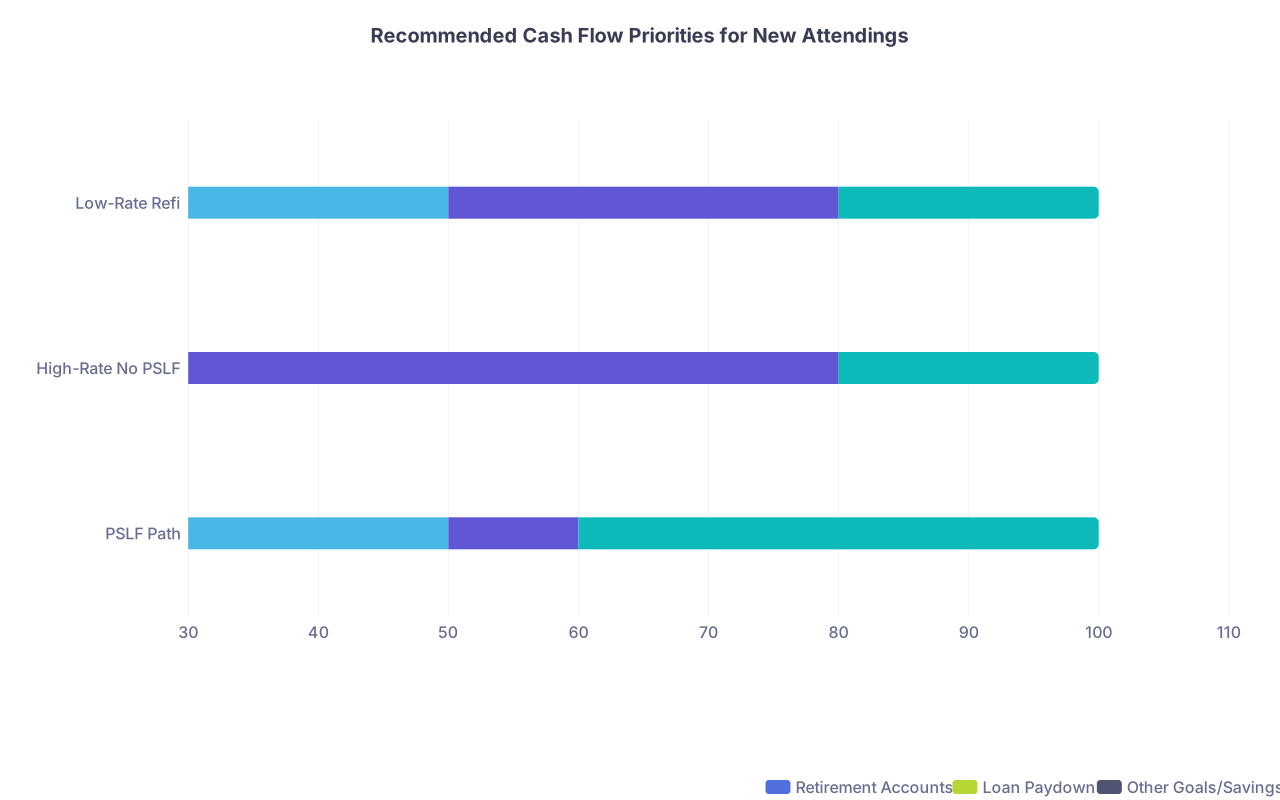
| Category | Retirement Accounts | Loan Paydown | Other Goals/Savings |
|---|---|---|---|
| PSLF Path | 50 | 10 | 40 |
| High-Rate No PSLF | 30 | 50 | 20 |
| Low-Rate Refi | 50 | 30 | 20 |

| Step | Description |
|---|---|
| Step 1 | New Attending |
| Step 2 | Use IDR, Min Loan Payments |
| Step 3 | Max Retirement Accounts |
| Step 4 | Build Emergency Fund |
| Step 5 | Match + Modest Retirement |
| Step 6 | Max Retirement Accounts |
| Step 7 | Aggressive Loan Payoff 3 to 7 Yr |
| Step 8 | Planned Payoff 5 to 7 Yr |
| Step 9 | PSLF Likely? |
| Step 10 | Loan Rate Above 6 Percent? |
FAQ: 7 Common Questions New Attendings Ask
1. If I expect PSLF but I’m not 100% sure I’ll stay in academics, should I refinance?
Usually no. Once you refinance federal loans to private, PSLF is dead forever. If there’s a real chance you’ll stay in qualifying employment, I’d keep loans federal, use IDR, and reassess after a few attending years when your direction is clearer.
2. Is it ever smart to ignore the 401(k) match to pay more on loans?
No. Skipping a true match is lighting free money on fire. Even with 7–8% loan rates, a 100% instant risk‑free return from a match beats the savings from extra loan payment. Take the match, always.
3. What about Roth vs pre-tax 401(k) as a new attending with loans?
For PSLF folks, pre‑tax often wins because it lowers AGI and thus IDR payments, increasing forgiveness. For non‑PSLF, it’s more nuanced. High earners who expect similar or lower tax brackets in retirement often benefit from pre‑tax, but Roth can be attractive for tax diversification. If you’re lost, a split (some pre‑tax, some Roth) is fine.
4. How fast should I realistically aim to pay off med school debt if I’m not doing PSLF?
If your rate is high (6–8%), I like a 3–7 year target, depending on specialty and income. Short enough to stay focused; long enough that you’re not living like a resident forever or ignoring retirement. At 3–4% refi, 5–10 years can be perfectly reasonable.
5. Should I buy a house before paying off my med school loans?
Often no, especially in your first 1–2 attending years. Get stable in your job, crush or at least control the high‑interest debt, and avoid chaining yourself to a location before you know you’ll stay. If you do buy, keep it conservative: no “doctor house” in year one.
6. What if I feel behind because I started investing late compared to non‑physicians?
Every physician feels this. You started late, but you also have a very high earning potential. If you can get to saving 20–30% of your gross income in your early attending years, you can absolutely catch up and surpass most peers. The danger isn’t starting late; it’s wasting your first 5 high‑income years.
7. What’s one number I should track to know if I’m on the right path?
Your savings rate as a percentage of gross income. Sum all retirement contributions (yours + employer), extra loan principal payments, and other true long‑term investments. Divide by your gross income. If you’re in the 20–30% range as a new attending, you’re doing very well. Under 15% for years on end? You’re probably under‑saving.
Open your paystub and your loan account right now. Write down: your current 401(k)/403(b) contribution percentage, your loan interest rates, and whether your job qualifies for PSLF. From that, pick one of the three scenarios above—and commit to a clear 3–7 year plan instead of drifting month to month.