
What if paying too much toward your loans as a new attending actually makes you hundreds of thousands of dollars poorer over your career?
Let me answer the question you’re actually asking: “I’m finally an attending, I’m making real money, I’ve got big loans — how much should I really be paying every month beyond the minimum?”
Here’s the short, blunt version:
- If you’re pursuing PSLF: you should usually pay the minimum required and invest the rest. Extra payments are often a waste.
- If you’re not going for forgiveness and your interest rate is 6–8% with no good refinance option: aggressively pay extra until the effective rate is “tolerable.”
- If you’ve refinanced to a low fixed rate (say 3–4.5%) and aren’t doing PSLF: there’s a reasonable “sweet spot” extra payment, typically 20–30% of your take-home pay going to all savings + debt, with loans just being one slice.
But that’s still abstract. You want numbers.
Let’s walk through a framework that gives you an actual monthly target instead of random guessing or guilt-driven payments.
Step 1: Figure Out Which “Bucket” You’re In
Before talking dollar amounts, you have to answer one non-negotiable question:
Are you realistically on track for PSLF or any other forgiveness?
If:
- You’re at a 501(c)(3)/government hospital
- You’ve got or will have 120 qualifying payments under an IDR plan
- You plan to stay in the non-profit/public sector at least until that 10-year mark
…then you’re in the PSLF bucket.
If not, you’re in the repay-in-full bucket.
Why this matters so much:
If you’re going for PSLF, extra payments are usually lighting money on fire. Every extra dollar you send just reduces what would have been forgiven. That’s not “being responsible,” that’s gifting the government money.
So:
- PSLF path → Optimize for minimum payments, maximize investing.
- No PSLF → Optimize for a smart balance between debt payoff speed and wealth building.
We’ll handle both.
Step 2: Decide Your Target Savings Rate First (Not Your Loan Payment)
People start with, “How much more should I pay toward loans?”
Wrong starting point.
The better question is: How much of my attending income should go to “future you” — which includes both savings and extra debt payoff?
For most attendings, a 20–30% gross savings rate (savings + extra loan payoff) is where you want to land, especially in the first 5–10 years.
Meaning:
- If your gross income is $300,000
- 20% is $60,000/year or $5,000/month
- That $5,000/month is your total “wealth building” bucket:
- Retirement accounts (401(k), 403(b), 457(b), Roth IRA, etc.)
- Taxable investments
- Extra student loan payments
You don’t put 30% purely toward loans and then try to figure out retirement later. That’s how people end up debt-free at 40 with almost no investments and a ton of lost compounding.
So the framework is:
- Set a target percent of your gross income for wealth building (start at 20–25% if you’re late to the game or heavily indebted).
- Fund your retirement accounts up to employer match + reasonable tax-advantaged space.
- Whatever’s left in that “wealth building” bucket can go to either loans or additional investing, depending on your situation.
Now let’s put numbers on “how much extra” depending on which bucket you’re in.
Step 3: How Much Extra to Pay If You’re Pursuing PSLF
If you’re PSLF-bound, the answer is almost always annoyingly simple:
Pay only what your IDR plan requires. Do not pay extra.
The only exceptions:
- You’re no longer certain you’ll stay in qualifying employment.
- Your income is now so high that your required IDR payment is basically the standard payment anyway.
- Your PSLF paperwork is a disaster and you’re not actually getting qualifying payment credit.
If you’re a clean PSLF case, your “extra” should go to:
- Maxing out:
- 403(b)/401(k)
- 457(b) (if decent)
- HSA (if available)
- Then taxable investments.
Your monthly student loan payment? Whatever the IDR formula says. Nothing more.
The mental trap here is guilt. New attendings feel weird paying $400/month on a $300k balance, so they start throwing $1,500 or $2,000 extra at it. I’ve seen people effectively burn $50k+ this way over a few years, only to still get forgiveness later.
So if you’re truly PSLF-bound, your “how much extra” answer is:
$0 extra. Increase investing instead.
Use your emotional energy to stay in qualifying employment and keep your paperwork airtight.
Step 4: How Much Extra to Pay If You’re NOT Doing PSLF
Now we get to the real tension: high-income attending, big loans, no forgiveness safety net.
Here’s how I’d structure it.
Step 4A: Look at your interest rate and refinancing options
Basic rule of thumb:
- If your rate is > 6% and you’re not in a forgiveness program → try to refinance (unless you need federal protections for a specific, real reason).
- If you can get into the 3–4.5% fixed range with a reputable private lender → strongly consider it, especially with a secure job and solid emergency fund.
Once you know your rate, your urgency changes:
| Rate Range | Priority Level | General Strategy |
|---|---|---|
| 7–8%+ | Very High | Aggressive payoff, large extra payments |
| 5–7% | High | Balanced: extra payoff + strong investing |
| 3–5% | Moderate | Favor investing, steady payoff |
| <3% | Low | Minimum required, invest the rest |
Step 4B: Concrete example – let’s put numbers on it
Say:
- Attending income: $300,000
- Take-home after taxes/benefits: around $16,000/month (this will vary)
- Student loans: $300,000 at 6.5%, 10-year standard payment ≈ $3,400/month
You decide on a 25% gross “future you” rate:
25% of $300k = $75,000/year ≈ $6,250/month for savings + extra loan payoff.
Break it down like this:
- Retirement:
- 403(b)/401(k): $2,000–$2,500/month
- Backdoor Roth IRA: ~$500/month
- That leaves: roughly $3,250–$3,750/month for either:
- Extra loan payments, or
- Taxable investing (index funds)
Your required loan payment is $3,400/month. Now the question is:
How much of that extra $3,250–$3,750 goes to loans vs. investing?
Here’s a reasonable framework by risk/comfort level:
Super risk-averse, hate debt:
- Put $2,000–$2,500 extra toward loans
- Put $750–$1,500 into a taxable account
Balanced approach (what I see work very well):
- Put $1,000–$1,500 extra toward loans
- Put $1,750–$2,250 into a taxable account
Aggressive investor, comfortable with debt at 6.5% (not most people):
- Put $500–$1,000 extra toward loans
- Put $2,250–$3,250 into a taxable account
That means your total monthly loan payment looks like:
- Conservative: $3,400 + $2,500 = $5,900/month
- Balanced: $3,400 + $1,500 = $4,900/month
- Aggressive investor: $3,400 + $750 = $4,150/month
Translate that to a general rule:
As a non-PSLF attending with 6–7% loans, a solid starting point is:
Required payment + $1,000–$2,000/month extra, as long as you’re still hitting a 20–30% total savings/wealth-building rate.
Step 5: Adjust Based on Your Life Phase
Your loans don’t live in a vacuum. You’ve got other financial “must haves” competing for those dollars: emergency fund, housing, kids, practice buy-in, maybe aging parents.
Here’s how to adjust the “how much extra” by common scenarios.
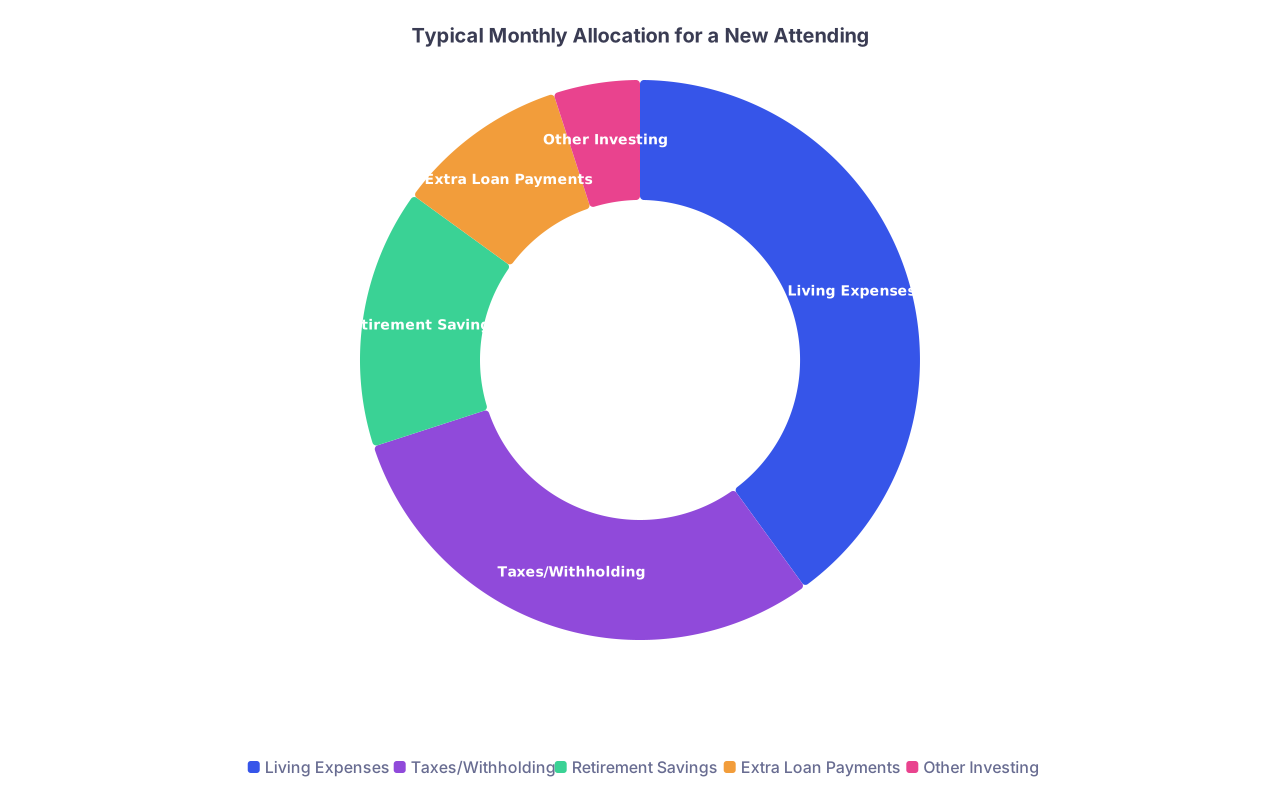
| Category | Value |
|---|---|
| Living Expenses | 40 |
| Taxes/Withholding | 30 |
| Retirement Savings | 15 |
| Extra Loan Payments | 10 |
| Other Investing | 5 |
Scenario 1: New attending, no kids, renting
You can be aggressive.
- Aim for 25–30% of gross to wealth building.
- Fund retirement accounts.
- Then I’d be completely fine seeing $1,500–$3,000/month extra toward loans if that fits your numbers and doesn’t starve investing.
Scenario 2: Young kids, spouse not working, daycare costs
You need more flexibility and cash on hand.
- Drop to maybe 20–22% gross for wealth building initially.
- Still fund retirement accounts (especially if there’s a match).
- You might only manage $500–$1,500/month extra toward loans. That’s fine. Don’t burn yourself.
Scenario 3: Planning a home purchase soon
Do not shove every extra dollar into loans and then panic-borrow with a tiny down payment.
- Prioritize emergency fund + home down payment fund first.
- During that period, you might only pay the required loan amount or a small extra ($200–$500).
- After closing and stabilizing, ramp the extra payment back up.
This is where a lot of people mess up: they lose all flexibility by turning every spare dollar into illiquid “loan payoff progress.” Then life happens.
Step 6: A Simple Rule-of-Thumb Formula
If you want a plug-and-play structure, use this:
- Decide your future-you rate:
- New attending: 20–30% of gross
- Out of that:
- At least 50–70% goes to retirement/investing
- The rest 30–50% can go to extra loan payments
So if your gross is $350,000, and you choose 25%:
- 25% of $350k = $87,500/year ≈ $7,300/month
- 60% to retirement/investing ≈ $4,400/month
- 40% to extra loans ≈ $2,900/month
If your required payment is already, say, $3,800/month, your total loan payment becomes:
$3,800 + $2,900 = $6,700/month
That’ll crush a $300k balance very fast without sacrificing retirement.
Step 7: When Are You Paying “Too Much” Extra?
You’re likely overdoing it on extra loan payments if:
- You’re not maxing at least:
- Your main workplace retirement account (especially if there’s a match)
- Roth IRA or backdoor Roth (if eligible)
- You don’t have 3–6 months of living expenses in cash.
- You’re putting off basics like disability insurance or appropriate life insurance.
- You feel “behind” on saving for a house, kids’ needs, or basic investing.
- Your savings rate is high only because “it’s all going to loans,” and nothing is going to build assets you’ll actually own once the debt is gone.
Debt-free and broke at 40 is not a flex.
Quick Comparison: Minimal vs Aggressive Extra Payments
| Strategy | Extra Payment | Approx Payoff Time | Total Interest Paid* |
|---|---|---|---|
| Minimum (10-yr std) | $0 | 10 years | Very high (~$115k+) |
| +$500/month | $500 | ~8.7 years | Lower |
| +$1,500/month | $1,500 | ~6.5 years | Much lower |
| +$3,000/month | $3,000 | ~4.5–5 years | Dramatically lower |
*Rough estimates. Exact numbers depend on your actual terms and amortization but the pattern holds: each additional $500–$1,000/month shaves years off.
Don’t Forget: Time and Attention Are Also a Cost
There’s a psychological cost to keeping loans around forever. For some people, it’s worth paying an extra $1,000/month not because of the math, but because they sleep better knowing the debt will be gone in 4–5 years instead of 10.
That’s valid.
Just don’t let vibes totally override math. Especially if:
- You’re PSLF-eligible (where extra payments are usually just wrong)
- Your rate is low after refinance and the market likely outperforms that rate over time
You’re a physician. You can think in probabilities and tradeoffs. Apply that same mindset to money.
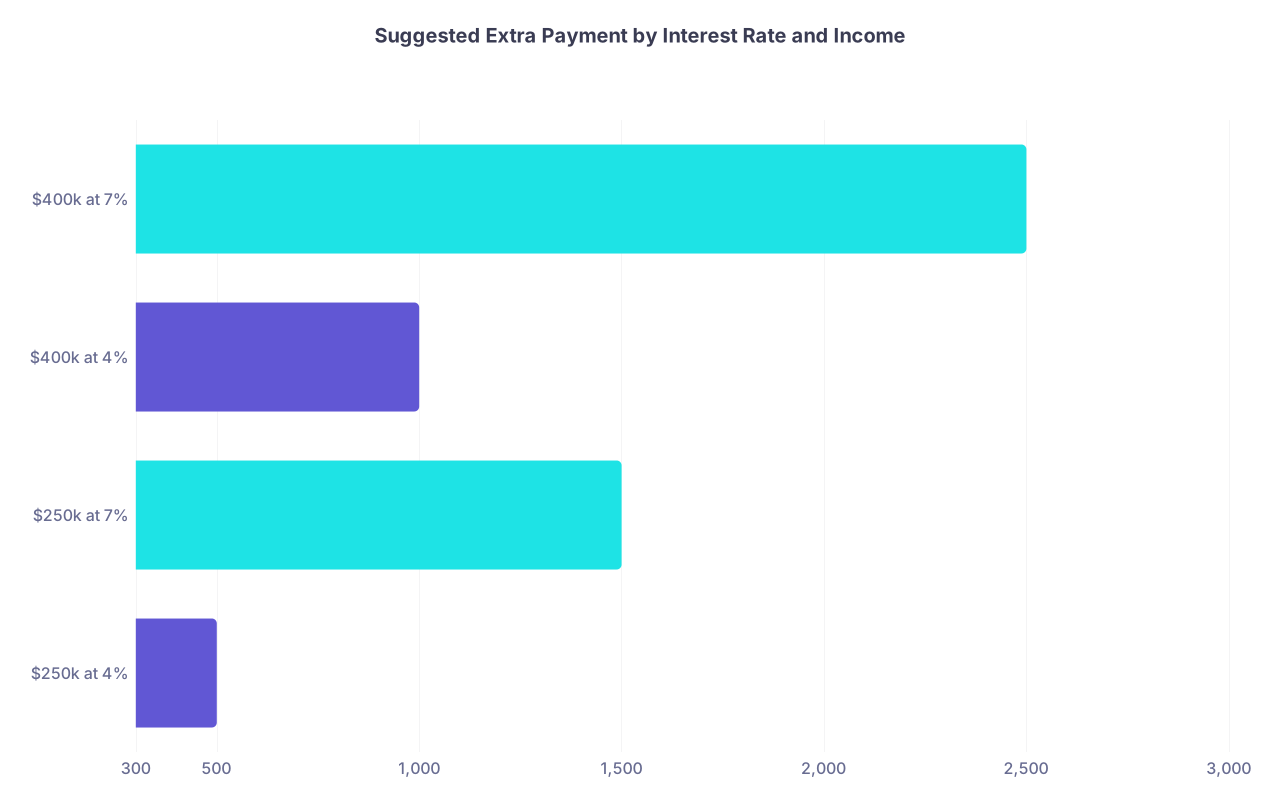
| Category | Value |
|---|---|
| $250k at 4% | 500 |
| $250k at 7% | 1500 |
| $400k at 4% | 1000 |
| $400k at 7% | 2500 |

Bottom Line: A Clear, Practical Answer
Let me give you the cleanest, no-handwaving answer I can:
If you’re doing PSLF
- Pay: minimum IDR payment, $0 extra
- Goal: maximize retirement/investing, keep PSLF on track
If you’re not doing PSLF and your rate is 6–8%
- Aim for 20–30% of gross income to “future you” (savings + debt)
- Out of that, send enough extra to loans so your total payment is usually:
- Required payment + $1,000–$2,000/month
- More if you’re single/low overhead and want them gone fast
- Less if you’re juggling family, house, or uncertain job
If you’ve refinanced to 3–4.5% and no forgiveness
- You can justify smaller extra payments:
- Required payment + $500–$1,000/month
- Favor investing more heavily; let the low-interest debt burn down steadily.
- You can justify smaller extra payments:
If you stick to that framework for 5–7 years, you’ll end up in one of two good places:
- Loans gone, and you’re not behind on retirement.
- Loans close to gone, with a big investment cushion already compounding for you.
That’s the real win.

Actionable next step for today:
Grab your last pay stub and your loan statement.
Calculate 20–30% of your gross monthly income. Write that number down. Then decide exactly how much of that is going to:
- retirement accounts,
- taxable investing, and
- extra student loan payments next month.
Put the actual dollar amounts on paper. If you can’t name them, you’re guessing — not planning.
FAQ (Exactly 5 Questions)
1. I’m a new attending and my loans feel crushing. Should I delay retirement savings to pay them off faster?
No. That’s a common but expensive mistake. You should almost never stop all retirement savings just to attack loans. At minimum, grab any employer match (that’s free money) and strongly consider contributing to tax-advantaged accounts up to a reasonable level. Use extra cash beyond that for faster loan payoff. Totally pausing retirement for years usually costs you far more in lost compounding than you gain in saved interest.
2. My loans are at 7% and I’m not eligible for PSLF. Should I refinance right away?
Probably, but not blindly. Make sure:
- You have or are getting solid disability insurance.
- You’ve got at least a small emergency fund (1–3 months expenses). If your job is stable and you don’t need federal protections like IDR safety nets or disability discharge, refinancing into a lower fixed rate (3–5%) is usually a good move. After refinancing, you can choose a term that lines up with your payoff goals, and then add extra payments on top.
3. How long should I aim to take to pay off my student loans as an attending?
For most attendings not doing PSLF, a 3–7 year payoff horizon from the start of attendinghood is a good target. Under 3 years usually means you’re under-saving for retirement. Over 7–10 years can be fine if your rate is low and you’re aggressively investing, but if you’re at 6–8% interest, dragging the loans out for a decade is usually suboptimal.
4. What if I’m not sure I’ll stay in non-profit employment long enough for PSLF?
Then you shouldn’t behave like a pure PSLF candidate. In that gray zone, a smart approach is:
- Use IDR and pay the minimum for now.
- Simultaneously build up a “PSLF hedge fund” in a taxable account with what would have been extra payments. If you end up getting PSLF, great — that taxable account becomes a wealth booster. If you don’t, you can dump that money into the loans in a lump sum. This keeps your options open instead of committing early to a path you may not follow.
5. Is it bad if I only pay $200–$500 extra per month as an attending?
Not necessarily. It depends on what else you’re doing. If your modest extra payment is paired with a strong savings rate (20–30% of gross) and you’re aggressively filling retirement and investment accounts, you’re doing fine. You don’t get bonus points for “suffering” under massive payments if the rest of your financial life is underbuilt. The right question isn’t “Is $500 extra enough?” It’s “Am I hitting a solid total savings/wealth-building rate while making steady progress on my loans?” If yes, you’re on track.