
The higher PSLF-eligible job is not automatically the right move—and neither is chasing the biggest paycheck. The people who win this game are the ones who run the numbers coldly and ignore the hype.
You’re asking the right question:
Should you choose a lower-paying PSLF-eligible job over a higher salary in the private sector?
Here’s the real answer:
Sometimes yes. Sometimes absolutely not. You decide that by doing one thing most people skip—a structured, side‑by‑side comparison over 10 years, not just looking at next month’s paycheck.
Let me walk you through exactly how to decide.
Step 1: Get Clear on Your Actual Situation
You can’t answer this in the abstract. You need your numbers:
- Total federal student loan balance
- Interest rates (especially for Grad PLUS / Unsubsidized loans)
- Current or expected income for:
- PSLF‑eligible job (usually government or 501(c)(3) nonprofit)
- Non‑PSLF job (private sector, for‑profit)
- Marital status and whether you’ll file taxes jointly or separately
- Your target repayment plan (almost always an IDR plan for PSLF: SAVE, PAYE, or IBR)
Write those down. Don’t guess. Don’t “roughly” estimate everything. Your decision might be worth six figures.
Step 2: Understand What PSLF Actually Gives You
PSLF (Public Service Loan Forgiveness) does one very specific thing:
If you make 120 qualifying monthly payments (10 years) on a qualifying federal loan under a qualifying repayment plan while working full‑time for a qualifying employer, the remaining balance is forgiven tax‑free.
Key points people mess up:
- It’s 120 payments, not 10 calendar years in a job. Gaps are allowed; the clock pauses.
- You can switch employers as long as you stay in qualifying public service.
- Forgiveness under PSLF is not taxable under current law (unlike some IDR forgiveness after 20–25 years).
So the real question is:
Over the next 10 years, will PSLF save you more than the extra salary you’d earn in the private job?
That’s the core trade‑off.
Step 3: Build a Simple 10‑Year Comparison
You don’t need a PhD spreadsheet. You need a clean framework.
We’re comparing:
Track A: PSLF‑eligible job
- Lower salary
- PSLF after 10 years
- Monthly payments = IDR payment (SAVE, etc.), based on income
Track B: Non‑PSLF higher‑paying job
- Higher salary
- No PSLF
- You either:
- a) Aggressively pay loans off, or
- b) Stay on IDR and maybe get long‑term forgiveness (with possible tax bomb later)
What to calculate for each track (over 10 years):
- Total post‑tax salary earned
- Total loan payments made
- Remaining balance after 10 years
- Any forgiveness value (PSLF) or remaining debt burden
Then compare net financial position:
Net = Total after‑tax income − Total loan payments + Value of forgiven balance
The forgiven balance under PSLF is like a one‑time tax‑free “bonus” that never hits your bank account but absolutely matters.
Step 4: Use a Real Example (So You Can See the Math)
Let’s use a common scenario:
- Federal loans: $200,000 at 6.5%
- Single, no kids (to keep it clean)
- Two job options:
- PSLF job: $65,000 starting salary, modest raises
- Private job: $110,000 starting salary, modest raises
- IDR plan: SAVE (current best for most PSLF‑bound borrowers)
I won’t drag you through every formula, but here’s the directional result most calculators will show:
Track A: PSLF job, $65k starting
- IDR payment might start around $200–300/month and rise slowly with income
- Over 10 years, maybe you pay $30k–40k total toward loans
- Remaining balance after 10 years could still be $150k+, all forgiven tax‑free with PSLF
- You’ve earned less income each year, but you got a six‑figure balance wiped out
Track B: Private job, $110k starting
Two realistic paths:
You stay on IDR but don’t have PSLF:
- Payments are higher (because your income is higher)—maybe $600–900/month and rising
- Balance may not drop much if payments barely cover interest early on
- No PSLF; you’re probably staring at 20–25 years on IDR with possible taxable forgiveness
You attack the loans aggressively:
- You throw $2,000–3,000/month at loans
- You’re probably debt‑free in 8–10 years
- You’ve paid a lot, but your income is also much higher
Now compare:
- PSLF path: lower salary but most of a $200k balance disappears
- Private path: higher salary, but you either:
- Pay that full $200k plus interest, or
- Drag it out for decades
Under numbers like these, if you’re committed to 10 full years of qualifying work, PSLF usually wins financially or at least ties, with a lot less stress.
But—and this is where people get burned—that’s only true if you stay eligible and actually finish.
Step 5: When PSLF is Probably the Better Choice
PSLF‑eligible lower‑paying job often wins in these situations:
You owe a lot compared to your income
Rule of thumb: if your federal loans are 1.5–2x your gross income or more, PSLF is usually extremely valuable.
Example: $250k debt, $60–80k income.You’re already in (or definitely going into) public service anyway
Teachers, government attorneys, nonprofit clinicians, academic physicians, social workers, etc. If those are your natural career lanes, PSLF is almost a free upgrade.You’re comfortable committing to 10 years
Not necessarily at one employer, but in the public/nonprofit sector. If you can see yourself there long‑term, the risk of “PSLF failure” drops a lot.You value lower mandatory payments and flexibility early on
IDR + PSLF keeps required payments low while your career and life stabilize. That’s not just math; it’s mental health.You’re not obsessed with a luxury lifestyle early
If your goals are modest housing, normal car, retirement savings, and being debt‑free eventually—PSLF can support that just fine.
Step 6: When the Higher Salary is the Smarter Play
There are also times when chasing PSLF is just forcing your life through the wrong hole.
Higher‑paying private job often wins when:
Your debt is modest relative to your earning power
Example: $80k loans, $130k+ private sector salary. You can fairly easily nuke that debt in 3–5 years with aggressive payments. PSLF may barely move the needle.You don’t actually want a public/nonprofit job
Don’t twist your whole career around PSLF if you secretly hate government work, academia, or nonprofit bureaucracy. That’s how burnout happens.You’re likely to jump jobs or sectors frequently
PSLF rewards stability in qualifying roles. If you know you’ll bounce between startup, industry, and self‑employment, banking on PSLF is fantasy.You want to maximize long‑term income and are disciplined with money
Some people will take the high salary, live like they’re still broke, and crush the loans in a few years. If that’s genuinely who you are, PSLF may be less critical.You might marry someone with a much higher income
This one’s underrated. Your future spouse’s income can blow up your IDR payment if you file jointly. In that world, PSLF may still work—but the “low payment” game gets harder.
Step 7: Don’t Ignore Non‑Financial Factors (They Matter More Than You Think)
You’re not a spreadsheet. You’re a person who has to wake up and do this job every day.
Ask yourself honestly:
- Which job will be less toxic? Bad management will wreck your life faster than high debt.
- Which job gives you better training, skills, and resume value for the next 20 years? PSLF doesn’t fix a dead‑end career.
- How do benefits compare? Health insurance, retirement match, job security, leave. Government and big nonprofits often crush private firms here.
- What city are these jobs in? Cost of living can wipe out a higher salary.
Sometimes the “lower salary PSLF job” is actually a better overall comp package once you include vacation, pension/retirement match, and stability.
Step 8: Run the Numbers With at Least One Calculator
You don’t need to guess. Use an actual tool.
Good options (searchable online):
- A PSLF/IDR calculator that lets you plug:
- Income now and projected raises
- Loan balance and interest rates
- Family size and tax filing status
Run two or three scenarios:
- PSLF‑eligible job, SAVE plan, 10 years of qualifying payments
- Higher salary job, aggressive payoff (what if you actually throw $X/month at loans?)
- Higher salary job, IDR with no PSLF (for comparison)
Look at total out‑of‑pocket paid and balance forgiven. Don’t just look at “monthly payment” in year one—that’s how people get tricked.
Step 9: A Simple Decision Framework
Here’s a rough, practical rule set you can actually use.
You should lean strongly toward the PSLF‑eligible lower‑paying job if:
- Your federal loans are >1.5x your gross income AND
- You can tolerate or genuinely like public/nonprofit work AND
- You can commit (reasonably) to staying in qualifying jobs for 10 years
You should lean strongly toward the higher‑paying private job if:
- Your loans are ≤ your yearly income, or only slightly higher AND
- You either dislike or don’t care about public service roles AND
- You’re willing to live below your means and attack loans aggressively
In between those? You’re in the gray zone. Then lifestyle, city, job quality, and career trajectory decide it.
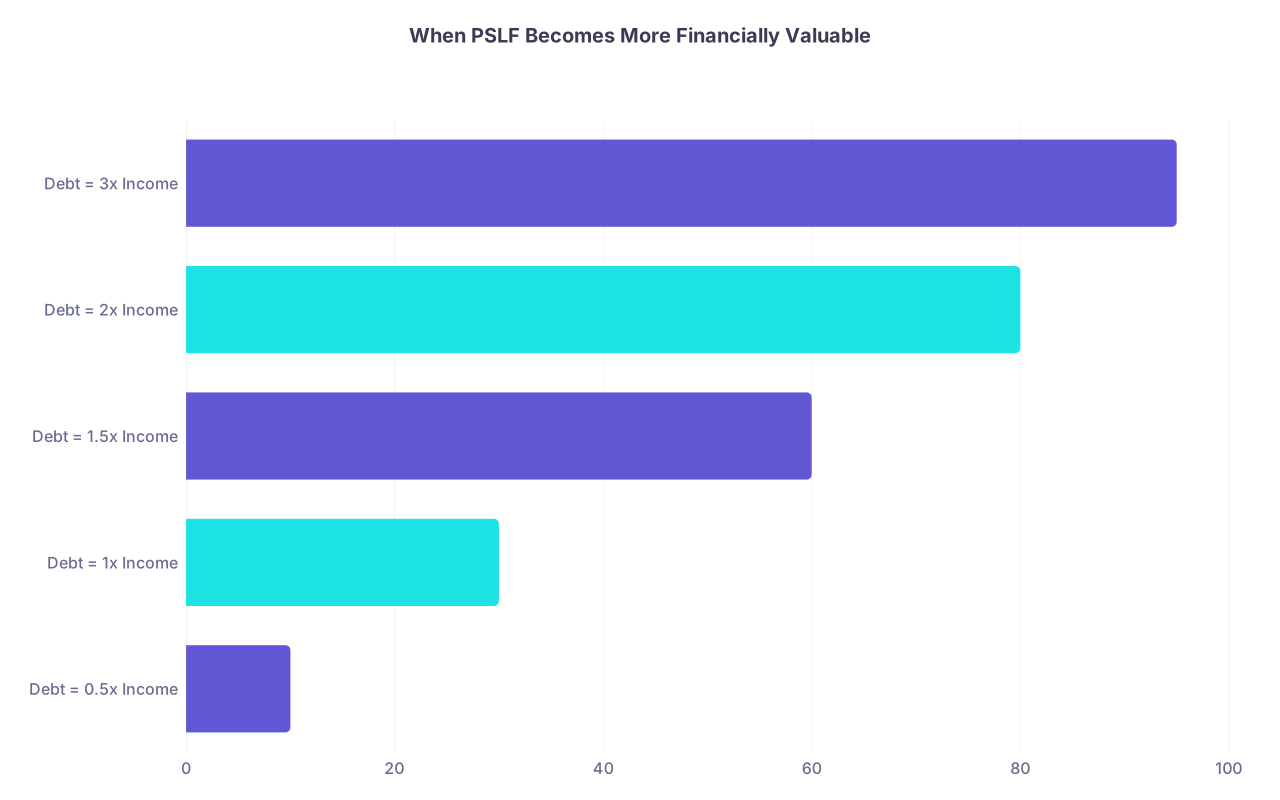
| Category | Value |
|---|---|
| Debt = 0.5x Income | 10 |
| Debt = 1x Income | 30 |
| Debt = 1.5x Income | 60 |
| Debt = 2x Income | 80 |
| Debt = 3x Income | 95 |
Step 10: Avoid the Big Mistakes People Make
I’ve watched people blow six‑figure decisions over these predictable errors:
- Chasing PSLF without certifying employment yearly. Then discovering half their payments don’t count. Always submit the PSLF form annually.
- Not updating IDR income correctly. Missing recertification, getting hit with giant payments, panicking, and switching plans randomly.
- Banking on PSLF but only doing 3–4 years of qualifying work. If you’re not going to reach 120 payments, PSLF doesn’t help. Period.
- Switching to private loans early for a slightly lower rate. You kill PSLF eligibility instantly. Once you refinance privately, PSLF is gone forever.
- Obsessing over forgiveness while ignoring retirement and emergency savings. PSLF is part of a plan, not the whole plan.
| Factor | PSLF-Eligible Job | Higher Salary Job |
|---|---|---|
| Salary (starting) | Lower | Higher |
| Loan forgiveness | After 120 payments | Usually none |
| Tax on forgiveness | No (PSLF) | Possible (long-term IDR) |
| Payment size (IDR) | Lower | Higher |
| Career flexibility | Lower if chasing PSLF | Higher |

| Step | Description |
|---|---|
| Step 1 | Start |
| Step 2 | Consider PSLF Job |
| Step 3 | Consider High Salary Job |
| Step 4 | PSLF path likely better |
| Step 5 | High salary or mixed path |
| Step 6 | Attack loans and be done fast |
| Step 7 | Run detailed calculator comparison |
| Step 8 | Debt vs Income |
| Step 9 | Can stay in public service 10 years |
| Step 10 | Willing to pay aggressively |
FAQs
1. What if I take the PSLF job now and switch to private later?
Then you’ll have some qualifying payments “banked,” but you only get forgiveness after 120 qualifying payments. If you leave public service and never come back, those early PSLF years don’t give you partial forgiveness. It’s all or nothing.
However, if you might return to public service later, those years do count toward the 120. The clock pauses, it doesn’t reset.
2. Is PSLF safe, or could the government take it away?
PSLF is written into law. Could Congress change it for future borrowers? Yes. Is it likely they’ll retroactively yank forgiveness from people already in the program and following the rules? Extremely unlikely. Programs may get tweaked, but planning around PSLF today is a reasonable bet, especially if your debt is huge.
3. Should I ever refinance privately if I might use PSLF?
If you seriously want PSLF, do not refinance your federal loans into private loans. That permanently destroys eligibility. The only time I tell people to refinance is when:
- PSLF clearly doesn’t make sense for them, and
- They’re committed to paying off the loans aggressively, and
- The private rate is meaningfully lower.
4. How do marriage and filing taxes affect PSLF vs a higher salary?
Big time. On most IDR plans, your household income matters. If you marry someone who earns a lot, your IDR payment can jump if you file jointly. Some plans (and SAVE) may let you use just your income if you file separately, but that can increase your tax bill. If marriage is on the horizon, model both filing options with a calculator before committing to a long PSLF path.
5. What if I hate my PSLF‑eligible job—should I stick it out for forgiveness?
No paycheck or forgiveness is worth a decade of misery and burnout. If the job is wrecking your mental or physical health, leave. You can always switch strategy: higher salary, refinance, aggressive payoff. PSLF should support your life, not trap you in a bad one.
6. I’m still stuck—what’s the one next step I should take?
Run a side‑by‑side 10‑year projection using an online PSLF/IDR calculator with:
- Your actual loan numbers
- Realistic incomes for both jobs
- Family size and tax filing
Print it or save screenshots. When you see “PSLF path vs high‑salary path” side by side with real dollar amounts over 10 years, the better choice usually becomes obvious.
Bottom line:
- Don’t pick PSLF or a high salary blindly—run a 10‑year comparison with real numbers.
- PSLF tends to win when debt is huge relative to income and you can tolerate 10 years in public service.
- If your debt is modest or you’re built for high‑earning private work and aggressive payoff, the bigger paycheck often wins.