
You’re staring at your loan portal again.
The number’s so big it barely looks real anymore. $427,000. And that’s before residency. Your stomach drops and your brain does the math: “If it grows during training, I could actually hit $500K. Half. A. Million. In debt. Am I insane? Did I just screw over my entire future for this degree?”
You start catastrophizing. No house. No kids. No retirement. Just you and Nelnet, till death do you part.
Let me say the scary part out loud so we can actually deal with it: yes, $500K in med school debt is bad. It’s heavy. It will constrain your options. You will feel it.
But it’s not a life‑ending, “why did I even do medicine” bad. It’s a “you need to be smart and a little ruthless with your decisions” bad. There’s a difference.
Let’s go through this the way anxious brains like ours work: worst‑case first, then pull it back to reality and concrete options.
How Bad Is 500K Med School Debt, Numerically?
First, strip the emotion for a second and just look at numbers.
Most attendings I know don’t actually understand how to quantify “bad.” They just toss around “I had $300K, you’ll be fine.” That’s not helpful if you’re staring at a projected $500K.
Here’s what you’re up against.
Assume:
- $500,000 principal
- Interest rate ~6.5–7% (typical for Grad PLUS / unsubsidized)
- Standard 10‑year repayment (what your servicer will default to if you don’t choose anything else)
Rough math:
- 7% interest on $500K = $35,000 per year
- That’s about $2,900/month in interest alone
- A standard 10‑year payment? Around $5,800–$6,000 per month
So yeah, on the default plan, your payment could literally be like:
| Debt Level | Approx Monthly Payment |
|---|---|
| $250,000 | ~$2,900–$3,000 |
| $350,000 | ~$4,000–$4,200 |
| $450,000 | ~$5,200–$5,400 |
| $500,000 | ~$5,800–$6,000 |
If your brain just went, “That’s basically another rent,” yeah. That’s why you’re panicking. Because those numbers are objectively intense.
But here’s the key point: almost nobody with $500K of med school debt is actually paying on the 10‑year standard plan from day one. And that’s where things get less apocalyptic and more “complicated but survivable.”
The Realistic Future: Income-Driven Repayment, Not Fantasy Land
You are not paying $6K a month as a PGY‑1 making $65K. That’s not how the system works.
You’re almost certainly going to be on an income-driven repayment plan (IDR). Right now, the big one for new borrowers is SAVE (successor to REPAYE). And SAVE changes how this feels.
Very simplified:
- Your monthly payment is based on your income, not your debt
- They look at “discretionary income” (income above ~225% of poverty line)
- You pay a percentage of that (5–10%, depending on when your loans are from and if they’re undergrad vs grad)
So as a resident making, say, $65K:
- After taxes, and with the SAVE calculation, your monthly payment might be in the $200–$400 range, maybe a bit more if you’re married or moonlighting
And here’s the crucial piece that people with older info don’t realize:
On SAVE, if your monthly payment doesn’t fully cover the interest, the remaining interest does NOT capitalize and does NOT accrue. The government eats the unpaid portion.
Translation for anxiety brain: during residency, with SAVE, your balance may grow slowly or even stay basically flat instead of ballooning to something absurd like $650K.
Is that ideal? No. You’re still in deep. But it’s not “debt goes to infinity” bad.
Now, fast-forward to attending life. This is where it gets serious again.
Say you’re:
- Hospitalist making $260K
- EM doctor at $320K
- Or primary care at $220K with some loan repayment benefits
On SAVE, your monthly payment will jump hard. You might see $1,500–$3,000+ depending on family size, spouse income, etc.
Still way lower than $6K. But also big enough that it hits your monthly budget pretty visibly.
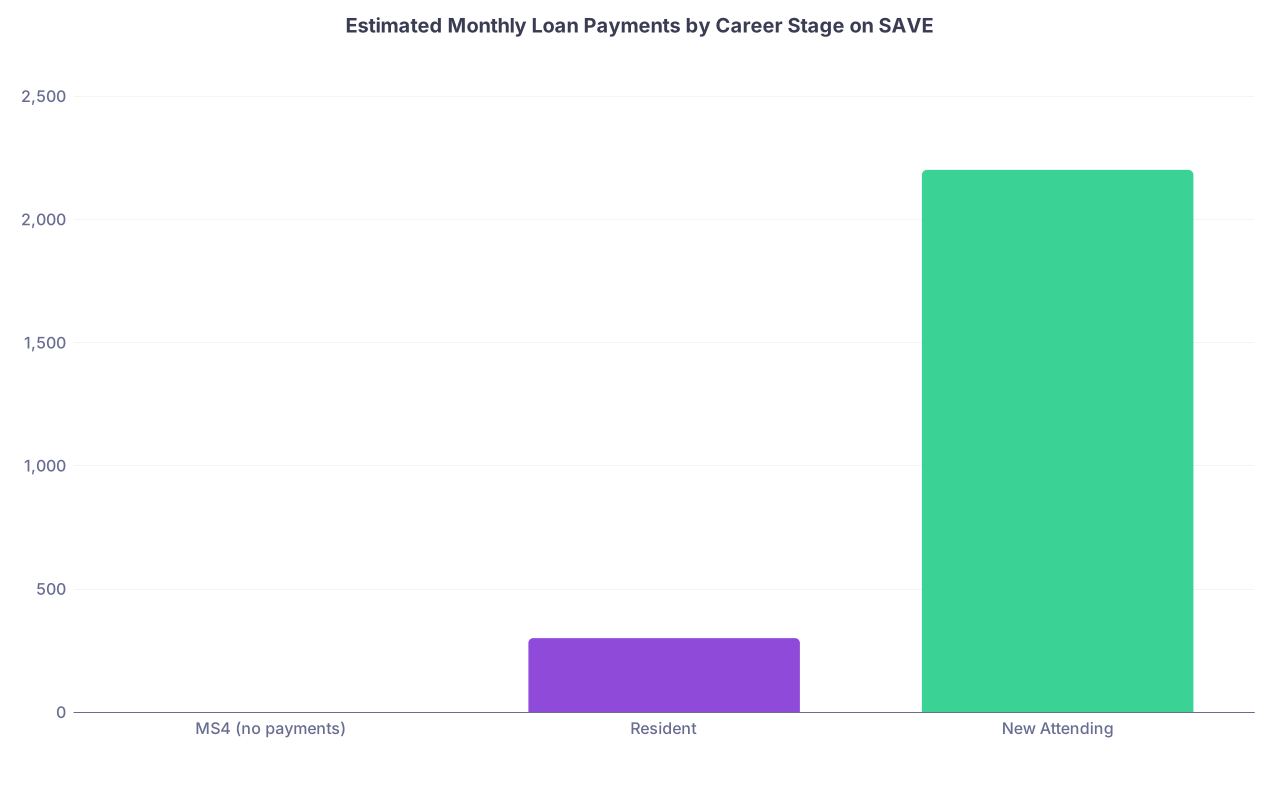
| Category | Value |
|---|---|
| MS4 (no payments) | 0 |
| Resident | 300 |
| New Attending | 2200 |
So yeah. It’s heavy. But notice something: the “I’ll literally never be able to afford anything” story doesn’t match reality when you use IDR correctly.
The Real Nightmare Scenarios (And How to Not Fall Into Them)
Your brain is probably already living in these scenarios. Let’s drag them fully into the light.
Nightmare 1: “I’ll Be 60 and Still Owe a Ton of Money”
Under IDR, after 20–25 years of payments, any remaining balance can be forgiven. That used to come with a terrifying tax bomb (you’d owe tax on the forgiven amount). For now, through 2025, that tax bomb is paused at the federal level. Beyond that…we don’t know yet. Congress can change things.
So is it possible you’re 50+ and still paying? Yes. Especially if you:
- Stay on low payments for years
- Don’t aggressively pay extra as an attending
- Or are aiming for forgiveness instead of payoff
But here’s the part I’ve actually seen: attendings with $400K–$600K who make a plan can usually:
- Get rid of their loans in ~10–15 years after training
- While still buying a modest house, having kids, and saving for retirement
The ones who are 45 and still drowning? They usually did some combo of:
- Forbearance during residency instead of IDR (interest ballooned and capitalized)
- Lifestyle creep immediately as an attending (Tesla + big house + private school right away)
- Ignored PSLF when they easily could’ve qualified
So yes, worst‑case: you can still be paying at 50. But that’s not automatic. That’s usually the outcome of chronic “I’ll deal with it later” plus bad info.
Nightmare 2: “I’ll Never Be Able to Buy a House or Have a Family”
Lenders look at your debt‑to‑income ratio. $500K in loans looks horrific…until they realize you’re a physician with a $250K+ salary and stable career.
Banks LOVE doctors. It’s gross, but it’s true. There are even “physician mortgage” programs that:
- Allow low or zero down payment
- Ignore student loans calculated a specific way
- Give good rates because they know you’re unlikely to default
Does that mean you can buy a $1.5M mansion right away? No. That’s how people stay broke forever.
But a $400K–$800K house in a reasonable COL area as a double‑income or even single‑income physician with $500K debt? I’ve seen that work over and over. The catch is: you must delay the “doctor high” purchases and build a buffer first.
Kids? Same thing. Expensive, yes. But plenty of attendings with $400K+ loans have two kids and still go on vacation. They just don’t do everything at the maximal, Instagram‑flex level.
Nightmare 3: “No Specialty Will Make This Manageable”
This one’s half‑true, and this is where I get a little harsh.
Going $500K in debt and then choosing a low‑paying field with no PSLF plan and no lifestyle restraint is financial self‑sabotage.
But that doesn’t mean you’re forced into neurosurgery if you want to survive.

As of now:
- Primary care in many places: $200K–$260K
- Hospitalist: $240K–$300K
- EM/Anes/Rads/Gas: $300K–$450K
- Highly paid surgical subs: easily $500K+
If you’ve got $500K debt and you’re hardcore about working at a qualifying non-profit hospital, PSLF (Public Service Loan Forgiveness) is your lifeline. Ten years of qualifying payments (including residency + fellowship) and the remaining balance is forgiven tax‑free.
I’ve seen hospitalists with absurd balances ($400K+) walk away after PSLF with zero loans and a normal life.
Is PSLF risky? Yes, in the sense that you’re trusting a government program not to get gutted. But people have already gotten real, huge balances forgiven. The trend is actually toward expanding it, not killing it.
If you don’t want PSLF, you’re basically signing up to:
- Keep your lifestyle pretty lean for the first 5–10 attending years
- Throw extra thousands monthly at your loans
- Potentially pick up extra shifts or locums early on
That’s not fun. But it’s survivable. The unhappiest people are the ones who thought they’d “feel rich” and instead feel like they’re in golden handcuffs.
How 500K Actually Feels Day-to-Day as an Attending
This is the part I wish someone had spelled out bluntly for me.
Emotionally, $500K feels like:
- A constant background weight
- Some guilt or resentment when you see friends in tech who are debt‑free
- Mild panic when you think about changing specialties or cutting hours
Financially, day‑to‑day, it often looks like:
- A big automatic payment every month that feels like a second rent
- You thinking twice about cars, vacations, and private school
- Delaying “doctor” purchases while non‑med friends buy homes earlier
But here’s what doesn’t happen, for 99% of people who are at least somewhat intentional:
- You don’t starve
- You don’t live like a resident forever
- You don’t literally “never retire”
You just shift the timeline. The fancy house at 32 becomes the nice, reasonable house at 38. The new BMW becomes a used Toyota for a while. The “money solves everything” fantasy becomes “I have a good life but I need to think before I swipe.”
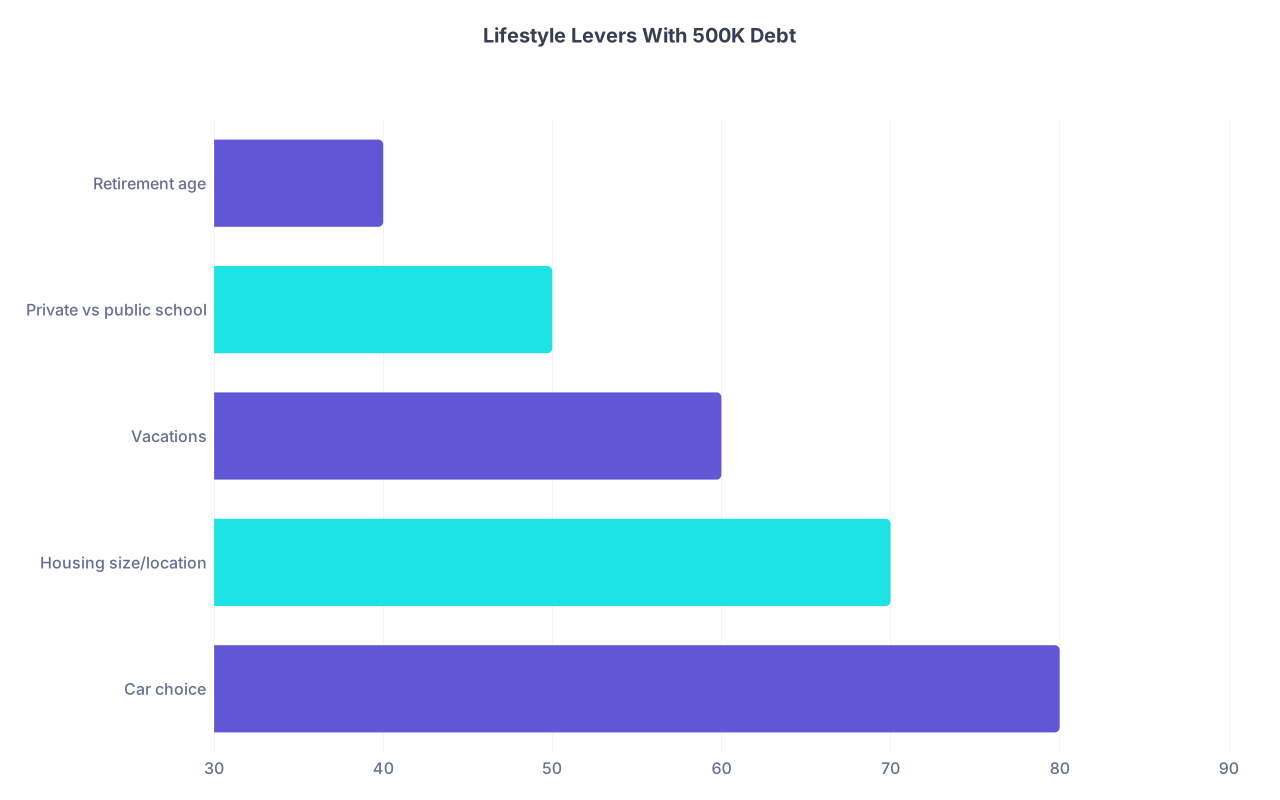
| Category | Value |
|---|---|
| Car choice | 80 |
| Housing size/location | 70 |
| Vacations | 60 |
| Private vs public school | 50 |
| Retirement age | 40 |
(Think of those as “how much this lever can relieve pressure” scores, not precise data.)
When 500K Debt Is Truly Dangerous
I’m not going to sugarcoat this: there are red‑flag combinations where $500K is borderline reckless:
- You hate clinical medicine and are already fantasizing about leaving
- You’re 100% sure you want to work part‑time as early as possible
- You’re going into a very low‑paying niche with no realistic PSLF path
- Your partner also has massive debt and low-income prospects
In those situations, yeah, this debt gets scary. Because med school debt is basically non‑dischargeable in bankruptcy. You’re stuck with it.
So if you’re early in the process (M1/M2) and you already feel like you want out, or you’re thinking of adding more expensive degrees (MBA, MPH) on top of $400K+? Stop. Run the numbers. Talk to a fee‑only financial planner who works with physicians. Don’t just “hope it works out.”
Ways to Make 500K Less Toxic (Not Magic, Just Math + Discipline)
You can’t make 500K “good,” but you can turn it from a nightmare into a heavy but controlled burden.
Some levers that actually move the needle:
- PSLF: Train and work at 501(c)(3) or government hospitals. Enroll in IDR early. Certify employment every year. Keep pristine records. This alone can save you literally hundreds of thousands.
- Geography: High-paying, reasonable COL areas (Midwest, South, some non-coastal cities) can turn a crushing situation into a very manageable one. Chasing Manhattan or Bay Area glam with 500K is a choice. A bad one.
- Lifestyle lag: For the first 3–5 years as an attending, live like a well-paid resident. Not monk-level. Just smaller house, used car, fewer flexy vacations. Use the gap to hammer your loans or build savings.
- Side income early on: Extra shifts, locums, telemed, urgent care, whatever your field allows. Earmark that entirely for loan payoff or savings, not lifestyle.
- Marrying someone with normal or high income and low debt: Crass but true. Two incomes + one big debt pile is worlds different than two giant debt piles.

None of that is glamorous. But it works. I’ve watched people go from panicking over $450K to totally debt‑free in 8–12 years as attendings. Not because they were geniuses. Just because they got mad at the number and treated it like an emergency instead of background noise.
So…How Bad Is 500K Really?
Let’s call it what it is:
- It’s a serious, heavy, anxiety‑generating number.
- It will absolutely shape your career, geographic, and lifestyle choices.
- It will delay some milestones and force you to be more intentional than your non-med peers.
But it is not:
- A guaranteed life sentence of poverty
- Incompatible with owning a home, having kids, or retiring
- Automatically worse than not doing medicine at all
The bigger risk isn’t the debt itself. It’s drifting through training and the first attending years without a concrete plan and then waking up at 40 bitter, burned out, and still owing hundreds of thousands because you never actually tackled it.
You don’t have to have every detail figured out right now. But pretending “future me will handle it” is how future you ends up Googling “physician burnout regret loans” at 3 AM.
Your Next Concrete Step (Today, Not “Someday”)
Do this today, not after the next exam, not “when rotations calm down.”
Open a blank note and write down three numbers:
- Your current or projected total debt at graduation
- Your probable specialty (or top 2–3 if you’re not sure)
- Where you’re most likely to practice (region or type of hospital)
Then:
- Go to a reputable physician loan calculator (like Student Loan Planner, White Coat Investor calculators, etc.).
- Plug in: $500,000, 6.5–7% interest, your rough future income, and try different scenarios:
- IDR + PSLF at a nonprofit hospital
- Aggressive payoff as an attending with no PSLF
- Mixed strategy: IDR during training, refinance after
Look at the actual monthly numbers on your screen. Don’t look away, don’t say “I’ll do this after Step.” Let your brain see reality instead of letting it invent something worse.
Because once you see the real range of payments and timelines, the monster under the bed stops being infinite. It’s still big. Still ugly. But it’s something you can plan around, attack, and eventually kill.
Open that calculator. Plug in $500,000. And make the “what if” in your head an actual plan on paper.