You’re sitting there staring at your loan balance, and it hits you: you deferred or forbearanced basically your entire training. Med school. Residency. Maybe fellowship. No payments. Just…delay.
And now the number on the screen doesn’t look real. It looks like a typo someone forgot to fix.
You keep thinking:
“Did I completely screw myself? Did I just add 5–6 years of interest for no reason? Is it too late to fix any of this?”
Let me just say this up front so you don’t spiral:
No, you did not ruin your financial life permanently.
Yes, you absolutely paid a price for deferring loans all through training.
And also yes—you still have real options to stop the bleeding and undo a surprising amount of the damage.
Let’s walk through this like two people sitting at a call room computer at 2 a.m. trying to make sense of the mess.
What Actually “Went Wrong” When You Deferred
The part that’s eating you alive right now is probably this:
“If I had just been on an income-driven plan (IDR) from PGY‑1, I’d have 3–7 years of forgiveness credit and maybe my balance wouldn’t look like this.”
You’re right to be annoyed. But don’t confuse “suboptimal” with “catastrophic and irreversible.”
Here’s what likely happened during training if you were in deferment or forbearance:
- Your loans kept accruing interest.
- That interest probably capitalized (got added to your principal) at certain points.
- You weren’t getting any credit toward PSLF or IDR forgiveness during those years.
- You trained during years when payments could’ve been tiny because your income was low.
So yes, financially speaking, you were in “maximum interest growth, zero progress” mode. Worst combo.
But the damage people imagine is often worse than the reality. You didn’t default. You didn’t ignore collections. You didn’t get wage-garnished. You didn’t end up with destroyed credit. You deferred in training—like thousands of residents before you who were told by someone, “Don’t worry about loans now, focus on training.”
You’re not uniquely irresponsible. You’re normal and now more aware. That’s fixable.
The Big Twist: It Might Not Be Too Late (Consolidation & Credit)
Here’s the part most people don’t realize until deep in a forum rabbit hole at 1 a.m.:
Some of that “lost time” might actually be recoverable. Not all. But some.
It depends on your loan types and your timeline.
| Question | Why It Matters |
|---|---|
| Are your loans federal Direct loans? | Direct loans can do PSLF and the current IDR plans. |
| Do you have older FFEL or Perkins loans? | These need consolidation to count for PSLF/modern IDR. |
| Did you ever make *any* qualifying payments during training? | Those may still count for forgiveness. |
| Are you interested in PSLF? | Changes how aggressive you should be. |
| Are you planning private refinancing soon? | That can permanently lock out forgiveness options. |
Here’s where the anxiety kicks in: you might be thinking, “I deferred everything, so I have zero qualifying payments, so there’s nothing to salvage.”
Not necessarily.
There are two big levers:
Consolidation timing and past credit
If you’ve had different loans with different histories—some in repayment, some in deferment—consolidating can sometimes pull up the lower-credit loans to the highest count among them for IDR forgiveness purposes.Translation: if any of your loans were ever in repayment and accumulating qualifying time, consolidation can sometimes give all of them that higher count.
PSLF vs. 20–25‑year IDR forgiveness
For PSLF, deferment doesn’t count, forbearance doesn’t count. You only get credit for months when:- You had Direct loans
- You were on a qualifying repayment plan (usually an IDR)
- You were working full-time at a qualifying employer (most academic hospitals, many nonprofits)
So if you deferred all through residency at a PSLF-eligible hospital, yes, you lost those years for PSLF. That hurts.
But for 20–25‑year IDR forgiveness, there have been temporary adjustment policies where certain past statuses counted more generously than before. Depending on when you’re reading this and what’s still active, you may get more credit than you think.
I’ve seen people assume they’re “resetting to zero” and then discover they already have 5–8 years of forgiveness credit once everything’s correctly counted.
So before doing anything dramatic—like refinancing to a private lender—your next move should be to pause and get accurate data on what credit you actually have on the books.
The Part That Hurts: Yes, Interest Grew—And That’s Real
Let’s not sugarcoat the bad part. Deferring during all of training means:
- Every year, your balance ballooned as interest accrued.
- When interest capitalized, your future interest was calculated on a bigger principal.
- By the time you finish training, what was maybe $250k can realistically look like $350k–$450k.
That isn’t fake, magical, reversible math. That’s real money.
And it’s completely reasonable to feel sick about it. I’ve watched residents refresh their loan servicer page three times thinking there had to be an error. I’ve heard the “I’m going to be paying this off until I die” line more times than I can count.
But here’s the mental trap:
You’re looking at the current balance and comparing it to some ideal alternate universe where you perfectly strategized from MS4. You did not live in that universe. None of us did.
What matters now is:
- Stop further unnecessary interest growth.
- Get every forgiveness/credit advantage you still can.
- Build a realistic plan that doesn’t wreck your life.
Step 1: Decide Your Path—PSLF, Long-Game IDR, or Aggressive Payoff
Everything hinges on what you want your future to look like, not just what your past mistakes were.
There are basically three main paths:
PSLF Path (Public Service Loan Forgiveness)
If you’re working (or plan to work) at a qualifying non-profit/academic hospital, PSLF is probably still your best friend—even if you deferred all of residency.The obvious downside: you lost those training years of PSLF credit by deferring.
The good news: PSLF forgiveness is still 10 years of payments. If you start now as an attending and stick with non-profit work, you could still have the majority of your remaining balance wiped out after 10 years of IDR payments.Worst-case thinking: “But if I had started in residency, I’d be done 3–7 years earlier.”
Yes. True. But you didn’t. You can still start now. Ten years from now you’ll either:- Be annoyed you had to do 10 instead of 5, or
- Be even more annoyed you did nothing and still have the entire balance.
Long-Game IDR Forgiveness (20–25‑Year)
If PSLF doesn’t fit your career (private practice, locums heavy, non-eligible employer), you can still use IDR with eventual forgiveness at 20–25 years.Here the missed training years may matter less because:
- Your time horizon is longer.
- Some of your past periods may be credited more generously depending on federal policy changes and adjustments.
You’re not doomed here. You’re just on a longer, stable, planned track.
Aggressive Payoff / Private Refinance
This is the “I hate debt, I’m never doing PSLF, I want the lowest possible interest and I’ll throw money at it” path.If you go private refinance, you’re locking the door permanently on federal forgiveness options. So only do this if you:
- Are sure PSLF doesn’t fit your career now or likely in the next 10 years, and
- Have a stable attending income and emergency fund, and
- Are mentally committed to aggressive repayment.
For someone who deferred all through training, this path can still make sense. You can absolutely dig out in 5–10 years with a good income and aggressive payments. Just don’t reflexively refinance because you feel ashamed and want to “clean up the mess.” Shame is a terrible financial advisor.
Step 2: Stop the Bleeding—Get on the Right Payment Plan Now
The worst thing you can do now is…keep deferring or forbearancing out of panic. That’s like watching a house burn and arguing about which hose to use while refusing to turn the water on.
You need to:
- Get out of deferment or forbearance.
- Get onto an income-driven repayment plan as soon as possible (SAVE, PAYE, IBR depending on what’s available and what you qualify for now).
- Confirm your employment qualifies for PSLF if that’s your direction, and start filing PSLF forms yearly.
If you’re an early attending, your payments are going to feel big compared to residency fantasy-land. That’s okay. You’re not a PGY‑1 anymore. You actually have income that can chip away at this.
The mental reframe:
You’re not “starting late.” You’re “starting now, with more information.”
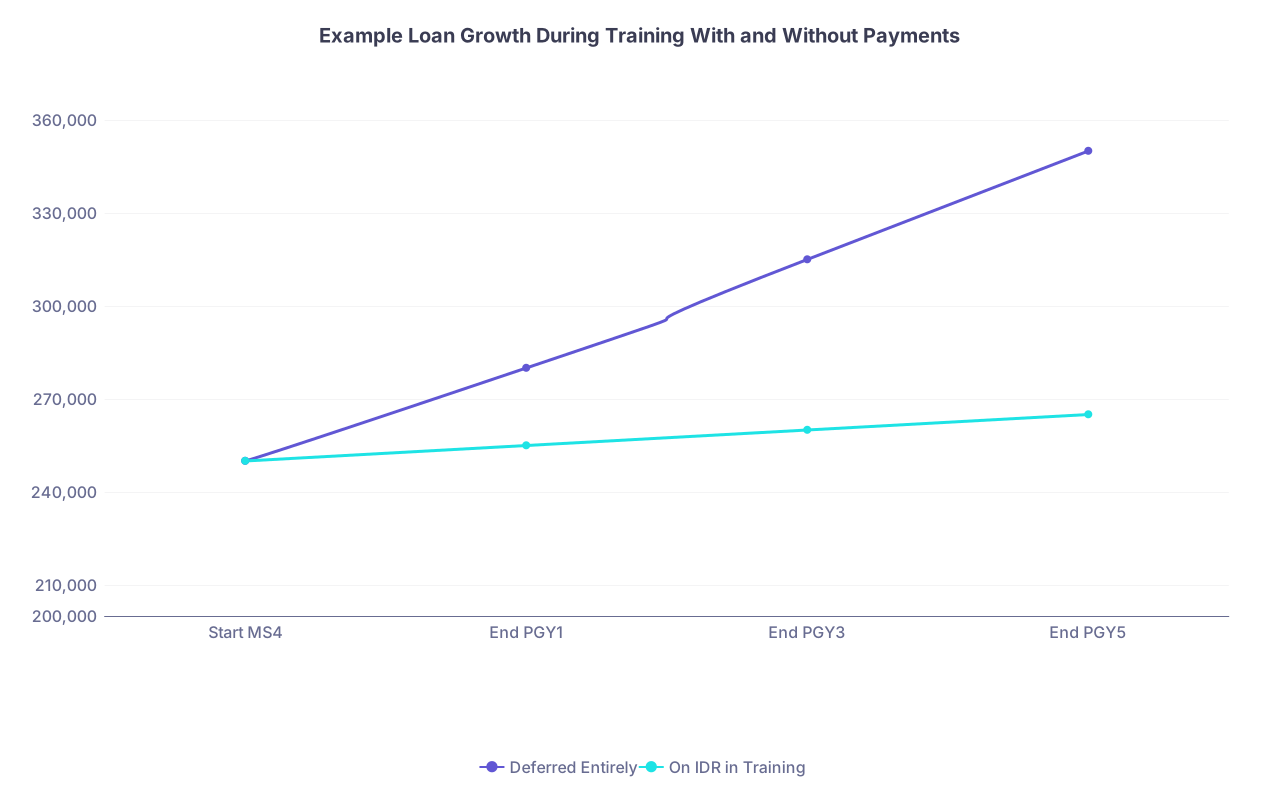
| Category | Deferred Entirely | On IDR in Training |
|---|---|---|
| Start MS4 | 250000 | 250000 |
| End PGY1 | 280000 | 255000 |
| End PGY3 | 315000 | 260000 |
| End PGY5 | 350000 | 265000 |
The Guilt Spiral: “I Wasted So Much Money”
This part is brutal. And very human.
You start tracking how much interest accrued during deferral and you think:
“That’s a down payment on a house.”
“That’s my kid’s college fund.”
“That’s years of my life.”
Here’s the harsh but freeing truth:
That money is already gone.
It’s not waiting to be rescued. It’s not a coupon you can reclaim. You paid it in the form of opportunity cost and extra interest. The only thing you control now is:
- How much more you let interest add up from this point forward.
- How long you stay in limbo pretending you “can’t deal with loans yet.”
I’ll be blunt: the emotional drag of avoiding your loans for another 2–3 years is worse than just sitting down for one nasty afternoon and building a clear plan.
Step 3: Get Clarity on Your Actual Numbers
Right now your brain probably just sees:
“Big scary number. Too late. I’m screwed.”
That’s vague fear. Vague fear is paralyzing. Specific numbers are less terrifying because you can do math on them.
Do this:
Log into your servicer and write down:
- Total balance
- Interest rate(s)
- Loan types (Direct, FFEL, Perkins, Grad PLUS, etc.)
- Current status (deferment, forbearance, repayment plan if any)
Pull your employment history from med school graduation to now:
- Where you trained
- Dates
- Whether those employers would be PSLF-eligible (nonprofit / government)
Use a reputable loan calculator (or a fee-only student loan specialist if you want real hand-holding) to model:
- Payments and total cost on PSLF track
- Payments and total cost on 20–25‑year IDR track
- Payments and total cost on private refinance with more aggressive payoff
You will probably be surprised that your situation is not “pay forever until death.”
It’s more like:
“Pay a painful but finite amount each month for 10 years, then the rest is gone.” or
“Pay a strong but doable amount for 7–8 years and be completely debt-free by early/mid-career.”
Is it fun? No. Is it hopeless? Not even close.

| Step | Description |
|---|---|
| Step 1 | Loans Deferred in Training |
| Step 2 | Gather Loan Details |
| Step 3 | Enroll in IDR and File PSLF Form |
| Step 4 | Model IDR vs Refinance Scenarios |
| Step 5 | Make Consistent Payments |
| Step 6 | Reassess Every 1-2 Years |
| Step 7 | PSLF Eligible Job Now or Likely? |
The “Too Late” Myth
There’s this toxic belief that if you didn’t play the student loan game perfectly from day one, you’re doomed forever. It shows up as:
- “I missed PSLF in residency, so PSLF is pointless now.”
- “My balance is too high, so I’ll never recover.”
- “Everyone else did this right and I’m the only idiot.”
I’ve seen attendings start PSLF at 35 and still get six figures forgiven. I’ve seen people with $600k+ in loans pay them off in under 10 years with a combination of private practice income, a reasonable lifestyle, and a clear plan.
You being late is not the same as you being finished.
What is too late?
- It’s too late to retroactively turn those deferment months into PSLF payments. Those are gone.
- It’s too late to pretend the interest never accrued. That’s baked in.
But it is absolutely not too late to:
- Capture forgiveness going forward.
- Minimize future interest.
- Align your loans with your career path instead of letting them just…happen to you.
What You Can Do Today (Not Someday)
You don’t need to solve your entire financial life tonight. You do need to break the “avoid and panic” loop.
Here’s one concrete thing you can do today:
Open your loan servicer account, download your full loan summary, and write at the top of that page:
“Training is over. Deferral is over. I’m in repayment now—on purpose.”
Then, while you’re already logged in, start the application for an income-driven repayment plan. Don’t worry about picking the perfect plan on the first try; you can change later as policies and your life change. The important thing is to get out of “no progress, max interest” mode and into “imperfect progress that actually counts.”
You’re not too late. You’re just finally paying attention. That’s the turning point.