
It’s 11:47 p.m. You’re still in your white coat pants, sitting on your bed because the desk chair hurts your back now. Your servicer portal is open on one tab: “Total balance: $312,486.17.” On the next tab is a salary survey with “Family Medicine: $230k” and “Orthopedic Surgery: $650k+” staring you in the face.
And the question you’re not saying out loud but can’t get out of your head is:
Am I actually insane if I pick primary care with more than 300K in student loans?
Let me be blunt: you’re not crazy. But you are right that the math can get ugly if you ignore it. The anxiety you’re feeling? That’s not you being dramatic. That’s your brain correctly sensing, “If I don’t have a real plan, this could wreck me.”
So let’s talk about what actually happens if you choose primary care with >300K in debt. Not the fantasy Instagram version. The real, spreadsheet, what’s-my-monthly-payment version.
First: Are You Financially Screwed If You Pick Primary Care?
Here’s the fear:
“I’ll be a 40-year-old attending, still living like a resident, with no house, no savings, and 600K in loans because of interest.”
Possible? Yes. Guaranteed? No. That nightmare usually happens to people who do two things:
- Ignore their loans through med school and residency.
- Graduate, pick some random payment plan, and never adjust.
If you’re asking this question now, you’re already not that person.
Let’s look at the rough numbers, because that’s what’s haunting you.
Assume:
- Debt: $320,000 (very common now)
- Interest: 6.5%
- Specialty: Family med / IM / peds
- Salary: say $220k–$260k as a standard W-2 job (could be more in rural/underserved)
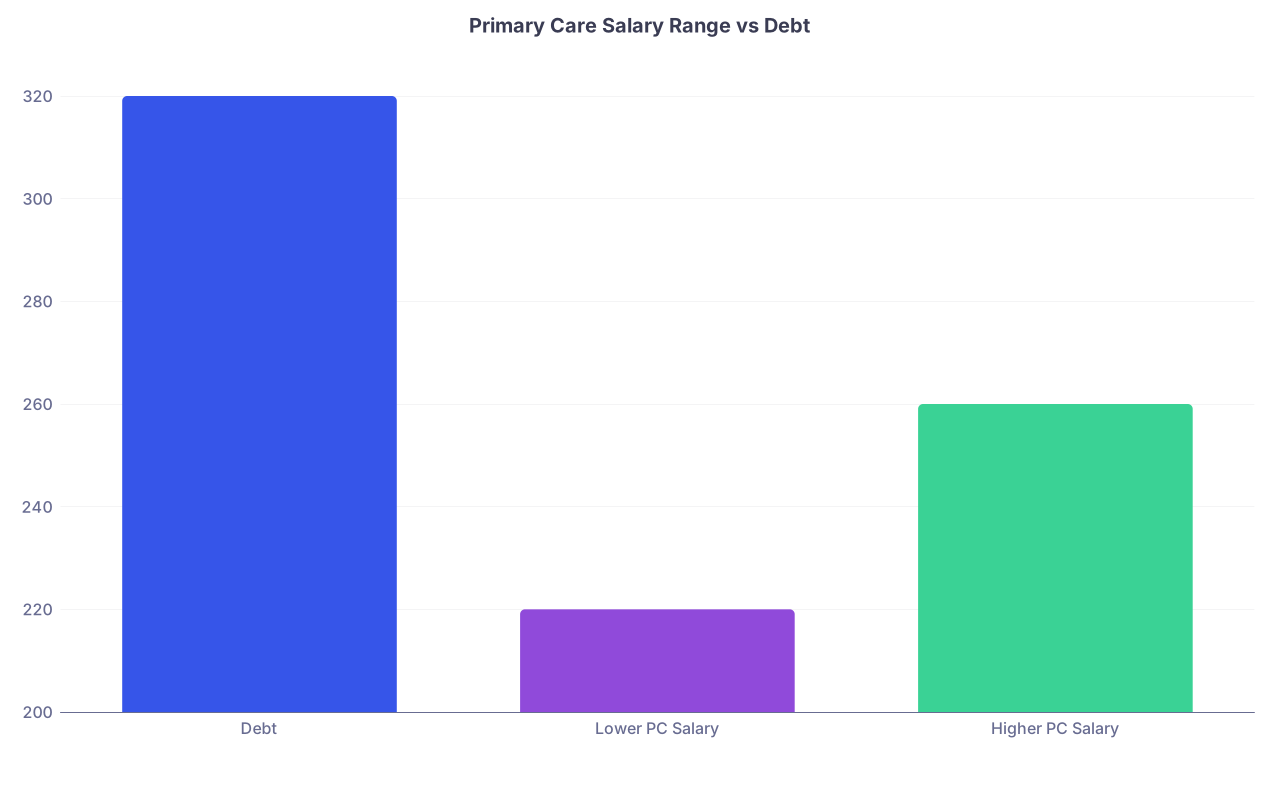
| Category | Value |
|---|---|
| Debt | 320 |
| Lower PC Salary | 220 |
| Higher PC Salary | 260 |
If you tried to “just pay it off aggressively” on a standard 10-year plan with no forgiveness, your payment would be somewhere around $3,600–$3,800 a month. After taxes, insurance, retirement, housing, etc. that would feel tight, especially in a high cost-of-living city.
But that’s not the only path. And honestly, with >300K, for most primary care docs, trying to brute-force-pay in 10 years is kind of dumb unless your cost of living is super low or you have a partner with a strong income.
The things that actually make primary care + high debt workable are:
- Income-driven repayment (IDR) plans
- PSLF (if you go nonprofit / academic / FQHC)
- Being deliberate about job and location, not just vibe
So no, you’re not doomed. But if you choose primary care and also choose to financially drift with 300K+ in loans? Yeah, that can blow up on you.
The PSLF / IDR Reality: Not Just Instagram Copium
Everyone on Reddit throws around “PSLF” like it’s magic. It’s not. It’s a contract where you trade 10 years of qualifying work + payments for tax-free forgiveness.
Let’s sketch out what this actually looks like so your brain stops filling in the horror-movie blanks.
Assume:
- You do 3 years of residency in IM or FM at a nonprofit hospital.
- Then you work 7 more years at an academic center, VA, county hospital, FQHC, or similar nonprofit.
That’s your 10 years for PSLF.
On an IDR plan (SAVE, PAYE, etc.), your payment in residency is low because it’s based on your income, not your loan size. You’re maybe paying $150–$400/month in residency, depending on spouse/income/plan.
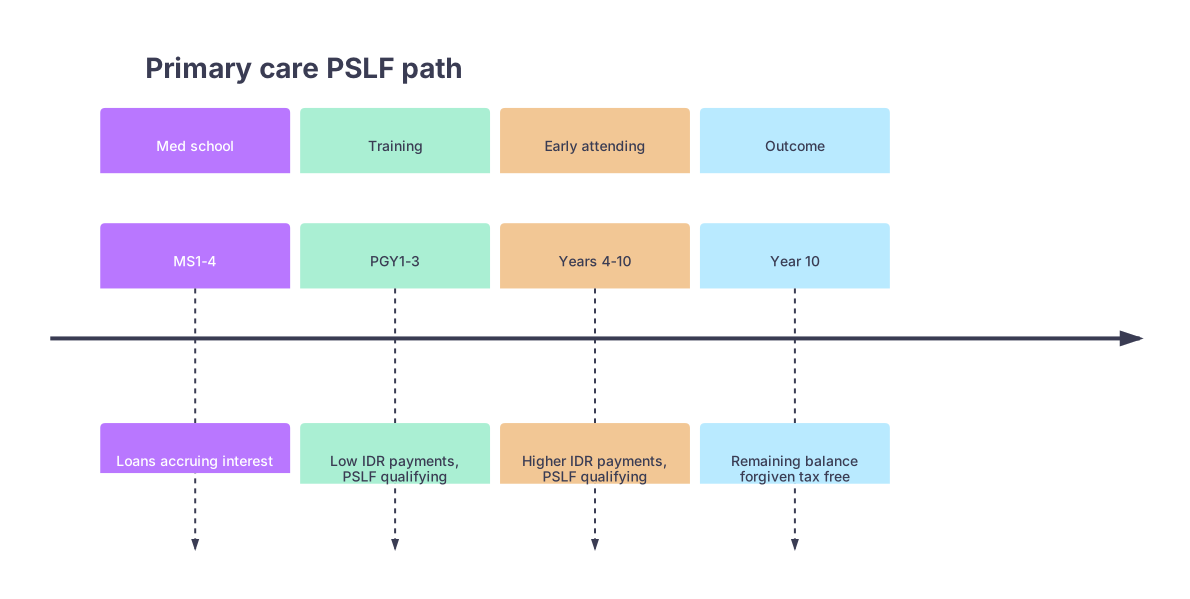
| Period | Event |
|---|---|
| Med school - MS1-4 | Loans accruing interest |
| Training - PGY1-3 | Low IDR payments, PSLF qualifying |
| Early attending - Years 4-10 | Higher IDR payments, PSLF qualifying |
| Outcome - Year 10 | Remaining balance forgiven tax free |
Then as an attending, your income jumps, your payment jumps, but it’s still tied to income, not to “I owe 312K so my payment must be brutal.” Many primary care docs under PSLF end up with something like:
- Years 1–3 attending: $800–$1,500/month
- Years 4–7 attending: $1,500–$2,500/month
And then the remaining balance—often still six figures—is forgiven at year 10 with no tax bomb.
Is PSLF guaranteed? No, nothing is 100%. But it’s baked into law, it’s survived multiple administrations, and the government has already forgiven billions under it. I don’t think it’s going away retroactively for people already in the system. Could the rules change for future borrowers? Sure. But if you’re already deep in, I wouldn’t base my career choice on a hypothetical apocalypse of PSLF.
The “Panic Thought #1” is:
“What if PSLF dies and I picked primary care and now I’m stuck?”
My answer? If PSLF completely died, it would hurt everyone, including surgeons, not just you. And income-driven repayment would still exist in some form. It would suck, but you still wouldn’t be uniquely doomed as a primary care doc. High debt + relatively modest income is exactly what IDR was designed for.
Primary Care vs Specialty: What Actually Changes With 300K+ Debt?
Let’s be honest: the more debt you have, the more tempting it is to think, “Okay maybe I should just go derm or ortho and be done with it.” Except you don’t love the OR, or you hate clinicless medicine, or you actually care about continuity and outpatient and talking to humans.
The money difference is real. I’m not going to gaslight you and say it doesn’t matter. Here’s the kind of spread we’re talking about in broad strokes:
| Path | Typical Starting Salary | Debt Pressure With 300K+ |
|---|---|---|
| Academic Primary Care | $200k–$230k | Manageable w/ PSLF/IDR |
| Community Primary Care | $230k–$275k | Manageable, more wiggle |
| Rural / Underserved PC | $250k–$300k+ | Strong position |
| Competitive Specialty | $450k–$700k+ | Aggressive payoff possible |
Does that bigger specialty salary give you more “brute force” to crush loans fast? Absolutely. You can knock down 300K+ in 3–5 years if you really go at it.
But here’s the catch no one admits out loud:
If you pick a high-paying specialty you hate just for the money, you absolutely will not live like a monk for 5 years and funnel $8–10k/month into loans. You’ll be burned out, you’ll compensate with lifestyle spending, and you’ll drift anyway. I’ve watched that happen. More often than the fairy tale “I paid off 500K by 35!” story.
If you pick primary care and you’re reasonably intentional—PSLF or smart IDR, maybe a bit of side income, not inflating your lifestyle instantly—you can have:
- A house in a non-insane market
- Retirement accounts actually growing
- Kids (if you want them) and not resenting them as “loan blockers”
- A loan plan that doesn’t eat your soul
So it’s not primary care = poor, specialty = rich. It’s more like:
- Specialty gives you more margin for error if you’re bad with money.
- Primary care requires you to be intentional and strategic.
And you’re… reading a loan article. So you’re already ahead of the curve.
The Real Levers That Matter More Than “Primary Care vs Specialty”
This is the part nobody tells you while they obsess about Step scores: the decisions that actually move the needle on whether 300K+ debt + primary care is livable are not just “what specialty.”
They’re:
Where you practice.
Rural, underserved, FQHC, VA, academic vs private outpatient in a high-rent coastal city. A family med doc making $280k in a mid-cost-of-living area can be way more comfortable than $230k in San Francisco.Employment type.
Nonprofit W-2 with PSLF potential vs for-profit private group vs locums. I’ve seen primary care docs strategically hop between nonprofit systems to keep PSLF alive while still negotiating decent salaries.How fast you inflate your lifestyle as an attending.
If you leave residency, buy a $900k house, two new cars, furnish everything, and take luxury trips in year 1—yeah, your loans will crush you. That’s not a primary care problem. That’s an everything problem.Whether you actually sit down and pick a repayment strategy.
The number of people who just click through their servicer’s default “plan” and never talk to anyone about it is scary. Those are the people who wake up at 38 with a ballooned balance wondering what happened.
Worst-Case Scenarios You’re Probably Imagining (And What Actually Happens)
Let’s drag the monsters out from under the bed.
Fear #1: “I’ll never be able to buy a house.”
Can it be harder with big loans and primary care income? Sure. But under IDR, your payment is based on income, not loan size. Underwriters look at actual monthly payments, not just the total debt number, especially with federal loans.
Primary care doc, $240k salary, IDR payment maybe $1,500–$2,000/month, reasonable other debts? You’re not “unlendable.” You just might need to:
- Wait a few years
- Keep your other debts low
- Avoid absurdly expensive markets unless you’re okay renting for longer
Is it frustrating to watch your non-med friends buy houses at 30 while you’re in residency apartments? Yes. Does that mean you’ll never own? No.
Fear #2: “I’ll be 60 and still paying my med school debt.”
If you do PSLF correctly? No—you’re done at 10 years of qualifying payments, which for a lot of people is early-to-mid 40s at the latest.
If you do non-PSLF IDR with 20–25 year forgiveness, then yeah, the loans can hang around. But there’s scheduled forgiveness at the end, with a potential tax bomb (unless the law changes). Not fun, but not “die with debt” either.
Fear #3: “If I ever want to leave nonprofit, PSLF chains me to a job I hate.”
This one is fair. PSLF can feel like handcuffs.
Reality: you don’t have to do all 10 years in one shot at the same place. You just need 120 total qualifying payments. You can stack them over time. You can change jobs. You can take a year at a for-profit and go back. Will that slow down forgiveness? Yes. Does it mean you’re locked in a miserable job for a decade? No.
And if a job is destroying your mental health, you leave. I’ve never seen “but PSLF” be a good reason to stay somewhere toxic long-term.
Fear #4: “What if I pick primary care, then realize I literally can’t make it work financially?”
Ugly scenario, but let’s be honest.
If you feel underwater as a primary care attending with >300K, your options aren’t “suffer forever or die.” You still have levers:
- Move to a higher-paying primary care job (rural, underserved, different system)
- Do some locums for a year or two and throw extra at loans or savings
- Add side work (urgent care, telemed, etc.) for a limited time
- Revisit your repayment plan with an actual student loan consultant and restructure
- In some rare cases, retrain into another specialty (extreme, but people do it)
You’re not locked into one exact salary and one exact payment forever.
A Hard Question You Have to Answer Honestly
If you hate the idea of primary care, and you’re only considering it because it’s “shorter training” or “less intense,” then combine that with 300K+ and yeah—I’d be nervous too. Because then you’re stuck in a job you don’t like, for less money, with big loans.
But if you genuinely like clinic, longitudinal care, diagnosing everything, being the “first stop” for patients? Then primary care with 300K+ debt isn’t insane. It just demands that you treat your finances like… another chronic disease to manage. Not ignore.
You would never tell a patient, “Yeah, your A1c is 11, but let’s just wait and see.”
Your loans are your A1c. They need a plan. That’s it.
Quick Mental Checklist Before You Panic-Quit Primary Care
Ask yourself:
- Am I willing to work at a qualifying nonprofit / academic / VA / FQHC for at least 10 years to make PSLF work?
- Am I okay not living at peak lifestyle immediately after residency? Like, actually okay, not fake okay.
- Does primary care genuinely appeal to me beyond “it’s shorter”?
- Am I willing to sit down with a spreadsheet or a loan advisor and actually map out a plan?
If you’re yes on most of those, then no—you’re not crazy to choose primary care with >300K in debt.
If you’re no on all of those and you also don’t love primary care? Then the issue isn’t just the loans. It’s that you’re ignoring who you are and what you want, and trying to have the math save you. It won’t.
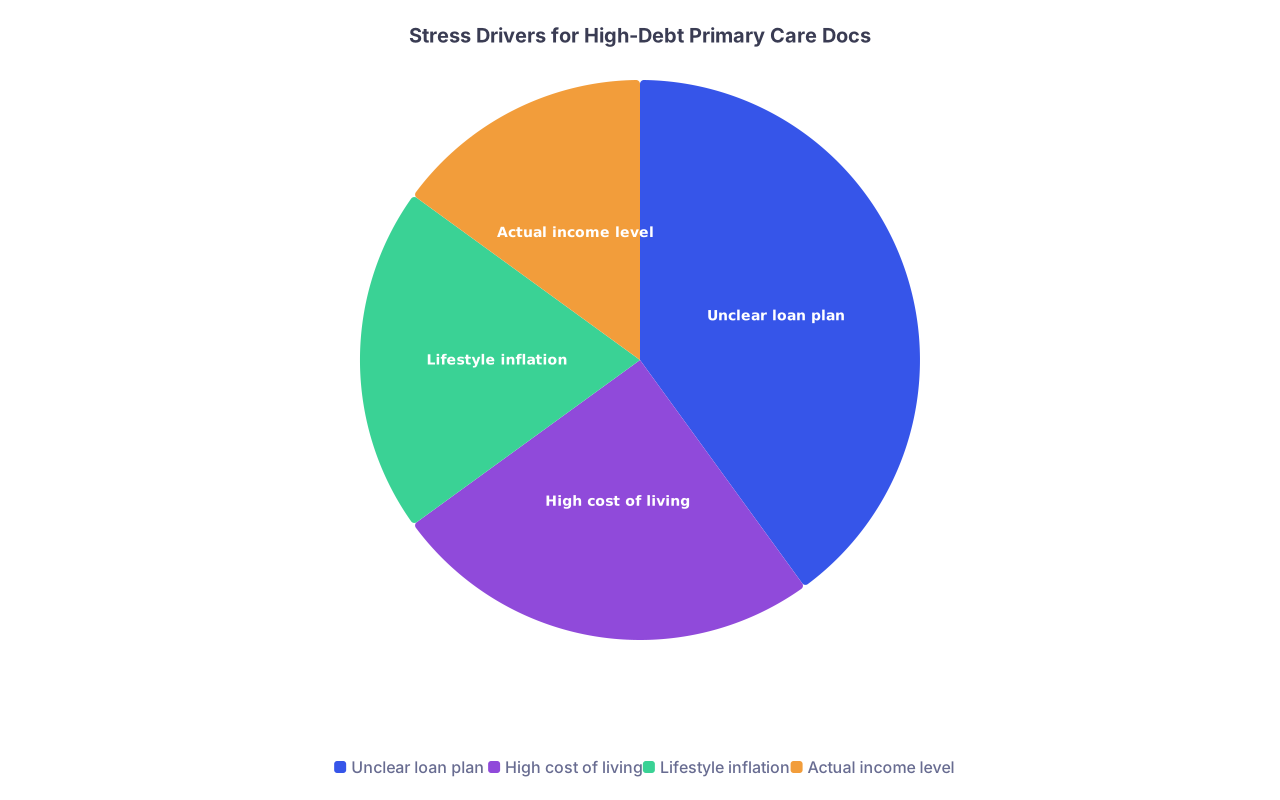
| Category | Value |
|---|---|
| Unclear loan plan | 40 |
| High cost of living | 25 |
| Lifestyle inflation | 20 |
| Actual income level | 15 |
FAQ (Exactly 4 Questions)
1. Is it financially irresponsible to choose primary care with more than 300K in loans?
No—if you build a real plan around PSLF or IDR and you’re thoughtful about job choice and cost of living. Irresponsible is ignoring the numbers and hoping it magically works out. Primary care with high debt is challenging, but absolutely doable with a strategy.
2. Should I switch to a higher-paying specialty just because of my debt?
Only if you can look yourself in the mirror and say, “I would still choose this specialty even if it paid like primary care.” If the honest answer is no, you’re trading 30+ years of your life for a faster loan payoff. I’ve seen that breed regret and burnout way more often than peace.
3. What if PSLF changes or disappears and I’m stuck in primary care with huge loans?
If PSLF vanished, it would hurt a lot of people across all specialties, not just you. You’d still have IDR options to keep payments tied to income. It would be rough, no way around that, but not uniquely catastrophic for primary care. Making every career decision out of fear of a theoretical policy collapse will paralyze you.
4. Can I still have a “normal” life—house, kids, retirement—with primary care and 300K+ debt?
Yes, but probably not immediately out of residency and not with maxed-out lifestyle in a super expensive city. If you pick decent-paying roles, use PSLF/IDR intelligently, and ramp your lifestyle gradually, you can absolutely reach those milestones. It just may be on a delayed timeline compared to your non-med friends—and that’s more about the path you chose (medicine) than primary care specifically.
Key points to walk away with:
- Primary care with >300K in loans isn’t crazy—it just demands an intentional, numbers-based plan (PSLF/IDR + smart job/location choices).
- The disaster stories usually come from ignoring loans and inflating lifestyle, not from choosing primary care itself.
- Don’t let fear of debt bully you into a specialty you hate; fix the loan plan, not your entire personality.