
What if opening your loan statements proves it’s actually as bad as you fear?
That’s the loop, right?
“If I don’t open them, maybe it’s not that bad. But if I do open them and it’s worse than I think, I’ll spiral. And I’m already barely holding it together.”
I’m going to be blunt: I’ve seen people ignore their statements for months… some for years. They don’t open emails. They swipe away notifications. They literally stash envelopes in a drawer. And every time they think about it, their heart rate jumps.
So if that’s you? You’re not uniquely irresponsible. You’re just scared. Welcome to the club.
Let’s walk through this like you’re sitting at the table with your laptop and a knot in your stomach, and I’m the slightly older, equally anxious friend saying, “Okay. We’re not fixing everything today. We’re just going to look.”
No heroic nonsense. No “take control of your financial future!” speeches. Just gentle, realistic first steps so you don’t feel like you’re about to be financially executed every time Navient, MOHELA, Nelnet, or whoever emails you.
Why Your Brain Is Terrified of Opening Loan Statements
You’re not afraid of a PDF. You’re afraid of what it means.
Common mental scripts I see:
- “If I see the real number, I’ll never sleep again.”
- “I already know it’s bad. Seeing it won’t help.”
- “I’m probably already in delinquency. What’s the point?”
- “I’m going into med school / grad school / residency. It’s not like I can pay it down right now anyway.”
The anxiety actually makes logical sense in a twisted way:
As long as you don’t open the statements, your brain can pretend it’s “future you’s” problem.
But here’s the harsh part: loan systems do not care about your anxiety. Interest runs whether you open the email or not. Late fees stack whether you log in or not. Default happens whether you’re “emotionally ready” or not.
I’m not saying this to scare you more. You’re scared enough. I’m saying it because this avoidance pattern tricks a lot of very smart people into quietly walking toward a cliff.
And there’s a second, less obvious problem: when you don’t look, you assume the worst possible scenario. I’ve watched people convince themselves:
- They’re in default when they’re just 15 days late.
- They owe $200k when it’s actually $92k.
- Their credit is “probably destroyed” when it’s actually just mildly bruised.
Your brain fills in the blank with horror. The statements, as awful as they may feel, replace that horror with facts. And facts give you options.
We’re not jumping straight to “budget overhaul” or “refinancing strategy.” That can wait. Our first win is simple: get the facts without emotionally exploding.
Step 1: Define Your Goal for Today (Keep It Tiny)
Today’s goal is not:
- Fix your loans
- Make a payment plan
- Become “good with money”
Today’s goal is:
- Find out three things, and then stop.
Those three things:
- Who is/are your servicer(s)?
- Total amount owed (rough range is fine)
- Current status (in school, grace, repayment, forbearance, delinquent, default)
That’s it. Not interest rate breakdowns. Not amortization schedules. Just the headline numbers.
If even that feels like too much, set the bar lower:
- Just find your logins
or - Just open one recent email from your servicer
or - Just open one physical envelope
The smaller the task, the less your anxious brain screams.
Step 2: Set Up a “Safe Container” Before You Look
You know that feeling where you’re scared to cry because you think once you start, you’ll never stop? Same energy here. So you create a “container” around the task.
Do this before you even touch an envelope:
- Pick a short time window: 15–20 minutes, max.
- Set a timer. When it goes off, you must stop, even if it feels unfinished.
- Decide what you’ll do right after that’s emotionally grounding: walk, shower, watch a dumb show, call someone.
Optional but surprisingly helpful:
- Have a notebook or simple doc open titled “Loan Facts – Not Feelings.”
- Every time your brain spirals (“I’m doomed”), write the fact instead (“Balance: ~62k, income-contingent plan available”).
You’re not trying to become zen. You’re just giving your nervous system guardrails so it doesn’t feel like you’re walking into an endless pit.
Step 3: Log In or Open the Envelope – With Training Wheels
Here’s a simple decision path:

| Step | Description |
|---|---|
| Step 1 | Start |
| Step 2 | Log in to servicer |
| Step 3 | Use password reset |
| Step 4 | View total balance |
| Step 5 | Check old emails or mail |
| Step 6 | Check loan status |
| Step 7 | Write 3 facts in notebook |
| Step 8 | Stop for today |
| Step 9 | Remember login? |
A few practical tricks:
If you can’t face the whole portal yet
Start with the subject line of emails. Something like:- “Your statement is ready” (normal)
- “Important information about your repayment plan” (could be change, not always bad)
- “Past due notice” (ok, sucks, but still fixable)
- “Delinquency” or “default” (scarier, but still not the end of your life)
If you physically can’t click
Seriously, this happens. Your hand hovers over the trackpad and just… stalls. Try this stupid-sounding hack:
Count backwards from 5 and then click on 1.
“5–4–3–2–1 click.” It pulls the decision out of the anxiety spiral and into a tiny mechanical action.If you’re convinced opening it will ruin your day
Pick a time late enough that your obligations are mostly over, but not right before bed.
Example: 6:30 pm after classes/work, not 11:45 pm when you’re already fried.
Remember, your only job is to get those three facts: servicer, total, status.
Step 4: Translate the Scary Words Into Plain English
Loan statements and portals love using words that sound like legal threats. They’re often much less dramatic than your brain hears.
Here’s a stripped-down translation:
| Status word | What it really means (roughly) |
|---|---|
| In school | You’re still enrolled; usually no pay due |
| Grace | Post-school buffer period, no/low payments |
| Repayment | Clock’s started; payments expected |
| Forbearance | Temporarily paused, interest may grow |
| Delinquent | You’re behind, but not in default yet |
| Default | Long-term nonpayment, serious consequences |
If you see “delinquent,” that means you’re behind, but it’s still fixable with phone calls, income-based plans, or consolidation.
If you see “default,” that’s more serious, but even then, there are “rehabilitation” options. It’s not game over. It’s just “hard mode.”
And if you see “in school,” “grace,” or “forbearance,” your anxiety’s been running a horror movie when the actual situation is… not great maybe, but not immediate catastrophe.
Step 5: Capture a Snapshot – You Are Not Deciding Anything Yet
Once you’ve got your three facts, write them down somewhere that isn’t an emotional war zone.
Example of what I’d want to see in your notebook:
- Servicer(s): MOHELA (federal), Sallie Mae (private)
- Total ballpark: ~86k
- Current status:
- Federal: in grace until 11/2025
- Private: repayment started, 2 payments behind
That’s already enough to build a plan later. For today, it’s enough to say: “Okay, this is where I actually am.”
Notice what’s not happening today:
- You’re not choosing a repayment plan.
- You’re not calling anyone if you don’t have the bandwidth.
- You’re not setting up auto-debit if that thought makes you nauseous.
You’re just creating a snapshot so the monster in your head stops being an undefined shadow.
Step 6: Very Gentle Next Moves (When You’re Ready)
Once you’ve survived the first look (key word: survived, not enjoyed), the next steps get way less terrifying because you’re no longer dealing with unknowns.
Here’s what usually comes next, eventually (not all today):
- If you’re federal: look at income-driven repayment (IDR) options like SAVE or PAYE/IBR.
- If you’re truly unable to pay anything right now: look up deferment or forbearance options (with eyes open about interest).
- If you’re in or near default: read about loan rehabilitation before you freak out.
- If you have multiple servicers: create a super-basic list of who you owe and how much.
To keep this concrete, imagine someone with:
- 65k in federal loans – still in school
- 20k private – repayment started, 1 month late
Their “not today, but soon” action plan might be:
- Set calendar reminder 1 month before grace ends: “Check federal repayment options.”
- Call private lender for hardship plan or reduced payment.
- Set up $25 token automatic payment just to break the avoidance pattern, even if it barely touches interest.
None of this is magical. It doesn’t erase the loans. But it stops you from silently drifting toward worse outcomes while avoiding emails.
Why This Isn’t About “Discipline” or “Being Bad With Money”
I get a little angry when people talk about this stuff like it’s just a discipline problem.
You’re juggling exams, rotations, maybe applications, maybe a job. Your bandwidth is fried. Then on top of that, you’re supposed to calmly manage a five- or six-figure debt with legal jargon and confusing portals?
Avoidance here isn’t “lazy.” It’s your nervous system saying, “This feels like a threat and I don’t have capacity.”
So we lower the threat level. We do one tiny, specific thing at a time.
You don’t become “good with loans” by waking up one day and deciding to be a financial superhero.
You become functional by:
- Opening one statement when you really wanted to open zero
- Getting three facts when you really wanted to know nothing
- Taking one next step when your default is “shove it in a drawer”
That’s progress. And yes, that counts.
Small Reality Check: What Actually Happens If You Keep Avoiding?
I’m not going to sugarcoat this part, because the fear in your head is half real, half distorted.
Realistic consequences if you keep never opening things:
- Late fees and interest grow quietly.
- You could slip into delinquency or default without realizing.
- Credit score tanks, which can bite you later (housing, car, some jobs).
- If you’re in default long enough, wage garnishment or tax refund seizure can eventually show up. That’s… not fun.
But here’s the important part:
Those awful outcomes do not happen because you opened statements. They happen because you don’t.
Opening the statement doesn’t trigger disaster. It gives you warning before disaster. It gives you a chance to say, “Okay, not great, but what can I do before this gets worse?”
If your brain is screaming, “What if it’s already too late?”
My honest answer: it almost never is. It’s just going to be more annoying and maybe more expensive to fix the longer you wait. But fixable? Usually yes.
Visualizing the Shift (From “I Can’t Look” to “I Know the Basics”)
Here’s roughly what the journey looks like, from panic to “not thrilled but functioning”:
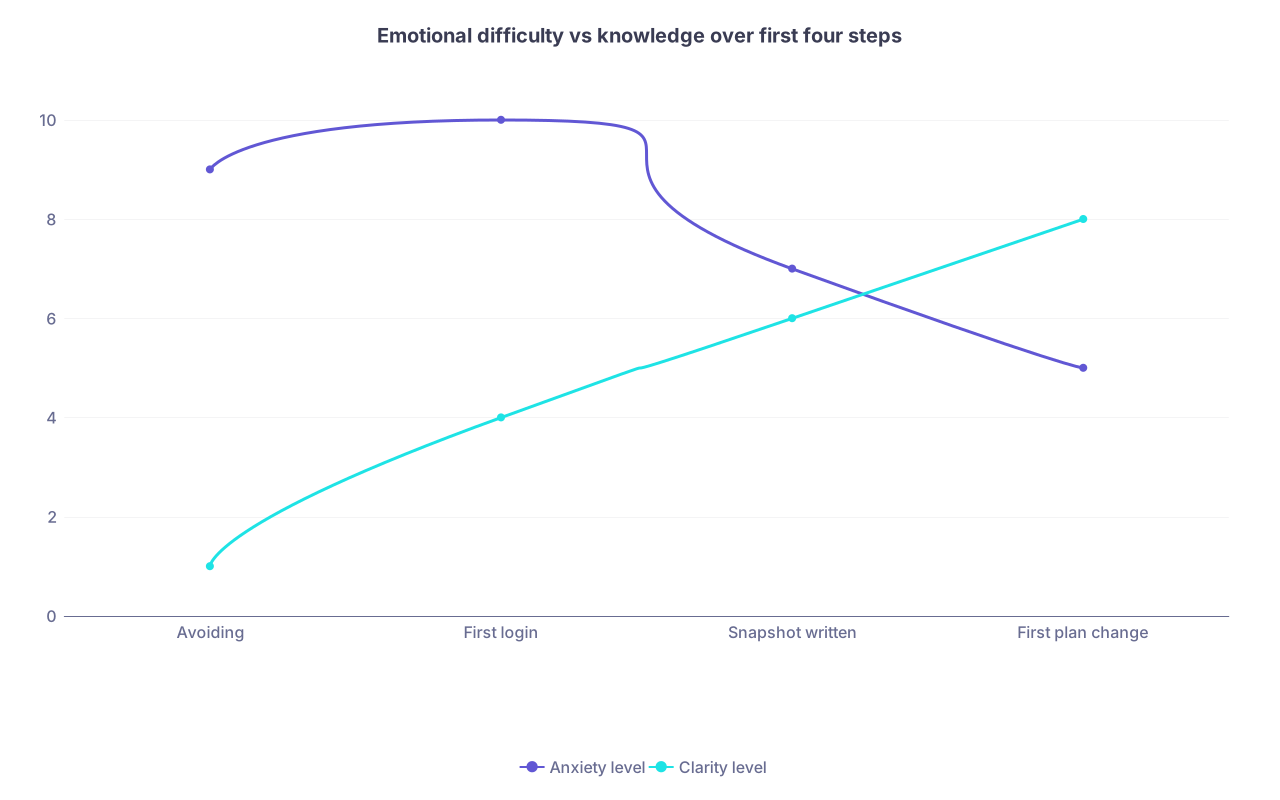
| Category | Anxiety level | Clarity level |
|---|---|---|
| Avoiding | 9 | 1 |
| First login | 10 | 4 |
| Snapshot written | 7 | 6 |
| First plan change | 5 | 8 |
You’re probably somewhere between “Avoiding” and “First login.” That spike in anxiety at step 2? Totally normal. It drops afterward. The anticipation is almost always worse than the reality.
If You Feel Yourself Spiraling While You Look
Quick tools you can use in the moment:
- Name what’s happening out loud: “I’m freaking out because this balance feels impossible, not because I’m actually in immediate danger.”
- Put your feet flat on the floor. Literally say, “Right now, nothing is happening to me. I’m just looking at numbers.”
- Tell yourself: “I’m not fixing everything today. I’m just gathering information.”
If you need to close the tab mid-way, do it. This isn’t an exam. There’s no penalty for coming back later.
FAQs
1. What if I open my statements and the number is way higher than I thought?
You’ll probably feel physically sick for a minute. That’s normal. Breathe, write the number down, and remind yourself:
“I already owed this much before I knew the number. Knowing it didn’t create the debt. It just removed the blindfold.”
Next step isn’t “fix everything”; it’s “what are the options for someone with this number and my income/status?” There are always options, even if they’re all slightly annoying.
2. What if I find out I’m already delinquent or in default?
It’ll feel like you’ve failed some secret adult test. You haven’t. Lots of people end up here by ignoring emails when life was on fire.
If you’re delinquent: contact your servicer, ask about income-driven plans or repayment options.
If you’re in default: look up “loan rehabilitation” or consolidation options. It’s a process, but people do it and get out. Not fun, but not permanent exile.
3. How do I deal with the shame of having so much debt?
You’re not defective. You’re in a system where education is massively overpriced and loans are normalized. Med, law, grad, even undergrad – this is baked in.
You’re allowed to feel gross about the number and still take responsible steps. Shame wants you to hide. You don’t have time for that. You’re allowed to say, “Yeah, it sucks, and I’m still going to open the statement.”
4. Should I avoid looking until I can actually afford to pay more?
No. That’s how small fires become full-blown disasters. Even if you can’t pay a cent more than the minimum (or anything at all right now), knowing your status lets you choose: deferment, forbearance, IDR, hardship plans. Not knowing just lets bad things happen in the background.
5. How often should I check my loan accounts once I’ve finally opened them?
At the beginning, once a month is plenty. Literally set a recurring 15-minute calendar event: “Loan check-in.” Glance at balances, make sure payments processed, check if any messages popped up. Over time, it’ll feel less like a horror ritual and more like checking a stubborn, mildly annoying plant you have to water.
Key things to remember:
- Opening your loan statements doesn’t create problems; it just shows you the ones already there.
- Your only first goal is to get a basic snapshot: servicer, total, status. Nothing more heroic.
- Tiny, unglamorous steps – like logging in once when you wanted to avoid it – are exactly how people quietly go from panic to actual control.