
It’s Tuesday afternoon. You open your work email between meetings and see a cheerful-sounding message from HR: “Important Update to Your Total Rewards Package.” Three paragraphs in, there it is:
“Due to changing business conditions, our student loan repayment benefit will be discontinued effective next month.”
Your stomach drops. That $200–$1,000 per month they were paying? Gone. You were counting on it. Maybe you stretched your rent a bit higher because of that benefit. Maybe you chose this job because of it.
You’re not alone. I’ve watched people in healthcare, tech, law, and nonprofit get blindsided by this exact move. Companies love marketing loan repayment as a shiny perk. They’re a lot quieter when they rip it away.
Here’s how you handle it—step by step—without panicking and without making dumb, rushed money decisions you’ll regret in three years.
1. Confirm What Actually Changed (And When)
Do not assume the email is the whole story. Corporate HR communications are masterclasses in vague half-truths.
You need clarity on five things:
- Exact end date
- What happens to already-earned benefits
- Whether they’ll honor payments already “in process”
- Whether you signed anything that guaranteed a timeframe
- Whether this affects only future benefits or claws back past ones (rare, but I’ve seen attempts)
Start with the written stuff:
- Re-read the HR email closely. Note dates, phrases like “effective immediately” vs “effective [date]”.
- Pull your original offer letter and any benefits brochure or policy document that mentioned the loan program.
- Log in to your loan account and download your payment history to confirm what the employer actually paid and when.
Then, send a direct, specific email to HR or benefits. Something like:
“I’m currently enrolled in the student loan repayment benefit. Can you please confirm:
- The last month for which I’ll receive a payment,
- Whether any pending payments that have already accrued will still be made, and
- Whether any other aspects of my compensation or benefits package are being adjusted to offset this change?”
You want their answers in writing. If they dodge, ask again. You are not being “difficult.” You’re protecting yourself.
2. Check If They’re Breaking Anything They Promised
Now we shift from “shocked employee” to “mildly annoyed contract reader.”
There are two main questions:
- Was this clearly described as an at-will, change-anytime benefit?
- Did they ever promise a fixed period (e.g., “We’ll pay $X/month for 3 years if you stay”)?
Go through:
- Offer letter
- Any signed student loan benefit agreement
- Benefits handbook/policy (even the PDF you never read)
You’re looking for language like:
- “Company reserves the right to modify or terminate this program at any time.” → They covered themselves.
- “Company will provide up to $X/year for Y years in student loan repayment” without a strong termination clause → Now there’s at least a question.
- “In return for continued employment, you will receive…” over a defined period → Stronger argument that this was part of your compensation bargain.
Am I saying you’re going to sue your employer over $200/month? Probably not. But if:
- You recently accepted an offer largely because of this benefit, or
- You relocated, took a pay cut, or declined another offer for this
…then it’s at least worth:
- A calm, factual conversation with HR about whether they’re offering any offset (salary adjustment, sign-on, retention, or one-time stipend), and/or
- A brief consultation with an employment attorney if the dollar amounts or impact are large.
Most of the time, the legal path isn’t worth it. The negotiation path might be.
3. Plug the Immediate Budget Hole (Next 30 Days)
Your first job is survival math, not optimal repayment strategy.
Figure out the immediate damage:
- What was the employer paying each month?
- What’s the required minimum on your loans now, without their help?
- When is your next due date?
Let’s say:
- Employer was paying: $300/month
- Your required minimum: $250/month
- You were only paying an extra $50 personally because their $300 made you feel aggressive
Now, their $300 disappears. Your real obligations:
- You must find $250/month for the minimum.
- If things are tight, you stop pretending you’re still doing $350. You don’t “keep up” a heroic payment and then put groceries on a credit card at 24% APR. That’s dumb math.
Do a 15-minute emergency budget pass:
- Open your bank/credit card app.
- Look at the last full month.
- Circle or list 3–5 flexible categories: eating out, subscriptions, ride shares, streaming, “quick” Amazon orders.
You’re trying to carve out an amount equal to the minimum payment, not your previous turbo-payment that included the employer portion.
If you can’t find it without real hardship:
- Call your loan servicer and confirm your current plan and payment.
- If you’re on a standard plan, hold your nose and move to an income-driven repayment (IDR) plan to lower payments in the short term. This is not a moral failure. It’s cashflow triage.
4. Decide: Short-Term Cushion or Long-Term Attack?
Once you’re not missing payments, you pick a direction:
- Build cash cushion first
- Or stay aggressive on loans
Here’s where most people mess up: they try to “replace” the employer benefit immediately, even if they have zero emergency savings.
That’s pride masquerading as strategy.
If you have:
- Less than 1 month of essential expenses saved:
- Priority = build cash. Pay the minimum on loans. Any freed-up money goes to a small emergency fund until you hit 1–2 months’ expenses.
- 1–3 months saved:
- Split the difference.
- Example: Employer used to pay $300. You can realistically free up $200. Maybe you put $100 to loans, $100 to savings.
- 3+ months saved, stable job, and stable health:
- You’re safer being more aggressive on loans again, if that actually matters to your long-term goals.
5. Re-run Your Student Loan Strategy (As If The Benefit Never Existed)
This is the mental reset. Pretend the employer loan repayment never existed. From scratch, you’d ask:
- What’s my total loan balance?
- What are my interest rates (list them)?
- Am I aiming for forgiveness (PSLF or long-term IDR) or full repayment?
- What’s my realistic monthly capacity without employer help?
Make a simple table for yourself:
| Loan Type | Balance | Interest Rate | Plan Type |
|---|---|---|---|
| Direct Subsidized | $18,000 | 4.5% | IDR |
| Direct Unsubsidized | $32,000 | 5.8% | IDR |
| Grad PLUS | $60,000 | 7.0% | IDR |
If you’re in healthcare, public service, government, or nonprofit and you still qualify for PSLF:
- The loss of employer repayment sucks emotionally, but mathematically, it might not wreck your forgiveness strategy.
- Your main objective stays the same: keep qualifying payments going, minimize required payment if your long-term plan is forgiveness.
If you’re not forgiveness-bound (private sector, or low chance of staying in qualifying employment for 10+ years):
- You’re now fully responsible for the payoff path.
- Reconsider whether refinancing (for stable high earners with no need for federal protections) makes sense—though not in the first week after losing the benefit. Give yourself a month to settle your numbers first.
6. See If Any Alternative Programs Can Replace Part of the Loss
Your employer might have killed the perk. That doesn’t mean everyone else did.
Scan for:
Federal programs you might’ve ignored before
- PSLF if you’re in qualifying employment and have Direct Loans on IDR
- Income-Driven Repayment recalculation if your income changed downward
- Temporary interest rate changes or special programs (these change; you have to look up current options at studentaid.gov)
State or profession-based repayment programs
Common for:- Physicians, NPs, PAs
- Nurses
- Social workers
- Dentists
- Teachers in high-need areas
Google “[your profession] loan repayment [your state]”.
Refinance bonuses / better rates (for private loans or if you’re voluntarily leaving federal protections)
- If your credit and income are solid, the rate drop might offset some of what your employer was giving you.
- But do not rush this. Once you refinance federal loans to private, the federal safety net is gone—no PSLF, no IDR, no broad federal relief if it shows up again.
7. Have the Awkward But Necessary HR Conversation
Most people just grumble in Slack and move on. Some of you should push a little.
If:
- The benefit was a major part of your recruitment, and
- This change happens relatively soon after you joined (within 12–24 months), and
- You’re a strong performer or in a hard-to-replace role
…then you have leverage. Not lawsuit-level leverage. But negotiation-level leverage.
You’re not going in guns blazing. You’re doing this:
Schedule a 20–30 minute conversation with your manager or HR (whoever has more sway).
Prepare something like:
“When I accepted this role, the student loan repayment program was a significant factor. I understand the company has to adjust benefits, but this is effectively a $X/year compensation cut for me.
Is there any possibility of:
- A base salary adjustment,
- A one-time retention bonus, or
- Another form of compensation to partially offset this change?”
Be quiet and let them talk. HR will try to use phrases like “consistent with market” and “standardizing our offerings.”
I’ve seen this result in:
- Nothing (common)
- A small one-time bonus
- A slight raise at your next comp review
- A quiet extra equity grant (in tech)
If you get nothing? Fine. Now you have more information about how your company values you. Use that when you think about your next job move.
8. Reassess Your Job—But Don’t Rage-Apply Blindly
People love to jump straight to “I’m out.” That’s emotional, not strategic.
Ask yourself three real questions:
- If the loan benefit never existed, would you still consider this job fairly paid for your role, skills, and market?
- Are there better-paying opportunities (or better total comp) realistically available to you in the next 6–12 months?
- Is your work experience here building your resume in a way that will raise your earning potential later?
If the answer to 1 and 3 is yes, but 2 is weak, then this sucks but probably isn’t “quit immediately” material. You stay, fix your loan plan, and carefully explore options, not panic-apply to worse roles.
If the answer to 1 is no and 2 seems promising, then:
- Add “total comp including loan support” to your checklist when evaluating new offers.
- Explicitly ask future employers:
“Is your student loan repayment benefit guaranteed for a set period, or can it be changed anytime?”
(Watch how they answer. Evasiveness is an answer.)
9. Protect Yourself From This Happening Again
You can’t fully prevent companies from changing their minds. You can stop being blindsided by their marketing.
Next time you’re job-hunting and you see “student loan repayment” splashed everywhere, here’s what you do:
Ask recruiting/HR:
- “Is this benefit written into the offer letter or is it a discretionary program?”
- “Has the company changed or suspended this benefit in the last few years?”
- “Is there a minimum time period for which this benefit is guaranteed?”
And in your own planning:
- Treat employer loan repayment as temporary bonus money, not the foundation of your plan.
- Build your budget so you can survive on salary alone. Employer loan money = accelerator, not life support.
10. A Simple 7-Day Action Plan
You don’t need a 6-month project. You need one focused week.
Here’s a clean sequence:

| Step | Description |
|---|---|
| Step 1 | Day 1 - Gather Info |
| Step 2 | Day 2 - Confirm Details with HR |
| Step 3 | Day 3 - Review Contracts and Policies |
| Step 4 | Day 4 - Rebuild Budget and Cash Plan |
| Step 5 | Day 5 - Recalibrate Loan Strategy |
| Step 6 | Day 6 - Explore Alternative Programs |
| Step 7 | Day 7 - Decide on HR Ask and Job Strategy |
Quick breakdown:
- Day 1: Pull offer letter, benefits docs, loan payment history.
- Day 2: Email HR for confirmation of exact end date and any alternatives.
- Day 3: Scan policies for any language on guaranteed period vs at-will changes.
- Day 4: Update budget and emergency fund plan. Make sure you can cover minimums.
- Day 5: Decide: IDR vs standard vs refinance (later), forgiveness vs full payoff.
- Day 6: Look up PSLF, state, and profession-specific programs.
- Day 7: Have (or schedule) the compensation/offset discussion with HR or manager and decide how this factors into your longer-term job plans.
Quick Visual: Where That Lost Employer Money Might Come From
To avoid magical thinking, it helps to actually allocate the shortfall.
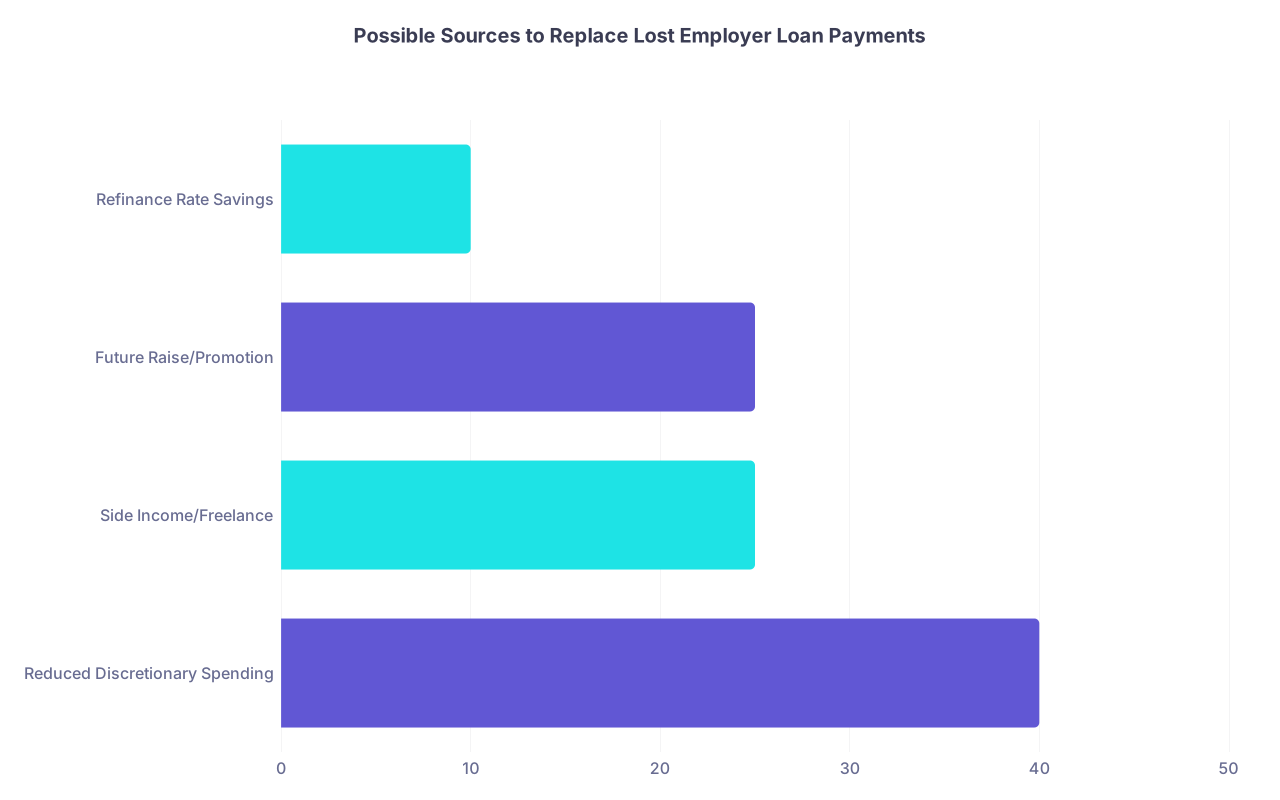
| Category | Value |
|---|---|
| Reduced Discretionary Spending | 40 |
| Side Income/Freelance | 25 |
| Future Raise/Promotion | 25 |
| Refinance Rate Savings | 10 |
Those percentages aren’t universal, but they’re realistic. Most of the fix comes from tightening and earning more, not some clever financial trick.
FAQs
1. My employer ended the loan repayment program, and now I truly cannot afford my payments. What’s my fastest move?
Call your loan servicer within the next 48 hours and ask two direct questions:
- “What is my current repayment plan and monthly payment?”
- “What would my payment be under the lowest payment income-driven plan based on my current income?”
If you’re federal, shifting to an IDR plan is usually the move to avoid delinquency. If you’re private, ask about temporary hardship options: interest-only payments, reduced payments, or short-term forbearance. Do not bury your head and start missing payments—late payments trash your credit long after you’ve forgotten why.
Then, cut your budget down to essentials for 1–2 months while you stabilize. You can revisit aggressive payoff later.
2. Can I force my employer to keep paying because it was in my offer letter?
Usually no, but sometimes you have leverage. If your offer letter promised loan repayment for a specific term (e.g., “$500/month for 36 months”) without clear language that they can change or terminate at will, you may have some contractual arguments. That’s when a short consult with an employment attorney makes sense, especially if the total promised value is large (five figures or more).
If the language is generic—“eligible for company loan repayment program,” plus a handbook that says they can change benefits anytime—you’re probably out of luck legally. You can still negotiate for some form of offset, but you won’t have a great legal hammer.
3. Should I refinance my federal loans now that my employer stopped helping?
Not immediately. Losing the employer benefit is not a good enough reason on its own to abandon federal protections. Ask yourself:
- Am I 100% sure I’ll never use PSLF or any forgiveness?
- Is my job and income stable enough to handle a fixed private payment even in a downturn?
- Do I already have a decent emergency fund (at least 1–3 months)?
If the honest answer to any of those is no, pause. Rework your budget, maybe move to an income-driven plan, and only revisit refinancing when you’re on solid ground and have shopped multiple lenders.
Open your last pay stub and look at the “employer contributions” section. Now open your loan portal and check the scheduled payment for next month. Those two numbers just divorced. Your next step is to build a plan that relies only on one of them—your paycheck. Start today by writing down your current minimum loan payment and the exact date it’s due. Then adjust one concrete spending category (e.g., cut $75 from eating out) to make room for that number.