
Big Signing Bonus vs Higher Salary: Choosing the Better Debt Move
You’re staring at two job offers in your inbox.
Offer A: $20,000 signing bonus, slightly lower base salary.
Offer B: no bonus, but $7,000 more per year in salary.
You’ve got $210,000 in student loans, interest clock ticking every day. Your friends are yelling “Take the bonus!” Your dad says, “Salary is forever, bonuses are one-time.” Your brain is just…tired.
You are not trying to optimize for “feelings.” You want the better move for your debt and long‑term money. Here’s how to actually decide, with numbers that make sense for federal and private loans, and for people in and out of forgiveness programs.
Let’s walk through this like we’re sitting next to each other at your kitchen table.
Step 1: What kind of debt are you dealing with?
Before picking bonus vs salary, you have to know what you’re actually trying to optimize.
You fall into one of three broad buckets:
- You’re paying loans to zero (no forgiveness strategy)
- You’re on track for forgiveness (PSLF or 20–25 year IDR)
- You’re honestly not sure and might change paths
The math is different in each situation. So is the best move.
| Situation | Priority |
|---|---|
| Aggressively paying to zero | Total interest paid |
| PSLF (10-year forgiveness) | Taxable income management |
| 20–25 yr IDR forgiveness | Payment size vs future tax bomb |
| Private refinance (fixed) | Interest rate vs job stability |
| Mixed (some federal, some private) | Separate strategies |
If you do not know which you are, here’s the blunt version:
- If you’re going for PSLF (government/nonprofit, 10-year plan): you’re in bucket 2.
- If you’re at a private employer with no realistic plan to do PSLF, and you’re not trying to keep payments low for decades: you’re probably bucket 1.
- If your long‑term career path is unsettled, assume bucket 3 and keep flexibility.
We’ll hit all three. But first, you need a quick way to compare the offers.
Step 2: Translate both offers into “loan power” in year 1
Ignore emotions for a second. Ask: in the first year, how much can each offer realistically help me attack my loans?
You want to convert:
- Signing bonus → how much of that will actually go to loans (after tax, after lifestyle creep)?
- Higher salary → how much “extra” per month will survive your budget and actually hit principal?
Estimate your after‑tax money
I’m going to keep this simple and practical, not perfect.
For most early‑career professionals in the US:
- Assume signing bonus is taxed at about 35–40% (federal + state + payroll), depending on your bracket and state.
- Assume extra salary is taxed at about 30–35% (it’s in your marginal bracket).
So:
- $20,000 signing bonus → maybe $12,000–$13,000 in your bank account.
- $7,000 extra salary → maybe $4,500–$5,000 more per year, or ~$375–$425 per month.
Already you can see the tension. The bonus gives you a big immediate slug; the salary quietly adds up every month.
Now let’s layer in debt strategy.
Step 3: If you’re paying loans to zero (no forgiveness strategy)
This is the most straightforward case. Your enemy is total interest paid and the time you stay in debt.
In this world, a signing bonus used correctly can be a sledgehammer.
But the key phrase is “used correctly.”
Example scenario
- $210,000 loans at 6.5% interest (mix of federal and refinanced private)
- Standard 10-year payment is around $2,380/month (just approximate)
- Offers:
- Offer A: $20,000 signing bonus, $120,000 salary
- Offer B: no bonus, $127,000 salary
Estimate after tax:
- $20k bonus → ~$12k usable
- Extra $7k salary → ~$4.5k/year or ~$375/month
Now ask: if you’re actually disciplined and throw all of this at loans, which wins?
How to roughly compare
Use this rule-of-thumb logic:
Bonus as immediate lump sum
You drop $12,000 on your loans right away.On a 6.5% loan, that $12k saves you:
- About $780 per year in interest
- Over 10 years, that’s roughly $7,800 in interest avoided
- And you shorten your payoff timeline.
Extra salary as monthly payments
$375/month extra = $4,500/year at 6.5% interest.If you pay $375/month extra from year 1:
- You’ll knock down principal faster
- Over 10 years, that’s $45,000 total extra paid.
- The interest savings can be significant too, likely more than what the bonus alone does, but it’s spread out.
Here’s the real question you need to answer honestly:
Will you actually send that extra monthly salary to your loans? Or will it evaporate into DoorDash, rent upgrades, and travel?
If you’re aggressive, disciplined, and maybe already living like a student, the higher salary often wins over time for people paying to zero, especially if you stick around long enough to enjoy multiple years of that extra base.
But there are exceptions where the signing bonus makes more sense:
- Your rate is very high (7–9% or credit card consolidation)
- You can refinance faster if you get under a certain balance
- You’re determined to be debt‑free in 5–7 years and will use that lump sum to immediately knock out a chunk and then refinance aggressively
When I’d pick the signing bonus in a “pay to zero” plan
I’d lean bonus if:
- The difference in salary is small (like $2–4k/year more),
- The bonus is large ($15k+ after tax), and
- You are 100% committed to sending that lump sum within the first 1–3 months to your highest‑interest debt.
I’ve watched people take a $15k signing bonus, put $13k to 7.5% loans on day one, and then refinance down to a lower rate sooner. Over time, that move saved them more than years of a tiny bump in salary would have.
When I’d pick higher salary
I’d pick the higher salary if:
- The salary bump is meaningful ($7–10k+ per year),
- You expect to stay at the job at least 3–5 years, and
- You’re actually willing to automate extra monthly loan payments so it is not a willpower decision.
In that case, set up an automatic extra monthly payment equal to the difference in take‑home pay between the offers. Treat it like a bill.
Do not trust yourself to “send more later” without automation. That’s how debt lingers for a decade.
Step 4: If you’re going for PSLF or long‑term IDR forgiveness
Different universe. Now the game changes.
If you’re truly not planning to pay your federal loans to zero and expect either:
- PSLF at a qualifying employer after 10 years, or
- IDR forgiveness after 20–25 years,
then your priorities shift:
- Lower taxable income → lower monthly payments → potentially more forgiven.
- But you also need to build savings and handle the tax bomb (for 20–25 year forgiveness, not PSLF).
Here’s where people often make a mistake: they still think of loans in pure “pay it off fast” terms when they’re actually in a forgiveness strategy.
In forgiveness strategies, salary matters more than bonus
Your monthly payment on IDR (SAVE, PAYE, IBR, etc.) is based on income, not your loan principal.
- Higher ongoing salary → higher IDR payments
- Signing bonus (one‑time) may bump income in a single year but doesn’t lock you into high payments forever
But you know what? For most early‑career borrowers, the difference in IDR payments from $7k of extra salary is not huge. We’re talking maybe $40–60/month difference, give or take, depending on family size, state tax, and exact IDR plan.
What’s actually more important here:
- Does the job qualify for PSLF? If yes, the whole bonus vs salary argument sits inside a much bigger win.
- Does the employer offer loan repayment assistance on top of salary or bonus? That can dwarf this decision.
How to play it if you’re PSLF‑bound
If you’re at a PSLF‑qualifying employer (government, 501(c)(3) non‑profit):
- You do not actually want to dump huge extra payments into federal loans you expect to be forgiven.
- Every extra dollar you pay is one less dollar forgiven.
So, between bonus and salary:
- I’d favor whatever maximizes your net wealth, not loan prepayment.
- That usually means:
- Take the higher salary if it also comes with better retirement match, promotion path, or stability.
- Take the signing bonus if you need cash to build an emergency fund, move, buy a car to get to work, etc.
But for loans, you’re better off:
- Keeping IDR payments as low as legitimately possible (retirement contributions help here),
- Stockpiling cash or investing rather than prepaying loans you expect to be wiped at year 10.
So if both offers are PSLF‑eligible and similar otherwise, the debt angle here is actually weaker than your life and career angle. The signing bonus vs salary matters less than sticking in PSLF long enough to actually get the forgiveness.
Step 5: If you’re on the fence or might change paths
This is a lot of people. You’re entering a PSLF‑eligible job but:
- You’re not sure you’ll survive hospital politics for 10 years
- You might move to private practice or industry later
- You may get married, move states, or switch sectors
When your future is genuinely uncertain, flexibility is king.
Here’s how I’d rank priorities:
- Job you are most likely to stay in for at least 3–5 years
- Employer quality (benefits, culture, growth)
- Loan impact of bonus vs salary
Why? Because nothing destroys student loan strategy like constant job churn.
From a pure “flexibility + loans” standpoint:
- A higher salary is more predictable. It helps you every year, wherever you are in your plan (PSLF, non‑PSLF, refinance later, etc.).
- A signing bonus gives you one shot to do something smart:
- Build a 3–6 month emergency fund
- Pay down high‑interest private debt
- Pay down a painful credit card used during training
If you know you’ve been living on fumes and your savings is basically $200 and a Costco card, I actually think the signing bonus used as a safety buffer + small loan paydown can be the smarter “mental health + math” move.
No emergency fund = higher odds you end up throwing expenses on 20–25% credit cards = your student loan APR will look charming compared to that.
Step 6: Include risk: what if you do not stay?
Most signing bonuses are not truly “free.” Many have clawback clauses:
- Stay 1 year or you repay pro‑rated bonus
- Some require 2 years
- Some are tied to location or role
Higher salary usually doesn’t have that string attached.
So check your contract. Actually read it. Out loud if you have to.
Look for:
- “Repayment of sign‑on bonus if employment terminates before X months”
- “Forgiveness of bonus” over time
If you’re looking at a toxic‑sounding job or an unstable company, that big bonus is a lot less attractive if you might have to hand half of it back after 9 miserable months.
On the flip side, if the employer is rock solid, the team seems supportive, and you can stomach at least 1–2 years there, the clawback risk is smaller.
Step 7: Quick comparison framework you can actually use
Here’s the stripped‑down way I’d have you compare in your notebook.
1. Write down both offers cleanly
Offer A:
- Signing bonus: $X (estimate after tax: 60–65% of that)
- Salary: $Y
Offer B:
- Signing bonus: $X2
- Salary: $Y2
2. Estimate “loan firepower” of each in first 2 years
- Bonus firepower: after‑tax bonus * percentage you will actually send to loans in year one.
- Salary firepower: after‑tax extra salary * 2 years * percentage you will actually send monthly to loans.
Be honest:
- If you’ve never sent an extra dollar to loans in your life, do not magically assume 100% discipline next year.
- If you’ve already been overpaying loans during training or in residency, you get more benefit of the doubt.
3. Mark your loan path: pay to zero vs forgiveness vs uncertain
Use:
- PZ (pay to zero)
- FG (forgiveness likely)
- U (uncertain)
Then:
- PZ: whichever option gives more total extra dollars to loans over the years you expect to stay, weighted by your actual behavior, likely wins.
- FG: stop obsessing over prepayment. Choose the job that’s more sustainable and financially solid overall. Use any bonus to shore up your finances, not to overpay federal loans that might be forgiven.
- U: favor flexibility, job fit, and enough cash buffer that you are not one flat tire away from credit card debt.
Step 8: What people consistently get wrong about this decision
A few patterns I’ve seen over and over.
They treat the bonus like lottery money
- They don’t plan ahead. It lands, they feel rich, and within 3 months it’s gone.
- If that’s your pattern, a higher salary that quietly supports steady extra payments is safer.
They underestimate how much job misery costs
- I’ve seen people take a slightly higher salary at a horrible place, burn out, quit within a year, and lose both income and PSLF eligibility.
- The “highest paying” job is not the one that makes you quit and restart.
They ignore other benefits
- 401(k) match, loan repayment benefits, relocation, CME, health premiums—these often matter more over 5+ years than a one‑time bonus versus a $5–7k salary gap.
- I’ve seen hospital systems pay $500/month directly to loans. That crushes both the bonus and the tiny salary differences over time.
They don’t segment federal vs private
- Federal loans: more flexibility, forgiveness in play. Less incentive to prepay if PSLF/IDR is real for you.
- Private loans at 7–9%: sledgehammer them if you can. Here, large bonus + refinance can absolutely beat a modest salary bump.
Visualizing the trade‑off over time
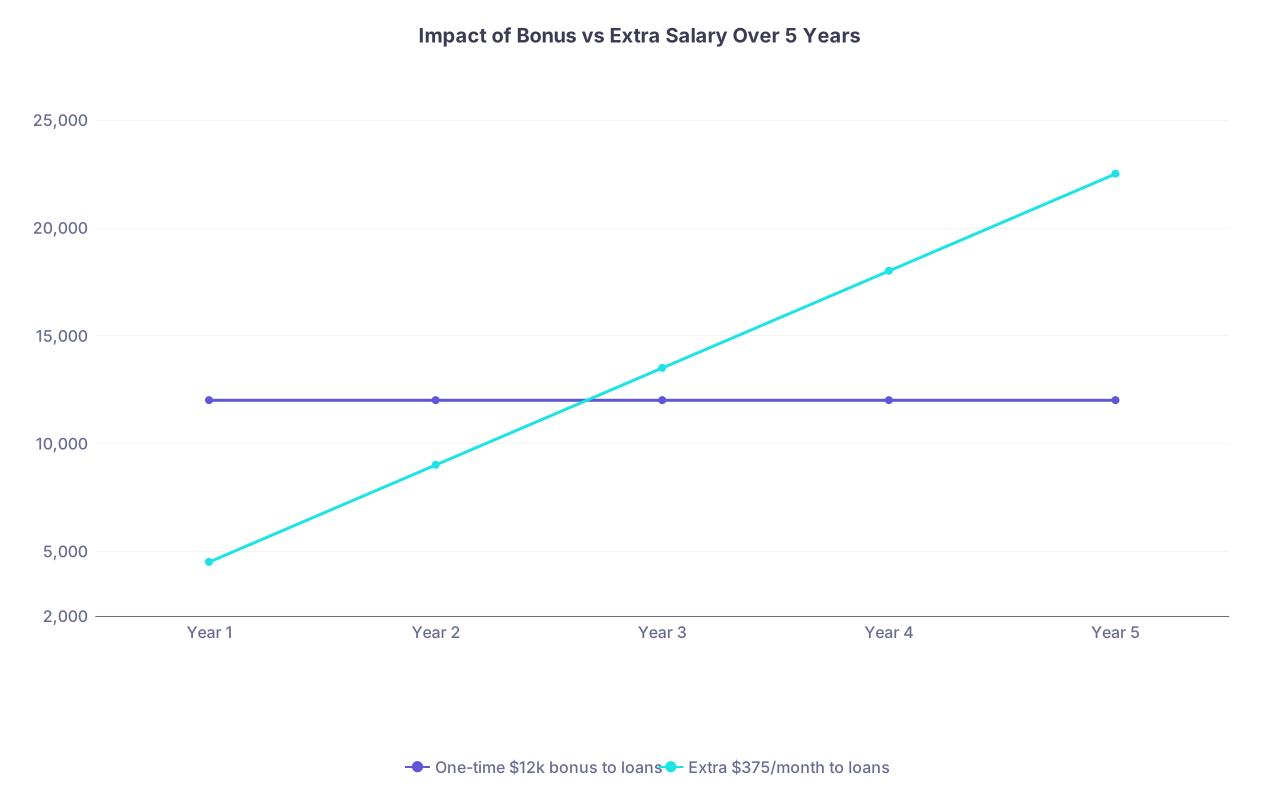
| Category | One-time $12k bonus to loans | Extra $375/month to loans |
|---|---|---|
| Year 1 | 12000 | 4500 |
| Year 2 | 12000 | 9000 |
| Year 3 | 12000 | 13500 |
| Year 4 | 12000 | 18000 |
| Year 5 | 12000 | 22500 |
You can see the idea: a big bonus wins early; disciplined extra salary contributions overtake it if you stick around long enough and actually keep paying extra.
Don’t forget: human life exists outside amortization tables
You’re not just a repayment machine. You’re also:
- Maybe moving cross‑country
- Maybe supporting family
- Maybe trying to get out of a terrible living situation
Where a signing bonus shines:
- Covering relocation costs without new credit card debt
- Paying first/last/security deposit on a safe apartment
- Buying a reliable used car so you don’t miss shifts
- Building a real emergency fund so one ER bill doesn’t wreck you
If using the signing bonus for these things prevents new high‑interest debt, that is still a loan win, even if it is not directly hitting your student loan principal.
A fast, honest decision script
If I had 10 minutes with you, I’d walk you through this:
Are you genuinely on track for PSLF or long‑term IDR forgiveness?
- Yes → prioritize job stability, PSLF eligibility, and total compensation. Bonus vs small salary differences = secondary.
- No → go to 2.
- Not sure → assume uncertainty and protect flexibility.
Will you actually send a large lump sum bonus to your loans in the first 1–3 months?
- Yes, and I know my own behavior → large bonus can be powerful, especially with high‑interest debt.
- No, I’ll probably nibble at it → then it’s just lifestyle fuel. Salary may be better if you can automate extra payments.
How long do you reasonably see yourself staying at this job?
- <2 years → bonus becomes more valuable relative to small salary differences (but watch clawbacks).
- 3–5+ years → salary has time to compound; steady extra payments win over a one‑time hit.
Do you have at least 3 months of expenses saved?
- No → a bonus used to build that cushion is a smarter debt play than you think. It prevents worse debt.
- Yes → you can truly decide based on loan math.
Quick reality check examples

Example 1: New grad PT, no PSLF, high private rate
- $120k in private loans at 7.75%
- Offer A: $15k bonus, $90k salary
- Offer B: no bonus, $95k salary
After tax:
- $15k bonus ≈ $9k
- Extra $5k salary ≈ $3.2k/year
If you’ll stay ~3 years and will actually throw money at loans:
- Total salary “loan power”: ~$9.6k over 3 years vs $9k right away.
- But if you can refinance down to 5% as soon as your balance drops under a certain level, the early $9k lump might unlock bigger savings.
Here, I’d probably say: take the bonus, slam it into loans early, then refinance aggressively—if you’re serious. If you’re not that disciplined, the difference is minor and other job factors matter more.
Example 2: Resident heading to academic hospital (PSLF)
- $280k federal loans, planning PSLF
- Offer A: $10k bonus, $210k salary
- Offer B: no bonus, $215k salary
You’re PSLF‑bound. You should not be racing to pay these off.
Here, I’d say:
- Pick the job that’s more sustainable (team, call schedule, leadership).
- Use any bonus to build emergency savings and maybe seed retirement, not to overpay PSLF‑bound loans.
- Between these two? I’d probably shrug and take the job I actually want, maybe leaning toward the bonus if you need cash to stabilize your life after training.
Two last points people skip

| Step | Description |
|---|---|
| Step 1 | Receive Two Offers |
| Step 2 | Prioritize Job Fit and Stability |
| Step 3 | Compare Bonus vs Salary Firepower |
| Step 4 | Use Bonus for Savings or High Interest Debt |
| Step 5 | Run 3-5 Year Math |
| Step 6 | Favor Higher Salary with Automation |
| Step 7 | PSLF or Forgiveness Likely |
| Step 8 | Will You Really Pay Extra? |
Retirement contributions can reduce IDR payments
If you’re on IDR, putting more into a pre‑tax 401(k)/403(b) lowers your AGI, which can lower your IDR payment. That can be more valuable than small differences in salary or bonus.Beware lifestyle creep anchored to higher salary
People adjust their spending to their paycheck faster than they think. If the higher salary will push you into a more expensive apartment, car, or social pattern, most of that “extra” won’t touch your loans.
Sometimes a big but one‑time bonus that you explicitly earmark—on paper—toward loans or savings is easier to protect than a slightly higher paycheck that just melts into a nicer life.
If you remember nothing else
- Decide your loan path first (pay to zero vs forgiveness vs uncertain). The right answer for a PSLF‑bound social worker is not the same as for a dentist with refinanced private loans.
- Run the behavior‑adjusted math: not how much you could pay, but how much you will realistically send to loans from bonus or salary. Automate whatever you can.
- Do not sacrifice job stability and basic financial safety (emergency fund, avoiding credit card debt) just to squeeze out a slightly “better” numeric decision on paper. The best debt move is the one you can actually live with for years.