
You get home from a 14‑hour shift. Your scrubs smell like the hospital, your kid is half-asleep on the neighbor’s couch because pickup ran late again, and when you finally sit down, there’s a stack of daycare invoices and a reminder email about your student loan payment.
Your monthly numbers look something like this:
- PGY‑2 salary: about $4,700 take-home (after taxes, benefits, etc., give or take)
- Childcare: $1,200–$1,800
- Rent: $1,200–$2,000 depending on your city
- Federal loan standard payment: $900–$1,400 (if you’re not on IDR)
And you’re thinking: this math does not work.
You’re not wrong. It doesn’t. So you stop trying to “make it work” in a vacuum and start using the systems that exist to protect you as a low‑earning (yes, by government standards) single parent with a professional degree.
Here’s how.
Step 1: Get Very Clear on Your Numbers (No Guessing)
You cannot manage what you’re eyeballing.
Take one hour this week. No more. Sit down and pull up:
- Your most recent pay stub
- Your daycare/childcare invoices or written agreement
- Your federal loan summary (studentaid.gov)
- Your private loan statements (if any)
- Your last bank or credit card statement for recurring bills
Make a bare‑bones monthly snapshot:
| Category | Amount (Monthly) |
|---|---|
| Take-home pay | $4,700 |
| Rent + utilities | $1,650 |
| Childcare | $1,400 |
| Groceries | $500 |
| Transportation | $250 |
| Loans (before IDR) | $1,050 |
If your “required” expenses are above your take‑home pay, that is not a personal failure. It means you must aggressively lean on:
- Income‑Driven Repayment (IDR)
- Public assistance that residents quietly use more than they admit
- Every tax and dependent advantage you’re entitled to
You are not trying to be noble. You’re trying to stay solvent, finish residency, and not implode.
Step 2: Put Your Federal Loans on the Right Repayment Plan
If you are a single parent in residency and you are not on an IDR plan, fix that first.
The point of residency is minimize cash outflow and preserve PSLF eligibility (if you’re headed for qualifying employment).
The plan that usually wins for residents: SAVE
As of 2024–2025, SAVE (the replacement/improvement of REPAYE) is usually the best for residents with federal loans.
Why? Three big reasons:
- Your payment is based on discretionary income, and as a single parent, your protected income is higher.
- SAVE cancels 100% of unpaid interest each month if your required payment doesn’t cover it. So your balance doesn’t balloon like it used to.
- SAVE counts for PSLF if you’re at a qualifying nonprofit hospital.
Rough math for a PGY‑2, single, 1 dependent:
- AGI: let’s say $65,000
- 225% of poverty line for family of two: roughly $45,000 (varies slightly by year)
- Discretionary income: $65,000 – $45,000 = $20,000
- SAVE payment: 10% of that / 12 ≈ $167/month
That’s it. Instead of a $1,000‑plus standard payment, you’re paying under $200.
If you’re not on SAVE (or PAYE/IBR if you have older loans with better terms for you), you’re donating money you absolutely cannot spare.
Sequence: what to do this week
- Log in to studentaid.gov
- Hit “Apply for an Income‑Driven Repayment Plan”
- Choose the “I want the lowest monthly payment” option
- Make sure you include your dependent in the family size
- Upload your most recent tax return or pay stub if requested
Do not wait until after exams. Do not wait until “I have more time.” You will never have more time in residency.
Step 3: If You’re PSLF‑Eligible, Treat Every Month Like Gold
If you’re at a 501(c)(3) or government hospital, you should assume PSLF is in play unless you know you’re going into some high‑earning private specialty and plan to refinance and crush the loans later.
To be PSLF‑eligible while in residency, you need four things:
- Direct federal loans (FFEL or Perkins must be consolidated)
- IDR plan or 10‑year standard (IDR is smarter in residency)
- Qualifying employer (most teaching hospitals are)
- 120 qualifying payments while full‑time
Key single‑parent move: those low SAVE payments in residency still count as full PSLF payments. You’re not punting your loans. You’re turning your low‑pay years into valuable credit toward forgiveness.
Action checklist:
- If you have older loans (FFEL, Perkins), consolidate them into a Direct Consolidation Loan now so your residency years count.
- Submit the PSLF form (now the PSLF Help Tool) and get your employer certification done annually.
- Put a recurring calendar reminder every 12 months: “Update IDR income + PSLF form.”
You want residency + fellowship to chew up 5–8 years of those 10 required PSLF years while you’re also spending money on childcare.
Step 4: Use Your Single‑Parent Status to Lower Payments Legally
Your family size is your leverage.
Things that must be correct on your IDR application:
- Filing status
- Number of dependents
- Reported income
Filing status: married vs. single
You’re a single parent; this is simpler. But if you ever remarry during training:
- Filing Married Filing Separately can lower your IDR payment by excluding your spouse’s income on some plans (PAYE, IBR, sometimes SAVE depending on regulations and what’s in effect that year).
- Filing jointly often makes payments skyrocket.
You do not choose a filing status based on vibes. You run the numbers with a tax person who actually understands student loans, or you use a reputable loan calculator that shows tax + payment impact.
Family size and dependents
You have at least one dependent. On IDR, that increases your protected income and drops your payment.
Make sure:
- You include every child you support (even if they don’t live with you full‑time but you provide >50% support).
- You update family size every year on IDR recertification. If you have another child, your payment goes down, not up.
Step 5: Attack Childcare Costs Strategically, Not Emotionally
You’re not failing if you can’t “just afford daycare.” Full‑time center care is easily $800–$2,000+ per month depending on your city and your child’s age. On a resident’s salary, alone, that’s brutal.
There are exactly three categories of levers you can pull:
- Lower the cost per hour
- Reduce the number of paid hours
- Bring in third‑party help (subsidies, family, grants)
1. Lower the cost per hour
This is where you stop thinking “daycare vs. nanny” and start thinking coverage matrix.
Some combinations I’ve seen residents use:
Hospital‑affiliated daycare: sometimes cheaper, longer hours, and more tolerant of weird schedules. HR often won’t advertise every financial aid option; ask specifically about:
- Sliding scales for income
- Employee discounts
- Priority waitlist for residents/fellows
In‑home daycare: usually cheaper than centers. Trade‑off: variable quality, limited backup if the provider is sick.
Nanny share: You and another family split a nanny. The nanny makes a better wage; you pay less per child. Tough part is syncing schedules, but it can cut your cost significantly.
Early/late coverage add-ons: Many centers charge extra for 6–7am or 6–7pm coverage. Sometimes it’s cheaper to:
- Use regular daycare hours
- Hire a high school/college student just for the edges (6–8am and 5–8pm) instead of full extended care
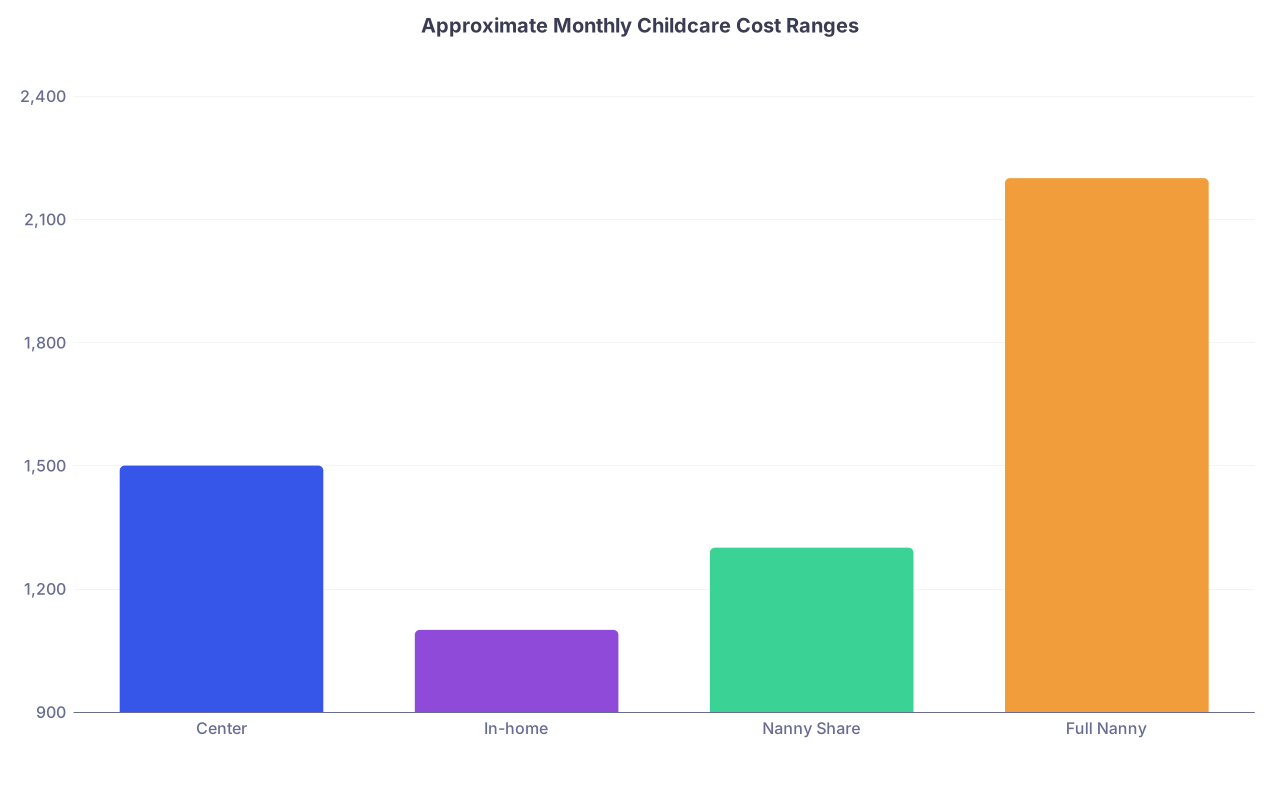
| Category | Value |
|---|---|
| Center | 1500 |
| In-home | 1100 |
| Nanny Share | 1300 |
| Full Nanny | 2200 |
2. Reduce the number of paid hours
This is about logistics, not heroics.
Shift trading with co‑residents: I’ve seen single parents sit down with their chiefs and say, “I cannot do five 6am starts a week with a toddler. Can I batch early shifts certain weeks and get some later starts on others?” Sometimes they say yes. Chiefs are often more human than the system around them.
Co-op with another resident parent: Example:
- You cover their kid one Saturday a month
- They cover one or two late evenings for you
- Both of you reduce paid hours slightly
Align with school schedules (for older kids): If your kid is school‑age, aftercare + occasional sitter is usually cheaper than full daycare.
3. Third‑party help: the stuff nobody in medicine wants to admit they use
You’re a low‑income household with a dependent on paper. That’s not a moral failing. That’s the literal reality of residency salaries.
Check, don’t assume:
State childcare subsidies: Many states have income thresholds that are higher than you think, especially adjusted for family size. You might qualify, especially early in residency.
Dependent Care FSA (through your GME benefits):
- Lets you pay up to $5,000/year of childcare with pre‑tax dollars.
- That’s effectively a 20–30% discount depending on your tax bracket.
Head Start / Early Head Start (for preschool-aged kids): Half‑day programs that can dramatically cut hours you’re paying full rate.
Hospital hardship funds: Some large systems quietly run employee emergency funds or childcare grants. You usually have to:
- Know they exist
- Be willing to fill out an annoying application

Step 6: Taxes, Credits, and Not Leaving Free Money on the Table
Single parent + resident pay + childcare = tax advantages. If you ignore them, you’re throwing away cash.
Key items to look at (with a real tax professional if you can, or good software at minimum):
Head of Household filing status: If you’re unmarried and your child lives with you more than half the year, you probably qualify. Usually better than Single.
Child and Dependent Care Credit:
- You get a credit for a portion of work‑related childcare expenses up to a certain limit.
- Credit = directly reduces your tax bill, not just your taxable income.
Child Tax Credit: Basic one, but don’t assume your software or HR “got it right.” Actually confirm you’re getting what you qualify for.
Student loan interest deduction:
- Up to $2,500 of student loan interest can be deducted above the line.
- Even on IDR with small payments, there may be interest accruing (though with SAVE’s interest benefit, it’s trickier; still, check what’s reported).
Tax refunds (or reduced tax owed) in March/April can become:
- A small emergency fund
- A buffer for childcare when your kid gets sick and you need backup care
- Paying down any high‑interest non-federal debt (credit cards, private loans)
Step 7: Private Loans and Credit Cards – Triage, Don’t Ignore
Federal loans have systems built for you. Private loans mostly don’t.
If you have private student loans:
First, see if they offer a residency forbearance or reduced payment program. Some do. Use it if the alternative is going into credit card debt to pay them.
Second, prioritize:
- Stay current enough to avoid default and credit ruin
- Do not overpay private loans while your federal loans are IDR/PSLF eligible and you’re struggling with childcare costs
If you’re choosing between:
- Paying an extra $150/month on a 5% private loan, or
- Not needing a credit card to cover groceries/childcare on a 25% APR card,
You pay the minimum on both and do not let the credit card swell. Once you’re an attending with real money, you can bulldoze the private loans.
Step 8: Emergency Planning: What Happens When Childcare Fails?
Because it will. Provider gets sick. Center closes for a holiday you’ve never heard of. Your kid spikes a fever at 3pm and can’t go back for 24 hours.
You need a Plan B and Plan C. On paper. Not in your head at 4am.
Plan B options I’ve seen work:
- Two reliable backup adults who can:
- Pick up on short notice
- Keep your kid 2–4 hours until you manage coverage
Yes, family is ideal. If you do not have family nearby:
Find a local sitter service and vet 1–2 people early, not in crisis.
Ask co-residents for sitter recommendations. Almost every program has a Word doc or group chat for this.
Talk to your chief / PD now, not mid-crisis:
- “I am a single parent with limited backup childcare. If my kid is sick and can’t go to daycare, what are the expectations and options?”
- Some programs will give you more flexibility than you think. Others won’t. But at least you know the terrain.

| Step | Description |
|---|---|
| Step 1 | Childcare fails |
| Step 2 | Call daycare for policy |
| Step 3 | Check work schedule |
| Step 4 | Contact backup adult 1 |
| Step 5 | Arrange pickup |
| Step 6 | Contact backup adult 2 |
| Step 7 | Notify chief about coverage |
| Step 8 | Use sitter list or swap with co resident |
| Step 9 | Confirm coverage and go to work |
| Step 10 | Kid sick or center issue |
| Step 11 | Available? |
| Step 12 | Available? |
You are not “unprofessional” for having a sick child. You are unprofessional if you repeatedly disappear without a contingency plan. So build the plan.
Step 9: Mindset: You Are Not Trying to Win the Debt Olympics in Residency
Here’s the trap I see single parents fall into:
- “I have so much debt, I should at least pay extra on my loans.”
- “It’s irresponsible to use IDR and pay ‘so little’.”
- “Everyone else seems to manage daycare and rent; I should too.”
No. Stop.
You are in survival + positioning mode, not optimization mode. Your real earning years start after residency. That’s when you can:
- Reassess PSLF vs. refinance
- Start actually attacking principal
- Upgrade your housing
- Rebuild savings
During residency, your goals are:
- Keep your loans in good standing on the cheapest legitimate payment plan
- Finish training without drowning in high‑interest consumer debt
- Maintain reasonably stable childcare so your kid isn’t constantly whiplashed by chaos
Your “extra payment” for now is showing up for work, finishing residency, and not burning out to ash.

Step 10: When You Have 60 Minutes Free, Do This Exact Sequence
If you’re overwhelmed, here’s a concrete hour-long workflow.
15 minutes – Loans
- Log in to studentaid.gov
- Check your repayment plan.
- If you’re not on SAVE or another IDR, start the application.
- If PSLF is relevant, start/submit the PSLF form.
15 minutes – Childcare cost check
- Pull your last 2 months of childcare payments.
- Calculate true average monthly cost.
- Email or message:
- HR to ask about dependent care FSA or childcare subsidies
- One alternate childcare provider (hospital daycare, in-home, nanny share board) just to see rates.
15 minutes – Tax + benefits list
- Write down:
- Filing status
- Number of dependents
- Whether you’re using a Dependent Care FSA
- Make a note: “Ask tax person or software about Child and Dependent Care Credit, Child Tax Credit, student loan interest deduction.”
- Write down:
15 minutes – Backup plan
- Text one local friend / co-resident:
- “Can I list you as an emergency pickup contact? I’m happy to be yours too.”
- Save at least one sitter contact or service in your phone.
- Put your chief’s number and your daycare’s number in a pinned note: “Childcare emergency script.”
- Text one local friend / co-resident:
Your Next Move Today
Do one concrete thing, not five.
Open studentaid.gov, log in, and check your current repayment plan.
If it’s not an income-driven plan, start that application now and list your child as a dependent. Your childcare bill is already high. There’s no reason your loan payment should be too.