
It’s June. You’re staring at your med school loan portal after a brutal call night. The number at the top is so big it barely looks real: $320,000. Maybe more. You’ve just signed your residency contract, and a thought hits you like a bus:
“What are program directors really thinking when they see how much debt I have? Am I a walking financial liability? A flight risk? Do they care at all?”
Let me answer that the way attendings talk in a closed-door faculty meeting. Not the polished “we consider the whole applicant” line you hear at info sessions. The real version.
First truth: your exact debt number is mostly invisible — but your relationship with money is not
Let’s start with the blunt reality.
Program directors do not get a neat little column in ERAS that says:
Debt: $317,492
Interest: 7.2%
There’s no standardized “debt” field that shows up in the way Step scores or clerkship grades do. In the formal file, your precise loan burden is usually unknown.
But here’s the catch: while they do not see the number, they see your behavior around it. And that matters far more than most students realize.
Where they see clues:
Your ERAS “Education” and “Activities” sections
Private med school with no scholarship. No meaningful family support. Heavy moonlighting during M3/M4. They start connecting dots.Your interview answers
When they ask, “How are you thinking about finances or loan repayment during residency?” and you either panic, joke, or sound completely naive.Your geography and specialty choices
You’re from California, trained in New York, applying to low-paying academic primary care in the Midwest with $400k in loans and no spouse income. They immediately wonder, “How long will this person actually stay?”Your personal statement tone
Some statements ooze quiet desperation: “I grew up poor, I took on enormous loans, I must match into derm or ortho so I can support my family.” They do not say it that directly, but faculty can read between the lines.
So no, they’re not sitting with your loan spreadsheet. But they absolutely form an impression of whether you’re someone who:
- Understands money
- Can tolerate delayed gratification
- Will make rational — not panicked — financial decisions over the next 3–7 years
And that impression does influence how safe or risky you look as a resident.
The three mental buckets PDs secretly put you in
Directors won’t say this on a podcast, but in many programs, applicants end up in one of three unspoken “financial stability” buckets.
| Bucket | How You Come Across |
|---|---|
| Stable | Loans manageable, plan in place |
| Stretched | High debt, but realistic and organized |
| Volatile | High debt, anxious or unrealistic |
Let’s unpack them.
1. The “Stable” applicant
You might have $250–$350k in loans, but you look composed and grounded about it.
You say things like:
“Yeah, my loans are substantial, but I’ve looked into REPAYE/PSLF. My goal is academic medicine, and I’m comfortable living pretty lean for a decade. I’ve talked with current residents about what’s realistic.”
They love this. They see someone who:
- Knows they’re in deep but isn’t flailing
- Has at least skimmed a student loan servicer website
- Won’t freak out and demand a massive salary or moonlight unsafely to make payments
This is the person PDs tag as: “Financially mature. Not going to implode halfway through PGY-2.”
2. The “Stretched but realistic” applicant
This is the majority. Debt is large — often $300k+ — and your face tightens when money comes up, but you’re still grounded.
You might say:
“I’ll be honest, loans are a big source of stress. I’ve met with financial aid and I’m planning to enroll in IDR, probably SAVE. I know private practice may be more realistic for me longer term.”
Faculty see someone who’s anxious but not delusional. That’s fine. They all remember being in this boat. Some still are.
The key here is your plan. Not whether it’s perfect. Whether it exists at all.
Programs don’t expect you to be a financial expert. They do expect you not to be a financial child.
3. The “Volatile” applicant
This is the one PDs worry about. High debt + magical thinking.
Comments that set off alarms:
“I’ll pay all this off in like 5–7 years easy. I’m planning on a high-paying job right out of residency.”
“I don’t really think about the loans. I just assume something like forgiveness will happen by then.”
“My plan is to just live with my parents and throw everything at the debt.”
They’ve heard versions of this, verbatim. And in closed-door discussions, faculty say things like:
“He has no idea how repayment actually works.”
“She’s banking on PSLF but wants to do concierge eventually. That doesn’t line up.”
“He kept mentioning needing money every other sentence. That worries me for call coverage and moonlighting.”
They are not judging that you have high debt. They are judging that your thinking around that debt is unstable. That’s what spooks them.
How different specialties actually think about massive debt
Debt is not interpreted uniformly. A PD in family medicine is reading your massive loans differently than a PD in neurosurgery.
Here’s the behind-the-scenes breakdown.
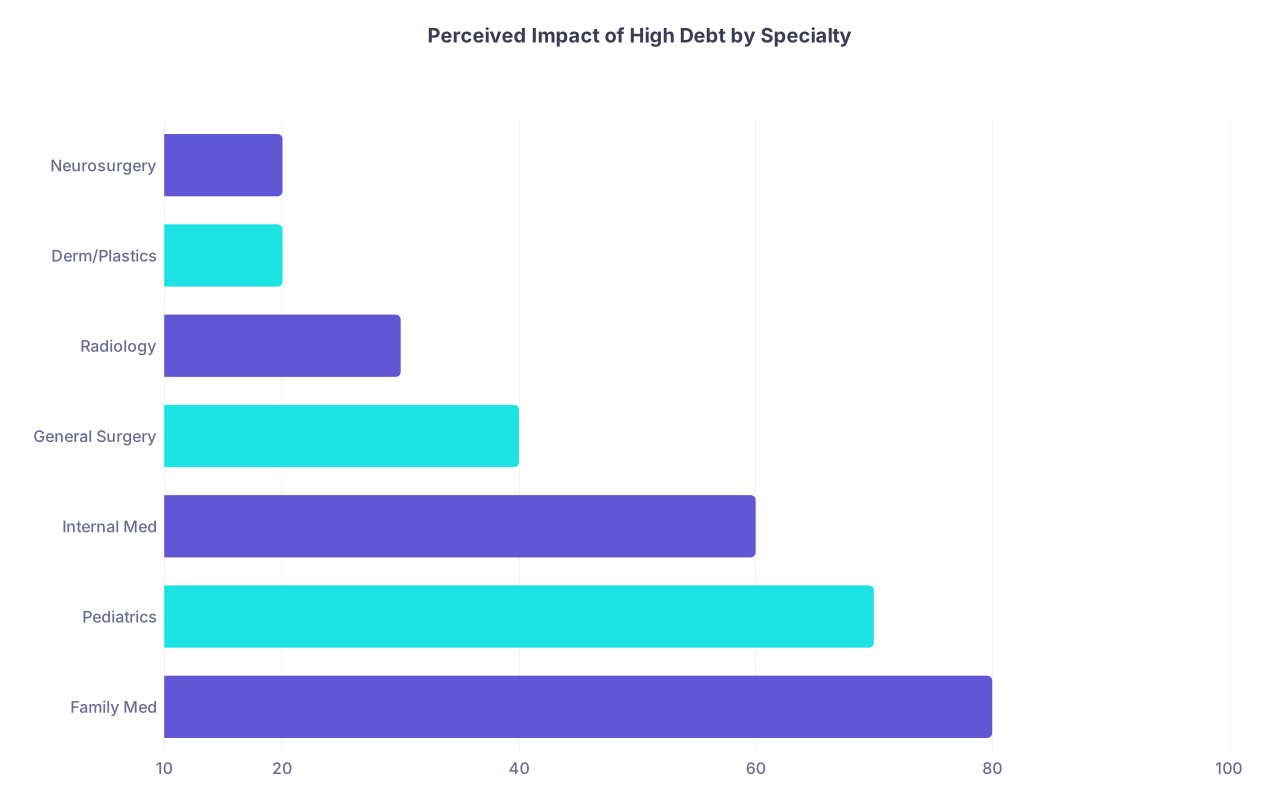
| Category | Value |
|---|---|
| Family Med | 80 |
| Pediatrics | 70 |
| Internal Med | 60 |
| General Surgery | 40 |
| Radiology | 30 |
| Derm/Plastics | 20 |
| Neurosurgery | 20 |
(Values are a rough “how much they worry” score out of 100, not some published metric.)
Primary care and lower-paying fields
Think FM, peds, psych, geriatrics, some academic IM.
These PDs know their salary offers cannot compete with orthopedics or interventional radiology. They are painfully aware many of their residents are underwater financially.
So they tend to see massive loans as:
- A retention risk
- A burnout amplifier
- A pressure to leave academics for pure RVU-driven clinic jobs as soon as you graduate
Conversations in faculty meetings sound like:
“She wants academic pediatrics, but she’s graduating with $420k in debt. Is she really going to stay?”
“He mentioned wanting PSLF but also hinted at moving to private practice ASAP. This worries me.”
If you’re going into a lower-paying specialty with very high loans, you do not need to hide it. You need to show you understand what you’re signing up for.
The quiet fear is: “Will this person be so financially squeezed they cut corners, moonlight in ways that hurt performance, or bail after PGY-2?”
Competitive, high-paying specialties
Derm, ortho, rad onc, plastics, neurosurgery, IR-heavy paths.
Here, huge loans are almost a non-factor. Cynical but true.
Many of the attendings in these fields paid off $300–500k themselves with a few years of attending income. They know the math. They know:
“Yeah, she’s gonna be fine. One or two years in private practice and those loans are toast if she wants them to be.”
Their concerns around debt are different:
- They worry about entitlement (“I’m doing this to get rich”).
- They worry about poor professionalism because you see the whole thing as a transaction.
- They worry you’ll bolt to a pure cosmetic or cash practice and never teach or do any academic work.
But the debt number itself isn’t the issue. It’s whether you come off as someone chasing dollars more than the specialty’s core work.
Internal medicine and transitional years
In IM especially, PDs have seen every version:
- The financially strapped but realistic person who aims for hospitalist or cards
- The starry-eyed student convinced they’ll be an interventional cardiologist with zero research and weak scores
- The PSLF hopeful who doesn’t realize private practice cards or GI won’t qualify them
Internal medicine PDs specifically look for coherence:
“Your stated interests, your specialty choice, your debt burden, and your long-term plan — do they make sense together?”
If you’re $450k deep and say you want to do rural primary care and are adamant you’ll pay every dollar off in 7 years without any forgiveness or side money, they know you haven’t done the math. And that makes them nervous.
What PDs actually talk about on Zoom when you’re not there
Let me pull you into a real-style post-interview discussion. You’ll never hear it verbatim, but this is the flavor.
Candidate A:
- $350k+ implied debt (privately funded, no scholarships, older student)
- Wants academic peds
- Talks frankly about PSLF, income-driven repayment, realistic time horizon
- Says, “I know it will be tight, but this is the work I want to do.”
Candidate B:
- Similar background and debt
- Talks about money constantly: “I need to pay this off fast,” “I’ll probably have to moonlight every chance I get,” “I don’t know how I’ll manage on a resident salary.”
- No clear understanding of IDR, PSLF, or what residents actually make
The debrief comments will sound like:
“A has thought this through. She’s not thrilled about the loans, but she’s grounded.”
“B worries me. He seems panicked. We’ve had residents like that; they start picking up unsafe amounts of moonlighting and their performance tanks.”
No one says, “Reject them, their loans are too high.”
They say, “Reject them, their relationship to their loans is unstable and that’s going to bleed into their residency performance.”
That distinction matters.
The PSLF and IDR elephant in the room
Here’s the quiet truth: a lot of PDs only vaguely understand the modern student loan landscape. The rules have changed enough that what was true when they trained is no longer true.
But they do know a few key things:
- PSLF exists and is real for many hospital-employed or academic docs
- Income-driven repayment means residents are not paying $4,000/month
- Massive balances can sit there for years without destroying your day-to-day life if managed properly
Where applicants screw themselves is when they clearly have no idea how any of that works.
On interviews, I’ve heard residents ask questions like:
“Do your residents usually refinance during training or stay on IDR for PSLF?”
That’s a good question. It shows you know the vocabulary, even if you’re still learning the details.
Bad is:
“I’m trying to pay as much as I can during residency so I can get this down quickly.”
Faculty know residents don’t make enough to do that without blowing up their own quality of life or taking on insane extra shifts. The PD might not correct you in the room, but later they’ll say:
“They really have no idea how tight residency finances are. That’s going to cause stress.”
What they want to see is not that you know every acronym, but that you aren’t operating on magical thinking.
The rural, community, and “flight-risk” problem
Community and rural programs are more debt-paranoid than big brand-name academic giants. Not because they care how many zeros you owe. Because they worry you’ll treat their program as a stepping stone, then bounce for a bigger paycheck.
Conversations in those PD offices include:
“He’s drowning in loans and keeps mentioning wanting to get back to the city. If we hire him, what are the odds he actually stays in this town?”
“She’s got $400k in loans and 3 kids. Do we believe she’s going to be happy long-term in a low-volume critical access hospital?”
High debt + clear desire to be in a high-cost city + applying to low-cost, lower-paying areas = red flag.
That doesn’t mean you shouldn’t apply. It means your story has to make geographic and financial sense.
If you’re going to a rural program, you better be able to convincingly explain why you’re not just killing time there until your loans scare you back to a big urban job.
How to talk about your debt like a grown professional
You can’t erase your loan balance. You can control the way it shows up in your story.
If debt comes up — and often it will indirectly — here’s how to sound like a resident, not a panicked M2.
First, stick to three principles:
- Acknowledge reality without drama
- Show you’ve looked into at least the basics (IDR, PSLF, realistic salary expectations)
- Tie your financial plan to your actual specialty and life goals
Examples of solid answers:
On an IM interview:
“My loans are significant, like many of my classmates, but I’ve run numbers on income-driven repayment. For me, an academic or hospitalist path that qualifies for PSLF makes sense, and I’m comfortable living modestly for a while. It’s not ideal, but it’s not driving my specialty choice.”
On a peds interview in a low-paying region:
“Pediatrics isn’t the most lucrative field, and I’m very aware of that. I’m planning to stay on IDR through residency, and long term I’m interested in academic or hospital-employed pediatrics where PSLF is realistic. I’ve accepted that my lifestyle will be pretty lean for a while, but I’m okay with that tradeoff.”
On a competitive, high-paying specialty:
“I do have substantial loans, but they’re not the reason I chose this field. I was interested in [specialty] long before med school. I’m aware that financially I’ll have options later to pay them down aggressively, but right now my focus is training well and not overextending myself during residency with extra work.”
Notice what these have in common:
- No specific dollar amount mentioned (not necessary)
- No whining
- No jokes about “selling my soul” (attendings hate that line more than you think)
- A clear signal that you’ve thought beyond next month’s rent
Where people lose points is with joking cynicism or obvious desperation:
“I just need to match something that pays, I can’t be broke my whole life.”
I’ve watched PDs write that exact quote down and circle it. Not in a good way.
One thing that matters more than your debt: are you going to chase money during residency?
Program directors have a much bigger and more concrete fear than your $400k principal balance:
You taking on so much outside work that your training suffers or patient care becomes unsafe.
This is where “massive debt” really hits the radar. PDs have seen this story:
- Resident comes in with huge loans and talks constantly about money.
- As soon as allowed, they pick up every moonlighting shift within 100 miles.
- Their performance during the day falls apart. They’re exhausted, behind on notes, cutting corners on learning.
- They start to resent mandatory clinic or didactics because “those hours don’t pay.”
That’s the nightmare scenario. Not your loan number. Your behavior in response to it.
So when you talk about your finances, you want to implicitly reassure them:
- You are not planning to burn yourself out chasing extra income.
- You understand residency is not the time to heroically “crush your loans.”
- You’d rather finish strong and have a long, stable career than squeeze every side dollar out of PGY-3.
If they sense you view residency primarily as a low-paid hazing ritual standing between you and “real money,” they’ll be wary.
How much debt is actually “too much” in their minds?
Here’s the uncomfortable truth: for most PDs, there is no fixed number that crosses a red line. They’ve seen:
- $150k and totally dysfunctional
- $500k and shockingly calm and organized
What shifts their perception is not the number, but the ratio of:
- Debt size
- Anticipated long-term specialty income
- Your clarity about repayment strategies
A $480k debt load going into dermatology is psychologically different to a PD than $480k going into outpatient geriatrics. They know that. They won’t put that in writing, but they talk about it.
They’re not doing actuarial tables. They’re making a gut call:
“Does this person understand the financial reality of the path they’re choosing, and will they still function as a good resident under that pressure?”
If the answer is yes, your “massive” loan burden stops being the headline problem and becomes background noise.
You, not your balance, are being evaluated
Programs are not banks. They’re not underwriting you. They’re not looking at your loan balance and calculating default risk.
They’re looking at you as:
- A future colleague
- A trainee they’re about to pour hundreds of thousands of dollars of attending time into
- Someone who will represent their program when you graduate
Massive debt only matters to the extent that it destabilizes that picture.
If you look like someone who:
- Has stared the number in the face and recovered
- Knows roughly how the federal repayment system works
- Has matched your specialty choice to some semblance of financial realism
- Won’t spend all of PGY-2 obsessing about side hustles
Then your debt is largely neutral in their minds.
If, instead, you look like someone who:
- Has never actually thought beyond “I’ll figure it out later”
- Is already visibly resentful about being “underpaid” as a resident
- Ties every life decision back to money in conversation
Then yeah, your massive loans become a serious concern. Not because they’re high. Because you are clearly drowning in them psychologically.
Key takeaways:
- Program directors rarely know your exact loan balance, but they absolutely read how you think and talk about money — and that shapes whether you look stable or risky.
- Debt size matters far less than whether your specialty choice, long-term plans, and basic understanding of repayment actually make sense together.
- The real red flag is not the number; it’s behavior: desperation for money, unrealistic payoff fantasies, or plans to over-moonlight during residency. If you can show grounded, adult-level thinking about your loans, even a “massive” balance won’t be the thing that sinks you.