
You: Matched, Relieved… and Financially Terrified
You just matched into a great program. Maybe it’s UCSF, NYU, MGH, Northwestern, or another big-name place in a brutally expensive city. Your group chat is buzzing about housing, someone just dropped a photo of a 400 sq ft studio for $2,800, and you quietly minimize your loan servicer tab showing $320,000 at 7%. Or $450,000. Or more.
You’re doing the math in your head:
- PGY‑1 salary: ~$60–75k before taxes
- Rent: stupid
- Loans: enormous
- And people keep telling you “it’ll be fine in attending life.”
You’re not worried about attending life. You’re worried about not going broke for the next 3–7 years.
This is the survival plan for right now — matched in a high-cost city with huge loans. How to not drown, not get scammed, and set yourself up so that when you finally get attending money, you’re not untangling five years of bad financial decisions.
Step 1: Lock in Your Big-Picture Strategy Before Orientation
Most residents drift into whatever their loan servicer suggests. That’s how you burn 5–6 figures unnecessarily.
There are only three real paths you’re choosing between:
- Public Service Loan Forgiveness (PSLF) path – maximize forgiveness
- Non-PSLF income-driven repayment (IDR) with long-term forgiveness at 20–25 years
- Aggressive payoff – plan to kill the debt within ~10 years of graduation
You need a working hypothesis now. It can change later, but drifting is how you overpay.
Quick Triage: Which Lane Are You Probably In?
| Situation | Likely Best Path |
|---|---|
| 300k+ federal loans, academic/nonprofit residency + likely nonprofit attending | PSLF-focused IDR |
| 300k+ loans, academic residency but planning private practice | IDR with possible long-term forgiveness or aggressive payoff later |
| <150k loans, good earning specialty, okay with lean years | Aggressive payoff after training |
| Mixed federal/private loans | Federal → IDR; private → refinance strategy later |
You’re in a high-cost city on resident salary. That means right now:
- You almost certainly need an income-driven repayment (IDR) plan, not standard 10-year.
- If your hospital is a 501(c)(3) or government employer (most big academic centers are), PSLF should be strongly on the table.
If there’s even a 30–40% chance you’ll work for a nonprofit after training, you act as if you’re doing PSLF from day one. You can always abandon PSLF later. You cannot retroactively count years you didn’t set up correctly.
Step 2: Get Your Loan File Clean and PSLF-Eligible (or IDR-Ready)
Before you touch housing, cars, furniture — you handle the loans. Because these decisions last 10–25 years.
1. Identify Exactly What You Have
Log in to each of the following:
- studentaid.gov – this is the source of truth for federal loans
- Every private lender (SoFi, Laurel Road, Sallie Mae, etc.)
Make a simple list:
- Loan type (Direct Unsub, Grad PLUS, Perkins, FFEL, private)
- Interest rate
- Balance
If you see older FFEL or Perkins loans and you’re considering PSLF, those must be consolidated into a Direct Consolidation Loan to be PSLF-eligible.
2. Convert to Direct Loans if Needed (PSLF People)
If you’re PSLF-curious, do this early:
- Use the Direct Consolidation Loan app on studentaid.gov
- Only consolidate federal loans
- Do not touch private loans in this process (they can’t be PSLF-eligible anyway)
Do this before you start repaying as an intern if possible. Consolidation can reset some IDR clocks, and you want all your PSLF-eligible loans under one roof.
3. Pick the Right IDR Plan (Not Just the Default)
Today the main players are:
- SAVE (the new REPAYE replacement) – currently the best for most residents
- PAYE – legacy, occasionally useful if you’re protecting future capitalized interest
- IBR – mostly a backup plan now
For 99% of high-debt residents:
- Choose SAVE unless you have a niche reason not to. It:
- Caps payment at a small % of discretionary income
- Has built-in interest subsidies that prevent balances from exploding
- Is PSLF-qualifying
Submit the IDR application on studentaid.gov. Use your PGY‑1 projected income, not your MS4 tax return if that shows $0 or very low. The servicer may initially base it on your last filed taxes; you can submit paystubs or contract to have it recalculated.
4. If PSLF Is On the Table – Start the Clock Immediately
You want every single year of residency to count.
- Confirm your employer is a qualifying 501(c)(3) or government entity
- Submit the PSLF form (Employment Certification Form) right after you start:
- You and HR fill it out
- Send to MOHELA (PSLF servicer)
- Repeat yearly or when you change employers
Every month you’re:
- On a qualifying IDR plan
- Paying at least the required amount
- Employed full-time by a qualifying employer
…that’s 1/120 towards tax-free forgiveness. Do not wait until PGY‑3 to “get around to it.”
Step 3: Build a Brutally Honest PGY‑1 Budget (Specific to High-Cost Cities)
You cannot “vibe” your way through SF or NYC on a resident paycheck. The city will eat you alive.
Let’s build a realistic skeleton budget for a PGY‑1 in a high-cost city. Ballpark numbers:
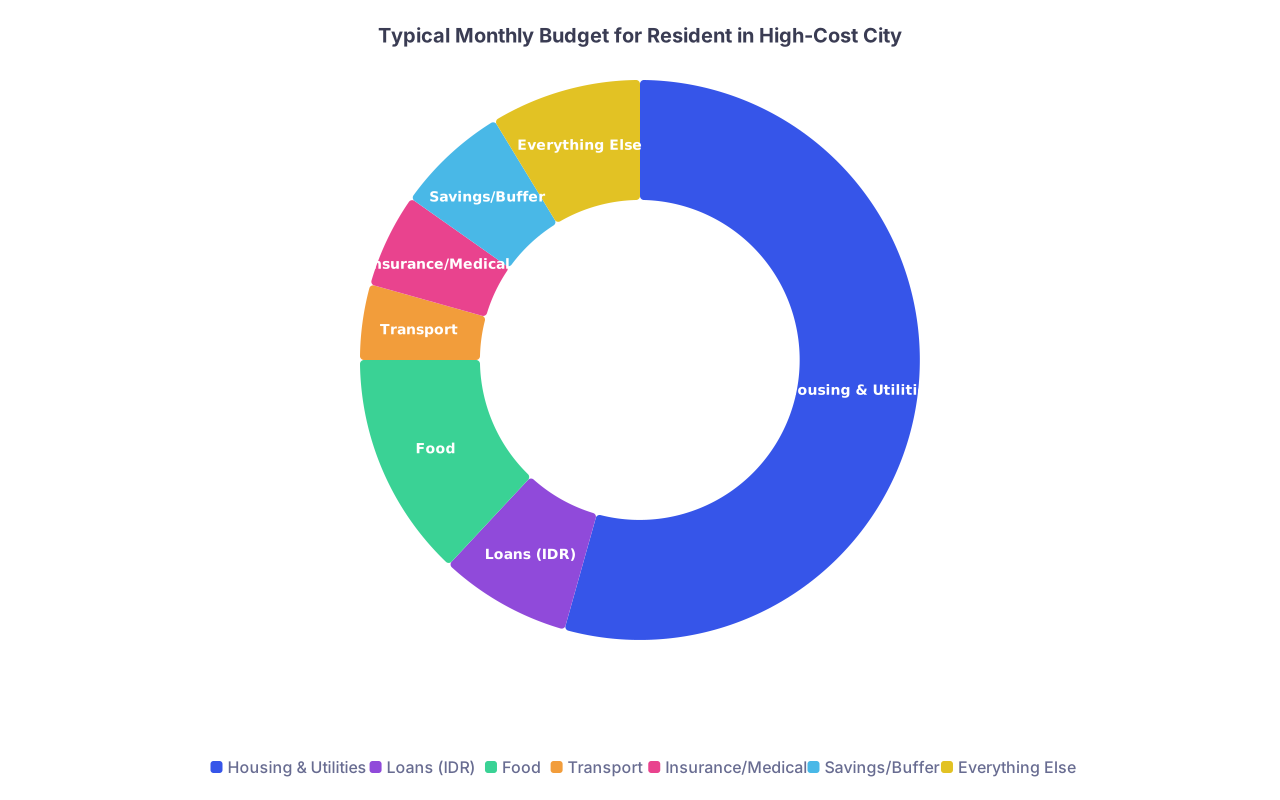
| Category | Value |
|---|---|
| Housing & Utilities | 2500 |
| Loans (IDR) | 350 |
| Food | 600 |
| Transport | 200 |
| Insurance/Medical | 250 |
| Savings/Buffer | 300 |
| Everything Else | 400 |
Assume:
- Gross: ~$5,200/month (62k/year)
- Net after taxes/benefits: ~$3,600–3,900/month (varies by city and withholdings)
Housing: Your #1 Lever
You can’t control your interest rate much. You can control your rent.
Target: No more than ~40–45% of take-home in high-cost cities, even if that feels tight.
With ~$3,700 take-home:
- Housing target: $1,500–1,700 ideal, $2,000 absolute max
- Reality for many big cities:
- Solo studio: $2,400–3,000
- Room in shared place: $1,200–1,800
You already see the answer: you probably cannot live alone in a luxury building and not bleed cash.
Strategies that actually work:
- Co-resident housing – 2–3 residents share a 2–3 BR in a non-fancy building near transit
- Live one transit zone out: Brooklyn instead of Manhattan, Oakland instead of SF, Somerville/Chelsea instead of central Boston
- Hospital-owned or affiliated housing if priced below market (run the actual numbers)
If your rent alone equals half or more of your take-home, everything downstream becomes painful.
Non-Negotiable Line Items
- Loan payment (IDR): maybe $0–400/month as an intern depending on income and family size
- Insurance/benefits:
- Disability insurance (if not provided): you need your own policy eventually; in PGY‑1 at least know the price and plan to get it soon
- Maybe small life insurance if you have dependents
- Food: You’re working a ton. You will eat out some. Be honest:
- “Barely trying”: $500–600/month
- Fully chaotic: $800–1,000/month
Build the Framework
You want something roughly like:
- Housing + utilities: $1,500–1,900
- Loans (IDR): $0–350
- Transport (subway, gas, Uber): $150–250
- Food: $500–700
- Phone + internet: $120
- Subscriptions/other: $100–150
- Insurance, meds, copays: $150–250
- Everything else (clothes, emergencies, flights home): $300–400
This structure leaves $200–400/month free in a good month. That buffer is your lifeline. It prevents credit card debt.
Step 4: What To Actually Do With Your Loans During Residency
Here’s the part where people mess up: “I’ll just forbear for residency and figure it out as an attending.”
That’s a disaster move if you’re PSLF eligible or using IDR.
Hard Rules
Do not use forbearance or deferment during residency unless you absolutely have no other option. Forbearance:
- Stops payments
- Interest keeps accruing and capitalizing
- Does not count towards PSLF or long-term IDR forgiveness
Make the minimum IDR payment. Even if it’s $0, those months can still count for PSLF and long-term forgiveness.
Do not refinance federal loans to private while in training if PSLF or IDR forgiveness is even remotely possible. You can refinance later. You can’t un-refinance.
PSLF-Focused Resident: Your Playbook
If you’re at a nonprofit hospital and think you may work in academic medicine / VA / FQHC / big nonprofit system later:
- Get on SAVE
- Lock in the smallest legal payment (recertify income annually, use your accurate resident income)
- Certify employment every year with PSLF
- Don’t panic about the growing balance; your job is to collect qualifying payments, not kill the loan
PGY1–3 (or 5):
- Make IDR payments (~$0–200/month as PGY‑1, more later)
- Keep records: PSLF forms, paystubs, annual recertification screenshots
- At the end of residency/fellowship, you’ll have:
- 3–7 years of PSLF credit
- 3–7 years of artificially low payments
After training:
- If you take a nonprofit attending job: keep riding PSLF; aim to hit 120 months and be done.
- If you go private: PSLF’s dead; you re-evaluate — maybe refinance & pay off aggressively.
Non-PSLF Resident: Your Playbook
If your employer isn’t nonprofit or you’re sure you’re going private:
You still almost always want IDR during residency, especially SAVE, because:
- Payments are low when your income is low
- Interest subsidies keep the balance from exploding
- You preserve optionality — long-term forgiveness or aggressive payoff
Your options:
- Do bare-minimum payments during residency (protect cash flow) and decide as an attending:
- Refinance and crush the loans in 5–10 years
- Or stay in IDR and pursue 20–25-year forgiveness (watch out for future tax bomb rules)
The crucial part: don’t let unpaid interest snowball unnecessarily when SAVE’s subsidy could be contained. For many high-debt residents, SAVE keeps interest growth much lower than old plans.
Step 5: Avoid the High-Cost City Money Traps
Big coastal cities are built to separate you from your paycheck. As a tired resident, you’re the ideal target.
Top traps I’ve watched residents fall into:
Trap 1: “I Deserve a Safe, Nice Place” → $3k Solo Apartment
You do deserve safety. You do not need floor-to-ceiling windows and a Peloton room in the building.
Practical compromise:
- Prioritize:
- Safety
- Reasonable commute (30–45 min door-to-door)
- Access to 24/7 transit or safe parking
- Sacrifice:
- Amenities
- New construction
- Living alone if rent is insane
If rent pushes your budget into credit card territory, that “safe, nice place” becomes financially unsafe.
Trap 2: Car in a City That Hates Cars
If you’re in NYC, Boston proper, SF city, central Chicago, etc.:
- Parking: $250–500/month
- Insurance: $150–250/month
- Gas + maintenance: $100–200/month
That’s $500–900/month to own a headache you barely use if you live near the hospital.
Run this decision by numbers, not by emotion. Many residents:
- Live near transit
- Zipcar/ride-share for occasional big trips
- Borrow/rent a car for off-site rotations
If your program truly requires a car (some do), then fine — but get the cheapest reliable used car you can. This is not Tesla season.
Trap 3: Lifestyle Creep in Scrubs
Attending “treat” mindset starts early:
- Fancy coffee twice a day
- Seamless/UberEats as default
- Vacation FOMO due to co-residents going to Tulum
You don’t need to live like a monk, but you do need one or two guardrails. For example:
- One delivery meal per call night, not three
- One proper trip/year, not four
- Cap eating out to X meals/week
A simple rule I’ve seen work: if you’re putting anything on a card you can’t pay off in full that month, your lifestyle is already too big for your salary.
Step 6: Insurance, Legal, and “Adult” Stuff You Can’t Ignore
It’s annoying. You’re tired. But this is where small decisions protect you from disasters bigger than student loans.
Disability Insurance
Your future attending income is your main asset. If you get sick/injured and can’t work in your specialty, those loans aren’t going away.
- Get own-occupation disability insurance as early as possible in residency:
- Some programs offer discounted group policies for trainees
- Many residents lock in a personal policy PGY‑2 or PGY‑3 while healthy and young
- Do not rely solely on your hospital’s group coverage; it’s usually weak and not portable
If you have to wait a year for cash-flow reasons, at least get quotes so you know what you’re aiming at.
Life Insurance
Only if:
- You have dependents
- Or someone co-signed your loans or is depending on you financially
In that case: cheap term life. Not whole life. Not some complex “investment” product from a smooth-talking advisor.
Legal Stuff
- Renters insurance: Get it. It’s $10–20/month. Fires and theft aren’t hypothetical; I’ve seen residents lose everything in one event.
- Will/power of attorney: If you have kids, property, or a spouse, look at a basic will and POA. Not urgent PGY‑1, but don’t ignore it indefinitely.
Step 7: Stop Random Financial Advice From Wrecking You
Every residency has That One Co-Resident who “day trades” or “does real estate on the side” or “doesn’t believe in debt” and aggressively explains why you’re doing everything wrong.
Filter advice by:
- Does this person have the same debt load, city, specialty, and life plans as you?
- Do they actually understand PSLF/IDR rules, or are they parroting something from a podcast?
- Do they make money if you follow their advice? (Financial advisors, insurance agents, realtors.)
Reasonable sources:
- Reputable student loan pros (you pay them a flat fee, not a commission)
- Your program’s financial counseling services if they exist
- Well-reviewed books/resources focused on physicians and student loans, not generic “debt-free in 2 years” nonsense
If someone says:
- “Always refinance ASAP, federal loans are garbage” while you work at a 501(c)(3) → wrong for you
- “PSLF is a scam, it’ll never happen” → flatly not supported by reality so far; hundreds of thousands have already received forgiveness
Step 8: What Changes as You Move Through Residency
Your plan is not static.
PGY‑1
- Main goal: Survive and avoid big mistakes
- Actions:
- Choose IDR (likely SAVE)
- If PSLF path, submit first employment certification form
- Lock in housing that doesn’t break you
- Track rough budget for 2–3 months to see leaks
PGY‑2–3
- You have a bit more income. Don’t immediately inflate life.
- Consider:
- Starting a small emergency fund if you haven’t (target: $1,000–3,000 to start)
- Getting individual disability insurance
- Increasing IDR payments only if it doesn’t jeopardize your stability
PGY‑4–7 / Fellowship
- Decisions start to pivot on your post-training plan:
- If strongly leaning academic/nonprofit: double-down on PSLF path; no refinancing
- If 90% sure about private practice: start mapping out aggressive payoff plan and possible refinance timeline
- Use your later PGY years to:
- Clean up any small debts
- Build a real emergency fund (1–3 months expenses by end of training if you can manage it)
Step 9: Mental Framing So This Doesn’t Eat You Alive
The debt is large. The city is expensive. That combination can make you feel like you’re already behind before your first H&P.
Here’s the reframing that helps:
You are not trying to “win” financially during residency. You’re trying not to lose.
If you:
- Avoid credit card debt
- Avoid forbearance
- Avoid blowing PSLF eligibility
- Avoid signing up for fancy stuff you don’t understand (whole life, crazy investments, luxury leases)
…then you’ve already done 80% of what you need to be in a good position as an attending.
You’ll make far more progress in your first 3–5 years as an attending than you ever could as a resident. Your job right now is to:
- Stabilize
- Protect future options
- Not sabotage your future self
Your Next Concrete Step (Do It Today)
Do not “file this away for later.” Later is how people lose PSLF years and pile up interest.
Today, do this:
- Log into studentaid.gov and:
- Download your aid summary
- Count how much is Direct vs other types
- Open a blank note and write in one sentence:
- “Tentative plan: I am / am not likely to pursue PSLF because ______.”
- Based on that:
- If PSLF is on the table: start the Direct Consolidation process if needed and submit an IDR (SAVE) application.
- If not PSLF: still submit an IDR (SAVE) application and plan out how low your payment will be in PGY‑1.
That’s it. Not perfect. Not final. But it moves you from vague dread to an actual plan.
You matched in a high-cost city with huge loans. Fine. Plenty of residents have been exactly there and walked out with forgivable loans, no credit card debt, and a clear path. Start with those three steps today, and you’re one of them.