
You just accepted a research year or decided to take a gap year in the middle of training. The email from the program director is sitting in your inbox: “Approved for 12-month leave for research.” Or you signed a contract for a one-year research fellowship between MS3 and MS4. You’re excited.
Then you remember your loans.
You log in to your servicer. The “in-school” status you’ve been leaning on for years is about to end because you’re dropping below half-time or leaving school entirely. Your stomach drops when you see the standard payment they’re projecting if you go into repayment. There’s no way your research stipend or gap-year job is covering that plus rent.
This is where most people make expensive mistakes. Or freeze and do nothing, which is worse.
Let me walk you through exactly what to do with your loans if you’re:
- Taking an official research year during med school
- Taking a funded/unfunded research fellowship during residency
- Taking a personal gap year (health, family, burnout, visa, whatever)
And you still have big student loans staring you down.
Step 1: Get Clear on Your Actual Status
Before you touch your loans, you need to know how your school or program is reporting you.

You’re likely in one of these buckets:
| Scenario | Typical Status for Loans |
|---|---|
| Med school research year with formal enrollment | Often still at least half-time |
| Med school research year with leave of absence | Not enrolled |
| Funded research fellowship during residency | Graduated, in grace or repayment |
| Personal gap year between MS years | Usually not enrolled |
| Gap after graduation before residency | Grace period or repayment |
Call or email TWO places:
- Your school’s registrar or dean’s office
- Your financial aid office
Ask specific questions, not vague ones:
- “For this research year/leave, will I be considered enrolled at least half-time for federal loan purposes?”
- “Will you continue reporting my enrollment to NSLDS / the National Student Loan Data System?”
- “Will my loans stay in in-school deferment, or will my grace period start?”
- “Do I have to do anything on my end for you to report this correctly?”
Get answers in writing if you can (email is fine). I have seen schools mess this up and mis-report students as withdrawn, which can trigger repayment earlier than you expect.
If you’re in residency: your program generally does NOT control your loan status. You’re out of school. Your options are repayment or deferment/forbearance.
Once you know your status, you’re choosing between four big buckets:
- In-school deferment continues (best case, usually)
- Grace period starts
- Repayment starts
- You apply for deferment/forbearance
Each of these requires a different move.
Step 2: Understand the Core Toolset (Without Getting Lost in Jargon)
You don’t need to know every acronym. You need the 5 tools you will actually use.
| Category | Value |
|---|---|
| In-School | 12 |
| Grace | 6 |
| IDR Plan | 12 |
| Deferment | 12 |
| Forbearance | 12 |
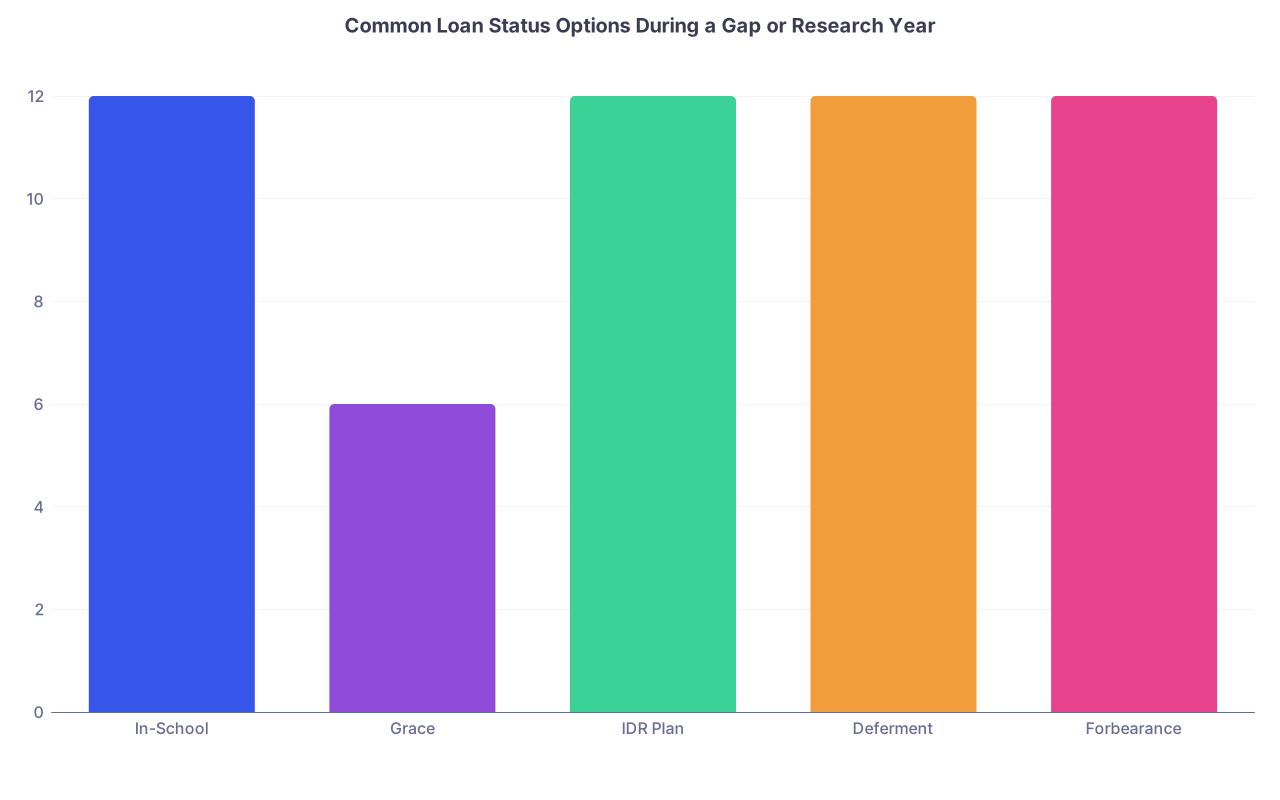
The numbers above are “typical” months you sit in each status during a year-long gap.
Here’s the stripped-down version:
In-school deferment
- You’re enrolled at least half-time.
- No payments required.
- Subsidized federal loans (if you have old ones) don’t accrue interest; unsubsidized do.
- You generally want this if you can get it.
Grace period
- Usually 6 months after you drop below half-time or graduate.
- No required payments, but interest accrues on almost everything.
- You only get one real grace period per loan. Once it’s used, it’s gone.
Income-Driven Repayment (IDR) – SAVE, PAYE, etc.
- Monthly payment based on your income, not the loan size.
- After a year of $0–$200/month payments, you’ll be glad you chose this over “standard.”
- Eligible payments can count toward PSLF and long-term forgiveness.
Deferment
- Rarely relevant in a research/gap year unless you qualify for economic hardship deferment or unemployment. Most physicians-in-training won’t.
- No required payments; interest usually still accrues (except for some subsidized loans).
Forbearance
- “Pause” button. No payments. Interest still accrues and can capitalize.
- Easy to get, often overused, and very expensive in the long run.
Everything you do in this year is moving your loans into one of these five states.
Step 3: If You’re Still Technically Enrolled (Medical School Research Year)
This is the best position to be in, and most students do not use it well.
Scenario A: Official research year, still half-time enrolled
Some schools keep you as “Research Year – Enrolled” or “Special student – Enrolled” while you do a full-time lab or public health project. That usually means:
- Federal loans stay in in-school deferment
- Private loans may or may not; you need to check those separately
Here’s what to do:
- Confirm with the registrar that you’re at least half-time for loan purposes.
- Log in to studentaid.gov and your servicer and check that loans say “In school” or “In-school deferment” after the term starts.
- If you have a research stipend and can afford it, make small voluntary payments:
- Target the highest-interest loans first (usually Grad PLUS or private loans).
- Even $50–$150/month knocks down accumulating interest while you’re protected from required payments.
What NOT to do here:
- Do not ask for a forbearance. You already have a better status.
- Do not ignore private loans; they often do not care that your school considers you enrolled.
Scenario B: Research year as a formal Leave of Absence (LOA)
Some schools treat your research year as LOA. That’s very different.
In LOA status:
- You are not enrolled for federal loan purposes.
- Your grace period probably starts.
- After 6 months, you hit repayment unless you make another move.
If you know you’re going out on LOA:
- Ask your financial aid office exactly when they will report your “less than half-time” status.
- Put a calendar reminder for 4–6 weeks before your grace period ends.
- Decide: do you want to go into an IDR plan right after grace, or forbearance?
If your plan is academic medicine or PSLF-eligible work later, you probably want IDR, not forbearance, so those payments could (eventually) count toward PSLF once you’re at a 501(c)(3).
Step 4: If You’re in Residency Taking a Research Year or Gap Year
This group gets hammered because residency programs don’t protect your loan status at all. You’re a worker, not a student.

| Step | Description |
|---|---|
| Step 1 | Resident taking research or gap year |
| Step 2 | IDR with low or zero payment |
| Step 3 | IDR - maybe SAVE |
| Step 4 | Consider aggressive repayment |
| Step 5 | Throw extra at highest interest loans |
| Step 6 | Stay in qualifying employment if possible |
| Step 7 | Focus on minimizing interest |
| Step 8 | Paid or unpaid? |
| Step 9 | PSLF likely later? |
If your research year is paid (stipend/fellowship)
Let’s say you’re an IM resident taking a T32 research year with a $45–60k stipend.
Here’s the move:
- Put yourself on an IDR plan (SAVE is usually best right now).
- Recertify your income using your actual current income, not last year’s resident salary if it’s lower now.
- If you’re at a university hospital (501(c)(3)) and still technically employed by them, your payments count toward PSLF.
Why IDR instead of forbearance?
- Your payment might be $100–$300/month.
- That keeps you moving toward PSLF or long-term forgiveness.
- Forbearance pauses the PSLF clock and lets interest balloon.
I’ve watched residents lose a full year of PSLF credit because they reflexively hit forbearance during a research year. $100/month vs losing $2–300k of future forgiveness is not a real debate.
If your research year is unpaid or very low income
Example: you moved to a different city for a spouse, you’re doing mostly unpaid research or observerships, and picking up occasional per-diem work.
Do this:
- Enroll in IDR before your grace period (if any) ends, or before your current plan recertifies.
- Use your projected or current income.
- If your AGI is near zero, your monthly payment might literally be $0. And yes, $0 on an IDR plan still counts as a qualifying PSLF payment if you’re otherwise eligible (employer, loan type, etc.).
Only use forbearance if:
- You’re disorganized and staring at a payment due in 10 days with no plan, or
- You’re dealing with a crisis and you just need a 3–6 month pause to function
But if you can handle a form and an upload of your last tax return, IDR beats forbearance 9 times out of 10.
Step 5: If You’re Taking a True Gap Year Outside the System
You stepped away. Burnout, illness, caregiving, immigration headache, reconsidering your entire life. You’re not enrolled. You’re not in residency.
Now your loans do not care about your feelings.
Your choices are straightforward:
- Use your grace period, if you still have it.
- Transition into IDR.
- Forbearance as backup.
| Category | Value |
|---|---|
| Standard 10-year | 1800 |
| SAVE IDR Low Income | 0 |
| Forbearance | 0 |
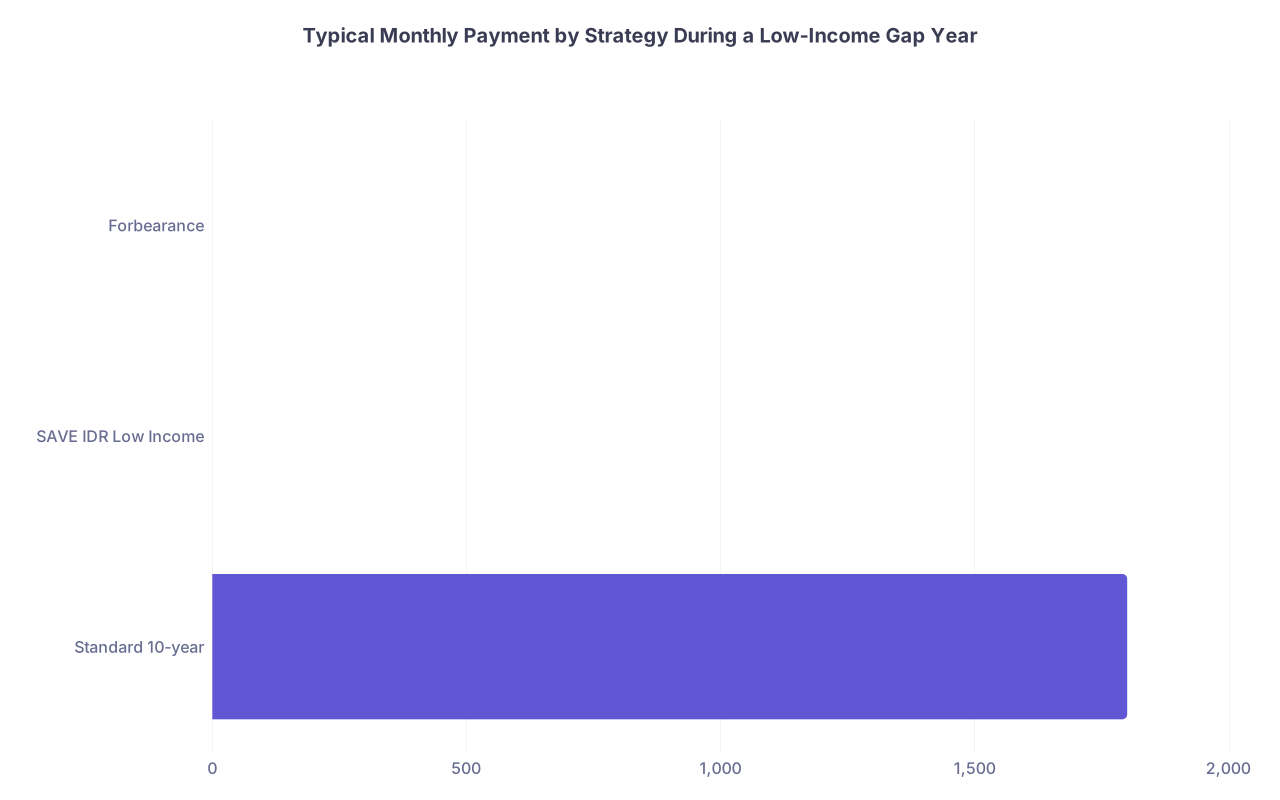
The big difference isn’t this year’s payment. It’s what happens to interest and forgiveness:
- Standard: you pay a fortune you don’t have.
- SAVE/IDR: payment tied to income, progress toward forgiveness.
- Forbearance: no payment, but interest piles up and capitalizes, and you get zero credit toward forgiveness.
If you’re truly out of the system with no employer and no idea what’s next, your order of operations:
- Check your remaining grace period on each loan at studentaid.gov.
- If grace is ending within 2 months:
- Compare IDR payment estimate at the loan simulator on studentaid.gov.
- If affordable (even $0–$100), set up IDR now.
- Only if you cannot get paperwork together or have very chaotic/unpredictable income, use a short forbearance (3–6 months), then revisit.
Step 6: Private Loans – The Annoying Side Quest
Federal loans have rules. Private loans have vibes. And the vibe is “we’d like all of your money, please.”

You cannot assume anything with private loans in a research/gap year. You need to:
- Pull up each private lender account individually.
- Look for:
- Current status (in school, grace, repayment)
- When your payment will start
- What hardship options exist (reduced payment, temporary forbearance, interest-only)
If you’re on a research fellowship with some income:
- See if they’ll let you do interest-only payments for a year.
- That at least keeps the balance from exploding.
If you’re on a true gap with no income:
- Ask explicitly for hardship or unemployment forbearance.
- Ask what happens to interest (hint: it almost always accrues).
- Mark the end date of any approved hardship on your calendar 30–45 days ahead.
Do not:
- Ignore private lenders’ emails. They move to delinquent and default faster than you think.
- Refinance into a lower rate if there’s ANY chance you’ll pursue PSLF or need federal protections later. Once federal becomes private, that bridge is burned.
Step 7: PSLF, Forgiveness, and How Not to Screw It Up
If you might want PSLF, your research or gap year can either:
- Help you (if you stay at a qualifying 501(c)(3) employer on IDR), or
- Stall you completely (if you hit forbearance or move to a non-qualifying employer)
| Category | Value |
|---|---|
| IDR at qualifying employer | 12 |
| Forbearance | 0 |
| Non-qualifying employer | 0 |
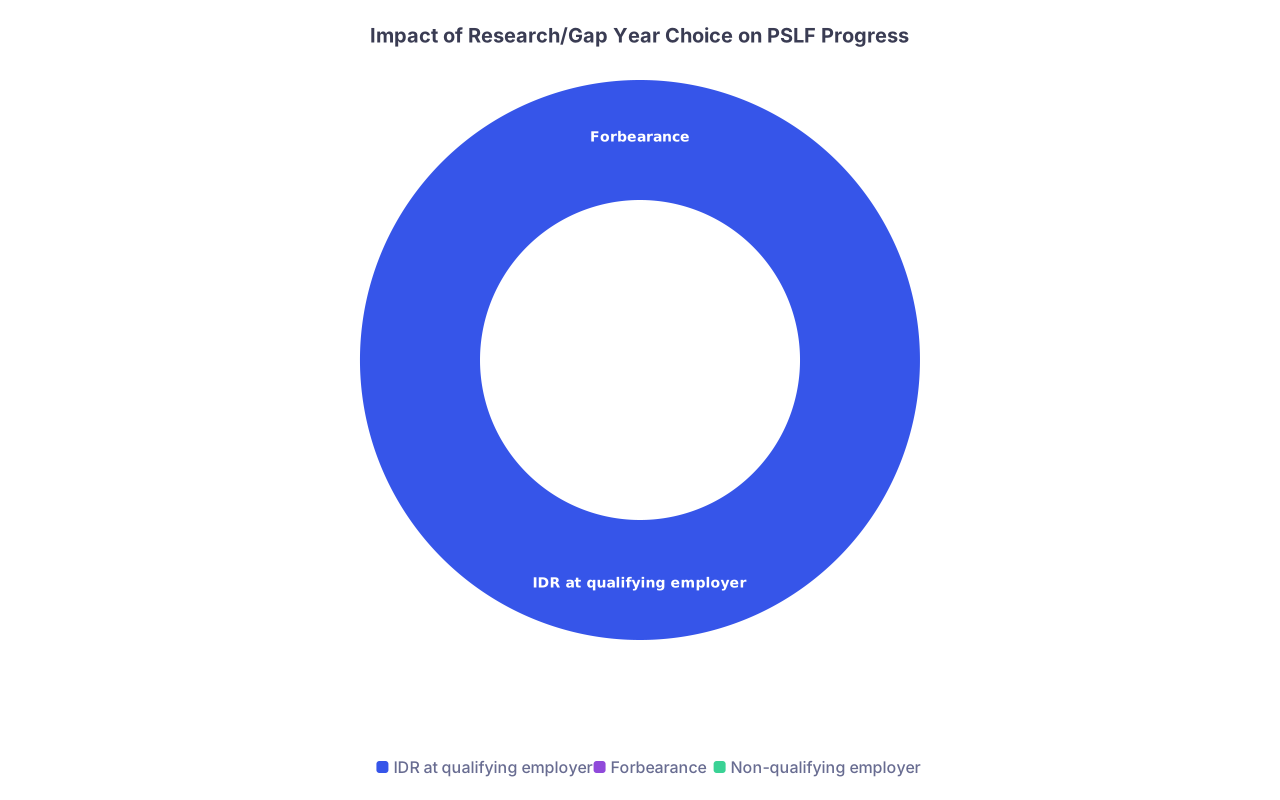
Translation of that “12 months vs 0” graphic: a year on IDR at a qualifying employer is twelve PSLF payments. A year in forbearance or at a non-qualifying employer is zero.
So:
If your research year is at your university hospital or NIH or another 501(c)(3)/government site:
- Make sure HR lists you as full-time employee if possible.
- Stay on IDR.
- File the PSLF employment certification for that year.
If your research/gap year is at a private institution or industry:
- PSLF clock is paused.
- That doesn’t mean you shouldn’t do it—just don’t fantasize that those months count.
If you’re planning long-run forgiveness on SAVE (20–25 years), not PSLF:
- Any year on IDR, even with super low payments, still counts.
- Any year in forbearance does not. That’s the difference.
Step 8: A Simple Playbook by Situation
Let’s compress this into “if this, do that.”
| Situation | Best Default Move |
|---|---|
| Med school research year, still enrolled | Stay in in-school deferment, optionally pay interest |
| Med school LOA research year | Use grace, then IDR (avoid forbearance) |
| Resident, paid research year at 501(c)(3) | IDR, keep PSLF clock running |
| Resident, unpaid research year | IDR with low/zero payments, avoid forbearance if possible |
| True gap year, no clear plan | Use grace then IDR; use short forbearance only if chaos |
Step 9: Tactical Moves That Actually Save You Money
A few higher-yield details that people usually miss:
Interest capitalization traps
Moving from:- Grace → repayment
- Deferment/forbearance → repayment
can trigger capitalization (accrued interest added to principal). That’s a permanent hit. One more reason to minimize forbearance.
Small payments beat zero payments
Even $25–50/month toward your highest-rate loan while you’re in a “protected” status (in-school, grace, low IDR) adds up over a year.Document everything when you’re in flux
When you change status (LOA, research fellow, resigning from residency), keep:- HR letters
- School emails
- Screenshots of your loan status These save you when a servicer miscodes your account.
Do not wait for them to tell you
Servicers are reactive and often wrong.
If you know your grace ends in January, apply for IDR in November. Not on January 28th when your first bill is due February 1st.
Step 10: One Concrete Example
You’re a PGY-2 in internal medicine. You want to do cardiology and just landed a one-year research fellowship at your academic hospital. Stipend: $52k. You have $280k in federal loans at ~6.5%.
Here’s the smart play:
- Stay employed by the same 501(c)(3) system as a “Research fellow” (HR classification matters).
- Enroll or stay on SAVE.
- Your payment might drop from, say, $350/month as a resident to $250/month on your lower research income.
- That year still counts toward PSLF. You hit fellowship later with 4–5 years of PSLF credit banked instead of 3–4.
What you don’t do:
- Put everything in forbearance “just for this year” because you’re stressed.
- Ignore your HR status and then realize that year didn’t count for PSLF because your position was misclassified.
Quick Reality Check
Here’s the part nobody likes hearing: you cannot make your loans disappear during a research or gap year. You’re choosing which pain you want:
- Short-term cashflow pain (small IDR payments now)
- Or long-term balance pain (forbearance and big interest later)
Most trainees wildly underestimate how bad the long-term pain gets. $200k becomes $300k a lot faster than you think if you stack forbearances and ignore interest.
Core Takeaways
- Figure out your exact status (enrolled vs LOA vs employee) and confirm how it will be reported for loan purposes.
- In a research or gap year, IDR almost always beats forbearance; small/zero income = small/zero payment, often with forgiveness credit.
- If PSLF is even a maybe, protect those qualifying months like gold—stay at 501(c)(3) employers on IDR and avoid needless forbearance.