
The biggest lie attendings tell residents about student loans is this: “Just pay what you can, it’ll work out.” It does not just “work out.” The ones who get free the fastest are gaming the system—quietly—using levers you’re never explicitly taught.
Let me walk you through what they’re actually doing. The backdoor ways faculty position themselves for faster debt freedom. Not theoretical. The real stuff I’ve watched being discussed in closed-door faculty meetings, hallway whispers after grand rounds, and “oh by the way” comments at promotion dinners.
We’re talking about three overlapping games:
- Using institution and government rules to make massive chunks of debt vanish.
- Structuring their careers on paper in ways that look noble but are actually financially surgical.
- Avoiding the traps their colleagues sleepwalk into for 10–15 extra years in debt.
The First Quiet Divide: Who Understands PSLF Early
Most physicians do not “discover” Public Service Loan Forgiveness (PSLF) until PGY4, fellowship, or later. By then, they’ve already burned years of potential qualifying payments in the wrong plans or with the wrong loan types.
The savvy ones? They start gaming PSLF before their first attending paycheck hits.
Here’s what actually happens behind the scenes.
During orientation or early in residency, you’ll occasionally see an attending pull a chief resident aside and say, “Are your loans in a qualifying plan yet?” That attending almost always has two things:
- A faculty appointment at a 501(c)(3) or government hospital.
- A well-structured PSLF strategy where every single month counts.
What most residents miss is that the PSLF clock doesn’t care about your job title. It cares about your employer type, your hours, your loan type, and your repayment plan. Faculty who get free fast never waste those early years.
They do all this before they sign their first faculty contract:
- Consolidate old federal loans into a Direct Consolidation Loan if needed so every loan qualifies.
- Pick an income-driven repayment plan that counts for PSLF (these days usually SAVE or a legacy IDR if grandfathered).
- Make sure their HR/benefits office understands they are full-time employees at a qualifying employer, and keep copies of everything.
Then they start the real maneuvering.
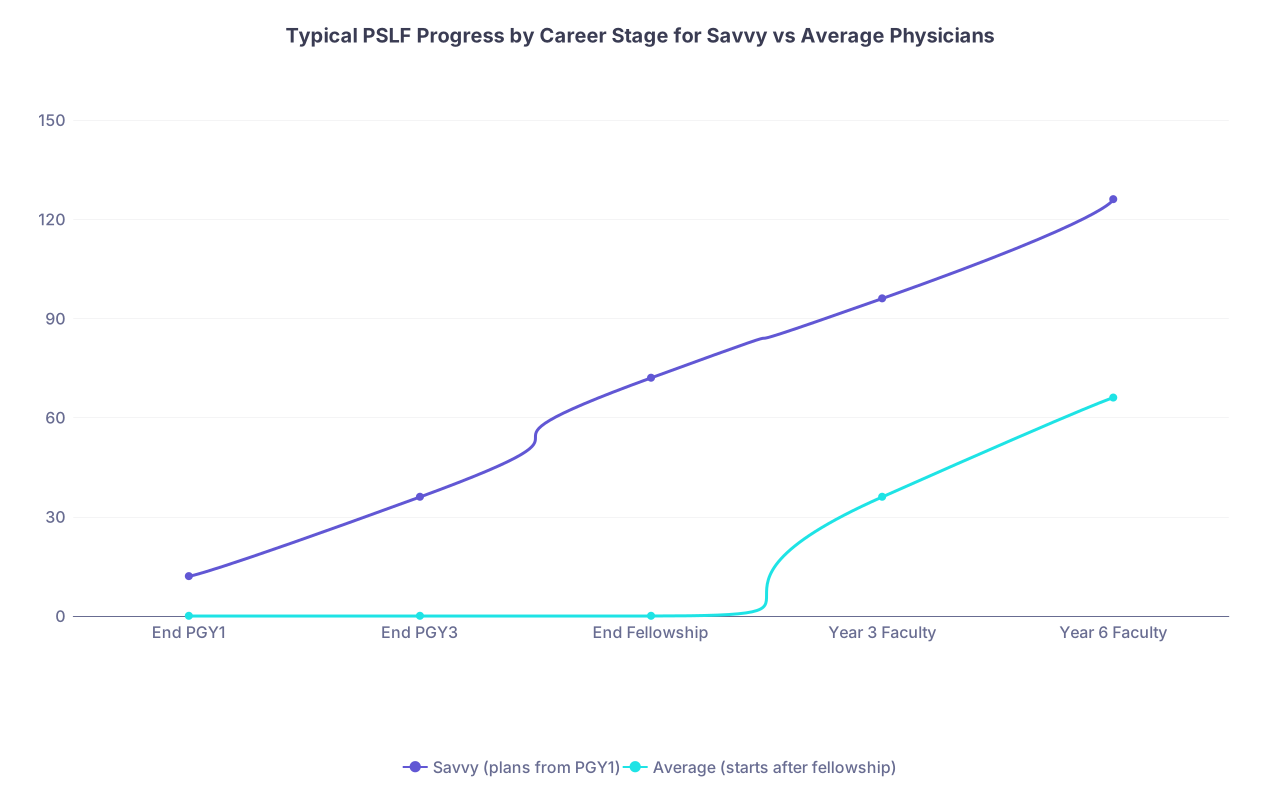
| Category | Savvy (plans from PGY1) | Average (starts after fellowship) |
|---|---|---|
| End PGY1 | 12 | 0 |
| End PGY3 | 36 | 0 |
| End Fellowship | 72 | 0 |
| Year 3 Faculty | 96 | 36 |
| Year 6 Faculty | 126 | 66 |
That graph? I’ve essentially watched that play out in multiple academic centers. The “savvy” doc hits PSLF forgiveness around year 6–7 of faculty life. The “average” one is just barely crossing 60–70 payments and still has almost 5–6 more years left.
Same employer. Same job title. Very different outcomes.
The Academic “Public Service” Shell Game
Let me be blunt. A huge percentage of junior faculty compensation is not salary. It’s loan forgiveness via PSLF. The institution doesn’t write that line item; the federal government does. Smart faculty and department chairs know this and structure everything around it.
Here’s the shell game:
Official narrative:
“Join us as full-time faculty, lower pay than private practice, but you’ll have academic prestige and teaching opportunities.”
Unspoken reality for those who understand PSLF:
“Let the federal government wipe out $300k–$500k while you collect a solid, if not spectacular, salary and build your CV. Then you’re financially unshackled way earlier than your private-practice friends with the same original debt.”
So what do backdoor-fast-track faculty actually do?
They:
- Lock in full-time (or 0.75–1.0 FTE) appointments at 501(c)(3) hospitals or university systems, even if they clinically “feel” part-time. On paper, it’s full-time at a PSLF-qualifying employer.
- Avoid split-employment models that screw PSLF. Those “half academic / half private practice” setups? Great for variety, terrible if the non-qualifying portion isn’t under the umbrella of the nonprofit or government entity.
- Push to get their clinical work billed under the university or hospital entity that counts as PSLF-eligible, even if there’s some private group involvement. I’ve watched smart faculty argue—and win—this in contract discussions.
Meanwhile, their colleagues take hospitalist jobs with private groups staffing the same hospital and say, “Well, it’s the same building as the university, so PSLF still counts, right?” No. HR doesn’t care which building you stand in. They care who signs your paycheck.
The backdoor move is aligning the paycheck, not the physical location.
Contract Details Faculty Exploit That You Ignore
Young faculty think about schedule, call, and RVUs. Experienced faculty who’ve dug themselves out of six-figure holes think about structure.
They study the fine print.
Here are the kinds of contract elements I see the “quietly rich” academics fight for that directly accelerate debt freedom:
Employer of record:
They insist employment is through the university or health system’s nonprofit corporate entity, not a pseudo-private “academic affiliate group” that isn’t actually 501(c)(3). Those affiliate shells ruin PSLF for people who don’t read.FTE thresholds:
They make sure their contract clearly states 0.75–1.0 FTE and qualifies as full-time under HR’s definition for PSLF certification. The department chair might shrug it off as paperwork; the savvy doc knows it’s hundreds of thousands of dollars.Protected academic time on paper:
Ten hours a week “protected time” for teaching or research is not just prestige. It often locks in full-time benefits and strengthens the institutional case for PSLF certification, even if clinically they’re not cranking 60+ patient hours.Length of appointment:
They implicitly line up their promotion tracks, loan forgiveness timeline, and career decisions. If they’re at 6 years of PSLF-qualifying payments when the first promotion review hits? They negotiate harder, because they know in 4 more years they may not need the institution.
I’ve watched a cardiologist with ~$400k in loans accept a hospital-employed academic job paying $70k less than a private offer—because his spreadsheet showed PSLF would erase about $280k in remaining principal and interest over the next 7 years. That private offer didn’t stand a chance once the math was done honestly.
The Tax Strategy Nobody Explains on White Coat Day
Here’s something your med school never told you: debt strategy and tax strategy are married. For faculty, that marriage is either power or disaster.
The core legal cheat code: lower your Adjusted Gross Income (AGI) while staying in an income-driven plan that counts for PSLF, so your required payments are as low as legally possible. That keeps more loan balance alive to be forgiven tax-free at 120 payments.
Faculty exploit this in ways residents don’t even realize are on the table.
The main levers:
- Maxing 403(b) + 457(b) + sometimes a 401(a) mandatory contribution
- Aggressive pre-tax HSA/flexible spending where relevant
- Filing taxes strategically if married (sometimes “married filing separately” to protect PSLF math, even if it’s suboptimal for pure tax purposes)
| Account Type | Typical Annual Limit (Approx) | Direct Impact on PSLF Payments |
|---|---|---|
| 403(b) | $23,000 | Lowers AGI, reduces IDR payment |
| 457(b) | $23,000 | Further AGI reduction, often unused by peers |
| HSA | $4,150–$8,300 | Small but meaningful AGI reduction |
| 401(a) | Employer/mandatory % | Built-in; confirms retirement saving while on PSLF |
You know what senior faculty with money conversations behind closed doors say?
“Use PSLF years to stuff every pre-tax account to the brim. Your ‘low’ payments today are future free money.”
The dumb version is paying extra on PSLF-eligible loans while skipping a 403(b) match. I’ve seen it. More than once. That’s lighting money on fire.
Exploiting Institutional Loan Repayment Programs (Without Getting Trapped)
Some hospitals and universities dangle “loan repayment” like candy: “We’ll pay $20k per year toward your loans for 5 years if you sign with us.” Faculty see that and lose all critical thinking.
The experienced ones treat it like what it really is: a golden handcuff. Sometimes useful. Sometimes poison.
Here’s how people who know what they’re doing approach these offers:
- They check whether the institutional payments are taxable or not. Many are. That $20k might really be ~$12k after tax.
- They verify whether those payments reduce potential PSLF benefit stupidly (for example, paying down principal aggressively when you were on track for forgiveness anyway).
- They make sure the clawback clause is clear: if you leave at year 3 of a 5-year commitment, what do you owe back?
I sat in on a faculty recruitment discussion where the chair literally said, “We’re better off offering them loan repayment than higher salary. The PSLF-savvy ones will ignore it or discount it. The naïve ones will be wowed by it.”
Backdoor move:
Turn down a mediocre loan repayment perk in exchange for higher base salary while staying PSLF-eligible, then funnel that extra salary into tax-advantaged accounts and let PSLF handle the rest.
You’d be stunned how many do the opposite.
Geographic Arbitrage: Where Faculty Really Win
Here’s where faculty quietly leapfrog their peers: they follow PSLF-eligible academic positions into low cost-of-living cities for 5–10 years, then cash out.
No one makes a big show of it. They just stop renewing leases in Boston, San Francisco, NYC, Chicago. They show up in Grand Rapids, Rochester, Madison, Durham, Birmingham, or some mid-sized city where:
- The hospital is 501(c)(3)
- The faculty base salary is “good enough”
- The housing prices are sane
- The call schedule is survivable
Suddenly, the math flips:
- PSLF wipes out $200–$400k over a decade
- Their mortgage is smaller than their old rent
- They bank real cash flow while still technically “underpaid” compared with big-market private practice
Then, once the loans are gone, I’ve watched them do two main things:
- Stay and become the well-off “lifers” in academic medicine who mysteriously seem low-stress about money.
- Or pivot back into higher-paying private practice or hybrid roles, now with zero student loan drag.
That second move is the real backdoor. Using academic employment as a temporary PSLF machine, not a forever identity, unless they actually like it.
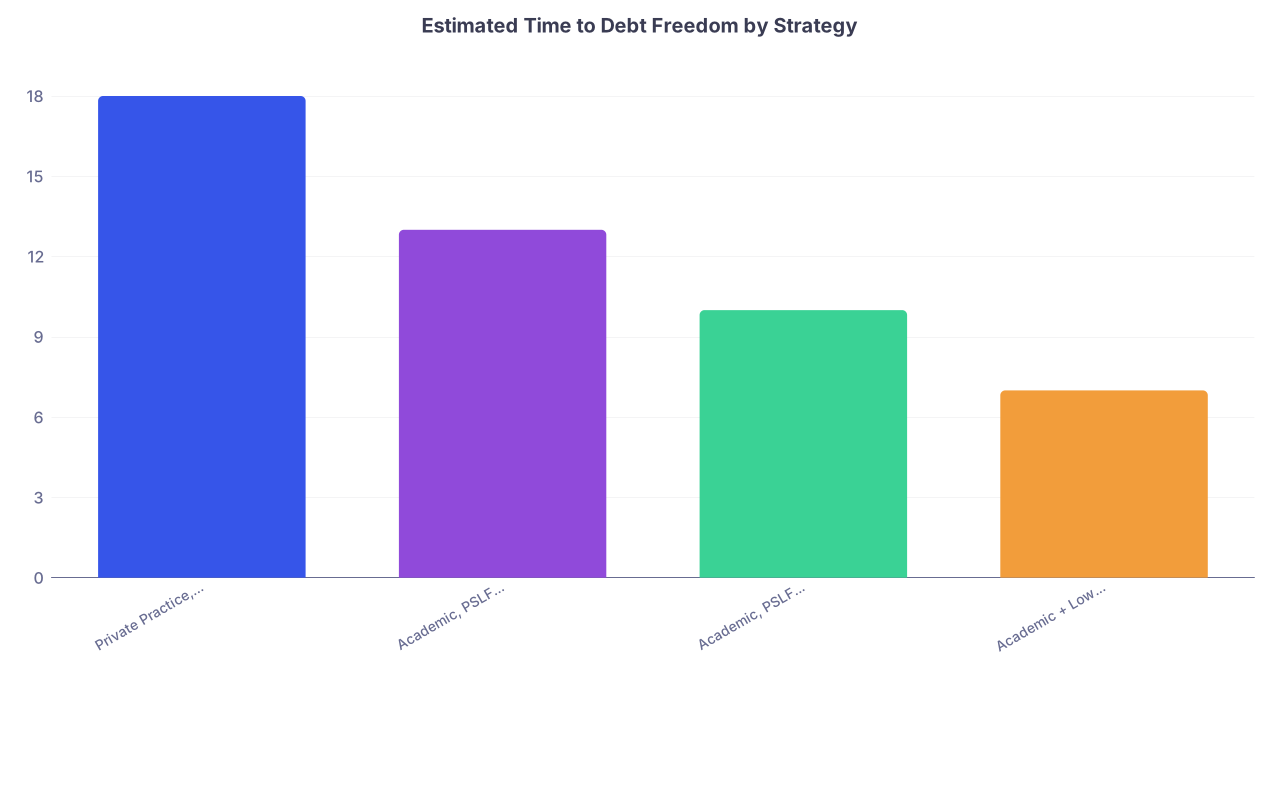
| Category | Value |
|---|---|
| Private Practice, No PSLF | 18 |
| Academic, PSLF Late Start | 13 |
| Academic, PSLF from PGY1 | 10 |
| Academic + Low COL + Max Pre-tax | 7 |
I’ve seen version #4—academic + low COL + maximal pre-tax + early PSLF planning—wipe out the functional burden of loans in under a decade from residency graduation. Meanwhile, their classmate in a high-cost private job “making more” is still dragging loans 15+ years out.
The Legal Fine Print Faculty Actually Read
Most residents sign paperwork like zombies. Faculty who are serious about getting free know contract language about loans, PSLF, and taxes is as important as malpractice coverage.
What they quietly check, or have an attorney check:
- Whether the employer is explicitly named as a 501(c)(3) or government entity in the contract.
- Whether their role is designated as full-time and benefits-eligible (PSLF needs this).
- Whether any “independent contractor” language sneaks in for clinical work. That kills PSLF.
- Whether loan repayment benefits come with clawbacks, vesting schedules, or conditions that could boomerang into a debt bomb if they want to leave.
They also keep pristine PSLF paperwork: ECF forms (or their current equivalent), annual employer certifications, pay stubs, HR letters. I’ve seen people get burned because a hospital merged, changed names, and suddenly FedLoan/MOHELA got confused 8 years into the PSLF timeline.
The careful ones:
- Download everything every year.
- Keep a PSLF binder or digital folder.
- Have HR re-certify when any structural change happens (merger, title change, department shift).
Boring? Yes. Worth hundreds of thousands? Also yes.
Side Gigs and the “Do Not Blow PSLF” Rule
Another subtle backdoor move: faculty build income outside their W-2 salary—but they’re careful about how it touches PSLF.
Common side channels they use:
- Expert witness work
- Speaking honoraria
- Small consulting agreements
- Some telemedicine on the side
- Writing, content, or niche teaching
The trick is not to let the side income wreck the PSLF optimization:
- Some deliberately keep side income modest until forgiveness hits.
- Some accept the slightly higher PSLF payments as a trade-off for bigger net worth growth, but they run numbers annually.
- The smart ones never sacrifice 6–7 figures of PSLF for a little extra side gig dopamine.
Once PSLF or other forgiveness hits? Different game. That’s when they often scale side gigs or jump into private practice or leadership roles with fewer constraints.
When Faculty Walk Away From PSLF Entirely
Now, here’s the other uncomfortable truth: the really sharp attendings also know when PSLF is a bad fit for their situation and they walk away early—on purpose.
Scenarios I’ve seen:
- Low debt (say <$120k) + very high earning potential in private practice specialties like ortho, derm, GI. In that situation, PSLF can be a distraction.
- Married to a very high earner, making IDR payments huge anyway, with PSLF benefit shrinking to almost nothing.
- Burned out by academic politics, offered a private gig with a signing bonus that can wipe out a huge chunk of debt upfront.
The “secret” isn’t that PSLF is always magic. It’s that smart faculty actually run the numbers, every couple years, and make deliberate pivots.
They treat their loans as a strategic problem, not a vague stressor.
One Example Composite: How the Game Looks in Real Life
Let me stitch together a composite of a real pattern I’ve seen multiple times:
- Graduate: $350k federal loans, started SAVE during PGY1.
- Residence/Fellowship: 6 years at a 501(c)(3) teaching hospital. All loans Direct, all payments qualifying.
- Faculty Job #1: Assistant professor at a mid-sized Midwest academic center (501(c)(3)), salary $220k, low COL city. FTE 1.0, documented.
- Strategy: Max 403(b) and 457(b), uses HSA, married filing separately for a few years to keep IDR payments lower, tracks every PSLF certification. Pays almost nothing extra toward principal.
- Institution offers: $15k/year “loan repayment” with a 5-year commitment. They negotiate it into base salary instead.
- PSLF Forgiveness: Hits 120 qualifying payments about 4 years into that first faculty role. Remaining balance forgiven: ~$210k.
- At that point: Retirement accounts already six figures because of PSLF-enabled pre-tax stuffing. No student loans. Stable mortgage.
- Next move: Either stays academic and coasts, or takes a carefully chosen private job purely for upside, not survival.
Yes, this kind of path takes planning. But it’s not fantasy. It’s exactly the sort of quiet, calculated path the financially free attendings around you actually took.
You just don’t hear them presenting it in grand rounds.
FAQs
1. If I’m already several years into attending life at a non-PSLF employer, is it too late to switch and still benefit?
No, it’s not automatically too late. I’ve seen mid-career attendings switch into academic or government roles, lock in 5–7 years of PSLF-eligible work, and still have six figures forgiven. The key is: get honest numbers. How much do you owe? What will your IDR payments look like at an academic salary? How many years can you realistically commit? If the projected forgiveness is big enough, a mid-course correction can still be worth it.
2. Should I ever aggressively pay down loans if I’m in an academic PSLF-eligible job?
Usually no, not during the PSLF-qualifying years. Extra payments reduce the amount that could have been forgiven tax-free. Better move: hit every pre-tax retirement option you can, build cash reserves, and let the loans sit on IDR. The exception is if you’ve run the math and PSLF benefit is minimal because of low remaining balance or high income making IDR almost equal to standard repayment.
3. How do I actually verify that my faculty job qualifies for PSLF?
You do not rely on verbal assurances. You:
- Confirm the employer’s tax status (501(c)(3) or government) through HR or public records.
- Make sure your contract lists that entity as your employer, not some private affiliate.
- Submit PSLF employer certification annually and see if the servicer counts those months.
If there’s any mismatch or rejection, you fix it immediately—titles, HR records, FTE status—before years slip by uncounted.
If you remember nothing else, remember this: the fastest faculty to reach debt freedom are not the ones “working hardest.” They’re the ones who understood three things early—PSLF is a structured game, your employer type matters more than your badge logo, and the tax code is a tool, not background noise. Use those three, and your loans become a solvable problem, not a life sentence.