
It is late March. Your W‑2 shows $310,000 of income. Your bonus finally hit. You log into your servicer to make an extra $20,000 “principal-only” payment on your student loans because you are “sick of them.”
You feel responsible. Disciplined. Like you are doing the grown‑up thing.
And you might be making a five‑figure mistake.
High earners are surprisingly good at working hard and surprisingly bad at working the tax code around their loans. I see the same pattern over and over: someone with $250k–$500k income, $200k–$600k in loans, and absolutely no integrated tax strategy. Just vibes and big payments.
This is how you accidentally:
- Overpay the IRS and your loan servicer at the same time
- Blow up potential forgiveness
- Ignore tax bombs until they become real bombs
Let me walk you through the major errors I see and how to avoid being the cautionary tale your colleagues whisper about later.
Mistake #1: Treating Loans and Taxes as Separate Universes
The core error: you think student loans live in one box and taxes live in another. So you hire a CPA for your return, maybe a financial advisor for investing, and you “just pay” the loans.
That siloed thinking is expensive.
Your student loan payment method literally is a tax decision, because most of the income‑driven repayment (IDR) plans are calibrated to your AGI (adjusted gross income). Change your AGI and you change your payment. Change your payment and you change:
- How much you pay over the life of the loan
- How much interest capitalizes
- How much might be forgiven later
- How big a future “tax bomb” could be
Here is what ignoring that linkage looks like in real life:
- You max the 401(k) but ignore a pre‑tax 457(b) that could drop AGI another $20k
- You do a ton of moonlighting and do not optimize deductions on that 1099 income
- You file separately “because PSLF” with zero projection of the total combined tax cost
You are making big moves—retirement, side income, filing status—without modeling how they interact with your loan plan.
That is like doing surgery with the lights off and hoping for the best.
How to avoid it
You need an integrated approach:
- Every big tax decision gets checked against your loan strategy
- Every loan decision gets checked against your tax return projections
You do not have to become a tax expert. But you cannot keep pretending they are independent.
Mistake #2: Blindly Chasing PSLF or Forgiveness Without Tax Math
Public Service Loan Forgiveness (PSLF) is great. IDR forgiveness at 20–25 years can also be reasonable. But the high‑earner mistake is assuming:
“Forgiveness = always better” or “Forgiveness = always a scam.”
Both lazy. Both wrong.
What you really have is a tax‑linked cash flow problem.
For high earners, the PSLF vs. payoff vs. long‑term IDR question is almost always decided by tax-aware math, not emotion.
Here is where people go wrong:
- They enroll in REPAYE/ SAVE on autopilot, make low payments in training, continue in attending years, and never re‑run the analysis
- They assume “I am at a nonprofit, so PSLF is for sure the best” without projecting total payments vs. aggressive payoff
- They ignore potential non‑PSLF forgiveness and the tax bomb that comes with it
| Scenario | Total Paid on Loans | Forgiveness Tax Bill | Years in Debt |
|---|---|---|---|
| Aggressive payoff (7 yr) | $280,000 | $0 | 7 |
| PSLF (10 yr) | $190,000 | $0 | 10 |
| IDR w/ tax bomb (20 yr) | $210,000 | $60,000 | 20 |
Illustrative numbers only. The point: PSLF is not “automatically best” and long‑term IDR is not “automatically stupid.” But both can be financially dumb if you ignore tax planning.
The tax twist people miss
Long‑term IDR forgiveness (non‑PSLF) is generally taxable under current law.
That means:
- Lower payments now
- Larger balance later
- That remaining balance treated as taxable income in the year of forgiveness
So you must be planning for two lines, not one:
- Your loan balance over time
- Your dedicated “future tax bomb” savings
Ignoring that second line is how attendings hit year 19 of an IDR plan with a six‑figure tax bomb and $0 set aside.
How to avoid it
Run forgiveness‑aware, tax‑adjusted projections early:
- What is my projected total payment under PSLF vs. aggressive payoff?
- If I go the non‑PSLF route, what is a realistic forgiveness balance and tax bill?
- How much per month should I be saving in a taxable account to meet that future tax bill?
If you are not projecting the tax hit, you are not doing real planning. You are just punting the crisis to your future self.
Mistake #3: Filing Status and IDR Without Doing the Math
This is where high‑earners get cute and end up burning money.
I see this often with dual‑income households where one or both have loans:
- They choose married filing jointly because “that is what we have always done”
- Or choose married filing separately because they heard “that keeps IDR payments lower”
Both can be totally wrong. The real answer is annoyingly specific.
Your filing status affects:
- Your total tax bill
- Your AGI
- Which loans count whose income
- How your IDR payment is calculated in certain plans
Here is where the mistakes creep in:
- Filing separately and losing credits/deductions that are worth more than the IDR savings
- Filing jointly and accidentally doubling your payment when you could have legally kept it lower
- Switching plans or filing status without checking PSLF implications
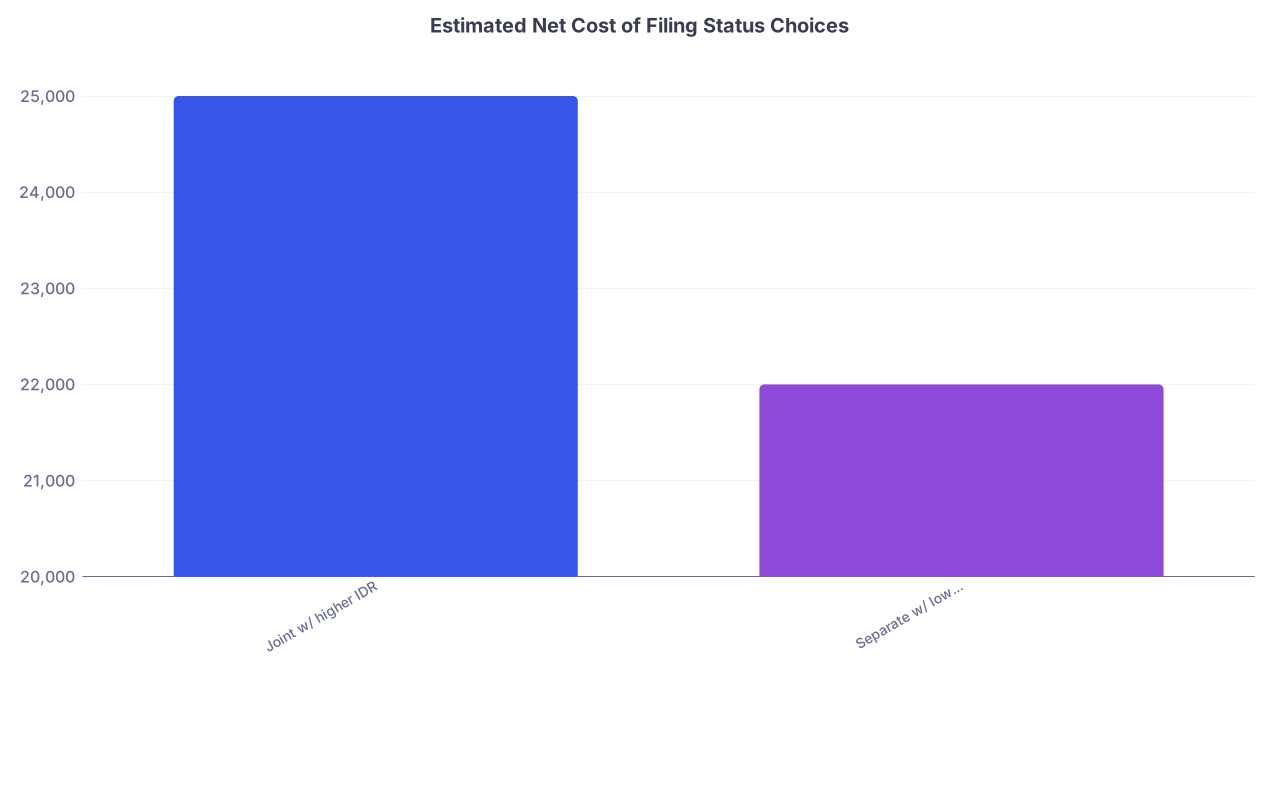
| Category | Value |
|---|---|
| Joint w/ higher IDR | 25000 |
| Separate w/ lower IDR | 22000 |
Again, sample numbers. But that $3,000 net difference can go either way depending on your incomes, credits, and loan details. I have seen cases where married filing separately saved $8,000 total per year. I have also seen it cost $5,000 more than it saved.
How to avoid it
Do not guess.
You (or your CPA or planner) should be doing two full tax returns:
- One as married filing jointly
- One as married filing separately
Then:
- Plug each version’s AGI into your IDR calculation
- Compare the whole picture: total tax + total loan payments + any forgiveness implications
If your tax pro says “married filing separately is always bad” or “PSLF means you must file separately,” that is your cue to bring someone else into the conversation. This is not one‑size‑fits‑all.
Mistake #4: Ignoring Pre‑Tax Space That Could Drop IDR Payments
This one makes me shake my head.
You will see high‑earning physicians, attorneys, and dentists aggressively paying $3,000–$5,000 a month to loans while simultaneously:
- Not using all pre‑tax retirement space
- Skipping HSA contributions
- Ignoring a 457(b)
- Under‑utilizing solo‑401(k)/SEP on 1099 income
Every dollar you legally move from “taxable income” to “pre‑tax contribution”:
- Lowers your current income tax
- Lowers your IDR payment (in most cases, via lower AGI)
- Often gives you more flexibility later when the loans are gone
Yes, sometimes you strategically use Roth. Fine. But if you are on an IDR plan and not even maximizing pre‑tax spaces, you are bleeding money.
Common missed opportunities
- Hospital 457(b) left empty because “I heard they are risky” (they can be, but many are fine if analyzed properly)
- HSA not maxed despite being on a high‑deductible plan
- Side‑gig 1099 income dumped into a regular brokerage with no solo‑401(k) design
That is lazy planning. Especially once your loans cross the six‑figure mark.
How to avoid it
List every tax‑advantaged bucket you have access to, then line them up against your IDR strategy.
Typical list for a high‑earner:
- 401(k) or 403(b)
- 457(b) (governmental vs. non‑governmental matters)
- HSA
- Solo 401(k) or SEP‑IRA for 1099 income
Then ask:
- If I maxed these pre‑tax, how much would my AGI drop?
- How much would that reduce my IDR payment?
- Over several years, does that reduction plus tax savings beat simply paying more on the loans?
Often, pre‑tax wins and leaves you with actual assets instead of just a smaller loan balance.
Mistake #5: Pretending the “Tax Bomb” Will Not Happen
For borrowers using non‑PSLF forgiveness (20–25 year IDR), the forgiven balance is usually considered taxable income at the end of the term. That future tax bill is called the “tax bomb.”
What do most people do? They:
- Acknowledge it once
- Shrug
- Save nothing earmarked for it
That is like knowing your roof will need replacement in 15 years and then acting stunned when the estimate comes in. You had 15 years.
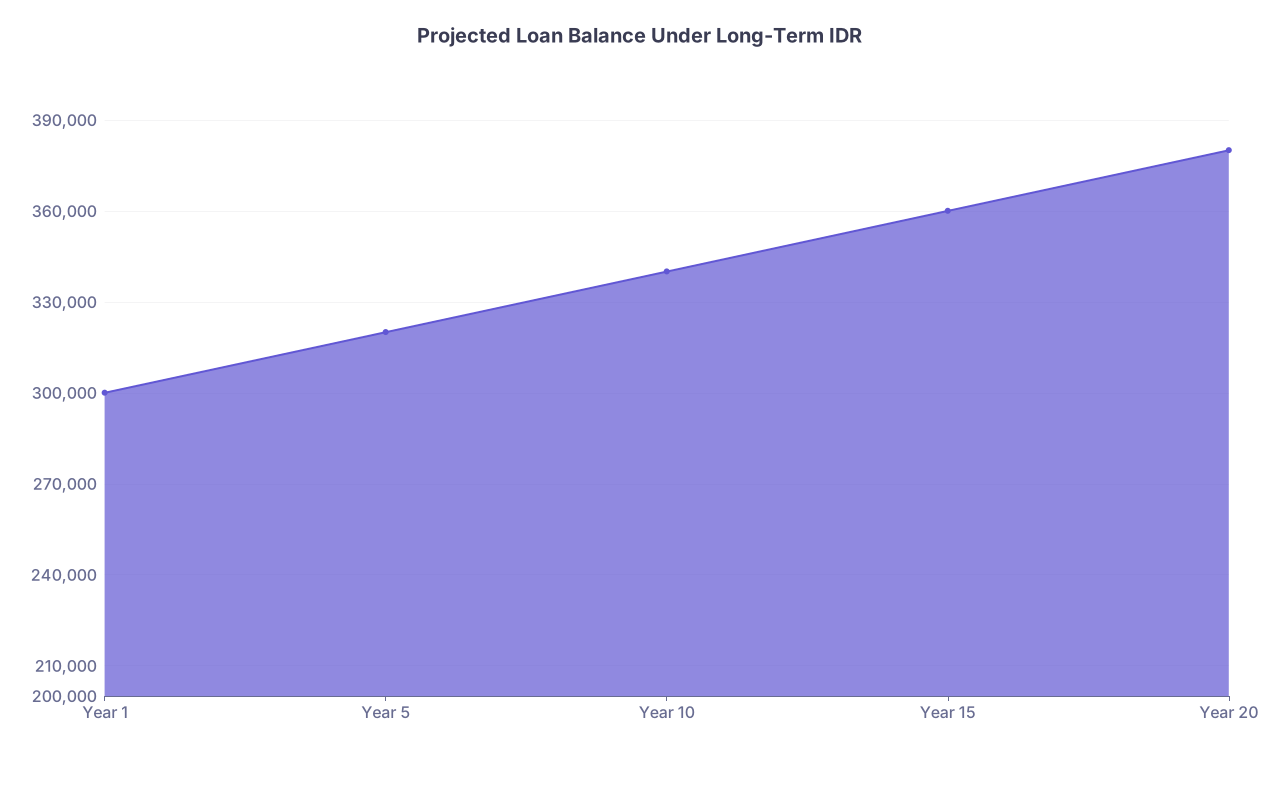
Here is how the tax bomb typically forms:
- You choose IDR with lower payments
- Interest accrues faster than you pay it
- Balance grows slowly
- At year 20–25, the remaining principal + interest is forgiven
- IRS treats it as taxable income that year
| Category | Value |
|---|---|
| Year 1 | 300000 |
| Year 5 | 320000 |
| Year 10 | 340000 |
| Year 15 | 360000 |
| Year 20 | 380000 |
Now imagine you earn $300k in that final year and have $200k forgiven. The IRS might view you as a $500k income earner for that one year. Yes, there are hardship exceptions and tax law changes could happen. Counting on that is not a plan. It is wishful thinking.
How to avoid it
If you intentionally choose a forgiveness strategy that is likely to create a tax bomb:
- Get a realistic projection of the forgiven amount
- Estimate the tax using conservative brackets
- Back into a monthly savings target just for that bill
- Put that money in a taxable investment account labeled “TAX BOMB”
You can invest that money, grow it, and if the law changes and the tax bomb disappears? Great. You are left with a six‑figure investment account as a “nice surprise.” That is hardly a bad outcome.
Mistake #6: Making Huge Extra Payments Without a Tax‑Aware Plan
High‑earners love the idea of “just killing the debt.”
There is a real emotional payoff to writing a $30k check in January and watching that balance drop. I am not against paying off loans aggressively.
I am against uncoordinated aggression.
Symptoms of this mistake:
- No projection of whether you might realistically hit PSLF
- No check of whether you are already on track for forgiveness under an IDR plan
- No comparison of loan interest vs. after‑tax return on investments
- No check of how those big payments affect cash flow for other goals
And zero consideration that maybe, just maybe, those extra payments would have been more valuable as:
- Pre‑tax retirement contributions
- Taxable investments at favorable long‑term capital gains rates
- Tax-bomb savings if forgiveness is the real long game
If you are sure you will never qualify for any forgiveness, fine. Pay fast. But high‑earners often have more options than they think—especially those working at academic centers, big nonprofit hospitals, or government entities.
Do not mock PSLF and then discover 7 years into your attending job at a 501(c)(3) that you accidentally “donated” six figures of potential forgiveness because you never certified employment or chose the right plan.
Mistake #7: Delegating to the Wrong Professionals (or None)
Here is a harsh truth. Many CPAs and many financial advisors are bad at student loans. They may be excellent at other parts of the game, but loans are their blind spot.
Typical problems:
- CPA prepares your return without ever asking your loan plan
- Advisor builds a portfolio ignoring IDR payment implications
- Nobody runs multi‑year projections integrating loans, PSLF, and taxes
Or worse, you let the loan servicer “help” you. Their guidance is often:
- Incomplete
- Biased toward what is administratively easy
- Ignorant of your life goals and tax picture
You also cannot outsource judgment entirely. If your CPA dismisses PSLF as “too complicated” or your advisor tells you to “just refinance and be done with it” without a full tax‑and‑job‑security analysis, that is a red flag.
How to avoid it
You need a coordinated team or at least one professional who actually understands:
- IDR plans
- PSLF rules
- Tax code basics
- High‑earner planning
Ask direct questions:
- “How do you incorporate student loan strategy into tax planning?”
- “Can you show me a sample projection comparing PSLF vs. payoff after tax?”
- “What experience do you have with physicians / attorneys / dentists with $300k+ loans?”
If they cannot answer clearly, they are probably not the right guide for this piece.
Quick Red‑Flag Checklist
If any of these are true, you are probably leaving money on the table:
- You have income-driven loans and do not know your AGI from last year off the top of your head
- You have never run a married filing jointly vs. separately comparison that included IDR payments
- You have $200k+ in loans and are not using all your pre‑tax space
- You are relying on non‑PSLF forgiveness and have no tax-bomb savings account
- You made a huge extra payment “just to get rid of it” without modeling alternatives
If that stings, good. That is the point. Better a small sting now than a six‑figure surprise later.
FAQs
1. I am a high‑earning attending at a nonprofit hospital. Is PSLF basically always best for me?
No. PSLF is often excellent for high‑earners at 501(c)(3) or government employers, but not automatic. You still need to:
- Confirm all your loans are Direct and on a qualifying IDR plan
- Confirm you will likely stay in qualifying employment for 10 years total
- Compare total projected PSLF‑path payments vs. an aggressive payoff after taxes
Sometimes, especially with lower loan balances or extremely high income, the savings from PSLF are modest and the psychological benefit of being debt‑free sooner can justify a payoff plan. But you only know that after doing the math.
2. If I am planning on long‑term IDR forgiveness, how much should I be saving for the tax bomb?
You start with estimates:
- Project the forgiven balance at year 20 or 25
- Apply a conservative effective tax rate (often 30–40% for high‑earners, depending on law assumptions)
- Divide that tax bill by the remaining years until forgiveness
That monthly amount goes into a dedicated taxable investment account. Example: projected $150k forgiven in 20 years at 35% tax → ~$52,500 tax bill → about $220/month if you earn some return. Many people under‑estimate this; do not.
3. Is refinancing to a private lender always a bad idea if I work at a nonprofit?
Not always, but it is dangerous if you do it blindly. Once you refinance federal loans to private, PSLF and federal IDR options are gone. Forever. If you are very certain you will never use PSLF and want a lower fixed rate with a fast payoff, refinancing can make sense. But you should:
- Confirm you are not eligible or realistically using PSLF
- Understand job risk and income volatility
- Compare after‑tax payoff timelines and risk profiles
Refinancing from a PSLF‑eligible position without a detailed analysis is one of the most expensive unforced errors I see.
4. Are HSAs and pre‑tax accounts always better than paying more on loans?
No. But they are often underused by people on IDR plans. You have to compare:
- After‑tax, risk‑adjusted expected return on investments
- Guaranteed interest savings from loan payoff
- Impact on IDR payments from reducing AGI
For many high‑earners, a balanced approach works best: maximize the most attractive pre‑tax spaces, maintain an optimal IDR plan, then direct surplus cash either to accelerated payoff or taxable investing based on interest rates and your goals.
5. My CPA told me student loans are “just personal debt” and not worth planning around. Is that true?
That is outdated and wrong for most high‑debt professionals. Federal student loans with IDR, PSLF, and potential forgiveness are policy‑driven liabilities, not simple consumer debt. They interact deeply with your taxes, employment choices, and long‑term planning. If your CPA dismisses them, that is a sign they are not up to speed on this corner of the world. You need someone who takes the integration seriously.
Key points to remember:
- Your loan plan is a tax plan. Treat them as one system, not separate silos.
- PSLF, IDR, and aggressive payoff only make sense after tax‑aware projections, not on vibes.
- If you choose forgiveness, you must plan for the tax bomb; if you choose payoff, do not ignore the pre‑tax tools that could make both your taxes and your payments lighter.