
The fantasy that “any doctor can pay off loans in a few years” is mathematically false for most specialties.
If you run the numbers instead of repeating folklore, a very different picture appears: a 2-year payoff is an outlier; 10–15 years is typical; and your specialty choice can easily swing your payoff timeline by a full decade.
Let’s quantify it.
1. The starting point: debt, interest, and residency income
Before we get into specialties, we need the baseline economics of a new physician.
Typical debt and rates
Recent graduating classes show roughly:
- Median MD student loan balance: about $200,000–$230,000
- 25–30% graduate with $300,000+
- Interest rates on federal graduate loans: ~6–7.5% in recent years
For a concrete model, I will use three representative starting debt levels:
- Low: $200,000
- Medium: $300,000
- High: $450,000 (common for extended training + high cost of living + capitalization)
And an average interest rate of 6.5%.
At 6.5%, compounding on $300,000 adds roughly:
- Yearly interest: $19,500
- Monthly interest: $1,625
If you are not at least covering that interest during residency, your balance grows fast.
Residency pay is not saving you
Current PGY-1 salaries cluster around $60,000–$70,000, with PGY-3 often around $70,000–$80,000. Call it:
- PGY-1: $65,000
- PGY-2: $68,000
- PGY-3: $71,000
After taxes, retirement withholding, and basic living expenses, you are not throwing $3,000 a month at loans. Realistically, aggressive residents might manage $500–$1,500 per month toward loans if they are unusually disciplined and in a reasonable cost-of-living area.
That is not “kill your debt” money. That is “slow the bleeding” money.
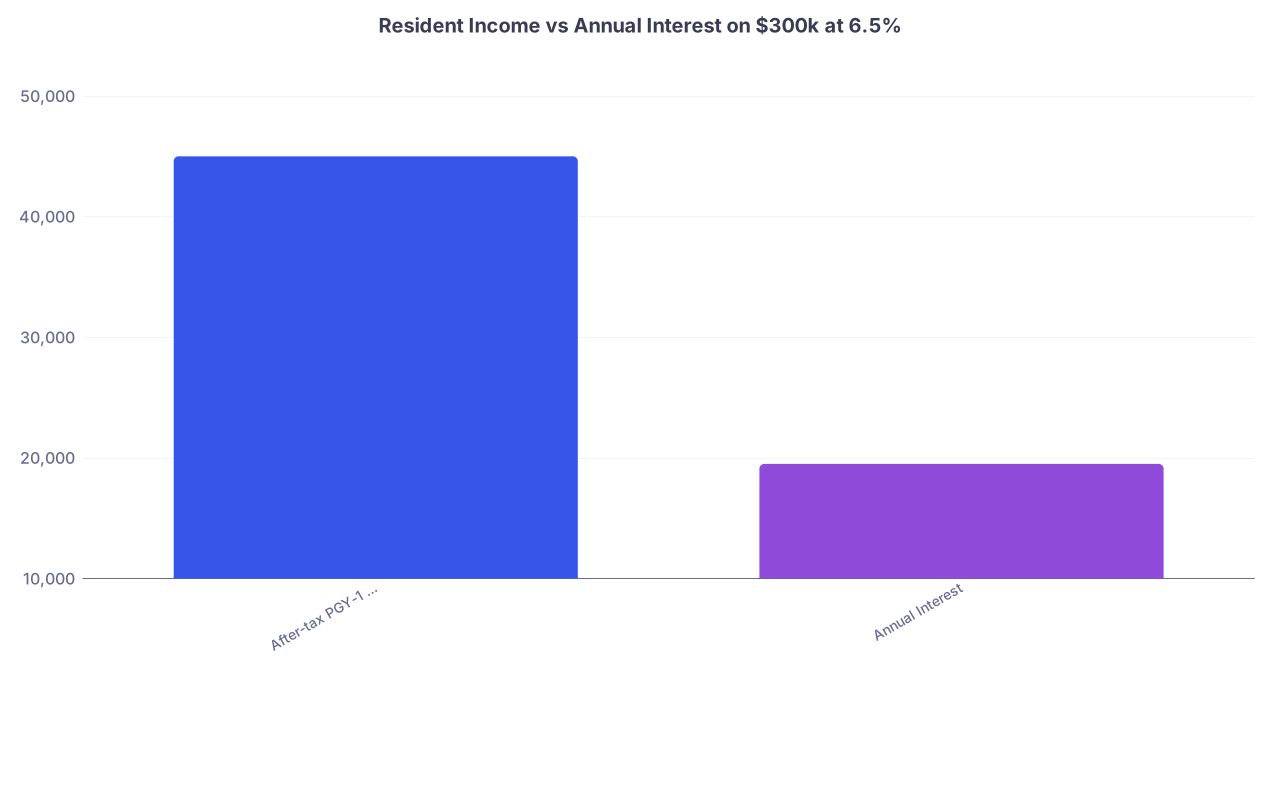
| Category | Value |
|---|---|
| After-tax PGY-1 (est.) | 45000 |
| Annual Interest | 19500 |
Even if you pay $1,000 per month in residency:
- Annual payments: $12,000
- Annual interest: $19,500
You are still negative by $7,500 per year. So by the time you finish a 3-year residency, your $300,000 can easily creep toward $330,000 unless you make interest-only or higher payments with intent.
So the data says: the real “debt-killing” phase starts at attending income, not in training.
2. Income trajectories by specialty: what the data actually shows
Now the important question: How much does specialty change your timeline?
A lot.
Surveys (think Medscape, MGMA, AAMC) consistently show the same pattern:
- Primary care and cognitive fields: $230k–$320k starting attending salaries
- Procedure-heavy and surgical fields: $400k–$700k+ starting, often rising rapidly with experience
Here is a simplified but representative snapshot of early-career attending incomes.
| Specialty | Early Attending Income (Approx.) |
|---|---|
| Family Medicine | \$230,000–\$260,000 |
| Pediatrics | \$210,000–\$240,000 |
| Internal Medicine | \$240,000–\$280,000 |
| Hospitalist (IM) | \$260,000–\$320,000 |
| Psychiatry | \$260,000–\$320,000 |
| Emergency Medicine | \$350,000–\$420,000 |
| General Surgery | \$350,000–\$450,000 |
| Anesthesiology | \$400,000–\$500,000 |
| Radiology | \$450,000–\$550,000 |
| Orthopedic Surgery | \$550,000–\$800,000+ |
Yes, there are regional variations, private vs academic, wRVU bonuses, etc., but the relative ranking is stable.
Now the key question: given these incomes, what is a realistic loan payoff timeline?
3. How fast can you kill $300k? Scenario modeling by specialty
We will standardize the assumptions to keep the comparisons clean:
- Starting debt at end of training: $300,000 at 6.5%
- Standard 10-year amortization baseline
- You behave like an adult: 20% effective tax rate (low but plausible with some deductions), 20% of gross to all savings/retirement, the rest to living + loans
- “Aggressive payoff” means you push 25–35% of gross income toward loans early on
Is this perfect? No. Is it good enough to see the order-of-magnitude differences between specialties? Yes.
Quick reference: payment vs payoff time
At 6.5% interest, approximate timelines to pay off $300,000 if you start now:
- Pay $2,000/month → ~20+ years
- Pay $3,000/month → ~11–12 years
- Pay $4,000/month → ~8–9 years
- Pay $5,000/month → ~6–7 years
- Pay $7,000/month → ~4 years
The math is unforgiving: to pay off in under 5 years, you are almost always in the $6k–$8k/month payment range.
Family Medicine / General Internal Medicine
Early attending income: $240k–$280k
Let us pick $260,000.
- Gross: $260,000
- Taxes (22–24% effective all-in): ~$60,000
- Net: ~$200,000
Now budget in a modest but adult lifestyle:
- Housing, utilities, transportation, insurance, food, etc.: maybe $90,000–$110,000
- That leaves $90,000–$110,000 for loans + saving
If you decide to be aggressive and put $4,000/month ($48,000/year) toward loans:
- Time to payoff ~8–9 years
- Total paid including interest roughly $380k–$400k
If you push to $5,000/month:
- Payoff ~6–7 years
Notice what is missing. There is no path, with normal living expenses and taxes, to a 3-year payoff from family medicine. You would need to live like a resident and push closer to $7,000–$8,000/month, which is 40–50% of your gross. Possible for a single person in a low-cost area; not realistic for most.
Pediatrics
Pediatrics typically earns less than family medicine.
Say early pediatric attending: $230,000.
You are realistically looking at:
- $3,000/month → ~11–12 years
- $4,000/month → still 8–9 years
“Kill it in 3–5 years” is almost a myth here unless you:
- Moonlight heavily
- Live far below attending norms
- Or marry someone with a much higher income
The data is not sentimental. The math is just worse.
Psychiatry / Hospitalist Medicine
Early income: $260,000–$320,000
Call it $300,000.
This looks slightly better than basic primary care.
At $300,000 gross:
- Effective taxes maybe $70,000
- Net $230,000
You could plausibly do:
- $5,000/month → payoff in ~6–7 years
- $6,000/month → payoff in ~5–6 years
Aggressive, but feasible if you cap lifestyle creep. The gap between 7 years and 15+ years is mostly behavior, not specialty, at this income level. But a lightning-fast 3-year payoff is still an outlier.
4. Procedural and surgical specialties: where the folklore comes from
The “I paid off $300k in 3 years” stories usually come from one corner of the distribution: high-paying procedure-oriented fields with added overtime, locums, and minimal lifestyle creep.
Let us look at concrete examples.
Emergency Medicine
Early income: $350,000–$420,000
Take $380,000 as a realistic figure (shift work, some nights/weekends, maybe a stipend).
- Taxes maybe $95,000
- Net ~$285,000
If you live on $100,000–$120,000 and direct the rest to loans:
- Loans: $10,000–$12,000/month is realistic if you are serious
At $10,000/month:
- Payoff time: about 3 years
This is where the folklore is born. But notice the behavioural assumptions: living at $100k while earning $380k. That means no doctor house, no luxury car, moderate childcare costs, and saying “no” to almost every attending-status expenditure in the early years.
If you instead pay $6,000–$7,000/month:
- Payoff: 4–6 years
Still very fast. The main risk in EM is not math. It is job market volatility and burnout.
Anesthesiology
Early income: $400,000–$500,000
Use $450,000.
- Taxes: around $115,000–$130,000
- Net: ~$320,000–$335,000
Extreme but realistic aggressive plan:
- Live on $110,000–$120,000
- Put $14,000–$15,000/month toward loans
At $14,000/month:
- Payoff: a bit over 2 years for $300k, maybe 3 years for $450k
Now you see where the “2–3 years to pay it all” stories come from. They are not lies. They are just drawn from the top 10–20% of earners and the top 10% of savers.
A more middle-of-the-road anesthesiologist doing $8,000–$10,000/month:
- Payoff: 3–5 years for $300k
Radiology and Orthopedics
Radiology early income: $450k–$550k
Ortho early income: $550k–$800k+
This is where the numbers become almost unfair compared to primary care.
Orthopedist making $650,000, even after heavy taxes, can pay:
- $15,000+/month toward loans while living on $150k–$180k
Result: 2–3 year payoff is very doable. Even with $450k in loans.
Radiology is similar to anesthesiology. A radiologist who keeps expenses low in the first 3–5 years can erase six figures of debt absurdly quickly relative to a pediatrician.
5. Timeline comparisons: specialty vs payoff horizon
Let us put these scenarios side by side, still assuming $300k at 6.5% and “aggressive but liveable” payments.
| Specialty Group | Typical Aggressive Monthly Payment | Approx. Payoff Time |
|---|---|---|
| Pediatrics / Family Med / IM | \$3,000–\$4,000 | 8–12 years |
| Hospitalist / Psychiatry | \$4,000–\$6,000 | 6–9 years |
| Emergency Medicine | \$6,000–\$10,000 | 3–6 years |
| Anesthesia / Radiology | \$8,000–\$12,000 | 3–5 years |
| Orthopedics / high-paying surgery | \$10,000–\$15,000 | 2–4 years |
Notice the pattern:
- Under 5 years → usually high-income specialties plus aggressive behaviour
- 6–10 years → mid-range incomes or moderately aggressive plans
- 10–15+ years → lower-paying specialties or more comfortable lifestyles
The specialty effect is massive. The lifestyle effect is almost as big.
6. High debt scenarios: what if you owe $450k?
Let’s stress test this. Because plenty of people finish med school + residency + interest capitalization in the $400k–$500k range, especially DOs with longer training, Caribbean grads, or people from high-cost private schools.
Use $450,000 at 6.5%.
At $6,000/month:
- Payoff: ~9–10 years
At $8,000/month:
- Payoff: ~7 years
At $12,000/month:
- Payoff: ~4–5 years
Now layer that on specialties.
- Pediatrician making $230k will struggle to put more than $3,000–$4,000/month into loans. That is 15–20 years, easy.
- EM doc or anesthesiologist can still hit $8,000–$12,000/month if they cap lifestyle. That is 4–7 years, even at $450k debt.
- Orthopod at $650k can erase $450k in 3–5 years without living like a monk.
So the data is blunt: if you are coming out with $400k+, primary care and pediatrics will require either:
- Long payoff horizons (10–20 years), or
- Very lean lifestyle plus side income or PSLF
You will not “out-earn” that kind of debt quickly at $230k/year without extreme behaviour.
7. PSLF, IDR, and the “kill debt vs manage debt” decision
So far I have assumed you are trying to pay everything off quickly. That is one strategy. Not the only one.
Income-Driven Repayment (IDR) and Public Service Loan Forgiveness (PSLF) change the calculus dramatically, especially for lower-paying specialties.
Who is a good candidate for PSLF?
Data pattern is clear:
- Lower-income specialties (peds, family med, academic IM, psychiatry in public settings) with high debt
- Strong likelihood of working at 501(c)(3) or government institutions for 10 years
- Large debt-to-income ratios (often >1.5–2.0)
For example:
- Pediatrician with $350,000 in debt making $230k at a children’s hospital.
- They pay on an IDR plan (e.g., SAVE/RePAYE-like), which caps monthly payments at a percentage of discretionary income.
- Over 10 years of qualifying payments, they might pay, say, $150k–$200k total and have the remainder forgiven tax-free under PSLF (under current law).
Compare this to trying to brute-force pay $3,000–$4,000/month for 15 years. The math often says PSLF is superior for those with low-ish incomes and high balances.
For high earners (ortho, radiology, private EM), PSLF is often irrelevant. Their IDR payments are so high, and their income so large, that they can simply pay off the loans outright in 3–7 years with aggressive payments.
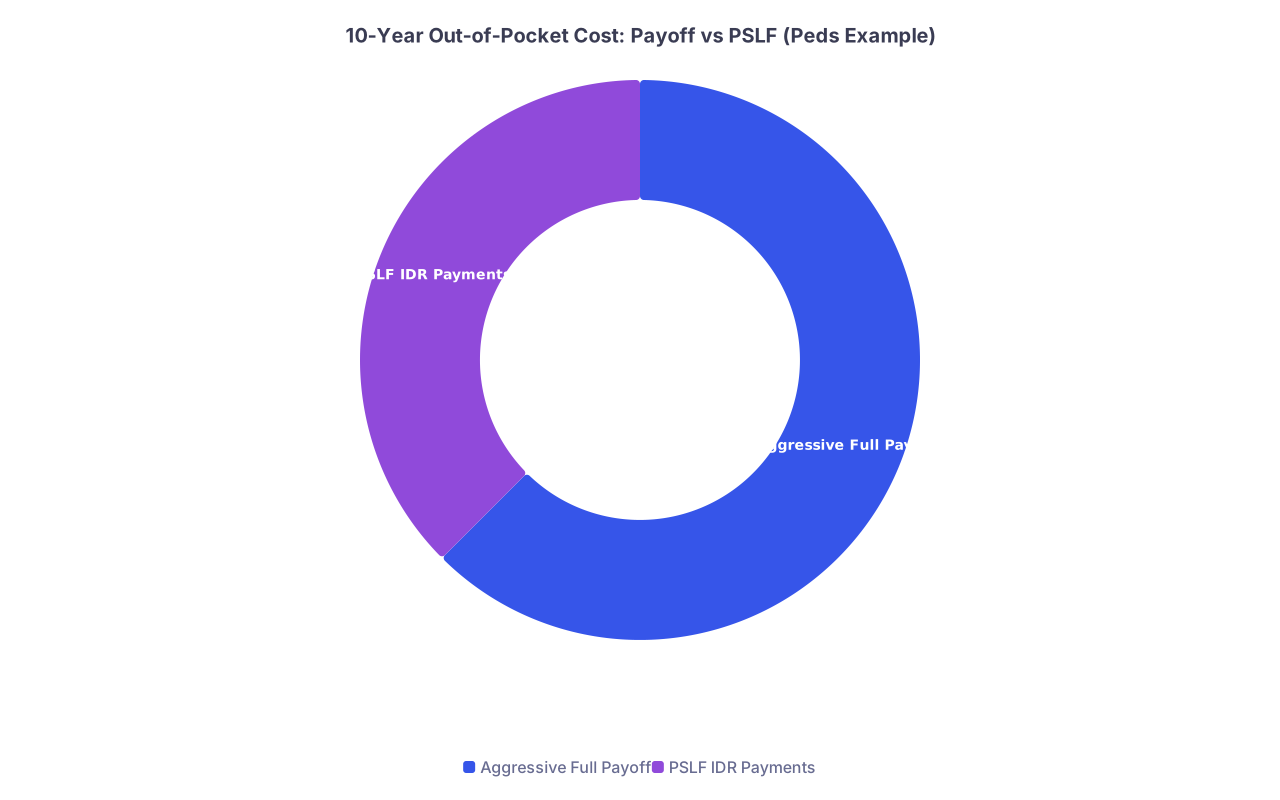
| Category | Value |
|---|---|
| Aggressive Full Payoff | 300000 |
| PSLF IDR Payments | 180000 |
The chart is conceptual but reflects a common pattern: PSLF can significantly reduce the total dollars leaving your pocket if your income is modest relative to debt.
8. Behaviour beats fantasy: what the numbers say you must actually do
Let’s strip away specialty labels and return to basic math. You can answer “How fast can I kill my debt?” with three numbers:
- Your after-tax income
- Your non-negotiable living costs
- The maximum monthly payment you are willing to commit
The formula is not complicated:
Loan payoff speed ≈ function(payment size, interest rate, principal).
The data-driven rules of thumb:
- To pay off $300k in under 5 years at 6.5%, you are usually north of $6,000–$7,000/month in payments.
- To pay off $450k in under 7 years, you are often in the $7,000–$9,000/month range.
- If you are only dedicating $2,000–$3,000 per month, you are signing up for 10–20 years, depending on the balance.
So before choosing a specialty under the illusion that “I’ll just pay it off fast,” match the folklore against actual amortization schedules.
The debt-to-income (DTI) ratio test
One simple quantitative tool:
Debt-to-income ratio (DTI) = total student debt ÷ starting attending income.
- DTI < 0.5 : You can pay off quickly with moderate effort. (e.g., $200k debt, $400k salary)
- DTI ~ 1.0 : You can pay off in 5–10 years with strong effort.
- DTI > 1.5 : Without PSLF or extreme frugality, payoff will be long.
So:
- Orthopod with $300k and $650k income → DTI ≈ 0.46 (easy to crush)
- Pediatrician with $350k and $230k income → DTI ≈ 1.52 (PSLF or long grind)
The ratio predicts your stress. And your realistic timeline.
9. Putting it together: realistic payoff benchmarks by specialty
Let me give you grounded expectations, not marketing copy. Assume $300k at 6.5%, no PSLF, reasonably aggressive but not monk-level behavior.
Pediatrics / Family Med / General IM
Reasonable payoff horizon: 10–15 years
Very aggressive payoff: 7–9 yearsHospitalist / Psychiatry
Reasonable: 8–12 years
Very aggressive: 5–8 yearsEmergency Medicine
Reasonable: 5–8 years
Very aggressive: 3–5 yearsAnesthesia / Radiology
Reasonable: 4–7 years
Very aggressive: 3–4 yearsOrtho / high-income surgical subspecialties
Reasonable: 3–6 years
Very aggressive: 2–3 years
Now layer in higher debts:
- Increase debt from $300k to $450k → add roughly 2–4 years unless you increase payments accordingly.
And PSLF:
- In low-paying specialties with high DTI, PSLF can turn a 15–20 year grind into a 10-year capped obligation with lower total dollars paid.
FAQ (exactly 4 questions)
1. If I am going into a low-paying specialty with high debt, is it financially irresponsible?
Not automatically. The data shows that high DTI (debt-to-income ratio > 1.5) in low-paying fields often makes PSLF or long-term IDR the rational strategy. Calling that “irresponsible” misses the point. It is only irresponsible if you pretend you will knock out $400k in 5 years on a $230k salary and then build your life around that fantasy. If you run the numbers and structure your career (academic, hospital-employed, PSLF-eligible), it can be financially coherent.
2. Should I choose a specialty mainly to pay off loans faster?
The numbers say the payoff speed difference is real: an orthopedist can erase debt 2–3x faster than a pediatrician with the same balance. But the career satisfaction gap will dwarf the financial win if you hate the work. From a purely quantitative perspective, high-paying specialties do buy you optionality faster. From a real-world perspective, choosing a miserable job for a 5-year payoff instead of a 10-year payoff is a bad trade for most people.
3. How much does living like a resident as an attending actually help?
Enormously. If you take a $350k job and live on $100k–$120k for the first 3–5 years, you can redirect $8,000–$12,000/month toward loans and savings. That is literally the difference between 4 years and 15 years in many cases. The data is extremely clear: early years’ spending behaviour matters as much as specialty choice for those in the mid-to-high income tiers.
4. Are “I paid off $300k in two years” stories realistic or just bragging?
They are real, but they are not representative. When you inspect the numbers, those stories nearly always involve: high-paying specialty (ortho, anesthesia, EM), high overtime or locums income, very low expenses (often no kids yet, modest housing), and a ruthless focus on debt. For the median pediatrician or family medicine doctor, those timelines are fantasy. For a high-earning surgeon, they are attainable but require discipline that most do not maintain.
Key points:
- Your payoff speed is a simple function of debt size, interest rate, and how many thousands per month you actually commit—specialty changes that ceiling dramatically.
- Under 5-year payoffs are realistic mainly for high-income procedural specialties plus aggressive spending control; 10–15 years is more realistic for many primary care paths without PSLF.