
The usual advice about “waiting for the right time” to refinance student loans is backwards. The data shows most people lose more in delay than they gain from perfectly timing the rate cycle.
You want to understand interest rate history because you are trying to answer one question: “Should I refinance now, or wait?” So let’s treat it exactly like an analyst would. Look at long-term rate trends, quantify risk versus reward, and translate that into specific refinancing timing rules for student loans.
1. The 50‑Year Interest Rate Story in Numbers
Strip away headlines and hot takes, and you are left with a very simple curve: market interest rates over time.
For student loan borrowers, the most relevant benchmark is the 10‑year U.S. Treasury yield and, secondarily, the federal funds rate. Private refinance lenders price off those, plus a credit spread.
Here is the long‑run view:
- 10‑year Treasury average, 1970–2023: ~5.8%
- 10‑year Treasury median, 1970–2023: ~5.6%
- Federal funds rate average, 1970–2023: ~4.6%
Now look at how extreme recent years have been:
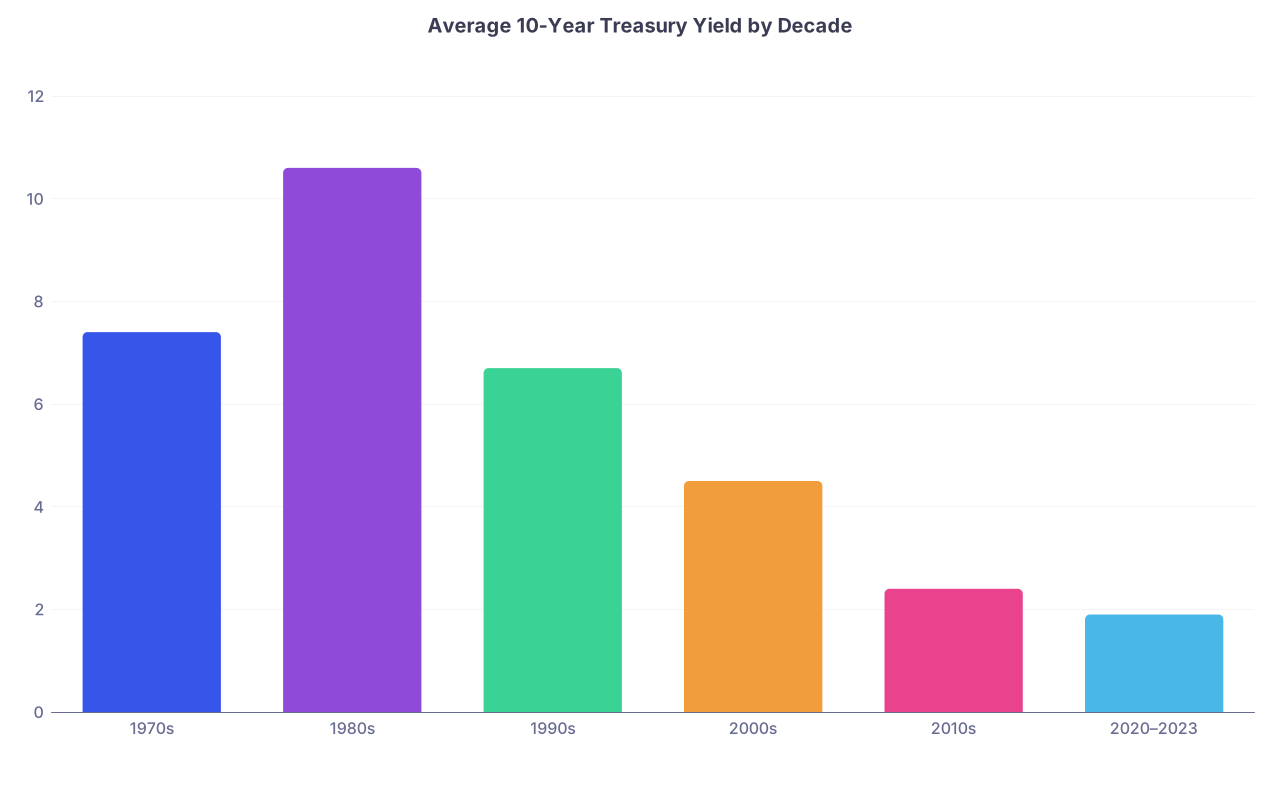
| Category | Value |
|---|---|
| 1970s | 7.4 |
| 1980s | 10.6 |
| 1990s | 6.7 |
| 2000s | 4.5 |
| 2010s | 2.4 |
| 2020–2023 | 1.9 |
The data says:
- The 1980s were an outlier high-rate decade.
- The 2010s and early 2020s (pre‑2022 spike) were historic low-rate environments.
- Anything under ~3% on the 10-year Treasury is historically cheap money.
Student loan refinance rates roughly track that benchmark plus 1–4 percentage points depending on credit profile, term length, and lender margins. So:
- When the 10‑year is at 2%, strong borrowers might see fixed refinance offers at 3–4%.
- When the 10‑year is at 4–5%, similar borrowers are more likely in the 5–7% fixed range.
The takeaway: if you are trying to “wait for low rates,” you are really trying to guess where the 10‑year Treasury will be over the next 6–18 months. That is a speculative bet. Most medical and graduate borrowers are not rate traders, and even the professionals get timing wrong consistently.
2. How Federal Student Loan Rates Are Set (And Why History Matters)
For existing federal loans, your current rate is locked in. But understanding how it was set tells you whether refinancing can realistically beat it.
Federal Direct Loan interest rates for new loans are pegged to the 10‑year Treasury each spring, then fixed for that year’s disbursements:
- Undergrad Direct: 10‑year Treasury + fixed margin
- Grad Direct Unsubsidized: higher margin
- PLUS loans: even higher margin
Result: federal rates issued in low‑yield years are unusually attractive by historical standards. Those are tough to beat through refinancing, even in a “good” private rate environment.
Here is a snapshot of recent new federal loan rates:
| Academic Year | Undergrad Direct | Grad Direct Unsub | Grad PLUS |
|---|---|---|---|
| 2013–2014 | 3.86% | 5.41% | 6.41% |
| 2016–2017 | 3.76% | 5.31% | 6.31% |
| 2019–2020 | 4.53% | 6.08% | 7.08% |
| 2020–2021 | 2.75% | 4.30% | 5.30% |
| 2021–2022 | 3.73% | 5.28% | 6.28% |
Two critical implications:
Borrowers with older federal loans issued in high‑rate years (mid‑2000s or certain post‑2018 years) often carry 6.5–8.5% fixed rates. Historically high compared with the last decade’s refinance markets. These are prime targets for refinancing when personal and market conditions line up.
Borrowers with federal loans from 2020–2021, especially grad loans around 4.3–5.3%, are closer to the floor of what private lenders can offer long term. Beating 4–5% by a meaningful margin is not guaranteed unless you have strong credit, high income, and rates drift back down.
Bottom line: the historical context tells you whether your current rate is “expensive debt” or “cheap debt.” Without that, timing decisions are just vibes.
3. The Real Math of “Waiting for a Better Rate”
The biggest timing mistake I see is people obsessing about whether rates might drop another 0.5% while ignoring the cost of doing nothing.
The data is merciless on this point.
Assume:
- $150,000 balance
- Current rate: 7.00%
- Remaining term: 15 years
- Possible refinance offer: 5.00% fixed, 15 years
First, monthly payments:
- At 7.00% over 15 years: about $1,348 / month
- At 5.00% over 15 years: about $1,187 / month
Difference: ~$161 less each month, and far more importantly, lower total interest.
Total interest over full term:
- At 7.00%: about $92,588
- At 5.00%: about $63,608
- Interest saved if refinanced now: ~$28,980
Now, what if you “wait 12 months” hoping rates improve and maybe you can refinance at 4.5% instead?
The cost of waiting 12 months at 7.00%:
- Interest paid in 12 months (early in a 15‑year amortization): roughly $10,000–11,000
Now compare two paths from today:
- Refinance now at 5.0% and hold that for the full 15 years.
- Keep 7.0% for 1 year, then refinance at an even better 4.5% for the remaining 14 years.
Quick calculation approximation:
- Path 1 (refi now at 5.0%): we already know total interest ≈ $63.6k.
- Path 2:
- Year 1 at 7.0%: interest ≈ $10.5k (rough midpoint estimate).
- Remaining balance after 1 year at 7% will be slightly below $145k.
- Then 14 years at 4.5%: interest maybe ≈ $49–50k.
Total Path 2 interest ≈ $10.5k + ~$49.5k = ~$60k.
Yes, in this very favorable scenario, waiting a year could save you around $3–4k over the life of the loan. But that required:
- You actually getting a 4.5% offer later (not guaranteed).
- You not messing up your credit profile or debt‑to‑income in the interim.
- You living with 7% risk for another year, with no guarantee that rates drop instead of rise.
And that is a pretty optimistic model.
More often, borrowers I see “wait” during periods where rates then stay flat or climb. Then they have locked in an extra $8–12k in interest for nothing. The expected value of waiting, averaged across scenarios, is negative unless your current rate is already relatively low, or you are expecting a large credit improvement soon (e.g., finishing residency, big attending jump).
4. Fixed vs Variable: What History Really Says About Risk
Variable rates scare people for good historical reasons. In the early 1980s, the federal funds rate briefly peaked above 19%. That would obliterate any borrower on an uncapped variable.
But let’s look at modern history, post‑2000, where central bank behavior is more data‑driven and less aggressive than the Volcker era.
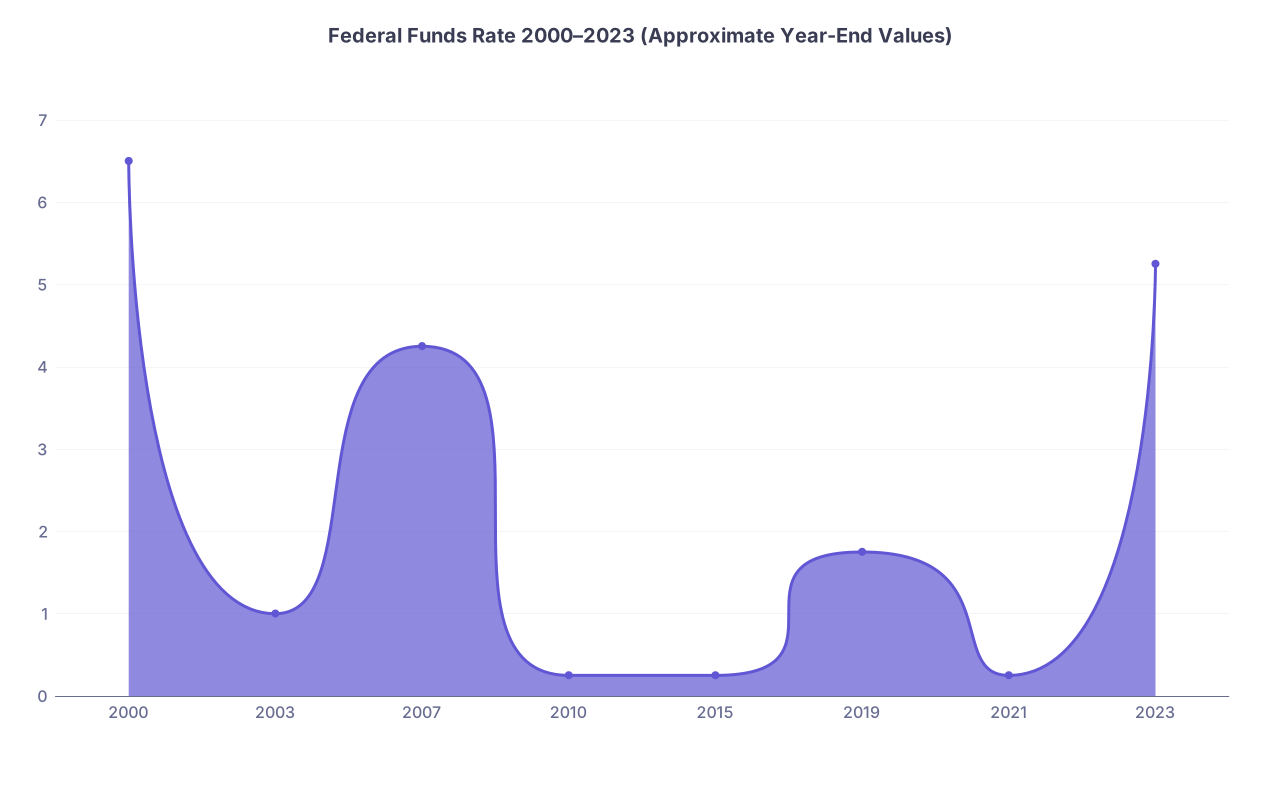
| Category | Value |
|---|---|
| 2000 | 6.5 |
| 2003 | 1 |
| 2007 | 4.25 |
| 2010 | 0.25 |
| 2015 | 0.25 |
| 2019 | 1.75 |
| 2021 | 0.25 |
| 2023 | 5.25 |
Key observations:
- Lower bound has been 0–0.25% in 2003, 2009–2015, and 2020–2021.
- Upper bound in this modern era (2000+): mid‑5% range.
- Moves are cyclical. The rate does not go up forever. Tight cycles are followed by easing.
What that means for variable student loan refis:
- When starting from a very low base (e.g., LIBOR or SOFR near 0.25–1.0%), variable rates can undercut fixed by 1–3 percentage points early on.
- Risk is back‑loaded. The cheap years are front‑loaded and obvious in your monthly payment. The pain shows up later if central banks tighten.
I have watched plenty of physicians start residency on 1.8–2.5% variable refinance rates when policy rates were at the floor, then 2–3 years later see their rate drift up to 4–5% as hikes came through. For some, it was still a win. For others, negligible savings versus just locking a good fixed early.
Variable can make sense if:
- Your payoff horizon is short (3–5 years), so you front‑load most payments during a low‑rate window.
- You have surplus cash and could aggressively pay down if rates spike.
- You are disciplined enough to refinance again into fixed if the cycle turns.
Fixed makes more sense when:
- You are already at a historically attractive absolute rate (say 3–4.5% for grad‑level debt).
- Your payoff path is 7–15+ years.
- You want to remove macro risk from the equation.
History does not tell you which is “always better.” It tells you that betting heavily on prolonged ultra‑low rates over a 10–15 year horizon is naive.
5. How Macroeconomic Cycles Translate Into Refinance Windows
Rates do not move at random. They move in cycles tied to inflation, growth, and central bank policy. You do not need an economics degree; you just need a few basic patterns.
Here is the rough cycle that drives most refinance windows:

| Step | Description |
|---|---|
| Step 1 | High inflation |
| Step 2 | Central bank hikes |
| Step 3 | Interest rates rise |
| Step 4 | Refi rates worsen |
| Step 5 | Growth slows |
| Step 6 | Inflation falls |
| Step 7 | Central bank cuts |
| Step 8 | Interest rates fall |
| Step 9 | Refi window improves |
What this means, practically:
- When inflation is hot and the news cycle is full of “rate hikes,” refinance offers tend to worsen. You will see fixed offers creeping up.
- After a hiking cycle, there is typically a plateau, then an easing phase. That easing phase is where some of the best refinance deals appear.
- Nobody rings a bell at the bottom. By the time the popular press is loudly celebrating “lowest mortgage rates ever,” you are often already on the upswing or near the trough.
Over the last 20 years, the best refinance windows tended to cluster:
- Mid‑2000s before the 2006–2007 hikes peaked.
- 2012–2016 during the post‑crisis zero‑rate era.
- 2020–early 2022, especially for those who moved quickly before the inflation spike forced aggressive hikes.
If you are holding 6–8% student loans and see refinance offers in the 2–4% range (which did happen in those windows for strong borrowers), the data says that is a generational opportunity, not something likely to be available anytime you feel like it.
6. Federal Protections vs Private Refinancing: Timing Risk Is Asymmetrical
Refinancing is not just an interest rate decision. You are also trading federal protections for private contract terms. That matters a lot more after the COVID forbearance experiment.
The federal side offers:
- Income‑driven repayment (IDR) options (SAVE, PAYE/IBR legacy, etc.)
- Potential Public Service Loan Forgiveness (PSLF)
- Broad disaster or emergency forbearances (as we saw 2020–2023)
- Death and disability discharge rules more favorable than many private contracts
The private side offers:
- Lower interest rates (sometimes dramatically lower)
- Shorter terms and aggressive payoff opportunities
- Fewer political or policy surprises—but also no broad relief events
The timing implication is asymmetrical:
- Once you refinance federal loans privately, you cannot return to the federal system.
- But you can refinance private loans again and again as rates or your risk profile improve.
So:
- If you are even a plausible PSLF candidate (hospital employed, academic medicine, government, or 501(c)(3) employer), history says you should not be in a rush to refinance federally‑held loans unless you have fully ruled out forgiveness.
- If you are firmly in the private camp (no PSLF path, not using IDR meaningfully, high income), the timing question becomes almost purely financial: current rate vs available private rate vs expected changes in your risk profile.
I have seen too many residents refinance federal loans into private at a modest 1–1.5 percentage point reduction… then take hospital or academic roles that would have qualified for PSLF. The “timing” they were focused on—grabbing a slightly lower private rate—was the wrong variable entirely. They missed six figures of forgiveness chasing a 1% APR improvement.
7. A Data‑Driven Framework: When Refinancing “Now” Beats Waiting
Let me strip this down to a decision model that behaves rationally given historical interest rate behavior.
You should lean toward refinancing now (or at least running serious lender quotes) when most of these are true:
- Your average interest rate is ≥ 6.5% on large balances ($50k+), especially grad or PLUS loans.
- You are not using, and do not plan to use, PSLF or long‑term IDR forgiveness.
- Refinance offers give you at least a 1.5–2.0 percentage point drop in rate with similar or shorter term.
- Your credit profile is stable to improving, but you are not expecting a massive jump in creditworthiness in the next 6–12 months (e.g., you already have attending‑level income).
- Macroeconomically, rates are not at obvious all‑time lows; they are in a mid‑cycle or rising cycle. In those environments, the expected value of “waiting for cheaper money” is especially poor.
You should lean toward waiting or partially refinancing when:
- Your current federal rates are in the 3–4.5% range and you anticipate possible PSLF eligibility.
- Your income or credit profile will reasonably jump in the next 6–18 months (residency to attending, high six‑figure job locked in, major debt payoff that drops your DTI).
- Market rates are obviously elevated relative to historical norms (10‑year Treasury in the 4.5–5.5%+ zone) and you are not getting compelling refinance quotes.
There is also a blended strategy that the numbers often support:
- Refinance only high‑rate private loans or high‑rate federal loans you are certain will never touch PSLF/IDR.
- Leave low‑rate federal debt in the system as a hedge against income variability, career shifts, or future policy changes.
8. Concrete Timing Scenarios: What the Data Favors
To make this real, here are three typical borrower profiles and how historic rate context shapes timing.
Scenario 1: Early‑Career Physician with 7.25% Grad PLUS
- $250k in federal loans, weighted average 7.1% (mix of Unsub + PLUS)
- PGY‑2, income $65k, no spouse, likely hospital employed attending at a non‑profit
- Current private refinance quotes: 5.5–6.0% (resident‑friendly, interest‑only period)
Historically, 7% is a high student loan rate. 5.5–6.0% is better, but the potential PSLF value dwarfs the interest savings if they spend 10 years in qualifying employment.
Data‑driven answer: Do not refinance federal loans yet. The refinancing timing question is moot until PSLF is clearly off the table. Use IDR, track PSLF-qualifying payments. Consider refinancing only if later you move decisively into private practice or non‑PSLF roles and can snag a truly meaningful rate cut.
Scenario 2: Private‑Practice Dentist with 6.8% Loans, No PSLF Option
- $400k in mixed federal and private loans, weighted average 6.8%
- Owner in private dentistry group, income ~$300k and rising, strong credit
- No chance of PSLF, no desire for 20‑25 year IDR forgiveness tax bomb
- Current refinance quotes: 4.0–4.5% fixed on 10–15 year terms, 3.5% variable
Historically, 4–4.5% fixed for high-balance grad/professional debt is good. The expected value of waiting for something like 3% fixed is low, and the cost of sitting at 6.8% is huge.
Data‑driven answer: Refinance now, lock a competitive fixed rate. A short‑term variable might offer slightly better early savings, but with a multi‑decade data set showing rate cycles, the added rate risk is not usually worth it on a 10–15 year horizon unless they are dead‑set on a 5‑year payoff and are very aggressive.
Scenario 3: MBA with Mixed 5.3% Federal and 9.5% Private Loans
- $120k total: $80k federal at ~5.3%, $40k private at 9.5%
- Corporate job, income $140k, unlikely to work for non‑profit government
- Refinance quotes: 4.0–4.5% fixed on 10 year, 3.5–4.0% variable
Here, history says:
- 9.5% is extremely expensive debt in any normal interest rate environment.
- 5.3% federal is moderately high but still within the range where federal protections may justify keeping it if you want flexibility.
Data‑driven answer: Refinance the 9.5% private loans immediately. That is a clear arbitrage. For the 5.3% federal portion, decision hinges on job stability and risk tolerance. If stable and confident in paying off in under 10 years, refinancing that portion later—particularly if rates ease—could make sense. There is no massive penalty in waiting on the mid‑5% federal piece because it is not as egregiously mispriced as the 9.5% private chunk.
9. What History Actually Means For You
Compress everything above and you get three simple, evidence‑based points:
Most borrowers lose money by over‑timing the rate cycle. The cost of carrying 6–8% loans while you wait for a hypothetical perfect window is usually higher than the incremental benefit of squeezing an extra 0.5–1.0% off your refi rate.
Historic context tells you if your current rate is “bad.” If you are above ~6.5% in a world where strong borrowers routinely got 3–5% over the last decade, you are on the wrong side of history and should be exploring refinancing—subject to federal protection trade‑offs.
Federal protections are a bigger timing variable than market rates. Once you give up PSLF and robust IDR, you do not get them back. Rates will rise and fall for the rest of your repayment life. You can always refinance private again. You cannot un‑refinance federal.
If you treat refinancing like a one‑time rate gamble, you will almost certainly misplay it. Treat it like a series of calculated, data‑driven adjustments over the life of the loan, anchored in historical context and your specific career path, and the numbers tend to land in your favor.