
The math on putting federal student loans in forbearance during residency is brutal. Not mildly suboptimal. Brutal.
For most residents with six‑figure debt, general forbearance is the single most expensive “easy” choice they can make in their financial life. And the damage is not just a few thousand dollars. Over a 20–30 year horizon, the data show mid–five figure to low–six figure differences compared with smarter alternatives.
Let me walk through the numbers like I would for a PGY‑1 who just brought me their servicer screenshot on a call.
1. The Baseline: What Your Loans Look Like Entering Residency
We need a realistic starting point. Not fantasy, not worst case, just median‑ish.
Recent data and what I see repeatedly:
- Total federal med school debt: $250,000–$350,000
- Weighted average interest rate: 6–7%
- Residency length: 3–7 years depending on specialty
I will use three scenarios to show how the math scales:
| Scenario | Principal | Rate | Residency Length |
|---|---|---|---|
| A | $250,000 | 6.0% | 3 years |
| B | $300,000 | 6.5% | 4 years |
| C | $400,000 | 7.0% | 5 years |
Assume you match in June, start residency in July, and your loans come out of in‑school deferment and grace around that same summer window. From that point, the clock is running.
Monthly interest, before doing anything fancy:
- Scenario A: 6.0% on $250,000 → $15,000/year → $1,250/month
- Scenario B: 6.5% on $300,000 → $19,500/year → $1,625/month
- Scenario C: 7.0% on $400,000 → $28,000/year → $2,333/month
Those are just the interest meters. Not payments. Not principal reduction. Just the cost of debt existing.
Now look at a typical PGY‑1 salary: roughly $60,000–$70,000 (pre‑tax), depending on geography and program. Your take‑home in a high‑tax city might sit around $3,500–$4,300 per month. A “standard” payment on a 10‑year plan would blow that to pieces.
So you are tempted by the little “Request Forbearance” link on your servicer’s site.
2. What Forbearance Actually Does To the Numbers
General forbearance feels merciful: $0 payment required, no delinquency, no collections. But under the hood, interest keeps accruing on the full principal balance. And for most med grads, that interest later capitalizes—gets added to principal—when the forbearance period ends.
Let’s quantify the pure residency effect first: 100% forbearance during residency, then you start repayment as an attending.
Scenario A: $250k at 6.0%, 3‑year residency, full forbearance
During residency, you pay $0. The loan does not care.
Annual interest:
$250,000 × 6.0% = $15,000
Three years of pure interest:
$15,000 × 3 = $45,000
End of residency balance if all interest capitalizes:
$250,000 + $45,000 = $295,000
That is an 18% increase in your balance before you make your first “real doctor” payment.
Scenario B: $300k at 6.5%, 4‑year residency, full forbearance
Annual interest:
$300,000 × 6.5% = $19,500
Four years:
$19,500 × 4 = $78,000
New balance:
$300,000 + $78,000 = $378,000
You exit residency owing 26% more than you borrowed.
Scenario C: $400k at 7.0%, 5‑year residency, full forbearance
Annual interest:
$400,000 × 7.0% = $28,000
Five years:
$28,000 × 5 = $140,000
New balance:
$400,000 + $140,000 = $540,000
That is a 35% increase. You essentially borrowed another year of med school just by doing nothing.
Here is the side‑by‑side:
| Scenario | Start Balance | Residency Years | Interest Accrued | End Balance | Percent Increase |
|---|---|---|---|---|---|
| A | $250,000 | 3 | $45,000 | $295,000 | 18% |
| B | $300,000 | 4 | $78,000 | $378,000 | 26% |
| C | $400,000 | 5 | $140,000 | $540,000 | 35% |
That is the short‑term damage. The real pain shows up when we extend this over a full repayment period with compound interest.
3. The Long‑Run Cost: Forbearance vs Income‑Driven Repayment
Residents rarely compare forbearance against the right benchmark. The real alternative is not “full standard payment” (which is impossible). It is income‑driven repayment (IDR): PAYE, SAVE (which replaced REPAYE), IBR, etc.
IDR does three things that matter while you are a resident:
- Lowers your required payment by tying it to discretionary income.
- Often triggers interest subsidies (SAVE especially).
- Keeps the clock running on the 20‑ or 25‑year forgiveness timeline and on Public Service Loan Forgiveness (PSLF).
Math time.
Assumptions for IDR comparison
I will use a concrete setup:
- Single resident, no dependents.
- PGY‑1 salary: $65,000, rising 3% per year through residency.
- 2024 poverty guideline for 1 person (contiguous US): ~$15,060.
- Discretionary income for SAVE/PAYE: income above 225% (SAVE) or 150% (PAYE) of poverty line. I will illustrate with SAVE because it is currently the most beneficial.
225% of poverty line:
$15,060 × 2.25 ≈ $33,885
Discretionary income PGY‑1:
$65,000 − $33,885 ≈ $31,115
SAVE payment is 10% of discretionary income / 12:
0.10 × $31,115 / 12 ≈ $259/month
Some numbers will change slightly with bracket updates and COLA, but this is close enough to show scale.
Annual payment PGY‑1: ~$3,100, rising modestly each year. Over a 3‑year residency, you might pay roughly $10,000 in total on SAVE. Over a 5‑year residency, maybe $20,000–$25,000.
Now compare that with $45,000–$140,000 of accrued interest under forbearance. The delta is enormous.
Interest Subsidy Under SAVE
SAVE has a not‑subtle feature: if your required payment does not cover monthly interest, 100% of the unpaid interest on subsidized and unsubsidized loans is waived. Not capitalized. Not carried forward. Erased.
So with a $250,000 loan at 6%:
- Monthly interest: ~$1,250
- Monthly SAVE payment: ~$260 (early residency)
You are underpaying interest by about $990 per month. SAVE wipes that $990 instead of letting it accumulate. Your balance stays roughly flat (ignoring slight drift from payment timing and salary increases).
With forbearance, that $1,250 per month just stacks up, then capitalizes.
The math is equally glaring on the larger balances.
Let’s quantify two paths for Scenario B ($300k at 6.5%, 4 years):
Path 1: Forbearance during residency, then 20‑year standard repayment
Residency:
- Accrued interest: $78,000 (from earlier)
- End residency balance: $378,000
Now suppose you refinance or enter a standard 20‑year fixed plan at, say, 5.5% as an attending (whether federal or private). What does that look like?
Use a standard amortization approximation:
Monthly rate: 5.5% / 12 ≈ 0.4583%
Term: 240 months
Payment ≈ P × [r / (1 − (1 + r)^−n)]
r = 0.004583, n = 240, P = $378,000
Payment ≈ 378,000 × [0.004583 / (1 − (1.004583)^−240)]
(1.004583)^−240 is about 0.369. Denominator ≈ 1 − 0.369 = 0.631.
So payment ≈ 378,000 × (0.004583 / 0.631) ≈ 378,000 × 0.007265 ≈ $2,744/month.
Total paid over 20 years:
$2,744 × 240 ≈ $658,560
Total interest over the 20 years:
$658,560 − $378,000 ≈ $280,560
Add the $78,000 you let accrue in residency (which is now baked into principal). Purely for framing, that is interest too, even though it has been capitalized.
Economic cost of interest from med school until loan death:
$78,000 + $280,560 ≈ $358,560
Path 2: SAVE during residency, then same 20‑year 5.5% repayment
Residency period on SAVE:
Total paid over 4 years: let us approximate $3,100 PGY‑1, then modest annual raises. Call it ~$11,000–$13,000 total. I will use $12,000 as a rough midpoint.
Because of SAVE’s unpaid interest subsidy, your balance after residency is roughly the original $300,000 (may drift a few thousand, but not tens of thousands).
Now that attending‑phase 20‑year, 5.5% amortization on $300,000:
Payment ≈ 300,000 × 0.007265 ≈ $2,180/month.
Total over 20 years:
$2,180 × 240 ≈ $523,200
Interest over those 20 years:
$523,200 − $300,000 = $223,200
Add the residency SAVE payments (~$12,000), which were mostly eating interest:
Total interest‑like cost: ~$235,200.
Compare that to Path 1’s ~$358,560. You are paying roughly $123,000 more over your lifetime for the privilege of not paying $12k during residency.
That ratio is absurd: avoid $12k now, pay ~$120k more later. A 10:1 penalty.
Here is a compact comparison:
| Metric | Forbearance Path | SAVE Path (Residency) |
|---|---|---|
| Balance at start of residency | $300,000 | $300,000 |
| Payments during residency | $0 | ≈ $12,000 |
| Balance at end of residency | $378,000 | ≈ $300,000 |
| 20-yr payment at 5.5% (attending) | ≈ $2,744/month | ≈ $2,180/month |
| Total paid over 20-yr attending | ≈ $658,560 | ≈ $523,200 |
| Lifetime “interest” cost (all-in) | ≈ $358,560 | ≈ $235,200 |
| Extra lifetime cost of forbearance | — | ≈ $123,000 |
That is for a mid‑range case. On a $400k loan with a 5‑year residency, the gap pushes even higher.
4. PSLF: Forbearance Destroys Progress You Cannot Get Back
If you are in residency at a 501(c)(3) hospital and even thinking about PSLF, forbearance is sabotage.
PSLF requires:
- 120 qualifying monthly payments (10 years),
- in a qualifying repayment plan (IDR counts),
- while working full‑time at a qualifying employer (most teaching hospitals qualify).
Each $0‑payment month under IDR in residency counts toward that 120. Each forbearance month does not. That is the entire game.
Let’s model two internal medicine residents, both at a big academic center.
- Both have $300,000 at 6.5%.
- Both plan to stay in academic medicine for at least 10 years total.
- Resident #1 uses SAVE throughout residency.
- Resident #2 uses forbearance during residency, then starts SAVE as an attending.
Resident #1: SAVE all 3 years of residency, then 7 more years as attending
- 36 qualifying PSLF payments during residency.
- Needs 84 more as attending.
If attending salary is, say, $250,000 and rises over time, attending‑phase SAVE payments might average $1,500–$2,000 per month early, climbing later, but even then the 10‑year PSLF horizon caps the total paid.
Even with approximate numbers, you might see:
- Residency payments: ~$9,000–$12,000 total.
- Attending SAVE payments over 7 years: say ~$180,000–$220,000 (depends heavily on family size, marital status, and raises).
- Total cash outlay before forgiveness: ballpark $200,000–$230,000.
- Remaining balance at 120th payment is forgiven tax‑free.
Resident #2: Forbearance for 3 years, then 10 full years of SAVE as attending
Residency:
- $0 payments.
- Accrued interest: roughly $58,500 (3 years at 6.5% on $300k).
- New principal: ~$358,500 (if fully capitalized).
Now they start PSLF clock as an attending:
- Need all 120 qualifying payments as an attending.
- Payments are larger because the principal is larger.
- Payments stretch over 10 full attending years, not 7.
Even if you conservatively assume average SAVE payment of, say, $1,800–$2,300 per month across that decade, total cash outlays are more like $216,000–$276,000 over those 10 years. And you sacrificed 3 years of residency payments that would have been small and still counted.
I have seen real PSLF scenarios where:
- Resident using IDR throughout: total paid ~$190,000 on $350k of loans, then forgiveness.
- Resident forbearing during 4‑year residency: total paid ~$260,000–$280,000 before forgiveness on roughly equivalent starting debt.
You do not get those “lost” qualifying months back. That is not a small clerical issue. That is $50k‑$100k of lifetime after‑tax money gone.
To make this concrete, here is a simplified chart comparing qualifying PSLF payment counts:
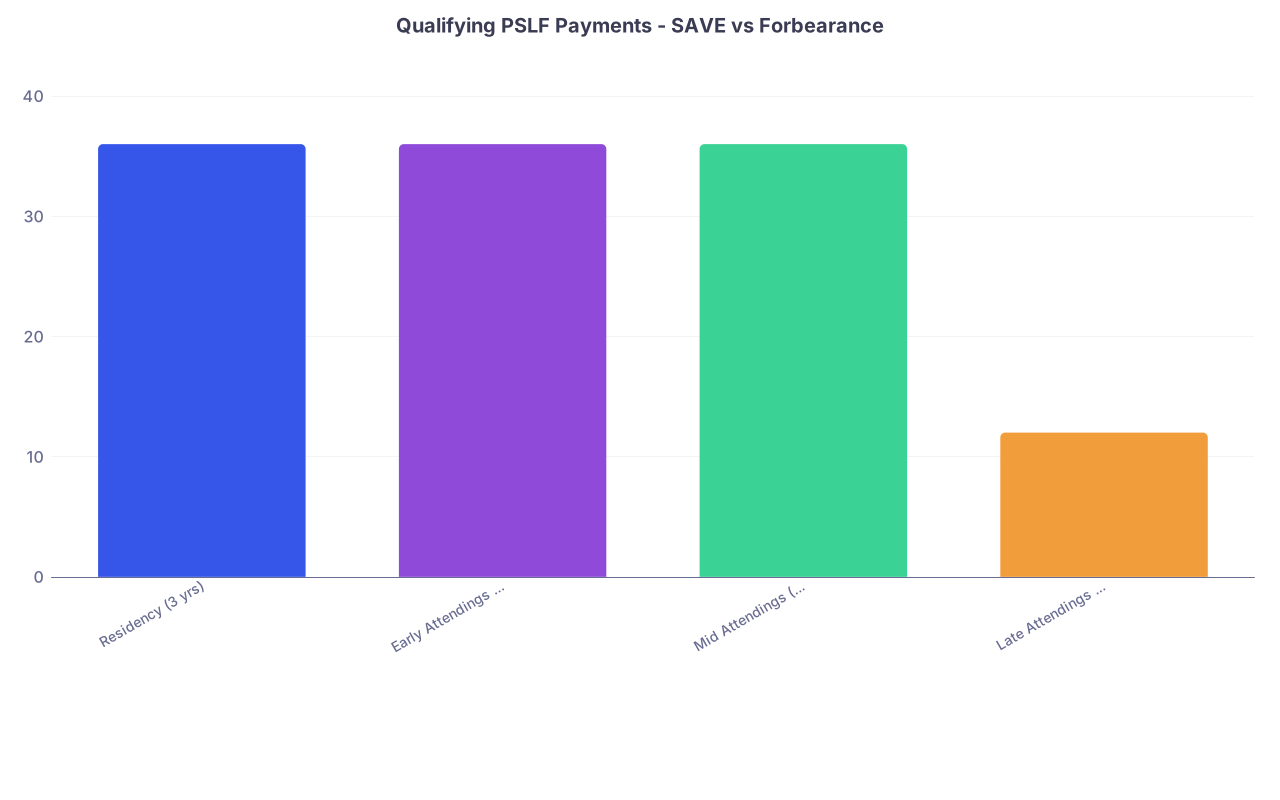
| Category | Value |
|---|---|
| Residency (3 yrs) | 36 |
| Early Attendings (Years 4-6) | 36 |
| Mid Attendings (Years 7-9) | 36 |
| Late Attendings (Years 10-12) | 12 |
In the SAVE‑during‑residency case, most PSLF “clock” runs while your payments are smallest. In the forbearance case, you shove all qualifying payments into your highest‑income, highest‑payment years. That is backward.
5. Psychological Comfort vs Quantitative Damage
I hear the same line from residents over and over: “I just cannot afford anything right now. I will deal with it as an attending.”
On paper, I understand the instinct. You are barely sleeping. You are moving cities. You are paying for board exams and licensing. The idea of sending $250/month to a servicer feels offensive.
But look at the ratios.
Using the Scenario B math:
- Short‑term “savings” from forbearance in residency: ~$12,000 avoided over 4 years (≈ $250/month).
- Long‑term extra cost: ~$120,000 higher lifetime payments.
That is like borrowing $12,000 today at an effective internal rate of return well north of 15–20% in “interest” cost. No rational person would sign that loan if you described it clearly.
On top of that, forbearance has these non‑obvious side effects:
- Extends your repayment horizon. Many residents who forbear then feel crushed by the size of attending payments and end up stretching to 25‑year IDR. That adds tens of thousands more in interest.
- Delays principal reduction. The first dollars you pay as an attending are servicing a larger principal.
- Messes with forgiveness math on IDR plans (outside PSLF) by letting the balance balloon, making eventual taxable forgiveness larger.
Here is a quick visual of how principal behaves:
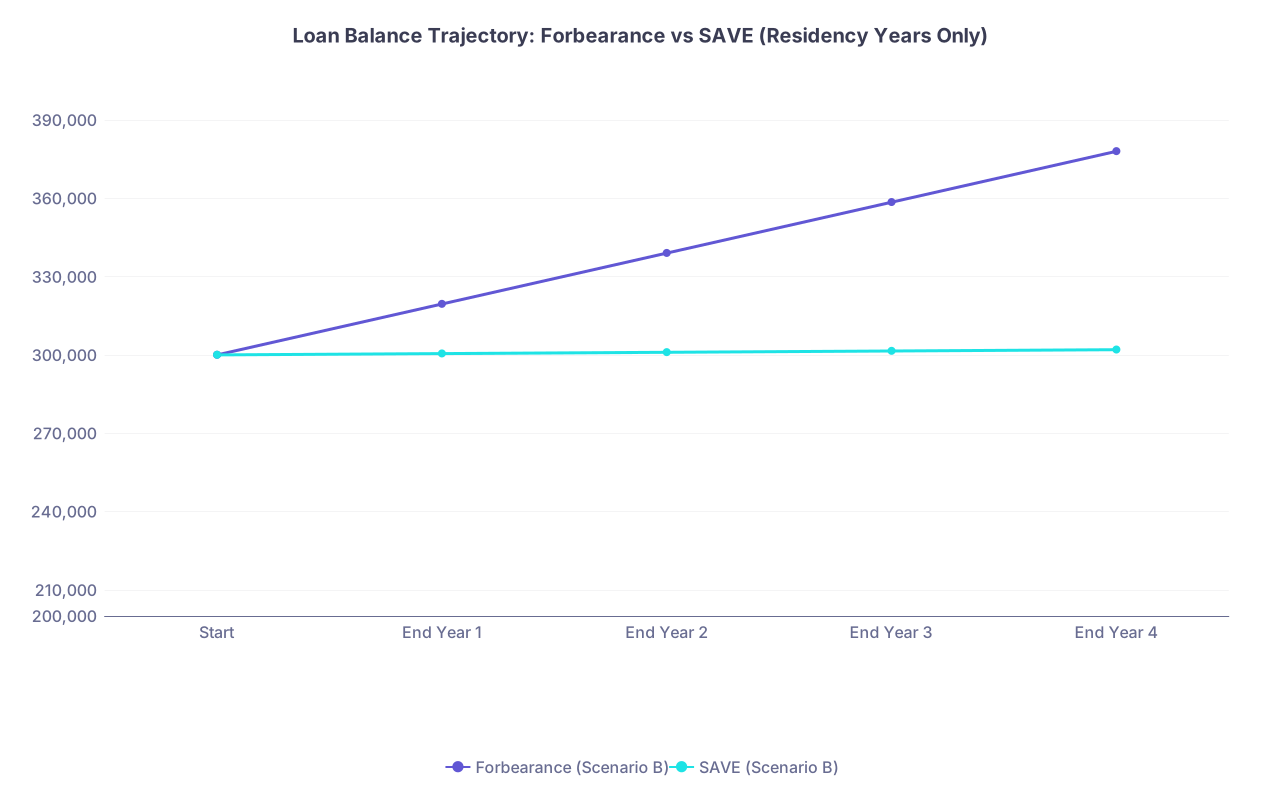
| Category | Forbearance (Scenario B) | SAVE (Scenario B) |
|---|---|---|
| Start | 300000 | 300000 |
| End Year 1 | 319500 | 300500 |
| End Year 2 | 339000 | 301000 |
| End Year 3 | 358500 | 301500 |
| End Year 4 | 378000 | 302000 |
The line for SAVE is almost flat. Forbearance climbs aggressively. That gap is your future working life.
6. Edge Cases: When Forbearance Might Make Sense (And When It Definitely Does Not)
I am not going to say “never” use forbearance. There are narrow conditions where it can be defensible, but they are far rarer than how often residents use it.
Potentially Defensible Uses
Short‑term emergency (≤ 3–6 months)
Sudden medical issue, family crisis, moving disaster, etc. Taking a few months of forbearance instead of missing payments and wrecking your credit is fine. The cost is limited if it is brief.You are 100% sure you will not use PSLF or IDR long term and will aggressively pay off as an attending in < 5 years
Even here, the data usually favor paying something during residency if you can. But if your numbers are: $150k of loans, high‑paying specialty, no interest in PSLF, spouse with high income, and you truly are going to wipe them out in 3–5 years, then full forbearance is less catastrophic. Still not optimal, just less awful.You already have huge cash drain from high‑interest consumer debt
If you are sitting on 24% credit card debt and have to choose between putting $300/month to that vs paying IDR on 6–7% federal loans, the data say kill the 24% first. Temporary forbearance on student loans while you eradicate toxic debt can pencil out.
Clearly Bad Uses
- You are at a nonprofit hospital, even considering PSLF: forbearance is almost always a major unforced error.
- Your debt‑to‑income ratio will be ≥ 1.5 as an attending (e.g., $400k loans, $250k salary): you are very likely to benefit from IDR and/or PSLF. Forbearance just makes the later math worse.
- You “do not want to think about it” and plan to “figure it out later”: that procrastination is expensive. The compounding meter does not care about your mental bandwidth.
7. Practical Numbers‑First Plan for Residents
Here is how I would structure this logically, looking only at the numbers.
Check employer PSLF eligibility
If your residency hospital is a 501(c)(3) or government employer, assume PSLF is on the table until proven otherwise. That alone makes forbearance a mostly terrible option.Get on SAVE as soon as your grace period ends
Not next year. Not “after intern year calms down.” The earlier your IDR plan starts, the more low‑payment months you bank.Estimate your payment with actual numbers
Take your PGY‑1 salary and run it through a discretionary income calculation. If your monthly SAVE payment is anywhere under $400–$500, the damage from paying that is minuscule compared to the lifetime cost of skipping it.Use forbearance only for truly acute shocks
If you must, do 1–3 months, then get back on IDR. Treat forbearance like a fire alarm, not like a lifestyle.If planning PSLF, treat each $0 IDR month as gold
Those zero‑or‑low payments are “buying” you 1/120th of total forgiveness at a discount. Forbearance months are buying nothing.
8. The Bottom Line, Backed by the Math
The data are not subtle:
- For a typical med grad with $300,000 at 6–7% interest, full forbearance during a 3–5 year residency inflates the balance by $45,000–$140,000 before real repayment starts.
- Comparing lifetime costs, forbearance vs SAVE during residency often creates an extra $80,000–$150,000 of total payments over your career.
- For residents at PSLF‑qualifying employers, each year of forbearance effectively throws away 12 cheap qualifying payment months and replaces them with 12 expensive attending‑income months later.
If you want a single sentence:
For most residents with six‑figure federal loans, the “true lifetime cost” of putting loans in forbearance during residency is not the $0 payment today—it is tens to hundreds of thousands of dollars in extra payments over the next 20–30 years.
Three key takeaways:
- Full forbearance in residency is usually a five‑figure to six‑figure mistake when you run the numbers against SAVE or other IDR plans.
- If PSLF is even a remote possibility, forbearance destroys progress that you cannot replicate later at the same low cost.
- A few hundred dollars per month during residency, via SAVE, is almost always a dramatically better financial trade than the illusion of “relief” that forbearance provides.