
The average physician is misreading their own balance sheet—and the data on 10‑year net worth curves proves it.
Most doctors obsess over “paying off debt fast” or “maximizing forgiveness” without ever quantifying what those choices do to their net worth trajectory over the first decade out of training. That is a mistake. When you model the numbers, the gap between strategies is often six figures by year 10, even when total lifetime cost ends up similar.
Let’s walk through it the way I would in a spreadsheet: income, taxes, loan rules, cash flow, then net worth curves. No folklore. Just math.
1. The Baseline: A Typical Young Attending Profile
To compare strategies, you need a clean baseline. I will use a simplified but realistic scenario that matches what I see repeatedly:
- Federal Direct Loans: $300,000 at 6.5% weighted average interest
- Residency: 3 years, PGY‑1 to PGY‑3 income rising modestly
- Attending salary: $300,000 starting in year 4 (post‑training), growing 3% annually
- Filing status: Single, standard deduction
- State income tax: 5% flat estimate for simplicity
- Employer: Nonprofit hospital (PSLF eligible scenario)
We will track net worth over 10 years from the end of residency (so ages roughly 31–41 for a traditional path). “Net worth” here is:
Net worth = Financial assets (savings and investments) – Loan balance
No home equity, no car value, no side businesses. Those complicate things but do not change the directional comparison of loan strategies.
To keep the focus on relative differences, assume:
- Any available surplus cash above loan payments goes into a taxable brokerage account at a 5% annual after‑tax return.
- Retirement accounts (401(k), 403(b)) could be layered on top, but that mainly shifts tax efficiency, not loan strategy ranking, over just 10 years.
2. The Four Competing Loan Strategies
We will compare four distinct strategies that I see physicians actually use:
- Standard 10‑Year Repayment (Aggressive payoff)
- Refinance privately to a 10‑Year Term (lower rate, same horizon)
- Income‑Driven Repayment (IDR) + PSLF (Public Service Loan Forgiveness)
- Income‑Driven Repayment, No PSLF (Long‑term IDR with potential taxable forgiveness later)
There are variants (5‑year refi, 20‑year refi, double payments, etc.), but these four will show the main shifts in the 10‑year net worth curve.
3. Strategy 1 – Standard 10‑Year Repayment
Under the federal standard 10‑year plan, the loan is amortized over 120 months at the stated rate. For $300,000 at 6.5%, the monthly payment is approximately:
- Payment ≈ $3,400/month
- Annual payment ≈ $40,800
You start these full payments after residency.
During residency, the options vary—most residents opt for REPAYE/SAVE or other IDR with partial interest subsidy. To simplify comparisons, assume residency payments are small and mostly interest only; the main action starts when you become an attending.
At attending income:
- Gross income: $300,000
- Estimated taxes (federal + state + payroll): roughly 35–38% effective, call it $110,000 total to keep numbers manageable
- Net after tax: about $190,000
- Minus loans: $40,800
- Remaining for living and investing: $149,200
If the physician lives on $120,000 (post‑tax expenses, a comfortable but not absurd lifestyle in many metro areas), that leaves roughly:
- Investable surplus: $29,200/year
Investing that at 5% for 10 years:
Using a standard future value of an annuity formula:
- FV ≈ 29,200 × [((1.05^10 – 1) / 0.05)] ≈ 29,200 × 12.58 ≈ $367,000
Loan balance after 10 years: $0 (since it is fully paid off).
So approximate 10‑year net worth under Standard:
Net worth ≈ $367,000 – $0 = $367,000
Before you say “that seems low,” remember: no employer retirement match modeled, no home equity, no early attending raises above 3%, and 5% investment return is conservative. This is not about the absolute number; it is about comparing curves across strategies.
The key shape:
- Years 1–3 out of training: net worth is dragged down by big payments and relatively low accumulated investments.
- Years 7–10: net worth accelerates, but you only really feel “debt‑free” around years 8–10.
4. Strategy 2 – Private Refinance, 10‑Year Term
Same payoff horizon, lower rate. Refinance is the blunt instrument physicians reach for when they do not qualify for PSLF or have already decided to forgo it.
Assume refinancing:
- Principal: $300,000
- Fixed rate: 4.0% (realistic for strong‑income physician with clean credit in a normal rate environment; recent years have varied)
- Term: 10 years
New payment:
- ≈ $3,040/month, or $36,500/year
So relative to federal standard:
- Payment is about $4,300/year lower
- Total interest cost over the 10 years also drops materially (from roughly $106,000 down to about $65,000—ballpark).
Cash flow as an attending:
- Net after tax: still about $190,000
- Minus loans: $36,500
- Remaining for living + investing: $153,500
If lifestyle is kept constant at $120,000, surplus to invest is around:
- $33,500/year
Now look at the 10‑year investment value at 5%:
- FV ≈ 33,500 × 12.58 ≈ $421,000
Loan balance at 10 years: $0.
Net worth at year 10:
Net worth ≈ $421,000 – $0 = $421,000
So, just moving from Standard to 10‑year refi, with identical lifestyle and investment behavior, raises 10‑year net worth about $54,000. Purely from slightly lower payments and lower lost interest.
The curve shape does not change much; it is still dominant debt service for the first decade. But the line is shifted upward.
5. Strategy 3 – PSLF + Income‑Driven Repayment (IDR)
The PSLF story is different. You are not optimizing for total interest paid. You are optimizing for forgiven balance and early positive net worth.
Assume:
- 3 years of qualifying IDR payments in residency (years R1–R3).
- 7 more years of qualifying IDR payments as an attending (years A1–A7).
- At 120 qualifying payments, the remaining federal loan balance is forgiven tax‑free.
Use a modern IDR framework similar to SAVE (the new iteration with generous terms):
- Payments based on 10% of discretionary income, where discretionary ≈ AGI – 225% of poverty line (rough approximation)
- In residency, AGI is low; payments are a few hundred per month.
- As an attending, AGI jumps, but IDR still keeps payments well below standard 10‑year amounts, especially early on.
To avoid a 20‑page digression into tax brackets and AGI engineering, I will use reasonable, conservative approximations from typical PSLF cases:
- Residency IDR payments: average $250/month, total over 3 years ≈ $9,000
- Attending IDR payments: year 1 around $1,200/month, growing with income and recalculation; average around $1,800/month over 7 years
- Total attending payments: ≈ $1,800 × 12 × 7 ≈ $151,200
Total paid over 10 years (3 residency + 7 attending):
≈ $9,000 + $151,200 = $160,000 in payments
That is barely more than half of the $300,000 principal and much less than what you pay under Standard or refi. The rest is forgiven.
Now focus on cash flow in the critical 10‑year attending window we are modeling:
For the first 7 years out of training (while you are making PSLF‑qualifying IDR payments):
- Attending net income after tax: ≈ $190,000
- Annual loan payment (average): ≈ $21,600
- Remaining for lifestyle + investing: ≈ $168,400
If lifestyle is still $120,000, the annual surplus for investing becomes:
- $48,400/year for 7 years
At year 7 as an attending (10th PSLF year including residency), your loan balance might still be, say, $200,000–$250,000, depending on interest accumulation and subsidies. Then it is wiped out tax‑free.
So net worth path:
- Years 1–7 out of training: you are investing aggressively while still technically heavily in debt.
- End of year 7 as an attending: investments sizable, loans drop to zero in a single accounting period.
- Years 8–10: you now redeploy former loan payment dollars to investments.
Let’s quantify.
Years 1–7 out of training (IDR + PSLF still active)
Invest $48,400/year for 7 years at 5%:
- FV at end of year 7 ≈ 48,400 × [((1.05^7 – 1) / 0.05)]
- (1.05^7 ≈ 1.407) → factor ≈ (0.407 / 0.05) ≈ 8.14
- FV ≈ 48,400 × 8.14 ≈ $394,000
Loan balance at that moment: still positive. Use a mid‑range example:
- Remaining balance at forgiveness: $220,000 (plausible under SAVE‑style rules given relatively modest IDR payments).
Net worth right before forgiveness:
≈ $394,000 – $220,000 = $174,000
The instant PSLF hits, that jumps to:
≈ $394,000 – $0 = $394,000
And then you still have three more years in our 10‑year attending window.
Years 8–10 out of training (post‑forgiveness)
No loan payments. Net income after taxes is still about $190,000. If lifestyle is unchanged at $120,000, you now invest:
- ≈ $70,000/year for years 8–10.
Add 3 more years of contributions plus growth to the existing $394,000:
Future value of the existing $394,000 after 3 years at 5%:
- 394,000 × 1.05^3 ≈ 394,000 × 1.158 ≈ $456,000
Future value of 3 years of 70,000 contributions:
- FV ≈ 70,000 × [((1.05^3 – 1) / 0.05)]
- 1.05^3 ≈ 1.158 → factor ≈ 3.158
- FV ≈ 70,000 × 3.158 ≈ $221,000
Total investments at year 10:
≈ $456,000 + $221,000 = $677,000
Loan balance: $0.
So 10‑year net worth under PSLF scenario:
≈ $677,000
Now compare that:
- Standard 10‑year: ≈ $367,000
- 10‑year refi: ≈ $421,000
- PSLF + IDR: ≈ $677,000
The net worth lift from PSLF vs 10‑year refi is roughly $256,000 by year 10 in this model. Over a quarter‑million difference.
And the shape of the curve is very different:
- Years 1–7: net worth is negative initially but climbs faster than any non‑PSLF strategy because payments are lower and investable surplus is higher.
- Year 7 (PSLF year): vertical jump in net worth when the loan balance disappears.
- Years 8–10: steepest positive slope because investments have compounding plus all prior “loan dollars” go to assets.
6. Strategy 4 – IDR Without PSLF (Long‑Term IDR & Taxable Forgiveness)
This is the slow burn. Some physicians at for‑profit employers stay on IDR without PSLF, hoping to ride to 20–25‑year forgiveness. For a 10‑year net‑worth lens, this usually looks weak unless cash flow is desperately tight early on.
Assume:
- Same $300,000 at 6.5%
- 25‑year IDR plan with 10% of discretionary income
- Forgiveness at year 25 is taxable under current law (this might change, but you do not plan on legislative miracles).
As an attending, IDR payments will be similar to the PSLF case but without the PSLF endpoint.
Use similar approximations:
- IDR payments during residency: total ≈ $9,000 over 3 years
- As an attending, maybe $1,800/month growing with income, but the loan persists and interest often partially capitalizes.
Over the 10‑year post‑training window, your out‑of‑pocket cost looks similar to the PSLF plan for those same 10 years. The big difference is that there is no forgiveness event after 7 attending years. The balance is still large at year 10.
Rough balance trajectory:
- Start: $300,000
- Modest residency IDR payments + interest → balance near or slightly above $300,000 at training end
- 10 years of attending IDR payments, but not enough to fully amortize principal
It is quite normal to see balances still in the $250,000–$290,000 range at year 10 post‑training in such a case.
Let’s model one specific path:
- Surplus for investing under IDR as attending (no PSLF): similar to PSLF earlier: about $48,400/year (same logic—IDR payments lower than standard)
- Invested annually at 5% for 10 years:
FV ≈ 48,400 × 12.58 ≈ $608,000
Loan balance at year 10: assume $260,000 (representative middle value).
Net worth:
≈ $608,000 – $260,000 = $348,000
Surprisingly, that is slightly worse than the standard 10‑year payoff ($367,000) and clearly worse than 10‑year refi ($421,000).
Why? Because you have allowed substantial interest to accumulate without any forgiveness offset inside this 10‑year window. Yes, you have higher liquid assets, but you are carrying a big liability with no tax‑free eraser at year 10.
The only reason you would rationally choose long‑term IDR without PSLF over a 10‑year refi, for a physician income, is if:
- You need maximum payment flexibility due to genuine uncertainty (disability, part‑time for years, entrepreneurial risk).
- You are explicitly planning for 20–25‑year taxable forgiveness and building a “tax bomb” fund in parallel.
From a raw 10‑year net worth curve perspective, the data is pretty unforgiving: long‑term IDR without PSLF usually underperforms.
7. Visualizing the 10‑Year Net Worth Curves
Here is a condensed comparison of the 10‑year outcomes under our modeled assumptions.
| Strategy | Rate | Year-10 Loans | Year-10 Investments | Year-10 Net Worth |
|---|---|---|---|---|
| Standard 10-Year | 6.5% | $0 | $367,000 | $367,000 |
| 10-Year Private Refi | 4.0% | $0 | $421,000 | $421,000 |
| PSLF + IDR | 6.5% | $0 (forgiven) | $677,000 | $677,000 |
| Long IDR, No PSLF | 6.5% | $260,000 | $608,000 | $348,000 |
And a simple picture of relative net worth by year 10:
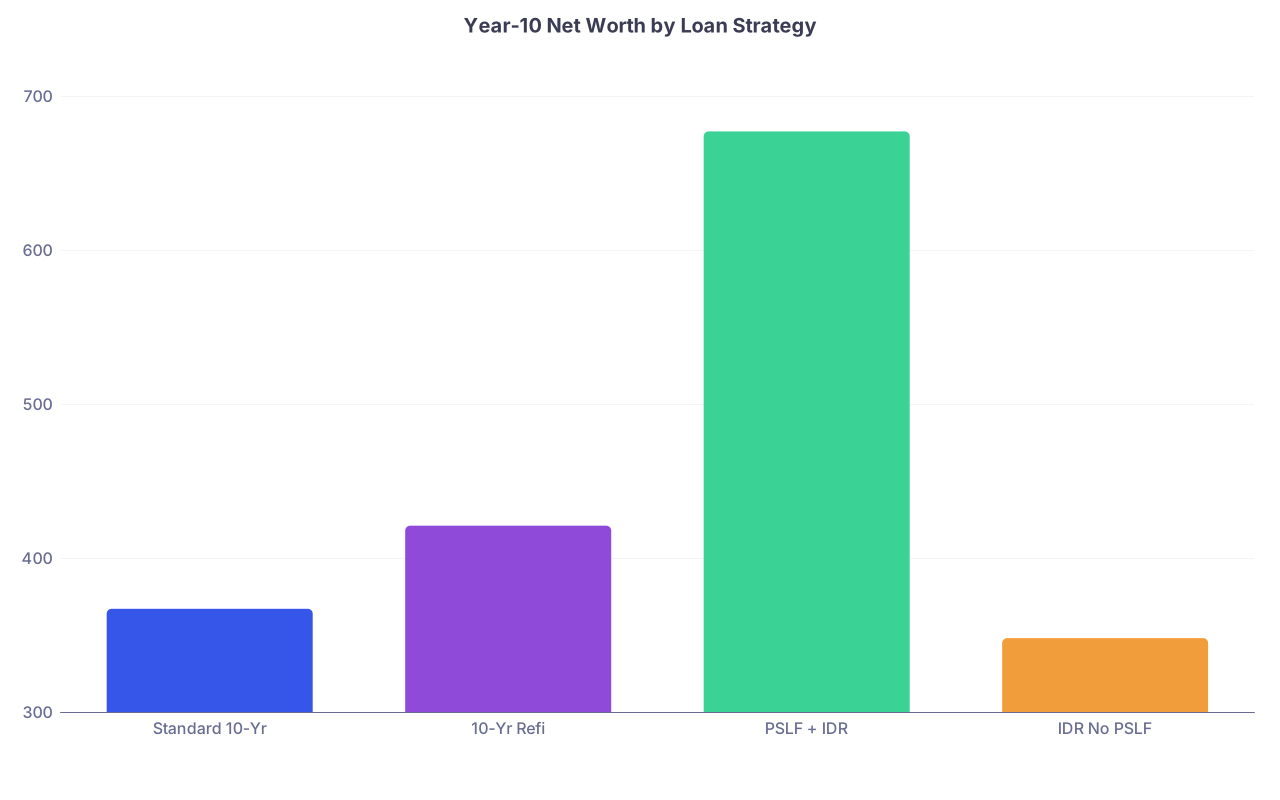
| Category | Value |
|---|---|
| Standard 10-Yr | 367 |
| 10-Yr Refi | 421 |
| PSLF + IDR | 677 |
| IDR No PSLF | 348 |
The outlier is obvious: PSLF + IDR, with serious investing discipline, pushes the 10‑year net worth curve much higher.
8. The Trade‑Off That Actually Matters: Flexibility vs Commitment
The numbers show clear patterns, but strategy is not just a math problem. It is also about risk tolerance and behavioral reality.
Standard vs 10‑Year Refi
The data here is boringly consistent:
- If you are not PSLF eligible, and
- Your income is high and stable, and
- You are committed to paying loans off in roughly 10 years or less,
then a well‑shopped private refinance almost always raises your 10‑year net worth relative to staying in federal Standard. You pay less in interest, keep similar payoff speed, and free cash to invest earlier.
The main trade‑off is loss of:
- Federal forbearance safety nets
- Disability discharge rules
- Future policy changes that might benefit federal borrowers
Most attendings with secure W‑2 jobs and no plan to return to academia or public service still underestimate these risks, but over a 10‑year window, they are manageable if you carry adequate disability and life insurance.
PSLF + IDR
Here is the mistake I see constantly: physicians at nonprofit hospitals reflexively refinancing out of PSLF eligibility because “forgiveness seems uncertain” or they “hate being in debt for 10 years.”
The math usually disagrees with that impulse.
In our model, PSLF boosted 10‑year net worth by roughly $256,000 vs a 10‑year refi. That is what you give up when you panic about policy risk that, so far, has moved in a more generous direction over time, not less.
Does PSLF always win? No.
Scenarios where PSLF loses edge:
- You switch to private practice or for‑profit employment within a few years and never accrue 120 qualifying payments.
- Your attending income is modest, your spouse earns a lot, and tax filing interactions push your IDR payment close to the standard payment anyway.
- You are extremely promotion‑oriented and expect a very rapid income rise that will make 10‑year payoff trivial, making forgiveness less meaningful.
But, for a full‑time attending at a PSLF‑qualifying employer with $300k+ loans, the default assumption, based on actual payment trajectories, should be: PSLF is likely to produce the highest 10‑year net worth, provided you invest the savings rather than inflating lifestyle.
9. How Lifestyle Creep Distorts the Curve
Every model above assumed a fixed lifestyle of $120,000 post‑tax. That is, frankly, optimistic for behavioral discipline. Many new attendings do something different:
- They “spend” the lower IDR payments via a bigger home, nicer car, private school, or general cost of living.
- The surplus that could have gone to investing simply vanishes.
When that happens, PSLF’s advantage shrinks dramatically.
Let’s quantify quickly. Under PSLF, instead of investing $48,400/year, suppose you invest only $20,000/year because you let spending expand.
10 years at 5%:
- FV ≈ 20,000 × 12.58 ≈ $252,000
Same forgiveness event removes the loans, but your total 10‑year net worth might now be:
≈ $252,000 – $0 = $252,000
Worse than even the plain vanilla Standard 10‑year payoff with disciplined investing.
The conclusion is not “PSLF is bad.” The conclusion is: PSLF only produces that high net‑worth curve if you capture the cash‑flow benefit and convert it to assets.
Loan strategy and lifestyle strategy are entangled. You cannot really separate them.
10. Adding Realistic Complexities: Marriage, Taxes, and Side Income
You can stop here if you want the main picture. But a few extra variables materially shift the 10‑year curve for many physicians:
Marriage and Filing Status
If you are married and use PAYE or SAVE with “married filing separately,” you can sometimes slash your IDR payment, which makes PSLF even more powerful—at the cost of a somewhat higher tax bill. The net financial impact over 10 years can be strongly positive or negative depending on income spread between spouses. I have seen couples pick the wrong filing status and give away $50k–$100k across a decade.Side Income (locums, moonlighting)
Extra earned income raises AGI, raises IDR payments, and slightly reduces PSLF value. But it also can be directly thrown at investments or even principal prepayments under a refinance model. The effect on the relative ranking of strategies is usually modest over 10 years unless side income is massive.Tax‑Advantaged Retirement Contributions
Maxing pre‑tax retirement accounts (401(k)/403(b), 457(b)) reduces AGI, which reduces IDR payments and increases PSLF benefits. For PSLF‑bound physicians, the data is blunt: not maxing your pre‑tax accounts is usually self‑sabotage, because you are paying higher IDR payments and higher current taxes for no good reason.
These factors all tilt the curves but they rarely invert the core hierarchy:
- PSLF + IDR (with disciplined investing)
- 10‑year refi
- Standard 10‑year
- Long‑term IDR without PSLF
11. What the Data Actually Tells You to Do
Strip away emotions and here is the cold hierarchy implied by the numbers for a $300k loan burden:
- If you are PSLF‑eligible and plan to stay in that world for at least 7–10 attending years, PSLF + IDR, paired with aggressive investing of the cash‑flow savings, is the dominant 10‑year net worth strategy in most cases.
- If you are not PSLF‑eligible and your job is relatively stable, a competitive 10‑year (or shorter) private refinance usually beats Standard and long‑term IDR for 10‑year net worth.
- Long‑term IDR without PSLF tends to look worst over a 10‑year horizon for high‑income physicians, unless you genuinely cannot handle higher payments or are strategically aiming for 20–25‑year taxable forgiveness with a dedicated “tax bomb” fund.
To make it explicit, here is a simple conceptual flow:

| Step | Description |
|---|---|
| Step 1 | Physician with 300k loans |
| Step 2 | Plan to stay 7-10 yrs? |
| Step 3 | Consider private refinance |
| Step 4 | Use IDR + PSLF |
| Step 5 | Model PSLF vs refinance |
| Step 6 | Compare refi term and rate |
| Step 7 | Invest IDR savings |
| Step 8 | PSLF eligible job? |
12. The 10‑Year Net Worth Curve: 3 Takeaways
PSLF + IDR, when used correctly, is not a “bonus” — it structurally lifts your 10‑year net worth curve by six figures compared with aggressive payoff. The catch is that you must convert reduced payments into investments, not lifestyle bloat.
For non‑PSLF physicians, refinancing to a lower‑rate 10‑year term is usually the cleanest way to shift your 10‑year net worth upward. Standard 10‑year repayment leaves money on the table; long‑term IDR usually just drags a large balance deeper into your 30s and 40s.
Your behavior with surplus cash matters more than your feelings about debt. The data rewards physicians who treat every dollar of reduced payment as investable fuel. It punishes those who confuse lower payments with more room to spend.