
Most residents are mispricing their IDR payments by hundreds of dollars a month. The math is not intuitive, and the online calculators are often misleading without context.
If you want realistic monthly ranges, you have to tie three things together: actual residency salaries, actual specialty income trajectories, and the exact IDR formula as it exists now. Not hypotheticals. Not marketing examples from servicers.
I am going to walk through what the data show, step by step, and then give you concrete bands: “If you are a PGY‑2 internal medicine resident, expect roughly $X–Y per month on SAVE,” and how that changes when your income jumps as an attending in different specialties.
1. The IDR mechanics that actually drive your payment
Before we talk specialties, get the engine right. Almost every “back of the envelope” estimate I see residents use is structurally wrong.
Core formulas (2025 rules, SAVE focus)
For the current SAVE plan (successor to REPAYE):
- Discretionary income = AGI – 225% of Federal Poverty Guideline (FPL)
- Annual payment = 10% of discretionary income (for graduate loans)
- Monthly payment = Annual payment / 12
Assume single filer, lower‑48 states FPL. 2024 FPL for a household of 1 is $15,060.
225% × $15,060 ≈ $33,885. I will round as needed.
So for a single resident on SAVE:
Discretionary income ≈ AGI – $33,900
Annual payment ≈ 0.10 × (AGI – $33,900)
Monthly payment ≈ 0.10 × (AGI – $33,900) / 12
Two important implications:
- Your loan balance is irrelevant to the monthly payment under SAVE (it controls interest and forgiveness timeline, not the payment formula).
- The resident salary and then your attending income are the main levers.
We also have to decide on AGI vs gross salary. A typical conversion:
- Gross salary × 0.90 ≈ AGI (after pre‑tax benefits, 401(k)/403(b), HSA, etc.)
In practice, residents in high cost programs sometimes have less pre‑tax shelter, so 0.92–0.95 might be more realistic. I will use 0.92 as a conservative AGI assumption for residents, and 0.90 for attendings who often maximize retirement contributions.
2. What residents actually earn by specialty and year
Programs are not paying wildly different PGY‑1 salaries by specialty. The big divergence in income happens after residency, not during. The 2023 AAMC and FREIDA data plus publicly posted GME contracts cluster tightly.
Typical gross salary bands:
- PGY‑1: $60,000–$68,000
- PGY‑2: $63,000–$72,000
- PGY‑3: $66,000–$76,000
- Longer programs (surgery, neurosurgery): modest step‑ups each year (2–4% annually)
For modeling, I will use representative midpoints:
| PGY Level | Annual Gross Salary |
|---|---|
| PGY-1 | $64,000 |
| PGY-2 | $67,000 |
| PGY-3 | $70,000 |
| PGY-4 | $73,000 |
| PGY-5 | $76,000 |
These numbers are blunt but directionally consistent with large academic centers.
Now run them through the SAVE formula.
Baseline single‑resident SAVE payments by PGY
Assume AGI = 92% of gross in residency.
PGY‑1:
AGI ≈ 0.92 × 64,000 = $58,880
Discretionary ≈ 58,880 – 33,900 = $24,980
Annual payment ≈ 0.10 × 24,980 ≈ $2,498
Monthly ≈ 2,498 / 12 ≈ $208/month
PGY‑2:
AGI ≈ 0.92 × 67,000 = $61,640
Discretionary ≈ 61,640 – 33,900 = $27,740
Annual payment ≈ $2,774
Monthly ≈ $231/month
PGY‑3:
AGI ≈ 0.92 × 70,000 = $64,400
Discretionary ≈ 64,400 – 33,900 = $30,500
Annual payment ≈ $3,050
Monthly ≈ $254/month
Extend similarly:
PGY‑4: AGI ≈ $67,160 → payment ≈ $278/month
PGY‑5: AGI ≈ $69,920 → payment ≈ $301/month
Let me summarize that concisely.
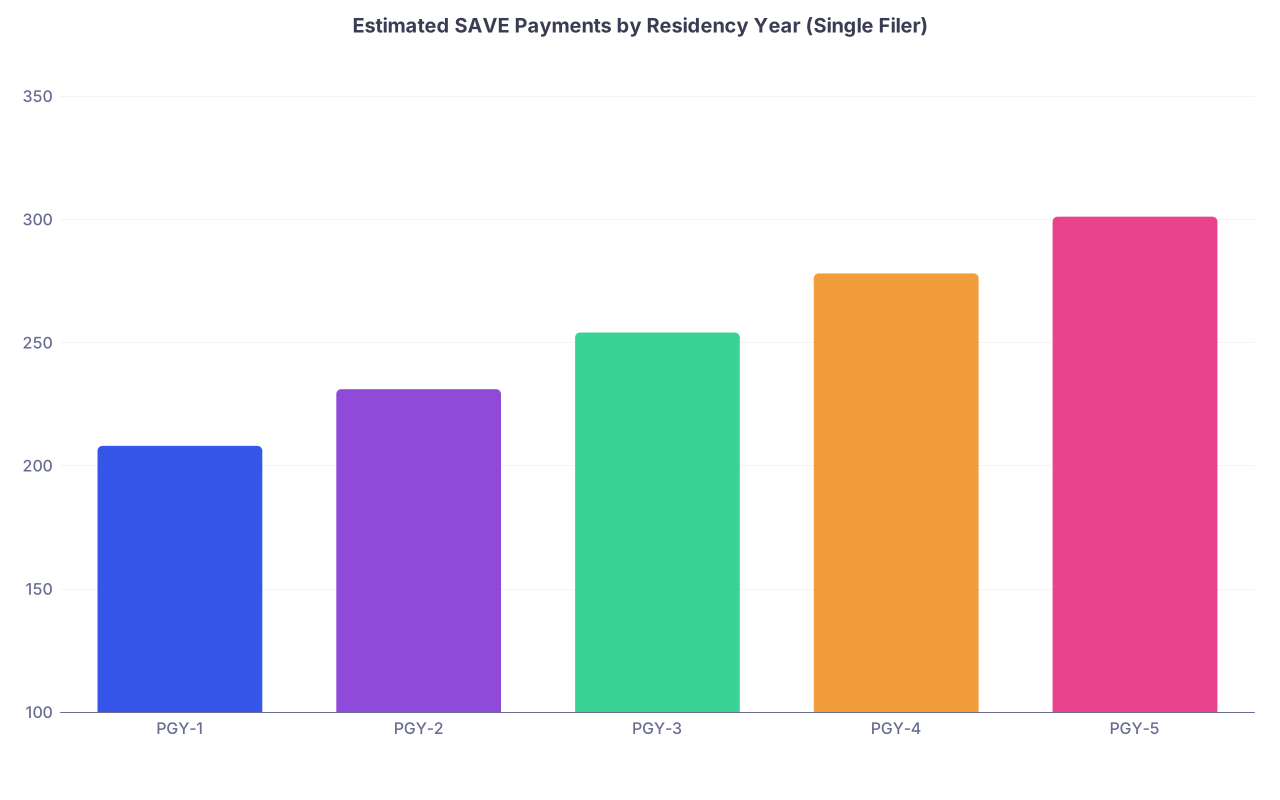
| Category | Value |
|---|---|
| PGY-1 | 208 |
| PGY-2 | 231 |
| PGY-3 | 254 |
| PGY-4 | 278 |
| PGY-5 | 301 |
So for a typical resident on SAVE, $200–$300 per month is a realistic band, regardless of specialty. That is the ground truth. The idea that residents “have to” pay $800–$1,000+ per month on IDR is math that belongs to older REPAYE/IBR assumptions or married‑filing‑joint scenarios without careful AGI planning.
3. Where specialty actually matters: attending income and IDR jump
The big shock is the step from PGY‑final to attending. This is where the specialty income distribution matters.
Let us anchor with reasonable starting attending salaries (total comp, not just base) for first‑year physicians, using recent MGMA and market reports:
- Primary care / lower‑paying specialties:
- Pediatrics: $190k–$230k
- Family medicine: $210k–$250k
- Internal medicine (general): $220k–$260k
- Middle‑tier:
- Hospitalist IM: $260k–$320k
- Emergency medicine: $320k–$380k (varies wildly by market)
- OB/GYN: $300k–$360k
- Higher‑paying surgical / procedure:
- General surgery: $350k–$450k
- Anesthesiology: $350k–$450k
- Orthopedic surgery: $500k–$650k
- Neurosurgery: $650k–$850k+
I will map out representative “starting” incomes for modeling:
| Specialty Group | Example Specialty | Starting Income Used |
|---|---|---|
| Primary care | Pediatrics | $210,000 |
| General IM / FM | Internal Med | $240,000 |
| Hospital-based | Hospitalist | $290,000 |
| OB/GYN / EM | OB/GYN | $330,000 |
| Typical surgical | General Surgery | $400,000 |
| High surgical/procedural | Orthopedics | $550,000 |
Assume AGI ≈ 90% of gross once you are an attending with retirement deferrals etc.
4. IDR payment ranges by specialty income level
4.1 Primary care / low‑paying specialties
Example: Pediatrics, starting gross $210,000; AGI ≈ 0.90 × 210,000 = $189,000
Discretionary: 189,000 – 33,900 ≈ $155,100
Annual SAVE payment: 0.10 × 155,100 ≈ $15,510
Monthly: ≈ $1,293/month
If a pediatrician starts at $200k instead, AGI ≈ 180,000 → payment ≈ $1,219/month.
At $230k, AGI ≈ 207,000 → payment ≈ $1,533/month.
Realistic IDR monthly range as a new primary care attending (single, SAVE):
Roughly $1,200–$1,600 per month
I want this visual:
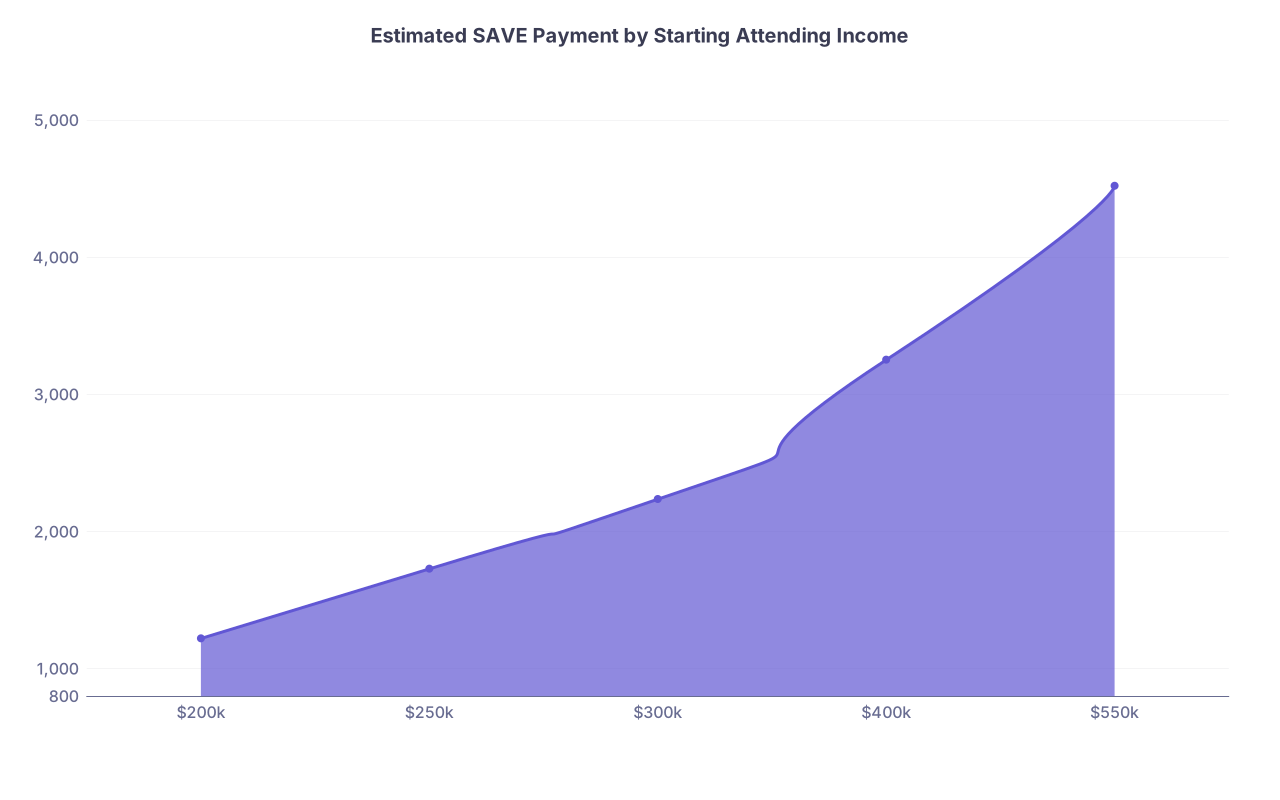
| Category | Value |
|---|---|
| $200k | 1219 |
| $250k | 1727 |
| $300k | 2235 |
| $400k | 3251 |
| $550k | 4519 |
You can see the curve is linear with income; it is just 10% of income above the threshold.
4.2 General IM / FM, mid‑200s
Example: General internal medicine, $240k starting; AGI ≈ $216,000
Discretionary: 216,000 – 33,900 ≈ $182,100
Annual payment: 18,210
Monthly payment ≈ $1,518/month
At $260k gross (AGI ≈ 234,000), payment ≈ $1,665/month.
Band for most non‑hospitalist general IM/FM attendings:
Roughly $1,500–$1,700/month on SAVE, single, at first job.
4.3 Hospitalist / OB‑GYN / EM band
Hospitalist, say $290,000 gross
AGI ≈ 261,000
Discretionary ≈ 261,000 – 33,900 = $227,100
Annual ≈ 22,710
Monthly ≈ $1,893/month
If you pick up extra shifts and hit $320k:
AGI ≈ 288,000 → discretionary ≈ 254,100 → annual ≈ 25,410 → $2,118/month
OB/GYN around $330,000
AGI ≈ 297,000
Discretionary ≈ 297,000 – 33,900 = $263,100
Annual ≈ 26,310
Monthly ≈ $2,192/month
EM at $350k looks like:
AGI ≈ 315,000 → discretionary ≈ 281,100 → annual ≈ 28,110 → $2,342/month
Band for hospitalist / OB‑GYN / many EM attendings:
Roughly $1,900–$2,400/month IDR payment on SAVE.
4.4 Typical surgical specialties (general surgery, anesthesiology, etc.)
Example: General surgery, starting at $400,000; AGI ≈ $360,000
Discretionary ≈ 360,000 – 33,900 = $326,100
Annual SAVE ≈ 32,610
Monthly ≈ $2,718/month
At $450,000 gross (AGI ≈ 405,000):
Discretionary ≈ 371,100
Annual ≈ 37,110
Monthly ≈ $3,093/month
So a new general surgeon or anesthesiologist is often looking at:
$2,700–$3,100/month on SAVE.
4.5 High‑earning procedural specialties (orthopedics, neurosurgery, some cardiology)
Take orthopedics at $550,000 gross; AGI ≈ $495,000
Discretionary: 495,000 – 33,900 = $461,100
Annual SAVE: 0.10 × 461,100 = $46,110
Monthly: ≈ $3,842/month
If someone lands a harsh but real $650,000 starting comp:
AGI ≈ 585,000 → discretionary ≈ 551,100 → annual ≈ 55,110 → $4,592/month
Neurosurgery at $800,000+ can cross $5,500/month easily under SAVE.
Band for ortho/neurosurgery and similar:
Roughly $3,800–$5,500+ per month on SAVE, single, starting attending.
At this level, the math pushes most people away from long‑term IDR unless they are PSLF‑bound. I have watched more than one ortho realize their projected 20‑25 year forgiveness bill was ridiculous when their annual IDR payments alone could nuke the principal in 6–7 years with standard or aggressive fixed payments.
5. Side‑by‑side: Residency vs attending payment shock
The most jarring point for many residents is the transition. You spend 3–7 years paying $200–$300/month. Then the payment quadruples or quintuples in a single calendar year.
Let’s compare three archetypes:
- A: Pediatrics (3‑year residency → $210k starting)
- B: Internal medicine → hospitalist ($240k → $290k)
- C: General surgery (5‑year residency → $400k starting)
| Path | Final PGY Level | Final PGY Monthly | First Attending Income | First Attending Monthly |
|---|---|---|---|---|
| A - Peds | PGY-3 | ~$254 | $210,000 | ~$1,300 |
| B - Hosp | PGY-3 | ~$254 | $290,000 | ~$1,900 |
| C - Gen Surg | PGY-5 | ~$301 | $400,000 | ~$2,700 |
The multiplier:
- Peds: 5× jump (≈ $250 → $1,300)
- Hospitalist: ~7× jump
- General surgery: ~9×–10×
Here is the same concept as a transition chart:
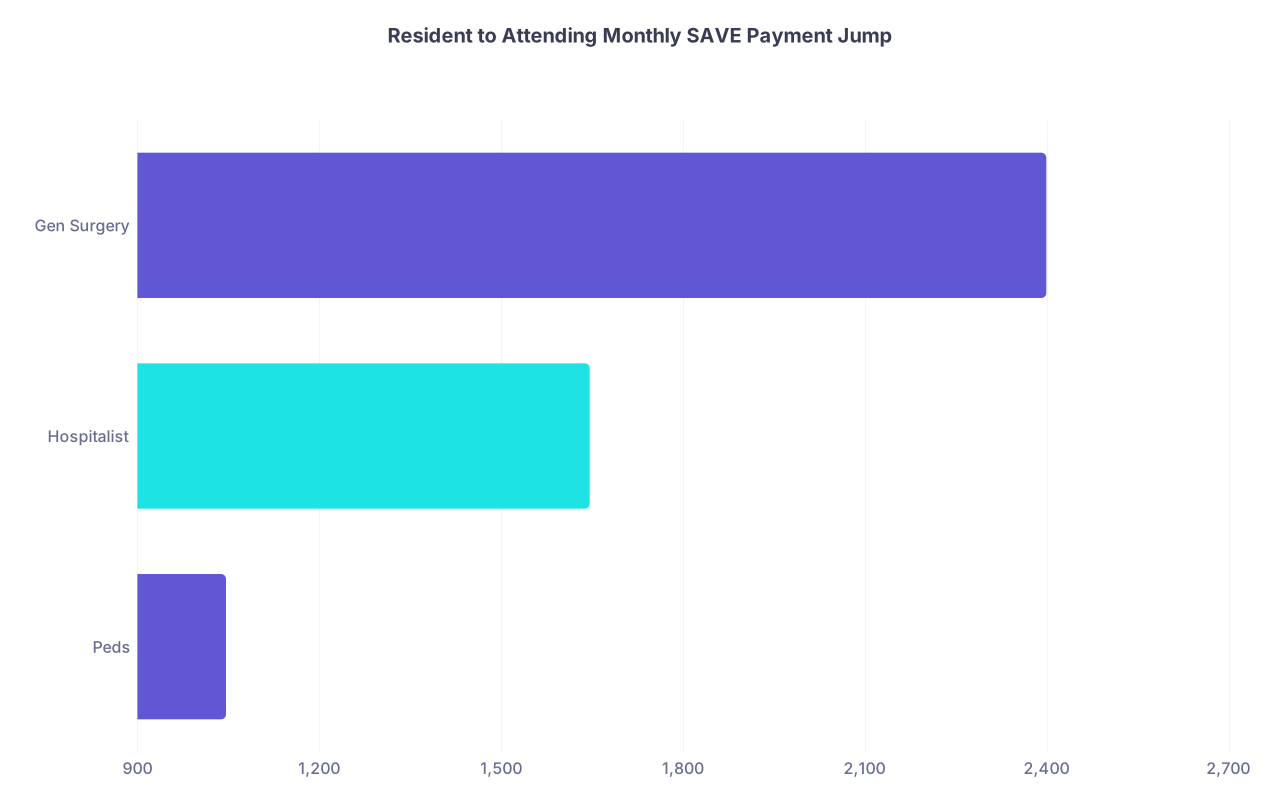
| Category | Value |
|---|---|
| Peds | 1046 |
| Hospitalist | 1646 |
| Gen Surgery | 2399 |
Values are the increase in monthly payment from final PGY year to first attending year.
This is why residents get blindsided. They optimize everything for a $250/mo payment and then do not pre‑plan for a $2,000+ line item when they graduate.
6. How household size, marriage, and filing status bend the curve
The ranges above assume: single, no kids, lower‑48, SAVE plan.
The two largest distortions I routinely see:
Marriage to a non‑physician with meaningful income
- If you file joint, their income is pulled into AGI and can blow up your payment.
- If you file separately (MFS), under SAVE, only your income counts, but some tax benefits vanish and you may pay higher total federal tax.
Children
- Each additional household member raises the 225% FPL threshold and lowers discretionary income.
Let us quantify the family effect.
For 2024 FPL, lower‑48:
- Household 1: $15,060 → 225% ≈ $33,885
- Household 2: $20,440 → 225% ≈ $45,990
- Household 3: $25,820 → 225% ≈ $58,095
So going from single to a family of 3 increases the protected income by roughly $24,200. That is a $2,420 reduction in annual IDR payments (% is 10%), or approximately $200/month less, at the same AGI.
Example: Hospitalist at $290k, AGI 261,000.
- Single: discretionary 261,000 – 33,900 = 227,100 → ≈ $1,893/month
- With 2 dependents (household of 3): discretionary 261,000 – 58,100 ≈ 202,900 → annual ≈ 20,290 → $1,691/month
About a $200/month drop.
Marriage calculations are trickier; I will not play with every permutation here, but the rule of thumb is simple:
- Under SAVE, you can exclude spouse income by filing taxes separately. That often makes sense when the spouse earns as much or more than you.
- Under older PAYE/IBR, the logic is similar but income caps and plan eligibility can change the calculus.
I have seen two EM physicians, both earning ~$350k, file separately to keep each person’s IDR manageable while planning a rapid private refinance and payoff. The extra tax bill was a few thousand dollars; the IDR payment savings before refinance was in the tens of thousands.
7. Specialty‑specific IDR strategy patterns (by the numbers)
The payment ranges tell you who should favor long‑term IDR + PSLF vs who should treat IDR as a temporary tool and then exit quickly.
I will group by realistic debt‑to‑income (DTI) ratios I see over and over:
7.1 High‑debt, low‑income (e.g., Peds with $350k+ loans)
Peds resident with $320k–$400k federal debt, then $210k income.
- Residency: $200–$260/month
- Attending: $1,200–$1,500/month
- DTI ≈ 1.5–2.0
For this group, PSLF or long‑term IDR forgiveness can actually win mathematically, particularly if you stay at non‑profit / academic centers.
Over 10 years, your total IDR paid might be $150k–$200k while your original principal was $350k+, and the remaining balance is forgiven tax‑free under PSLF. That is why so many peds and academic IM folks rationally chase PSLF.
7.2 Moderate‑debt, mid‑income (IM/FM with $250k–$300k loans)
Internal medicine, $260k attending income, $270k debt:
- Residency: $220–$260/month
- Attending: $1,500–$1,700/month
Here the math is more balanced. Standard 10‑year payment on a $270k balance at 7% is around $3,100/month. IDR saves cash flow but extends horizon.
The key ratio:
- If total projected IDR payments to PSLF point (120 payments) < principal + interest on standard 10‑year, PSLF is attractive.
- Otherwise, a refinance and 7–10 year payoff often yields less lifetime cost even though nominal monthly payments are higher.
I have run spreadsheets where hospitalists with mid‑200s starting incomes and ~$250k loans were better off refinancing and paying $3k/month than paying $1.8k/month on IDR and dragging this out, assuming no PSLF.
7.3 High‑income, moderate‑debt (surgery/anesthesia with $300k–$400k loans)
General surgery, $400k starting, $350k loans.
SAVE monthly ≈ $2,700–$3,100. At that payment, you can kill $350k in roughly 10–12 years even at 7% interest, so forgiveness may not leave a huge leftover. PSLF is only compelling if you know you will stay in qualifying employment for a decade.
But the bigger point: These incomes allow more aggressive strategies:
- Refinance to private loans at lower rate (e.g., 4–5%)
- Pay $4,000–$6,000/month for 5–7 years
- Exit debt quickly; total interest paid often under $80k–$100k instead of >$200k over 20–25 years.
For ortho and neurosurgery, the math is brutal against long‑term IDR unless PSLF is locked. Paying $4,000–$5,000/month for two decades to slowly erode a mid‑6‑figure balance is just an expensive way to pretend the debt is “managed.”
8. What “realistic monthly ranges” look like by phase and specialty
Let me compress the key ranges so you can sanity‑check your own numbers.
During residency (SAVE, single, any specialty)
Assuming typical PGY salaries and 0.92 AGI factor:
- PGY‑1: ~$180–$230/month
- PGY‑2: ~$210–$260/month
- PGY‑3: ~$230–$280/month
- PGY‑4–5: ~$260–$320/month
That is the true working range for most residents, regardless of debt size, if they are on SAVE and single.
First attending year, by starting income band
Assume SAVE, single, lower‑48, AGI = 0.90 × gross.
| Starting Income | Typical Specialty Examples | Approx Monthly SAVE |
|---|---|---|
| $200k–$230k | Pediatrics, low-paid primary care | $1,200–$1,600 |
| $230k–$270k | IM/FM, some outpatient specialties | $1,500–$1,800 |
| $270k–$320k | Hospitalist, some EM, OB/GYN | $1,800–$2,200 |
| $320k–$380k | EM, OB/GYN high-end | $2,200–$2,500 |
| $380k–$450k | Gen surg, anesth, cards (early) | $2,500–$3,200 |
| $450k–$600k | Ortho, high-end surgical/procedural | $3,200–$4,600 |
| $600k+ | Neurosurg, late-career ortho/cards | $4,600+ |
Plot this against your residency numbers and the jump is obvious.
9. How to forecast your own payments: a simple flow
You do not need elaborate calculators if you know your rough income targets.
Here is the workflow I push residents to use on a single sheet of paper.

| Step | Description |
|---|---|
| Step 1 | Estimate Gross Income |
| Step 2 | Multiply by 0.90 or 0.92 |
| Step 3 | Subtract 225 percent FPL |
| Step 4 | If negative, payment is 0 |
| Step 5 | If positive, multiply by 0.10 |
| Step 6 | Divide by 12 for monthly |
For FPL threshold, use:
- $34k (single)
- $46k (household 2)
- $58k (household 3)
If your quick math deviates by more than ~$100/month from your servicer quote, then something else is going on (wrong AGI, joint filing, out‑of‑date recertification, or different IDR plan).
10. The decision point: IDR as bridge vs endpoint
The data pattern is blunt:
- Residents have artificially low payments relative to debt; principal often grows, but SAVE interest subsidies mute the damage.
- Primary care / academic tracks with large debt loads often rationally stay on IDR and chase PSLF.
- Higher‑earning specialties generally use IDR as a 3–7 year bridge (residency + early attending) before refinancing and paying off quickly.
The mistake is pretending everyone belongs in the same strategy bucket.
If your specialty likely puts you in the $2,700–$4,000+ monthly SAVE payment range as an attending, and you are not planning PSLF, treating IDR as a long‑term home is usually a misallocation of your future cash flow. The numbers rarely favor stretching payments over 20–25 years when your income is that high.
On the other hand, if you are staring at $350k+ of loans and a $210k pediatric job at a 501(c)(3) hospital, long‑term IDR plus PSLF is not “gaming the system.” It is just rational response to the income distribution.
You now have the realistic monthly ranges, tied to real income bands and the actual SAVE formula. The next move is not another calculator. It is mapping those numbers onto your specific career path and deciding whether you are building toward PSLF or toward rapid payoff after training. With that decision made, the rest of your financial plan—where you work, how much you moonlight, when you refinance—starts to fall into place. The details of that playbook are a separate conversation, but this is the spine you build it on.