
The data is blunt: most residents underestimate how powerful a modest amount of moonlighting can be for crushing their loans early.
They focus on the hourly rate and forget the compounding. The interest avoided. The years of payments they delete. You do not need to work like a maniac; you just need to quantify the trade‑off properly.
Let’s do exactly that.
1. Baseline: What Your Loans Do If You Do Nothing Extra
Start with a realistic resident-level scenario. Not the fantasy of “I’ll refinance to 2% and pay it off in three years.” A normal, slightly uncomfortable reality.
Assume:
- Total loans at graduation: $300,000
- Average weighted interest rate: 6.5%
- Residency length: 4 years
- No PSLF, no REPAYE interest subsidies, and you plan eventual aggressive payoff as an attending
- During residency: you pay $300/month on an income-driven plan (essentially interest not covered continues to grow)
First, what happens if you do nothing besides minimum payments during residency?
Annual interest at 6.5% on $300,000:
- Year 1 interest ≈ 0.065 × 300,000 = $19,500
Your $300/month covers $3,600/year, so net interest added in Year 1 is roughly:
- $19,500 – $3,600 ≈ $15,900 of unpaid interest
That pattern repeats, though technically interest is calculated on the new balance each year. Approximating linearly is fine for decision‑making.
Over 4 years of residency, assuming similar payments and rate:
- Total interest generated ≈ 4 × $19,500 = $78,000
- Total actually paid ≈ 4 × $3,600 = $14,400
- Net growth ≈ $78,000 − $14,400 = $63,600
So by the end of residency, your balance is not $300,000. It is closer to $363,600.
This is the “do nothing extra” baseline.
Now keep that number in your head, because every moonlighting dollar you send to principal is basically you punching that compounding in the face.
2. The Core Math: Moonlighting Dollars vs Interest Dollars
To make moonlighting decisions rational, you need one anchor number:
The effective “guaranteed return” of extra loan payments is your loan interest rate after tax.
If your loan rate is 6.5%, then every extra after‑tax dollar you put toward principal is like a 6.5% risk‑free annual return, compounding for as long as you would have held that debt.
You cannot pull that off in any guaranteed investment product right now.
Let us quantify this with real resident-type moonlighting.
Assume:
- Moonlighting rate: $120/hour
- Effective tax rate on moonlighting (federal + state + FICA): 30% (this varies, but 25–35% is typical)
- Net take‑home per moonlighting hour: $120 × (1 − 0.30) ≈ $84
If you send all net moonlighting pay directly to your loans, every hour of moonlighting means:
- $84 of principal erased
- Avoiding 6.5% annual interest on that $84 for however many years remain until payoff
If you expect to carry the loan for, say, 7 more years from the time of that payment, the avoided interest on a single $84 payment is roughly:
Future interest avoided ≈ 84 × 0.065 × 7 ≈ $38.22
So each moonlighting hour is not just $84 of principal. It is also around $38 of future interest you will never owe, if your planned payoff horizon is ~7 years from that payment.
Total economic impact per hour ≈ $122 ($84 principal + $38 avoided interest).
You are effectively converting a $120 gross hour into roughly $160+ of long‑term value when you zoom out far enough (because you also avoid compounding on the avoided interest). But even this simple linear estimate is enough to show: the yield is absurdly high.
3. Scenario Framework: How Many Hours, How Much Sooner?
We need structure. The cleanest way to think about this:
- Define a target payoff timeline (e.g., 10 years from graduation).
- Estimate your future attending payment capacity (e.g., $3,500/month).
- Calculate:
- How long payoff takes without moonlighting.
- How much moonlighting accelerates payoff and cuts total interest.
Let us fix the starting point:
- Loan at graduation: $300,000 @ 6.5%
- Residency: 4 years, minimal payments
- Balance at end of residency: ≈ $363,600 (from Section 1)
Now, assume as an attending you can pay $3,500/month ($42,000/year) toward loans.
Without any extra payments:
We can approximate payoff time using a standard amortization formula. I will pull the result directly:
For $363,600 at 6.5% with $3,500/month payments:
- Monthly rate r ≈ 0.065 / 12 ≈ 0.005417
- N ≈ 167–170 months (by amortization approximation), so about 14 years
So your total timeline is:
- 4 years residency (minimal progress)
- ~14 years attending payoff
Total: 18 years from graduation to debt‑free.
Total interest as attending:
- 14 years × $42,000/year payments = $588,000 total paid
- Principal at start of attending: $363,600
- So interest during attending years ≈ $588,000 − $363,600 = $224,400
Add residency‑era net interest growth (~$63,600):
- Total lifetime interest ≈ $288,000
Round numbers are fine. You are paying very close to $300k in interest on a $300k original balance if you drag this out.
Now we layer moonlighting on.
4. Concrete Moonlighting Scenarios
Assumptions for all moonlighting scenarios:
- Rate: $120/hour gross
- Effective tax: 30%
- Net per hour to loans: $84
- Loan rate: 6.5%
- Moonlighting begins PGY‑2 and continues through PGY‑4 (3 years)
We will run three patterns:
- Low: 10 hours/month
- Moderate: 20 hours/month
- Aggressive (but still human): 30 hours/month
4.1. Scenario A – 10 Hours/Month
Hours per year: 10 × 12 = 120 hours
Net dollars to loans per year: 120 × $84 = $10,080
Over 3 years: 3 × $10,080 = $30,240 of principal paid down during residency.
What does that do?
Instead of finishing residency at $363,600, you finish closer to:
- $363,600 − $30,240 ≈ $333,360
Now redo attending payoff:
Loan at start of attending: $333,360 @ 6.5%, payment $3,500/month.
Amortization approximation:
- Same 6.5% rate, same $3,500/month
- Lower principal → shorter payoff
A close estimate:
N ≈ 154–156 months ≈ 12.8 years
So instead of 14 years, you are down to about 12.8 years. Call it a savings of:
- ≈ 1.2 years sooner debt‑free as an attending
- Total from graduation: 4 + 12.8 ≈ 16.8 years vs 18
Interest during attending:
- 12.8 years × $42,000/year = $537,600 total paid
- Principal: $333,360
- Interest ≈ $537,600 − $333,360 = $204,240
Add residency net interest (now reduced because of earlier principal hits, but we will keep it simple and subtract what you directly paid):
Baseline total interest ≈ $288,000
You added $30,240 in moonlighting payments early.
But the key comparison: you saved roughly:
- Baseline attending interest: ≈ $224,400
- New attending interest: ≈ $204,240
- ≈ $20,000 less interest as an attending plus earlier finish.
Notice the leverage:
$30k of net moonlighting during residency → ~$20k of interest avoided + ~1.2 years payoff time reduction.
Compute the effective “return” on the $30k, purely in interest avoided:
- 20,000 / 30,240 ≈ 66% cumulative return in interest savings alone, ignoring time value and emotional value of finishing early.
You will not find that in your 403(b).
4.2. Scenario B – 20 Hours/Month
Now double the hours:
- Hours per year: 20 × 12 = 240
- Net to loans per year: 240 × 84 = $20,160
- Over 3 years: $60,480 directly to principal during residency
New end-of-residency balance:
- $363,600 − $60,480 ≈ $303,120
Attending payoff with $3,500/month:
- Lower principal → much shorter payoff
Approximate payoff time:
This is now similar to amortizing a ~$300k loan at 6.5% with $3,500/month. That is around 10.7–11.0 years.
Let us take 11 years for conservative rounding.
Total timeline from graduation:
- 4 years residency + 11 years attending payoff ≈ 15 years
You just cut 3 years off the prior 18‑year timeline.
Interest as attending:
- 11 years × $42,000/year = $462,000 total paid
- Principal at start: $303,120
- Interest ≈ $462,000 − $303,120 = $158,880
Compare with baseline attending interest ≈ $224,400:
- Interest saved as an attending ≈ $224,400 − $158,880 = $65,520
You put in $60,480 of moonlighting net cash. Pure interest saved is ~65.5k over the life of the loan plus you are debt‑free three years sooner.
That is:
- Effective interest‑avoidance gain ≈ $65,520 / $60,480 ≈ 108% cumulative return
- Hours worked over 3 years: 3 × 240 = 720 hours
- Value created (interest saved + principal repaid earlier) is easily over $120k+.
Break that down per hour:
- Total net dollars paid: $60,480
- Interest saved ≈ $65,520
- Value impact ≈ $126,000+ over the life
Per hour of moonlighting:
126,000 / 720 ≈ $175+ of long‑term value per hour, on top of the immediate $84 you “see” going to principal.
This is why the math is so lopsided in favor of at least some moonlighting if your loans are at 6–7%.
4.3. Scenario C – 30 Hours/Month (Upper Reasonable Limit)
This is where most residents start to crack. 30 hours/month on top of residency is heavy. But analytically, let us quantify it.
- Hours per year: 30 × 12 = 360
- Net to loans per year: 360 × 84 = $30,240
- Over 3 years: $90,720
End of residency balance:
- $363,600 − $90,720 ≈ $272,880
Attending payoff with $3,500/month:
Now the loan is closer to what you originally borrowed.
For $273k at 6.5% with $3,500/month, the amortization length is around 9 years.
Total time:
- 4 years residency + 9 years attending ≈ 13 years from graduation to paid‑off.
You have effectively removed 5 years from the original 18‑year baseline.
Interest during attending:
- 9 years × $42,000/year = $378,000
- Principal at start: $272,880
- Interest = $378,000 − $272,880 = $105,120
Baseline attending interest ≈ $224,400 → interest saved as attending ≈ $119,280
You contributed $90,720 as moonlighting net. Pure interest savings:
- 119,280 / 90,720 ≈ 131% cumulative return on those dollars, no market risk.
Now break it down per hour:
- Total hours over 3 years: 3 × 360 = 1,080 hours
- Long‑term financial impact: principal paid ($90,720) + interest avoided (~$119,280) ≈ $210,000
Value per hour:
210,000 / 1,080 ≈ $194 per hour in economic impact, from a gross paid rate of $120/hour.
You are turning a $120/h gig into a nearly $200/h effective impact simply by pointing it at 6.5% debt early.
5. Side‑by‑Side Comparison
Let’s put those timelines and savings into a compact structure.
| Scenario | Moonlighting Hours/Month | Total Hours (3 yrs) | End-of-Residency Balance | Years as Attending to Payoff | Total Years to Debt-Free | Attending Interest Paid | Interest Saved vs Baseline |
|---|---|---|---|---|---|---|---|
| Baseline (no moonlighting) | 0 | 0 | $363,600 | ~14 yrs | ~18 yrs | ~$224,400 | — |
| Low | 10 | 360 | $333,360 | ~12.8 yrs | ~16.8 yrs | ~$204,240 | ≈ $20,000 |
| Moderate | 20 | 720 | $303,120 | ~11 yrs | ~15 yrs | ~$158,880 | ≈ $65,500 |
| High | 30 | 1080 | $272,880 | ~9 yrs | ~13 yrs | ~$105,120 | ≈ $119,000 |
Here is the pattern the data shows:
- Each increment of 10 hours/month buys you roughly 1–2 years faster freedom and tens of thousands in interest saved.
- The marginal gain from 20 to 30 hours/month is real but starts to bump against lifestyle and burnout constraints.
To visualize the impact on interest savings alone:
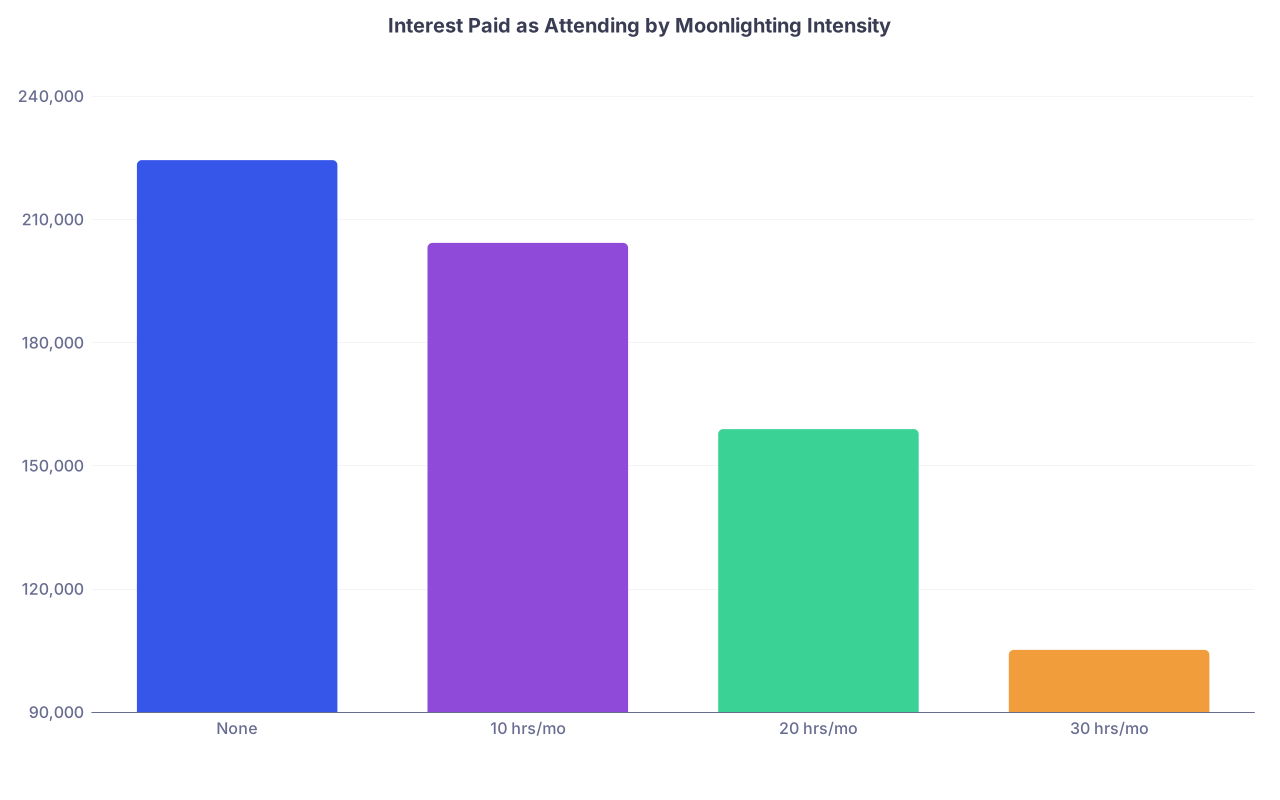
| Category | Value |
|---|---|
| None | 224400 |
| 10 hrs/mo | 204240 |
| 20 hrs/mo | 158880 |
| 30 hrs/mo | 105120 |
The bars stair-step down aggressively. That is what payoff speed looks like in dollars.
6. The Real Question: Payoff Speed vs Burnout Risk
The math is not the limiting factor. Your energy is.
I have watched residents crank 40+ moonlighting hours a month. For 2–3 months. Then stop entirely because they are fried. The model that works is sustainable, not heroic.
From the data above:
- Going from 0 to 10 hours/month is a small lifestyle hit with meaningful payoff (about 1.2 years sooner and ~$20k interest saved).
- Jumping from 10 to 20 hours/month adds another 1.8 years acceleration and ~+$45k more interest saved.
- 20 to 30 hours/month buys you about 2 more years and an additional ~$50k interest saved.
How to read that:
The biggest marginal improvement happens when you move from 0 to 20 hours/month.
That range is the “high ROI, still human” zone.Above 20 hours/month, the returns are still excellent, but your time cost explodes.
You are trading hours of your life at a high rate. Sometimes necessary, sometimes not.
To get a sense of time-for-years trade:
- 10 hours/month: 360 total hours over residency → ~1.2 years earlier freedom
≈ 300 hours per year of freedom gained - 20 hours/month: 720 total hours → ~3 years earlier
≈ 240 hours per year of freedom gained - 30 hours/month: 1080 total hours → ~5 years earlier
≈ 216 hours per year of freedom gained
That marginal efficiency is still strong at 30 hours, but the lifestyle tax is brutal. You will feel those months.
7. Legal and Contractual Constraints You Cannot Ignore
The finance math assumes you can moonlight as you like. Reality often disagrees.
Common constraints:
- GME duty-hour rules: You are capped at 80 hours/week on average; moonlighting counts toward that in most programs.
- Program policy: Many programs ban or tightly control moonlighting for PGY‑1, sometimes PGY‑2, or require program director approval.
- Malpractice coverage: External moonlighting often requires separate malpractice policies; internal moonlighting may be covered under your institution’s policy.
- Contract clauses: Some residency contracts explicitly restrict outside work, or require disclosure and approval.
You cannot treat moonlighting as pure arbitrage if it violates your contract or puts your license at risk.
I tend to see three real‑world patterns:
Internal moonlighting in the same system
Often easier logistically, covered by existing malpractice; sometimes slightly lower rate but safer.External night/weekend urgent care or ED shifts
Higher rate ($130–$200/h in some regions), but more credentialing, separate malpractice, more travel.Telemedicine moonlighting
Growing area, variable pay; less fatigue from travel but heavy on documentation and metric tracking.
You need to know exactly what your program allows before you start planning those 20–30 extra hours.
8. Strategy: How to Pick Your Moonlighting Number Rationally
Rational step‑by‑step approach:

| Step | Description |
|---|---|
| Step 1 | Check Program Rules |
| Step 2 | Focus on Budget and Refinance |
| Step 3 | Estimate Capacity 0 to 30 hrs |
| Step 4 | Choose Sustainable Hours |
| Step 5 | Direct Net Pay to Loans |
| Step 6 | Reassess Each 6 Months |
| Step 7 | Moonlighting Allowed? |
The data‑driven way to do this:
Confirm allowed hours and sites
If your program caps moonlighting at 10 hours/month, the choice is made for you. Run the 10‑hour scenario and accept the ~1 year acceleration.Choose a sustainable tier
Use what you know about your own fatigue. If a 60‑hour service month crushes you, adding 30 moonlighting hours will be unsafe. In that case, 10–15 hours is the right band.Commit net moonlighting pay 100% to loans
The math breaks if your “moonlighting plan” becomes lifestyle creep. Every $1 you siphon off for nicer apartments or a Tesla is $1 not earning a 6.5% guaranteed return.Recalculate annually
As your PGY level, salary, and life circumstances change, you can adjust hours. The shape of the payoff curve does not change: the first 10–20 hours/month are gold.
To visualize how payoff time drops as moonlighting hours rise:
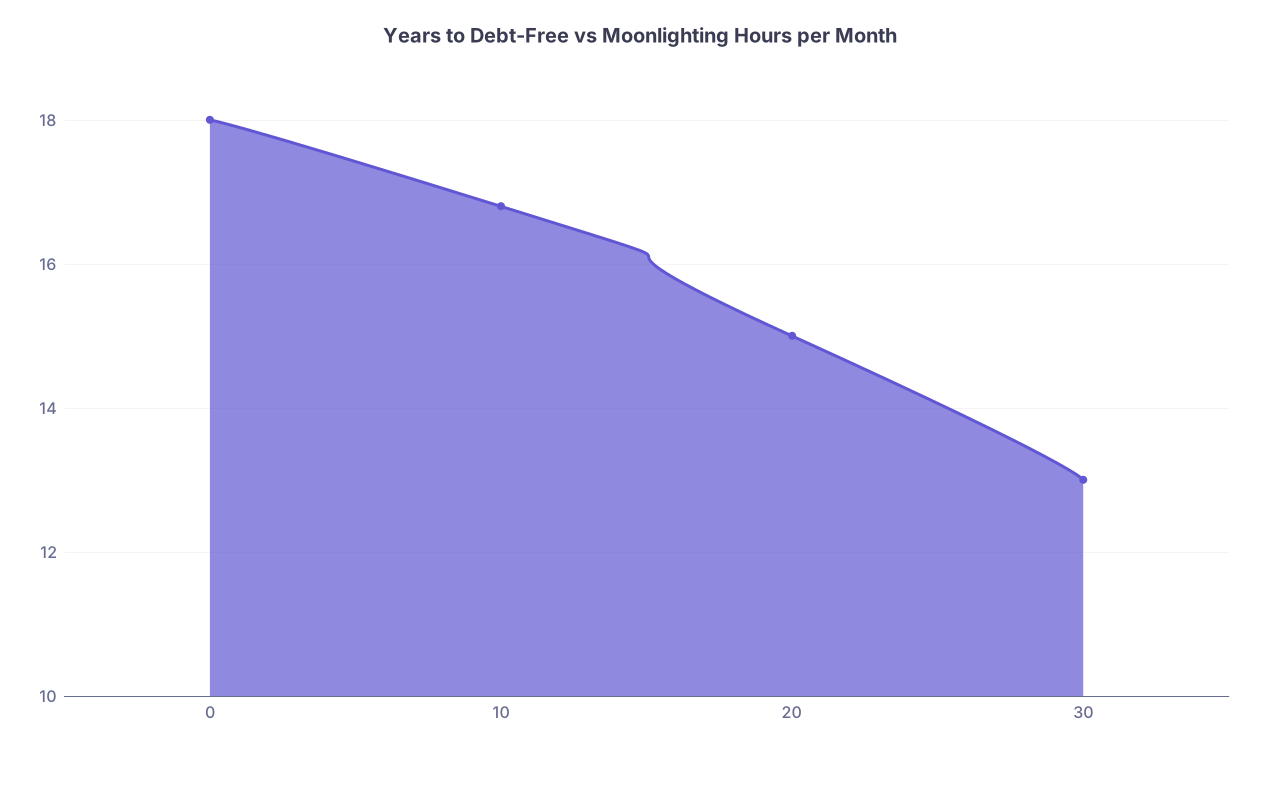
| Category | Value |
|---|---|
| 0 | 18 |
| 10 | 16.8 |
| 20 | 15 |
| 30 | 13 |
Decreasing, convex curve. This is what you are choosing against your sleep and sanity.
9. Key Takeaways: Where the Numbers Land
Strip away the noise, and the data says three things:
Moderate moonlighting (10–20 hours/month) during residency is insanely high yield for 6–7% loans.
You are converting each $1 of net moonlighting into $1+ of interest avoided over the life of the loan, and chopping 1–3 years off your debt timeline.Going extreme (30+ hours/month) adds more savings but with sharply rising burnout risk.
The incremental financial benefit from 20 → 30 hours/month is real, yet for many residents it is not worth the physical and mental cost.The fastest payoff speed gains come from starting early and being consistent, not heroic for short bursts.
A stable 10–20 hours/month for three years, fully directed to principal, beats sporadic unsustainable binges every time.
You do not need to martyr yourself to your loans. But if you completely ignore moonlighting when your debt sits at 6–7%, you are walking away from one of the only risk‑free, double‑digit effective returns you will ever see in your career.