
The most common advice about PSLF vs rapid payoff is based on vibes, not math. That is a mistake.
When you actually model the cash flows, PSLF usually wins by a mile on total dollars paid, but rapid payoff often wins on risk and psychological simplicity. The trade‑off is quantifiable. So let’s quantify it.
I will walk through modeled outcomes for three debt levels—$200K, $400K, and $600K—under two competing strategies:
- PSLF path: 10 years of income‑driven payments with forgiveness at year 10
- Rapid payoff: aggressive 10‑year payoff on the standard amortization schedule
All numbers are approximations using reasonable, explicitly stated assumptions. The point here is not perfection. The point is order‑of‑magnitude clarity so you can stop guessing.
1. Core Assumptions (The Engine Behind the Numbers)
The first step in serious analysis is to lock inputs. Hand‑wavy assumptions give hand‑wavy conclusions.
Loan and income assumptions
I will use the following baseline across all scenarios:
- Interest rate: fixed 6.5% (typical for Grad PLUS mix)
- Repayment term for “rapid payoff” comparison: 10 years (standard plan)
- Repayment plan for PSLF: SAVE (most generous IDR as of 2024)
- Poverty guideline: $15,000 for single borrower (rounded, using 225% of poverty for SAVE)
- Income growth: 3% per year (realistic, modest)
To keep the modeling concrete, I will anchor each debt level to a plausible career income:
- $200K debt → Mid‑earning professional / primary care type income
- $400K debt → Higher‑earning specialist or dual‑income household
- $600K debt → Very high debt, specialist track, higher starting income
We will not chase every micro‑detail of the tax code or every possible family scenario. We are comparing relative outcomes using consistent rules.
Quick formulas
For a 10‑year standard repayment at 6.5%:
- Monthly rate r = 0.065 / 12 = 0.0054167
- Term n = 120 months
- Payment = P × r / (1 − (1 + r)^(-n))
You do not need to do this math yourself. You just need to understand: at 6.5%, 10‑year payoff is brutal on monthly cash flow but excellent at stopping interest from compounding endlessly.
For SAVE (single borrower):
- Discretionary income = AGI − 225% of poverty
- Payment = 10% of discretionary income / 12
We will assume AGI ≈ gross income for simplicity and ignore the tax benefit of deductions; that just makes the PSLF numbers slightly conservative.
2. Baseline: How Painful Is a 10‑Year Standard Payoff?
Let us first compute the 10‑year standard payments for each debt level at 6.5%.
Using the amortization formula:
- $200K → monthly ≈ $2,270 → 120 payments → total ≈ $272,400
- $400K → monthly ≈ $4,540 → total ≈ $544,800
- $600K → monthly ≈ $6,810 → total ≈ $817,200
So with “rapid payoff” over 10 years, you are paying about 36–37% above principal over the decade due to interest.
| Debt Level | Monthly Payment | Total Paid over 10 Years | Total Interest |
|---|---|---|---|
| $200,000 | ~$2,270 | ~$272,400 | ~$72,400 |
| $400,000 | ~$4,540 | ~$544,800 | ~$144,800 |
| $600,000 | ~$6,810 | ~$817,200 | ~$217,200 |
Those monthly numbers are the benchmark the PSLF strategy is competing against.
If your after‑tax income cannot comfortably swallow those monthly payments, the “rapid payoff” is not just suboptimal. It is infeasible.
3. PSLF Scenario Build: How the Cash Actually Flows
Under PSLF with SAVE, payments are a function of income, not debt. That is the key. Once your debt crosses a certain point, increasing loan balance barely changes your PSLF payments at all. The government just forgives the excess at year 10.
So for each debt level, if we hold income constant, IDR payments are identical. That is why PSLF becomes wildly favorable as debt grows.
Let’s define three income tracks:
- Scenario A (for $200K debt): Start income $80,000, 3% raises
- Scenario B (for $400K debt): Start income $150,000, 3% raises
- Scenario C (for $600K debt): Start income $250,000, 3% raises
We will assume single, no kids, living in a state with no extra state‑level forgiveness complications.
Step: Approximate 10 Years of SAVE Payments
You can do a year‑by‑year table, but I will shortcut using approximate averages, which is valid for comparative analysis.
Scenario A: $80K starting income (3% growth)
Year 1 income: $80,000
Year 10 income: ≈ $80,000 × 1.03^9 ≈ $104,000
Rough 10‑year average income ≈ $92,000
- 225% poverty ≈ $33,750
- Average discretionary income ≈ $92,000 − $33,750 ≈ $58,250
- Annual payment ≈ 10% × $58,250 = $5,825
- Monthly ≈ $485
- Over 10 years: ≈ $58,250 total payments
That is your PSLF cost in this income band, regardless of whether your debt is $200K, $400K, or $600K. The debt size affects only: how much is forgiven and how much interest accrues behind the scenes.
Scenario B: $150K starting income (3% growth)
Year 1 income: $150,000
Year 10 income: ≈ $195,000
Average income over 10 years ≈ $172,000
- Discretionary income ≈ $172,000 − $33,750 ≈ $138,250
- Annual payment ≈ 10% × $138,250 = $13,825
- Monthly ≈ $1,152
- 10‑year total payments ≈ $138,250
Scenario C: $250K starting income (3% growth)
Year 1 income: $250,000
Year 10 income: ≈ $325,000
Average income ≈ $287,000
- Discretionary income ≈ $287,000 − $33,750 ≈ $253,250
- Annual payment ≈ 10% × $253,250 = $25,325
- Monthly ≈ $2,110
- 10‑year total payments ≈ $253,250
Now we compare these PSLF total payments with the 10‑year standard payoff totals.
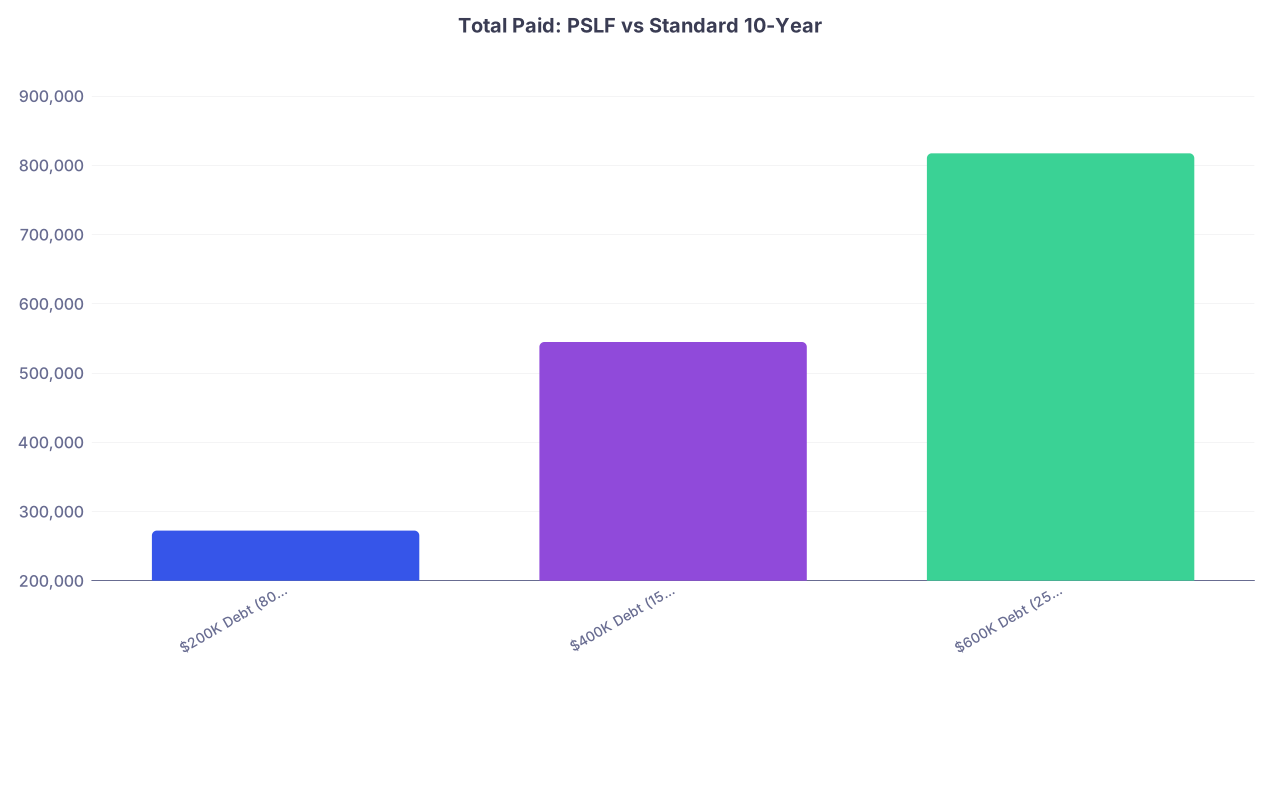
| Category | Value |
|---|---|
| $200K Debt (80K start) | 272400 |
| $400K Debt (150K start) | 544800 |
| $600K Debt (250K start) | 817200 |
The chart above shows only the standard totals; now we will put the PSLF totals side‑by‑side in a table so you can see the gap clearly.
| Debt / Income Track | Standard 10-Year Total | PSLF (SAVE) Total | Estimated Forgiveness* |
|---|---|---|---|
| $200K debt, $80K→$104K income | ~$272,400 | ~$58,000 | Large (most of balance) |
| $400K debt, $150K→$195K income | ~$544,800 | ~$138,000 | Very large |
| $600K debt, $250K→$325K income | ~$817,200 | ~$253,000 | Massive |
*Forgiveness is approximate; exact numbers depend on capitalization rules and any unpaid interest subsidies, but the direction is not ambiguous.
The data here is blunt: on pure total dollars paid, PSLF is dramatically cheaper. You are paying roughly:
- 20–25% of the 10‑year standard total at $200K
- 25% of the 10‑year standard total at $400K
- 30% of the 10‑year standard total at $600K
As debt rises, the absolute savings from PSLF explodes, even though the relative percentage can shift slightly with income.
4. Modeled Outcomes by Debt Level
Now let’s drill down debt by debt and frame this like real choices.
4.1 $200,000 Debt
This is a common number for many non‑medical graduate degrees, lower‑debt MDs, or people with some scholarships.
Rapid payoff option
- 10‑year standard payment ≈ $2,270/month
- Hard to manage on $80K–$90K income unless your cost of living is very low
- Total paid ≈ $272,400
PSLF on SAVE (Scenario A income)
- Starting payment about $450–$500/month, growing with income
- 10‑year total ≈ $58K
- Remaining balance forgiven at year 10, tax‑free under PSLF
Here is the uncomfortable truth: if you are PSLF‑eligible and plan to stay in qualifying employment for 10 years, “rapid payoff” on $200K debt is usually a financially bad move. You are paying roughly $214K more for the emotional satisfaction of being debt‑free earlier. That might be worth it to you, but it is a conscious choice to burn six‑figure value.
When might rapid payoff still be rational at $200K?
- You are not in, and do not want to be in, qualifying public/nonprofit work
- You are skeptical PSLF will exist unchanged for a decade and you want autonomy
- You are extremely high income relative to debt (e.g., $200K+ income with $200K debt) so IDR payments approach or exceed standard payments anyway
But if your income is modest and you qualify for PSLF, the math is not close. PSLF dominates.
4.2 $400,000 Debt
Now we move into classic physician territory.
Rapid payoff option
- 10‑year standard payment ≈ $4,540/month
- Total paid ≈ $544,800
- If you are earning $150K–$200K early attending income, $4.5K/month is painful but doable, especially if you live like a resident
PSLF on SAVE (Scenario B income)
- Starting monthly payment roughly $1,000–$1,200, growing over time
- Modeled 10‑year total ≈ $138K
- Likely forgiveness well above $300K including interest
Here, the data gets almost absurd. With $400K debt and a public/nonprofit career (e.g., academic hospital, VA, FQHC), PSLF can cut your total loan spend by ~75%.
That difference—roughly $400K—translates directly into:
- Earlier financial independence
- Ability to save heavily into retirement accounts
- Option value: you can leave medicine earlier or cut back hours without being shackled by debt
At $400K, it is very hard to justify rapid payoff unless you exclude PSLF from your universe on purpose. That exclusion might be rational if you:
- Want private practice / for‑profit employment soon (where PSLF does not apply)
- Do not trust federal policy stability and would rather take the guaranteed path
- Prefer simplicity over optimization and are comfortable with higher payments
But strictly on a spreadsheet, the PSLF path is the clear financial winner.
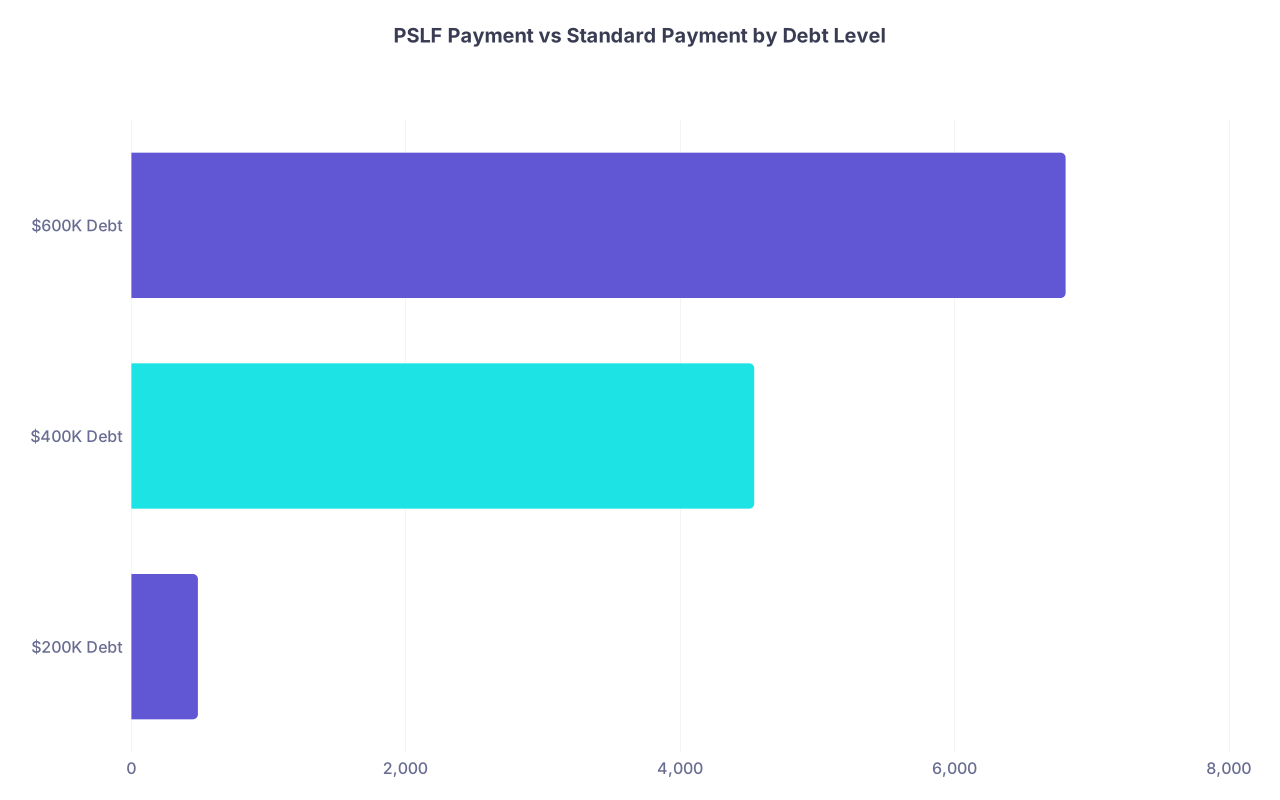
| Category | Value |
|---|---|
| $200K Debt | 485 |
| $400K Debt | 4540 |
| $600K Debt | 6810 |
The horizontal bars above should trigger one thought: “Why am I paying standard‑plan amounts tied directly to debt, when IDR payments tied to income are so much lower and forgiveness wipes out the rest?”
4.3 $600,000 Debt
This is extreme but not rare for certain combinations: private med school + undergrad + cost of living, some dental programs, etc.
Rapid payoff option
- 10‑year standard payment ≈ $6,810/month
- Total paid ≈ $817,200
- This number intimidates even many specialists earning $300K–$400K
- It is achievable only with aggressive lifestyle compression
PSLF on SAVE (Scenario C income)
- Starting monthly payment ≈ $2,000–$2,200, scaling up with income
- 10‑year total ≈ $253K
- Forgiveness likely north of $500K with interest
At $600K debt, the debt is no longer just “big.” It is structurally incompatible with fast private‑sector payoff for a lot of people. PSLF is not just the winning strategy; it is often the only sustainable way to have a humane life while paying loans.
Does high income slowly erase the PSLF advantage? Yes, there is a crossover point.
If you earn so much that:
- 10% of discretionary income approaches or exceeds what a standard plan would require, then PSLF becomes less compelling.
- For very high income (e.g., $500K+), IDR payments can rival or exceed standard payments, while forgiveness shrinks because you are paying so much along the way.
But for most real‑world specialist incomes with $600K debt, PSLF stays mathematically superior unless you deliberately disqualify yourself.
5. Sensitivity: What Happens When Key Inputs Change?
No model survives first contact with reality perfectly. So let’s stress‑test.
Variable 1: Income higher or lower than modeled
Rule of thumb from the data:
- If your income is low‑to‑moderate relative to debt, PSLF wins.
- If your income is extremely high relative to debt, rapid payoff begins to look more reasonable, particularly if you do not qualify for PSLF.
Concrete example:
- $400K debt, $300K income, no PSLF: your standard 10‑year payment is $4,540/month, which is about 18% of gross. That is painful but not catastrophic.
- If you work private and PSLF is off the table, then “rapid payoff” via standard or slightly accelerated payoff is simply your best of the bad options.
Variable 2: Interest rates
At 3–4% instead of 6.5%, the pain of standard 10‑year payoff decreases substantially. On the flip side, PSLF math barely changes, since IDR payments are based on income, not interest or principal.
Lower interest rates:
- Make rapid payoff more viable
- Reduce the relative savings of PSLF but usually not enough to flip the decision at high debt levels
- Make refinancing to private loans more attractive for non‑PSLF borrowers
Variable 3: Policy risk
Here is where pure math collides with reality. PSLF is a policy program. Congress and the Department of Education can and do change rules.
What the data from the last decade shows:
- PSLF has been reformed, expanded, and “fixed,” not canceled
- Waivers and IDR account adjustments have forgiven billions in extra loans
- Retroactive fixes have usually been in borrowers’ favor, not the opposite
Could that change? Yes. You are taking policy risk if you plan 10 years around PSLF.
But the forgone savings for many borrowers are six figures or more. That is the size of the bet: you are effectively paying $100K–$400K in “insurance premium” if you reject PSLF solely due to fear it might change.
6. Behavioral and Risk Trade‑offs (Where the Data Meets Psychology)
It would be dishonest to say “PSLF always wins; end of story.” Humans are not spreadsheets.
PSLF strengths (by the numbers)
- Lowest total dollars paid in the majority of high‑debt scenarios
- Lower required payments early in your career → more flexibility
- Massive forgiveness potential, tax‑free in PSLF
PSLF weaknesses (non‑numerical but real)
- Requires 10 years of qualifying employment; loss of eligibility late in the path is painful
- Administrative risk: paperwork failures, servicing errors, need to recertify income annually
- Policy risk: future changes that might alter program generosity (though existing borrowers are often grandfathered to some degree)
Rapid payoff strengths
- Simplicity: you know the monthly payment and the end date
- Autonomy: you can switch jobs, sectors, or even careers without worrying about PSLF eligibility
- Psychological benefit: being truly debt‑free has value that is not easily priced
Rapid payoff weaknesses (the data’s verdict)
- Far higher lifetime loan costs in most public‑service‑eligible, high‑debt cases
- Higher monthly payments → less capacity to invest early in retirement, which has its own compounding cost
- For very high debt (e.g., $600K), it may not be realistically achievable without extreme austerity
7. Pulling It Together: PSLF vs Rapid Payoff Across $200K / $400K / $600K
Here is the cleanest way to summarize the modeled outcomes.
| Debt Level | Typical Starting Income | Purely Financially Optimal (if PSLF-eligible) | When Rapid Payoff May Make Sense |
|---|---|---|---|
| $200K | ~$80K–$120K | PSLF clearly cheaper | Very high income or no PSLF |
| $400K | ~$150K–$250K | PSLF dramatically cheaper | Private sector with no PSLF |
| $600K | ~$250K–$350K | PSLF overwhelmingly cheaper | Ultra-high income, no PSLF |
To be blunt:
- At $200K, PSLF usually wins by ~$200K in lifetime dollars paid if you are in qualifying employment.
- At $400K, the delta between PSLF and rapid payoff is on the order of ~$400K.
- At $600K, the gap can approach or exceed half a million dollars.
That is not marginal optimization. That is life‑changing money.

8. What You Should Actually Do with This
You do not need a perfect model. You need a good enough one with your own numbers.
Here is a practical sequence that mirrors the analysis above:
- Write down your total federal debt, weighted average interest rate, and current/expected income trajectory.
- Compute your standard 10‑year payment at your true interest rate. That is your “rapid payoff” baseline.
- Estimate your SAVE payment using 10% of (AGI − 225% poverty) and project it forward with expected raises.
- Multiply that estimated average annual payment by 10 to get a rough PSLF total.
- Compare PSLF total vs standard total. If the PSLF total is less than ~60–70% of the standard total, PSLF is a strong contender, assuming you can stay in qualifying employment.
If you want to sanity‑check, build a simple spreadsheet. Year 1–10, estimate income and IDR payment line by line, then sum.
Key Takeaways
- The data shows that for large federal debts ($400K–$600K), PSLF with SAVE usually cuts your lifetime loan costs by hundreds of thousands of dollars compared with a 10‑year rapid payoff, assuming you remain in qualifying employment.
- For smaller but still significant debts (~$200K), PSLF still often wins decisively if your income is modest relative to debt; rapid payoff only becomes competitive when your income is very high or PSLF is off the table.
- The real decision is not “PSLF vs paying it off eventually.” It is “am I willing to trade 10 years of qualifying employment and some policy risk for six‑figure savings?” Once you frame it that way, the numbers make the answer much clearer.