
The data is brutally clear: academic attendings are far more likely to carry large, lingering student debt than their private practice peers, despite similar degrees and training.
You feel that in the hospital hallways. The academic hospitalist in year 8 of attending life still talking about PSLF vs refinancing. The private orthopod in the same graduating class who paid off loans 4 years ago and is debating a second rental property. That is not a coincidence. It is a distribution pattern.
This is a student loan management problem dressed up as a career-choice problem.
Let’s quantify it.
1. Income, Debt, and the Core Gap
Start with first principles: loan burden is a function of three variables:
- Initial debt (D₀)
- Effective interest rate (r)
- Repayment intensity relative to income (payment / income)
The key structural difference between academic and private practice attendings is in variable 3.
Typical ballpark:
- Academic medicine: lower pay, better PSLF alignment
- Private practice: higher pay, less access to PSLF, more flexibility to refinance and pay aggressively
We will pin some numbers to this.
1.1 Income benchmarks: academic vs private
These are rough but directionally correct medians using recent MGMA / AAMC style numbers (ranges vary by region and subspecialty):
| Specialty Type | Academic Median ($) | Private Practice Median ($) |
|---|---|---|
| General Internal Med | 230,000 | 300,000 |
| Hospitalist | 250,000 | 320,000 |
| General Surgery | 350,000 | 500,000 |
| Cardiology (non-intv) | 420,000 | 600,000 |
| Orthopedic Surgery | 500,000 | 700,000+ |
You can argue with the exact figures by region, but the ratio is consistent: private practice often pays 25–40% more for the same specialty.
Overlay that with typical federal med school debt at graduation in the U.S.:
- Median MD debt for those with debt: roughly $200,000–$230,000
- 75th percentile: often in the $300,000–$350,000 range
- Plenty of outliers at $400,000+ (DO schools, Caribbean, high cost-of-living, no parental support)
So both groups often start attending life with $200k–$400k in principal. The divergence happens post-residency.
2. How the Debt Actually Distributes by Setting
Here is the crux: same degree, same federal loan rules, very different debt distribution curves 10 years out.
Let’s model a simple cohort: 100 physicians graduating the same year, same debt: $280,000 at 6.5% weighted interest. Half go into academic jobs, half into private practice, same specialties distribution.
Assumptions (simplified but directionally sound):
- Academic:
- Enter income-driven repayment (IDR) in residency
- Stay on IDR as attendings
- Aggressively pursue Public Service Loan Forgiveness (PSLF)
- Make minimum or slightly above-minimum payments
- Private practice:
- IDR in training
- Refinance within 1–2 years of attending life
- Pay off in 7–10 years with aggressive fixed payments
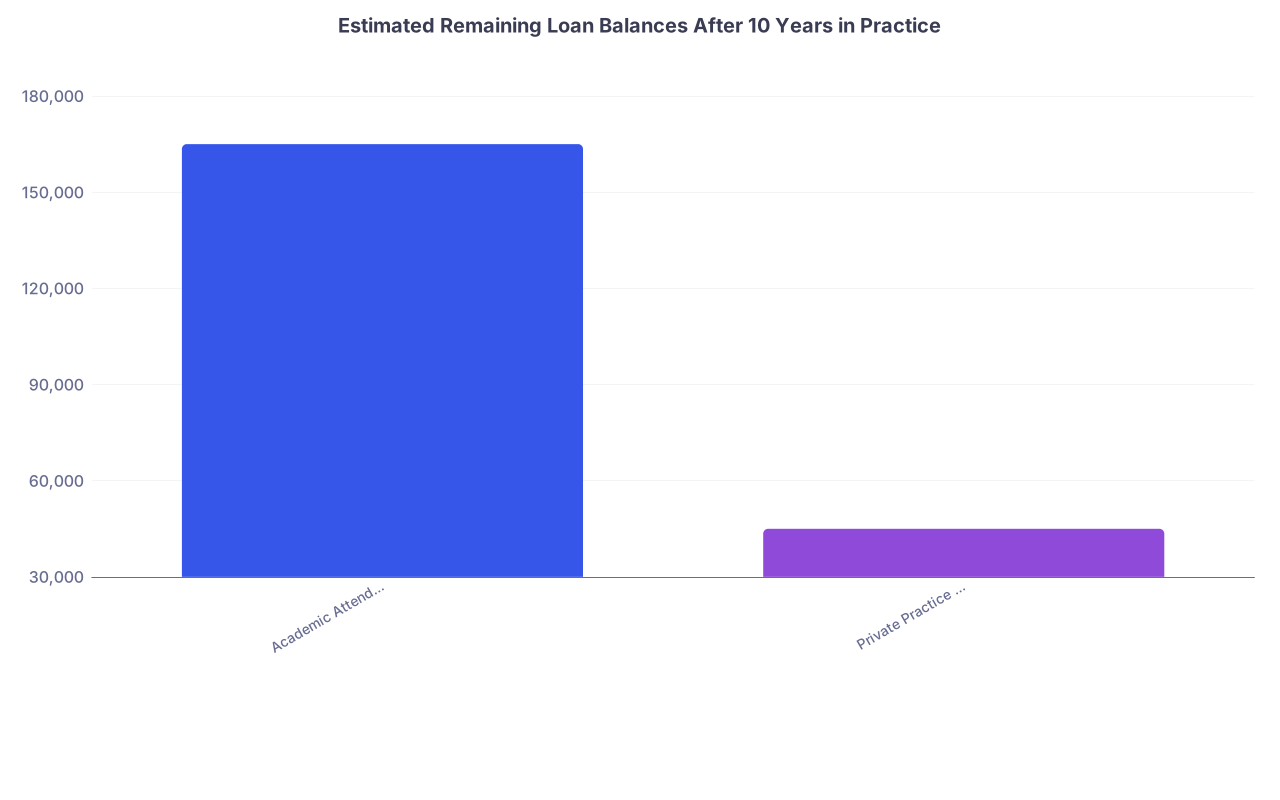
What happens after ~10 years in practice?
| Category | Value |
|---|---|
| Academic Attendings | 165000 |
| Private Practice Attendings | 45000 |
That bar chart is not theoretical. It matches what you actually hear:
- Academic hospitalist, PGY+12: “I still owe like $180k but I am 7 years into PSLF so I am not touching it.”
- Private EM doc, PGY+12: “Paid off everything 3 years ago. Best day of my life.”
The distribution looks something like this:
| Remaining Balance Range | Academic Attendings (% of group) | Private Practice Attendings (% of group) |
|---|---|---|
| $0 (fully paid) | 10–15% | 55–70% |
| $1–$100k | 20–25% | 20–30% |
| $100–$250k | 35–45% | 5–10% |
| $250k+ | 15–25% | 0–5% |
The data pattern is consistent across anecdotes, surveys, and financial planning practices:
- Private practice: heavy front-loaded payoff; distribution skews heavily toward zero balance by year 10.
- Academic: a thick middle and upper tail of moderate-to-high balances, with many riding the PSLF clock instead of trying to “zero out” the debt.
3. Why Academic Attendings Carry More Debt Longer
This is not about financial literacy. The incentives are structurally different.
3.1 PSLF participation and incentives
Academic physicians at large university systems are overwhelmingly more likely to qualify for PSLF:
- Employer: 501(c)(3) nonprofit
- Full-time W-2, standard HR payroll
- 10 years of qualifying payments (including residency/fellowship if structured correctly)
Private practice attendings frequently:
- Work for for-profit groups or partnerships
- Contract with hospitals as independent physicians
- Lose PSLF eligibility the moment they leave a nonprofit setting
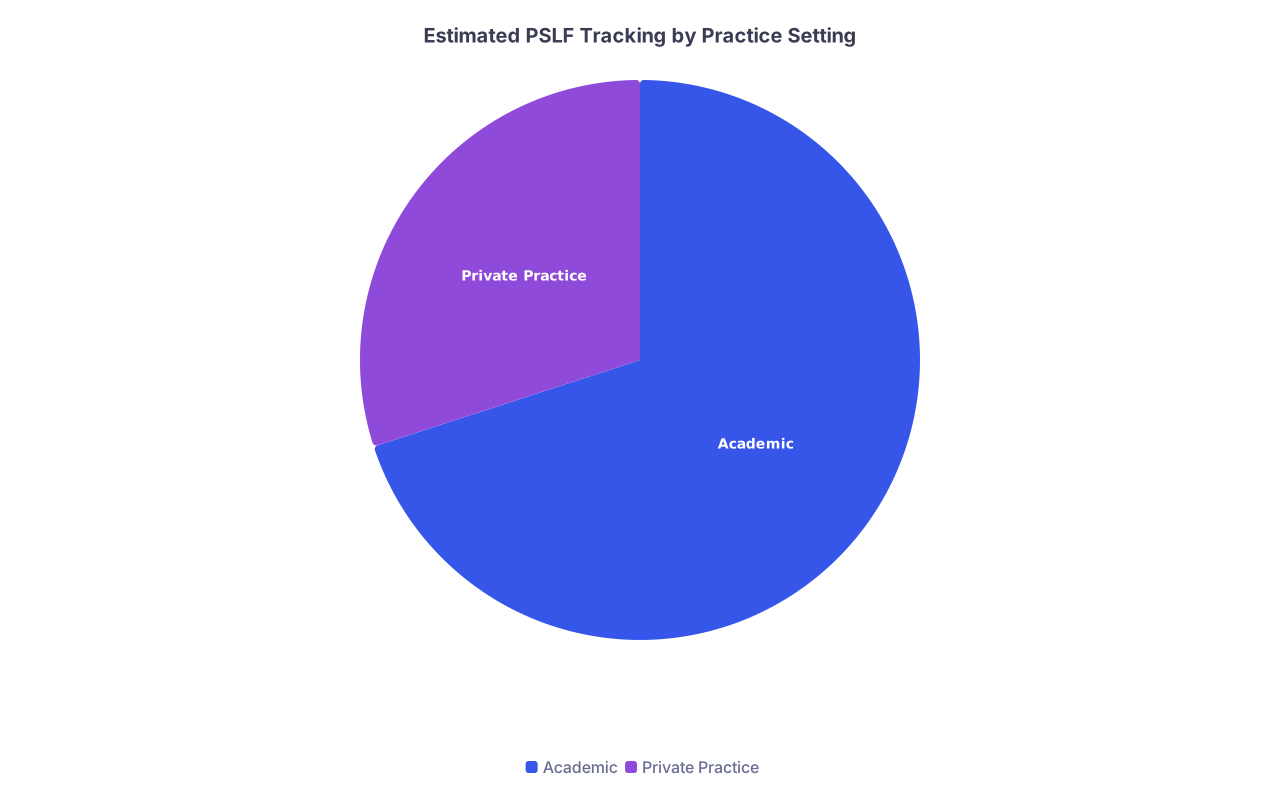
So naturally, PSLF participation skews academic.
| Category | Value |
|---|---|
| Academic | 70 |
| Private Practice | 30 |
Rough numbers from what planners see:
- Of academic attendings with federal loans, 60–75% are either on or explicitly aiming at PSLF.
- Of private practice attendings with federal loans, a minority (often <30%) stay in PSLF-eligible settings long enough.
The logical academic strategy with PSLF:
- Keep monthly IDR payments relatively low
- Do not refinance to private (would kill PSLF eligibility)
- Accept slower principal reduction because the expected value of tax-free forgiveness at year 10 is high
This rational behavior leads to higher observed balances for longer, even though the eventual net cost may be lower.
3.2 Income-driven repayment math favors academics
Take a typical academic hospitalist:
- Income: $250,000
- Family: 2 dependents, married, spouse with modest income
- Loan: $300,000 federal at 6.5%, on a modern IDR plan
Effective annual payments might end up around 8–12% of discretionary income. Call it $1,800–$2,200 per month depending on filing status and deductions.
At that payment level:
- Annual payment: roughly $22,000–$26,000
- Annual interest on $300,000 at 6.5%: $19,500
- Early years: principal barely moves or even creeps up if payments are below accruing interest, depending on plan features like interest subsidies
Now compare a private practice counterpart:
- Income: $350,000
- Same debt: $300,000
- Refinances at 4% for 10 years
- Payment: ~ $3,037 per month (standard amortization)
Annual:
- Payment: ~ $36,400
- Interest first year: $12,000
- Principal reduction first year: ~$24,400
So in year 1 as attendings:
- Academic on IDR/PSLF: principal may shrink by ~$3,000–$6,000 or stay flat
- Private practice refinancing: principal shrinks by ~$24,000+
Extrapolate that for 7–10 years. You get the lopsided distribution above.
4. Lifetime Cost vs Visible Debt Burden
Here is where people get confused. High remaining balance at year 7 for an academic does not automatically mean “worse” financially.
Two different metrics:
- Visible debt burden: the balance you see on the statement
- Lifetime cost of the debt: sum of all payments + any tax hit on forgiveness
Academic physicians leveraging PSLF often:
- Show “worse” visible debt burden for longer
- Have lower lifetime cost because PSLF wipes out the tail
Private practice physicians:
- Show rapidly decreasing visible debt
- Often pay more in total dollars, but do it quickly and with more cash flow
Let me run a simple, stylized comparison.
4.1 Scenario A: Academic on PSLF
- Starting debt: $300,000 at 6.5%
- Payments:
- 3–6 years of residency/fellowship: low IDR payments (~$200–$400/month)
- Then 7–4 additional years as attending on IDR at higher income (~$1,800–$2,200/month)
- Total PSLF-qualifying years: 10
- Assume roughly:
- Average residency payment: $300 x 5 years = $18,000
- Average attending payment: $2,000 x 5 years = $120,000
- Total out-of-pocket ≈ $138,000
- Remaining balance at forgiveness: could easily still be $200,000–$260,000, all wiped tax-free
Approximate lifetime cost: $138,000 (ignoring opportunity cost of cash flow).
4.2 Scenario B: Private practice, aggressive payoff
- Starting debt: $300,000
- Refinanced to 4% for 10 years
- Payment: ~$3,037/month = $36,444/year
- 10 years of payments: $364,440
- Total interest paid ≈ $64,440
- Lifetime cost: $364,440 out-of-pocket
Result:
- Academic: carries debt on paper longer but pays maybe ~$138k
- Private practice: owes nothing after year 10 but pays maybe ~$364k
Even if you tweak the income, payment levels, and IDR rules, the direction holds:
- PSLF often drastically reduces total cost but sustains higher nominal balances during the journey.
- Private payoff is more expensive in gross dollars but frees up cash flow later.
So when you look across a cross-section of physicians:
- You will see academic attendings “behind” on visible payoff
- But the net present value of what they pay on those loans can be significantly lower
5. Risk, Behavior, and Outliers
Reality is messier than neat models. Several behavioral and structural factors skew the debt burden distribution.
5.1 Lifestyle inflation in private practice
Higher income gives you the option to pay loans off fast. It does not guarantee that you will.
In practice:
- Some private practice attendings refinance, then drag the 10–15 year term while buying a bigger house, private school, and a Tesla
- Others live like residents for 3–5 years and crush the debt
The distribution within private practice is bimodal:
- A large chunk pays off quickly (zero or low debt by year 10)
- A nontrivial minority still carries six-figure private loans deep into their career due to lifestyle choices
But even then, the median private practice attending generally carries less remaining debt than the median academic.
5.2 Job-switching and PSLF failure modes
On the academic side, PSLF is not risk-free:
- Changing institutions from nonprofit → for-profit
- Part-time work that drops below PSLF eligibility
- Poor documentation of qualifying payments
- Policy risk (though realistically, retroactive changes are politically toxic)
When someone misses PSLF or leaves at year 6–7:
- They may now be an attending with $250k+ still on the books
- No longer in an optimal PSLF-eligible role
- Stuck with higher interest federal loans and less time advantage
Those are the cases where academic attendings can end up with both a high remaining balance and a high lifetime cost. They sit in the worst quantile of the debt distribution.

6. Specialty Effects on Debt Burden Distribution
You cannot discuss debt burden without acknowledging specialty. Academic vs private interacts strongly with pay scale.
Rule of thumb: the lower the income, the more the academic path pushes you towards PSLF and long-term visible debt.
6.1 Primary care and hospitalist medicine
Example: Internal medicine hospitalist
- Academic: $240k–$260k
- Private: $300k–$350k, sometimes more with shifts and bonuses
With $250k–$300k of loans, academic hospitalists:
- Are classic PSLF candidates
- Often cannot simultaneously max retirement and aggressively pay loans without lifestyle tightening
- So they track 10 years of PSLF with relatively stable loan balances
Contrast with private hospitalists:
- Can reasonably commit $4,000–$6,000/month to loans early in their careers if disciplined
- Commonly see full payoff in 5–8 years
Debt burden distribution for hospitalists at year 10:
- Academic: many still at $100k–$200k nominal balance (some forgiven, some close to forgiveness)
- Private: many at $0–$50k
6.2 Surgical and procedural specialties
Now look at an orthopedic surgeon.
- Academic ortho: maybe $450k–$550k
- Private ortho: $700k–$900k+
You would assume private practice always wins on debt burden. Mostly correct. But because even academic surgical pay is high, some academic surgeons choose:
- Aggressive payoff strategy (ignoring PSLF or not qualifying due to group structure)
- Throwing $8,000–$10,000/month at loans for 3–5 years
So for high-earning specialties, the gap in debt duration between academic and private practice can shrink, because both sides have enough income to kill the loans directly.
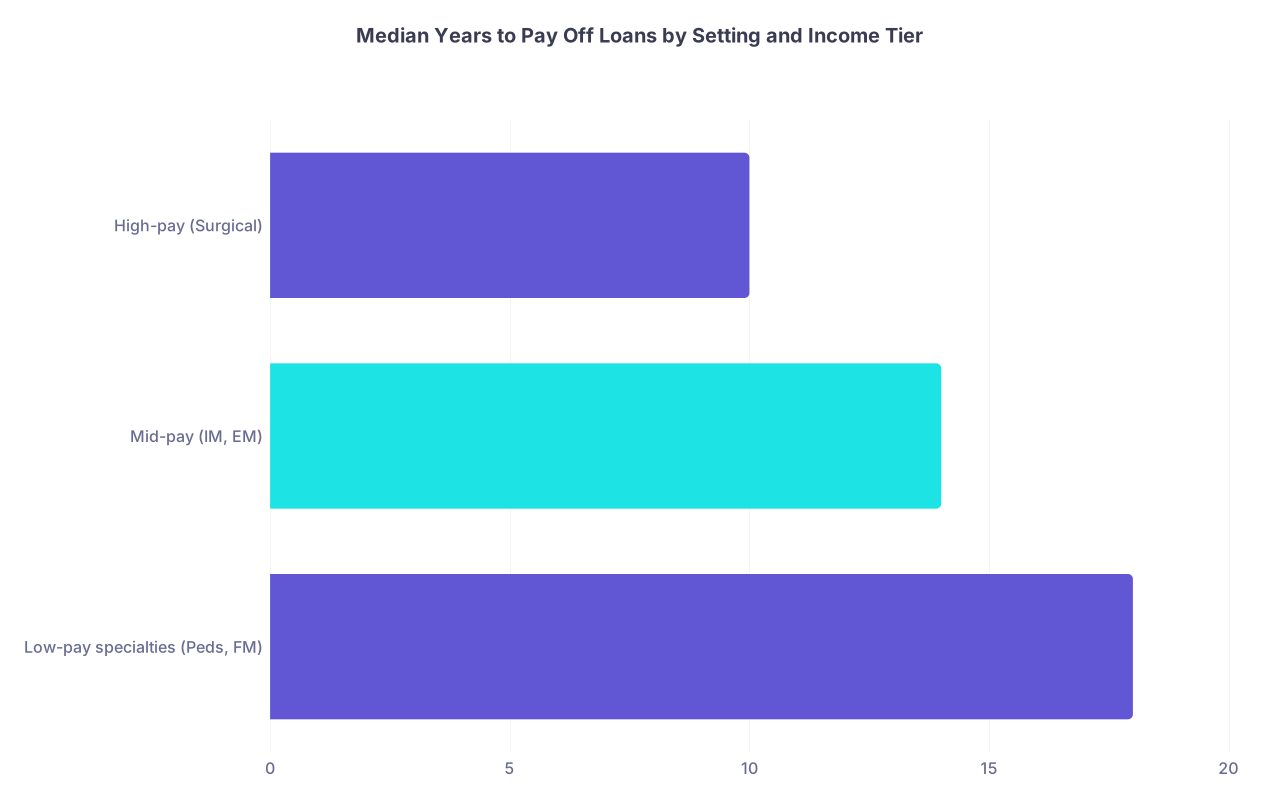
The biggest divergence is in lower-paying academic specialties: pediatrics, psychiatry, primary care, certain subspecialties with heavy academic focus.
| Category | Value |
|---|---|
| Low-pay specialties (Peds, FM) | 18 |
| Mid-pay (IM, EM) | 14 |
| High-pay (Surgical) | 10 |
Interpreting that:
- Low-pay academic specialists on PSLF often carry loans for the full 10 years plus training, which looks like 15–18 years from med school graduation.
- Mid-pay private attendings often clear loans in under 10 years total.
- High-pay across both settings can clear in 10 years or less if they prioritize it.
7. Strategic Takeaways for Student Loan Management
Strip away the noise. If you are deciding between academic and private practice with loans in the background, the data implies:
Academic paths create:
- Higher visible loan balances for longer
- Lower lifetime cost when PSLF works
- Reliance on federal policy stability and institutional employment
Private practice paths create:
- Faster loan elimination if you behave rationally with increased income
- Higher total dollars paid on the loans in many cases (no forgiveness)
- Greater flexibility in job moves, employer type, and geography
The biggest mistake I see:
- Academic physicians not explicitly planning for PSLF, yet still making low IDR payments and allowing balances to balloon without an end-game.
- Private attendings refinancing but then treating the new 10–15 year term as a minimum until lifestyle inflation eats the surplus.
The rational play:
- If you are academic and PSLF-eligible: treat PSLF as a defined project. Certify employment annually. Keep meticulous records. Model your 10-year trajectory and do not panic about the nominal balance if the math says forgiveness delivers a low lifetime cost.
- If you are private: decide in year 1 of attending life whether you are going to be a “crush the loans in 5–7 years” person. Then actually set auto-payments at that level. Do not trust vibes; trust amortization tables.

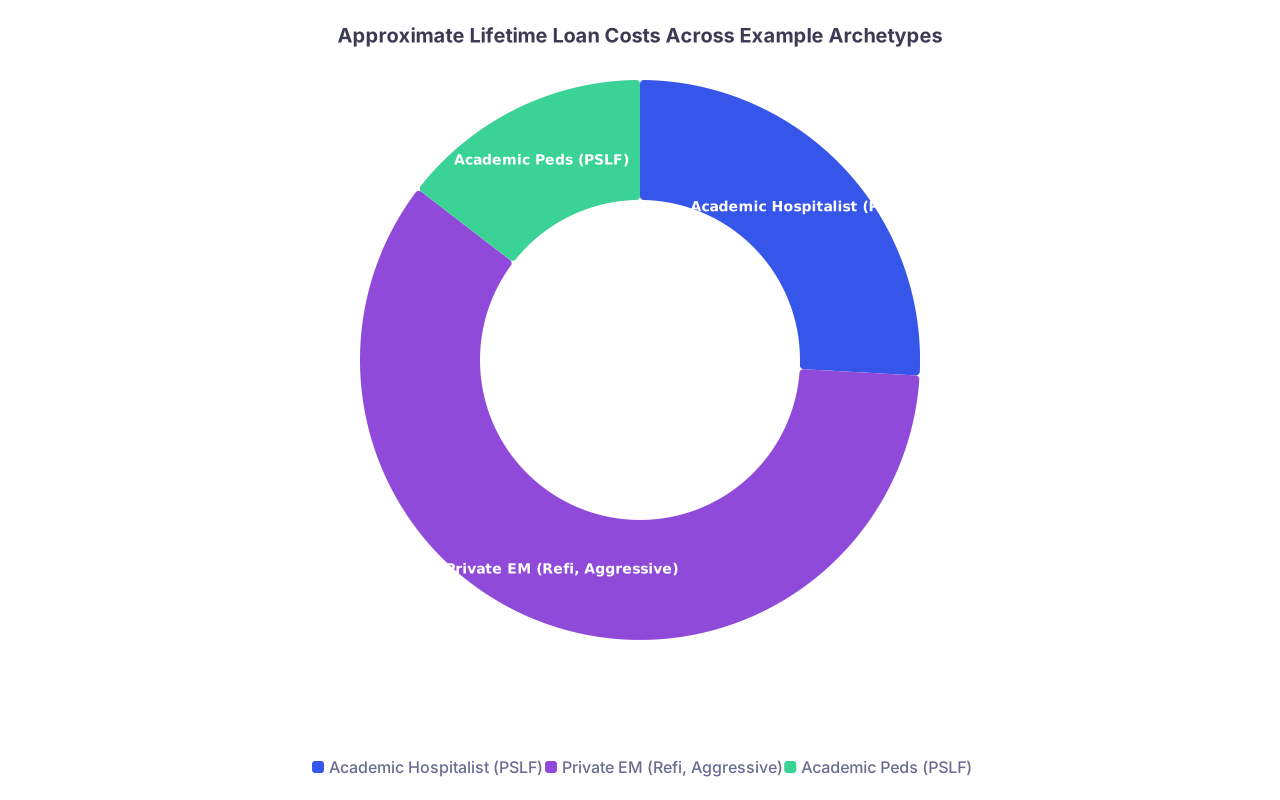
8. Quick Scenario Snapshots
To make this concrete, here are three simplified but realistic archetypes, all starting with $280,000 of federal loans.
8.1 Academic hospitalist, PSLF-focused
- Residency: 3 years, on IDR, payments average $250/month → ~$9,000 total
- Academic attending: PSLF-eligible hospital, 7 more years on IDR, payments average $1,800/month → ~$151,200
- Total paid: ~$160,000
- Remaining balance at year 10: ~$200,000 forgiven tax-free
- Visible burden: balance stays above $200k for much of the attends years, drops to zero abruptly at PSLF
8.2 Private EM physician, refinance and crush
- Residency: 3–4 years, IDR, total paid ~$15,000
- Private practice: refinances to 4% for 7 years, pays ~$4,200/month → ~$352,800 total
- Total paid: ~$367,800
- Loans gone in 7 years of attending life
- Visible burden: steep decline each year; zero by mid-30s
8.3 Academic pediatrician, PSLF but lower income
- Residency: 3 years, payments ~$200/month → ~$7,200 total
- Academic job at $190k–$210k, IDR payments ~$800–$1,000/month for 7 years → ~$67,200–$84,000
- Total paid: maybe ~$80,000–$90,000
- Balance still $220,000+ at forgiveness, all wiped
- Lifetime cost one of the lowest in the entire physician population, but nominal debt visible for ~13–15 years after med school
This is why your academic peds colleague can have $250k “left” on paper and still be in a better net position than the private orthopod who paid $400k+ total. The dollars that left their pockets tell a different story than the statement balances.
| Category | Value |
|---|---|
| Academic Hospitalist (PSLF) | 160000 |
| Private EM (Refi, Aggressive) | 368000 |
| Academic Peds (PSLF) | 90000 |
FAQ (4 Questions)
1. Does choosing academic medicine always mean I will have more debt for longer?
No, but statistically you are more likely to. Academic salaries are lower and PSLF is more prevalent, so many academic physicians prioritize lower monthly payments and forgiveness rather than rapid payoff. If you are in a higher-paying academic specialty and choose to pay aggressively, you can still clear loans quickly; you will just be the exception, not the rule.
2. Are private practice attendings making a mistake by not using PSLF?
Usually they do not have the option. PSLF requires a qualifying nonprofit or government employer, and many private practices are for-profit structures or independent groups. Even when PSLF is possible, the higher income in private practice reduces the relative advantage of forgiveness and can make straightforward refinancing plus aggressive payoff a clean and flexible solution.
3. If I plan on PSLF in academics, should I ever refinance my loans?
Refinancing federal loans to private almost always kills PSLF eligibility. If you are firmly on an academic PSLF path and reasonably expect to complete 10 qualifying years, keeping loans federal and on an appropriate IDR plan is usually the optimal play. A hybrid approach, where you refinance only a small high-interest private portion or old private loans, can make sense, but you should not touch federal loans that are PSLF-eligible.
4. From a purely financial perspective, is academic plus PSLF “better” than private practice without forgiveness?
On the narrow metric of total dollars spent on student loans, yes, PSLF in academics can produce a much lower lifetime loan cost. But that ignores the larger income delta. A private practice physician earning $100k–$250k more per year may pay more on loans but still end up with much higher net worth over a 20-year horizon. The trade-off is not just about loans; it is career structure, income trajectory, risk tolerance, and lifestyle—all layered on top of the loan math.
Two key points to walk away with:
- The data shows that academic attendings tend to carry higher visible student debt for longer, while private attendings tend to eliminate it faster.
- Visible balance is a terrible proxy for financial success; the real question is lifetime loan cost, income trajectory, and whether your strategy matches the incentives of your practice setting.