
The worst financial mistake many young physicians make is not a bad investment or a luxury car. It is buying a house too early.
Not too big. Too early.
You can survive an overpriced car. You can correct a mediocre portfolio. But an ill‑timed home purchase—stacked on top of massive student debt—can quietly strangle your options for a decade.
Let me walk you through how that happens, and how to avoid handcuffing your future.
The Seduction of “I Deserve It” After Training
You will be exhausted when you finish residency or fellowship. Burned out. Underpaid for years. Watching friends in tech or finance buy homes while you sleep in call rooms.
So when that attending paycheck hits, the narrative in your head sounds something like this:
- “I’ve waited long enough.”
- “This is finally my chance to put down roots.”
- “I’m done throwing money away on rent.”
- “Rates are only going up; I should buy now.”
- “Everyone else in my group owns.”
I hear this constantly from PGY3s and new attendings.
The problem is not homeownership itself. The problem is timing—and how it collides with student loans.
You are uniquely vulnerable in those first 1–5 years post‑training:
- Your earning potential is high, but your actual income is new and untested.
- Your student debt is at its peak and still compounding.
- Your career trajectory, specialty stability, and geography are not fully settled.
- You are tempted by every lender who sees “MD/DO” as a green light, not a warning sign.
Buying a house during that window often locks you into:
- Higher monthly obligations than you realize.
- Less flexibility for career moves, fellowships, or academic shifts.
- Terrible leverage in negotiating contracts.
- And the big one: student loan decisions that cost you six figures.
Let’s be very clear: the bank’s willingness to lend does not mean you can afford it. It means the bank is confident it will get paid, even if you suffer.
How Early Homeownership Wrecks Your Student Loan Strategy
This is the part almost everyone underestimates.
Your mortgage choice and your student loan plan are tightly connected. Get one wrong, and you damage the other.
Mistake #1: Forcing Yourself off Income‑Driven Repayment Too Soon
A young doc finishing training often relies on:
- SAVE (formerly REPAYE)
- PAYE (if still eligible)
- IBR to keep federal loan payments manageable.
Then they buy a house.
Suddenly:
- Underwriters want to see stable, higher income.
- Lenders count your existing student loan payment—or, if you are on a $0–low IDR payment, they may impute a much higher “standard” payment for debt‑to‑income ratio (DTI) calculations.
- You start thinking about refinancing to private loans to “clean up” your profile.
That’s how people get pushed into:
- Refinancing federal loans (losing federal protections, IDR, and PSLF eligibility) just to qualify for a mortgage.
- Or increasing their IDR payments by filing taxes jointly or increasing reported income prematurely, wrecking a carefully planned forgiveness strategy.
Both are ugly.
If you are even remotely pursuing:
- Public Service Loan Forgiveness (PSLF)
- Long‑term IDR with taxable forgiveness at 20/25 years
- SAVE optimization (lower AGI, higher forgiveness) then a mortgage in your first 1–3 attending years often:
- Increases your required payment sooner than necessary.
- Reduces the amount that will be forgiven.
- Locks you out of strategic moves like working less, changing jobs, or extending training.
Mistake #2: Ignoring the “Cash Flow Cage”
On paper, a $400k house at 6.5% looks “affordable” to a new attending making $230k.
Here is where people get burned: total monthly obligations.
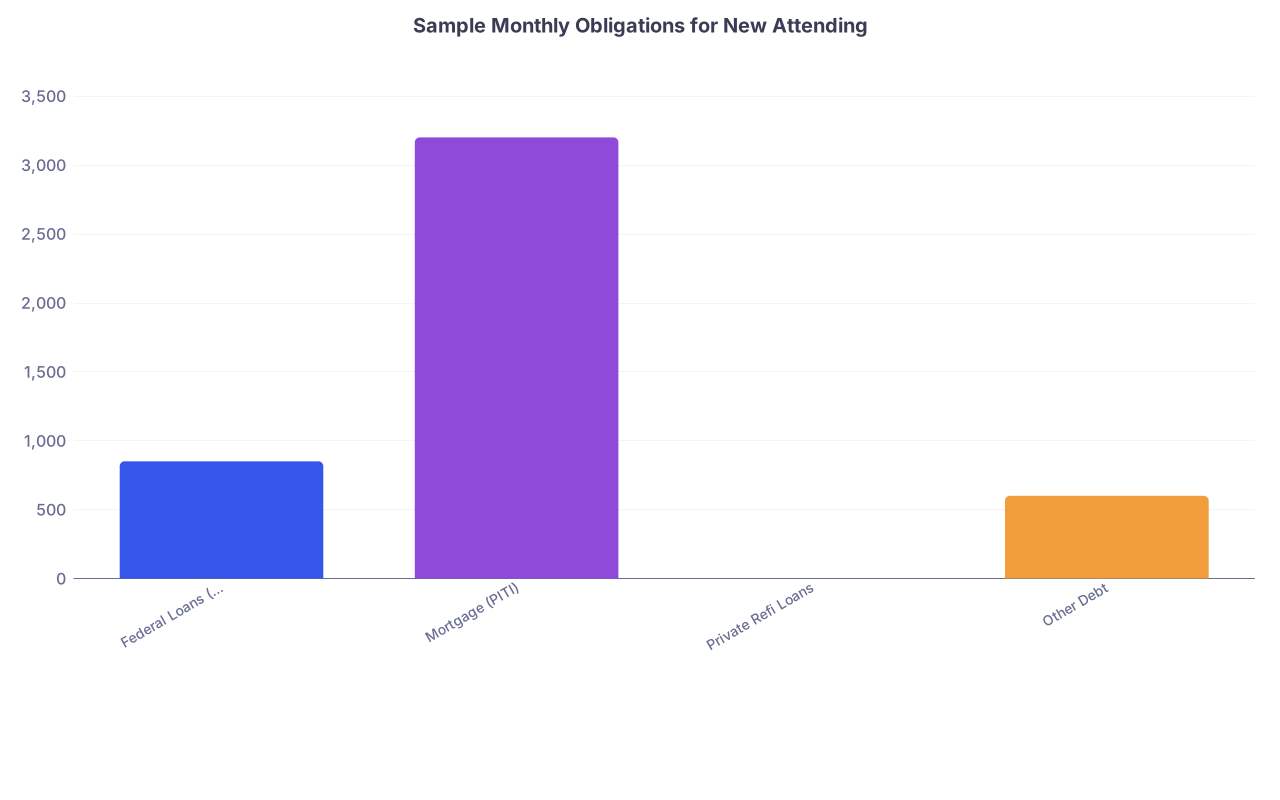
| Category | Value |
|---|---|
| Federal Loans (SAVE) | 850 |
| Mortgage (PITI) | 3200 |
| Private Refi Loans | 0 |
| Other Debt | 600 |
This is the “reasonable” version.
Now add:
- Daycare
- Disability insurance
- Professional fees
- Retirement contributions
- Car payment you convinced yourself you “deserve”
You have constructed a lifestyle where:
- Dropping to 0.8 FTE = impossible
- Taking a lower‑pay academic job = impossible
- Moving to a PSLF‑qualified institution = nearly impossible without serious pain
You boxed yourself in, not with one catastrophic decision, but with a set of commitments that only make sense at your current income and health.
That is the real risk: no room to adjust when life changes.
Physician Mortgages: Friendly Branding, Hidden Handcuffs
Doctor loans (physician mortgages) are marketed as a gift:
- Little or no down payment.
- Ignore student loans in DTI calculations, or use a favorable formula.
- No private mortgage insurance (PMI).
- “We understand residents and physicians.”
Sounds tailored to your life. Convenient. Respectful.
The reality? They are a business model built on the assumption you will:
- Earn a lot,
- Rarely default,
- And tolerate higher interest rates or worse terms because of your title.
| Feature | Physician Mortgage | Conventional Loan |
|---|---|---|
| Down Payment | 0–5% | Usually 5–20% |
| PMI | Often waived | Required if <20% down |
| Interest Rate | Often slightly higher | Often lower |
| Student Loans in DTI | Ignored or reduced impact | Count actual or imputed |
| Flexibility to Move | Lower (high LTV, low equity) | Higher if you put 20%+ |
The most dangerous part: 0–5% down with huge loan‑to‑value (LTV).
Here is what happens:
- You buy with 0–5% down in Year 0.
- Market is flat or slightly down in Year 2–3.
- You need to move for a better job, PSLF opportunity, or to escape toxicity.
You discover:
- After realtor commissions and selling costs (easily ~8–10%), you owe money at closing.
- Or you cannot sell at all without writing a big check.
You are trapped. Golden handcuffs made of drywall and granite countertops.
Geographic and Career Lock‑In: The Cost You Don’t See on Zillow
Residency feels permanent. That hospital. That city. Those colleagues.
Five years later, a frightening number of people are gone. Switched:
- From academic to private.
- From private to hospital employment.
- From one state to another for family, spouse, or legal reasons.
- To different subspecialties or nonclinical work.
Buying too early assumes:
- You will stay in the same metro area.
- Your current job is sustainable.
- Your spouse/partner will never need to move.
- Your kids’ future needs (schools, medical care, family support) will align with your current ZIP code.
That assumption is wrong more often than people admit.
Once you own:
- You have to sell or rent to move.
- If the local rental market is weak, you either discount or bleed cash each month.
- Managing a rental from a distance—while working 50–70 hours a week—is not a small side hobby. It is another job.
Even worse, contracts and employers feel different when you are anchored by a mortgage. I have watched:
- Young attendings tolerate unsafe staffing or abusive leadership because “I need this job to pay the house.”
- Docs pass on fellowships they wanted because “I can’t take the pay cut and keep the house.”
- People stay in high‑stress, high‑volume jobs purely because they are stretched thin on housing costs.
The house is not just a building now. It is a shackle on your risk tolerance.
The Tax and “Building Equity” Myths New Docs Fall For
You will hear two tired justifications:
- “Rent is throwing money away.”
- “I need the mortgage interest deduction.”
Let’s dismantle those.
Rent Is Not Your Enemy. Liquidity Is Your Friend.
Paying rent is buying flexibility:
- You can move across town or across the country with 60 days’ notice.
- You can change jobs without calling a realtor.
- You can downsize or upgrade quickly as your life shifts.
What actually wrecks young doctors is not “wasted” rent. It is:
- Overspending on housing.
- Underfunding emergency reserves.
- Underpaying, or mismanaging, student loans while chasing a house fantasy.
You do not build wealth by owning a home you can barely afford. You build wealth by maintaining high savings rate, low fixed costs, and optionality.
The Mortgage Interest Deduction Is Not a Prize
You only benefit from the mortgage interest deduction if:
- You itemize and your itemized deductions exceed the standard deduction (which is quite high now).
- And you pay a significant amount of interest.
Celebrating that is like celebrating paying more interest to get a slightly lower tax bill. You are spending a dollar to save maybe 30 cents.
The better move for most early‑career docs:
- Keep housing costs lower.
- Build cash, retirement accounts, and a sane student loan strategy.
- Worry about tax optimization once you are not drowning.
The Risk Layer Cake: Where Young Docs Stack Too Much
Here is what I often see in the first attending year:
- $300k–$600k+ federal student loans (sometimes more with private)
- Uncertain job fit and burnout risk
- Tight cash reserves (maybe 1–2 months of expenses)
- New disability and life insurance premiums
- Pressure to contribute to 401(k)/403(b)/457(b)
- Maybe a car upgrade
- Then… a $500k–$1M mortgage
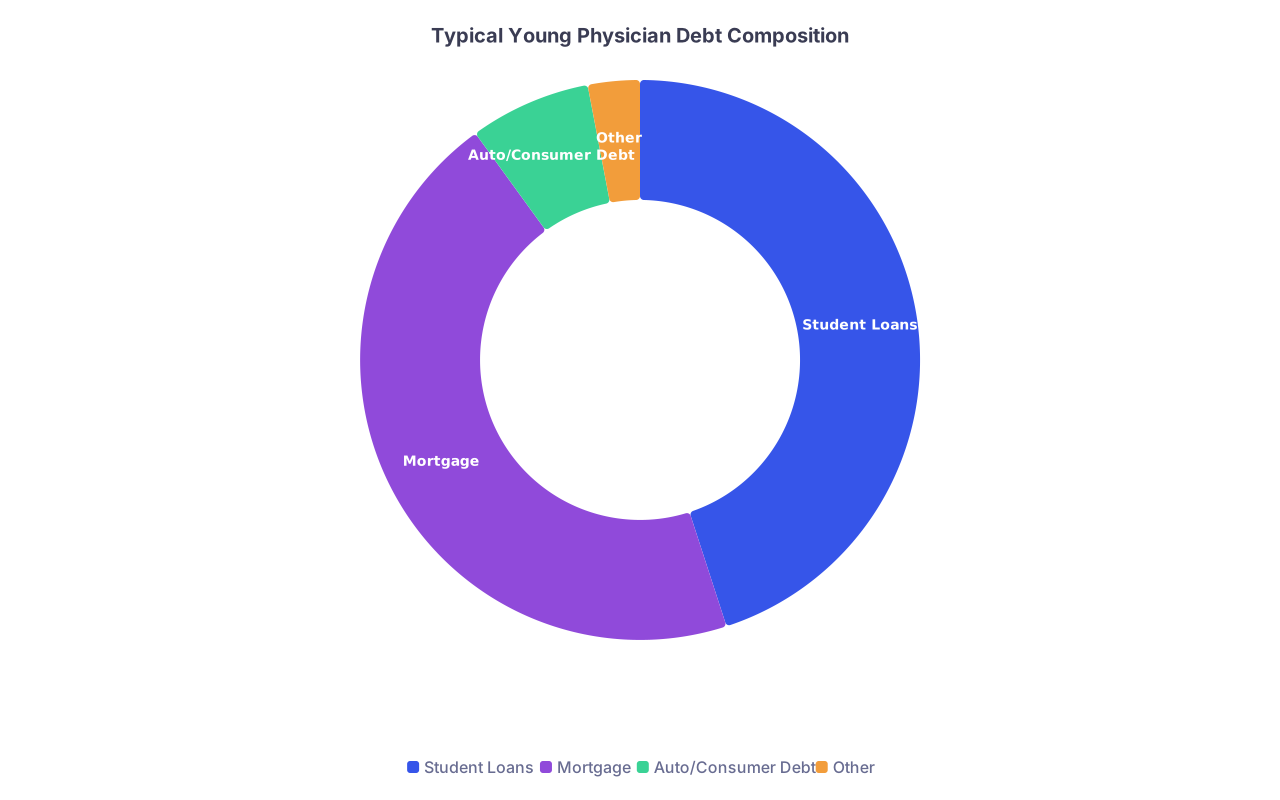
That is how people end up with something like this:
| Category | Value |
|---|---|
| Student Loans | 45 |
| Mortgage | 45 |
| Auto/Consumer Debt | 7 |
| Other | 3 |
Every slice demands a monthly payment. There is almost no room for:
- Career shifts.
- Health issues.
- Family crises.
- Bad markets.
This is how even “high income” doctors feel perennially broke.
The problem is not just the amount of debt. It is the illiquidity and inflexibility of that debt, especially the mortgage.
When a House Purchase Actually Makes Sense for a Young Doc
I am not anti‑homeownership. I am anti‑rushing into it during the most unstable period of your professional and financial life.
You want some guardrails? Use these. If you cannot check most of these boxes, you are likely buying too early.
1. Job and Geography Stability
You should:
- Have been an attending in the same job for at least 1–2 years.
- Believe with high confidence that you will stay in the same metro area for 5+ years.
- Have completed any known upcoming training (e.g., not about to start fellowship in another city).
If you are a PGY‑3 looking at your “dream attending job” you have not started yet, you do not have stability. You have a guess.
2. Student Loans Under Control (With a Clear Strategy)
You should:
- Have a written student loan plan—federal vs private, IDR vs aggressive payoff, PSLF vs non‑PSLF.
- Know your monthly payment for the next 3–5 years under that plan.
- Be able to maintain that payment comfortably even with the new mortgage.
If your plan is “I’ll figure it out after closing” you are walking into a trap.
3. Strong Cash Reserves
At minimum:
- 3–6 months of total living expenses in cash after closing, not including the down payment and closing costs.
- If you are in a volatile specialty or private practice, lean closer to 6–12 months.
If the house will wipe you down to a $5k emergency fund, you are gambling your entire life on:
- No job loss.
- No major medical issue.
- No sudden move.
That is not prudence. That is denial.
4. Reasonable Housing Ratio
A conservative rule that keeps people safe:
- Keep total housing costs (PITI—principal, interest, taxes, insurance + HOA if any) at no more than 20–25% of your gross income.
- And preferably under 15–20% of take‑home pay.
If your lender says, “You qualify for up to 40–45% debt‑to‑income,” understand: that is the bank optimizing for their security, not your quality of life.
A Better Sequence for Young Physicians
Let me give you a basic timeline that avoids the worst landmines.

| Step | Description |
|---|---|
| Step 1 | PGY1-3 |
| Step 2 | Late Training |
| Step 3 | First 1-2 Attending Years |
| Step 4 | Consider Home Purchase |
| Step 5 | Learn loan options |
| Step 6 | Set student loan plan |
| Step 7 | Build emergency fund |
| Step 8 | Buy carefully |
PGY 1–3 / Early Residency
- Understand federal loans, IDR, PSLF.
- Avoid private refinancing unless absolutely sure PSLF is off the table.
- Ignore housing FOMO. Rent near the hospital and protect your sleep and sanity.
Late Residency / Fellowship
- Solidify loan strategy.
- Run numbers on PSLF vs private payoff using realistic attending income.
- Save a small emergency fund (even $5k–10k helps).
- Do not buy “because I will be here for fellowship.” That is a 1–3 year plan, not 5+.
First 1–2 Attending Years
- Test your job. Confirm you like the work, the group, the city.
- Clean up any high‑interest consumer debt.
- Build a robust emergency fund.
- Start retirement contributions and decide how aggressively to pay/unpay student loans.
- Track your real monthly cash flow for at least 6–12 months.
Only After That: Consider a House
- Once your job, city, loan plan, and cash reserves are all stable.
- Buy a house that you can afford comfortably on less than your current income, assuming no bonuses and no overtime.
Red Flags You Are About to Buy Too Early
If you recognize multiple items on this list, stop.
- You are still in residency or fellowship and thinking, “I might stay here after.”
- Your attending job offer is not signed yet.
- You just signed an attending contract but have not actually worked there.
- You need a doctor loan with 0% down to make the numbers work.
- The mortgage will push total housing above 25% of gross income.
- You do not have 3–6 months of expenses in cash after closing.
- You are vague about your student loan plan: “Probably refinance once I start.”
- You are relying on moonlighting or overtime to safely afford the mortgage.
- A recruiter or lender is telling you, “With your income, you’d be crazy not to buy.”
Any one of these should make you slow down. Multiple? You are sprinting toward a cage.
The Psychological Trap: Identity, Status, and Shame
There is one more piece people underestimate: the ego hit.
Physicians are used to:
- Being the responsible one.
- Projecting stability.
- Meeting societal expectations of “success.”
So when:
- Your non‑MD friends own homes.
- Your co‑residents post closing‑day photos.
- Your family keeps asking, “When are you going to buy a place?”
you feel behind.
That shame is a powerful driver of bad decisions. I have watched perfectly smart doctors rationalize absurd purchases because they cannot tolerate looking “behind” their peers.
Here is the truth few say out loud:
- You started working a full attending salary later than almost any high‑income profession.
- You are carrying more non‑bankruptable debt than 99% of the population.
- You are still learning what kind of life you want outside the hospital.
You are not behind. You are just early in a very long game.
Waiting 2–5 extra years to buy—even if everyone around you is closing this year—can be the single most important financial decision you make in your 30s.
What To Do Right Now
Before you scroll away, do this:
Write down your total monthly fixed payments
- Student loans (current or projected post‑training)
- Rent
- Car loans or leases
- Minimums on credit cards
- Insurance premiums (disability, life, etc.)
Add a hypothetical mortgage payment
- Go to any mortgage calculator and plug in a realistic house price you have in mind.
- Include taxes and insurance. Do not delude yourself with principal and interest only.
Compare the total to your realistic attending paycheck (after taxes, retirement, and benefits).
If that number makes your stomach tighten—even a little—treat that feeling as a warning, not something to rationalize away.
The next step is simple: press pause on Zillow and sketch a 2–3 year plan that gets you:
- A stable job you know you like.
- A clear student loan strategy.
- 3–6 months of expenses in cash.
- A target housing budget that does not choke you.
Open your budget or notes app right now and write one sentence:
“I will not buy a house until I can comfortably afford it without compromising my student loan plan or my career flexibility.”
That single line, followed by a few years of patience, may be worth more than any “doctor loan” you will ever be offered.