You’re at your desk on the 12th of the month. Your federal student loan payment is due on the 15th. Your checking account balance looks pathetic. Your next paycheck doesn’t hit until the 20th.
You stare at your wallet. There’s a credit card sitting there with a tempting $6,000 of available credit. You think:
“I’ll just put this month’s loan payment on the card. Bridge the gap. I’ll pay it off next month. No big deal.”
That thought right there is where people blow up their finances. Not dramatically at first. Quietly. One “bridge” at a time.
Let me walk you through why “credit card bridging” your student loans is a trap, how it actually works under the hood, the nasty legal and credit consequences people don’t think about, and what to do instead if you’re genuinely stuck.
What “Credit Card Bridging” Actually Is (And Why Lenders Love That You Don’t Understand It)
“Bridging” your loans with a credit card usually looks like one of these:
- Using a credit card directly to pay a loan servicer (via their website or a third-party processor).
- Using a card to buy a money order or use a bill-pay service (like Plastiq-type platforms) to send a check to your lender.
- Taking a credit card cash advance to your bank account, then paying your loans from the checking balance.
- Using a 0% balance transfer card to move existing loan or credit card debt, then paying the student loans with the freed-up cash.
On the surface it feels clever. Arbitrage. You’re “moving” a loan payment onto a card with more time, maybe even 0% interest for a promo period. You feel like you’re outsmarting the system.
You are not.
You’re trading:
- Lower interest for higher interest
- Safer debt for more dangerous, less protected debt
- Clear options (forbearance, deferment, IDR, PSLF) for… none of that
Here’s what typically happens when people start doing this.
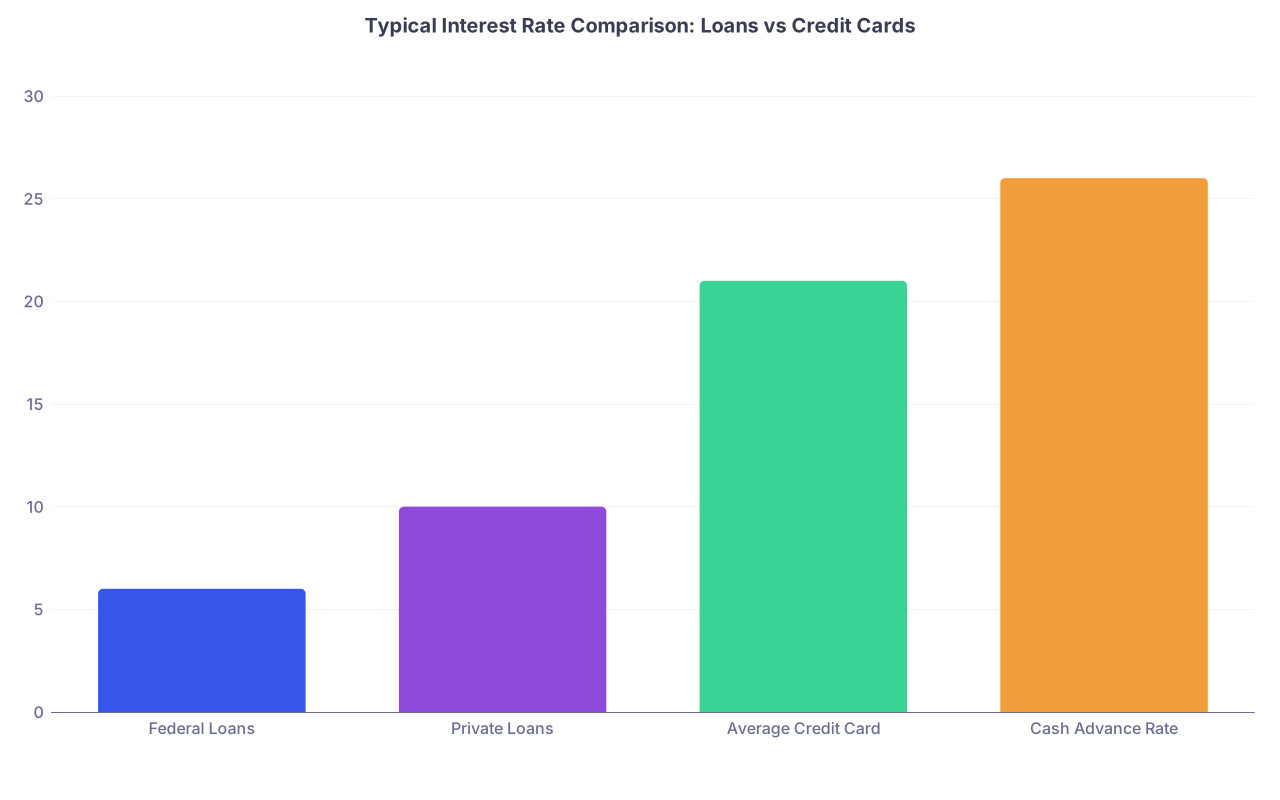
| Category | Value |
|---|---|
| Federal Loans | 6 |
| Private Loans | 10 |
| Average Credit Card | 21 |
| Cash Advance Rate | 26 |
Notice the spread. You’re not “bridging.” You’re upgrading your debt. To a worse species.
The Five Big Ways This Shortcut Blows Up On You
1. You’re Converting Protected Debt Into Predatory Debt
Student loans—especially federal loans—come with protections that credit cards simply do not.
With federal loans, you’ve got:
- Income-driven repayment (IDR) options
- Deferment and forbearance possibilities
- Potential forgiveness (PSLF, IDR forgiveness, some teacher/nurse programs)
- Hardship options during unemployment or medical crises
Credit cards give you… minimum payments and a phone tree that ends with “we can’t help you unless you pay.”
When you put loan payments on a card, you’re doing something incredibly destructive: you’re moving part of what could be negotiable, flexible debt into rigid, consumer credit debt. If things go bad later, you’ll wish that money was still in the student loan bucket.
I’ve seen people who:
- Lost their job, got approved for $0 IDR payments on federal loans
- But still had $8,000 sitting on a credit card from a year of “bridging”
- Guess which one went to collections and wrecked their credit? Not the loans. The card.
You do not want to be stuck with unprotected 24% credit card debt while your loans are calmly sitting at 6% with a $0 required payment.
That “bridge” just burned the only safety net you had.
2. You’re Paying Interest On Money That’s Already Interest
Here’s the part people ignore because it’s boring and math-y. But it’s also the part that stabs you in slow motion.
When you make a minimum student loan payment, a chunk goes to interest, and a chunk might go to principal. If you throw that payment onto a credit card, you’re now financing that interest portion at credit card rates.
So if your $400 loan payment is:
- $260 to interest
- $140 to principal
And you put that $400 on a card at 21% APR?
You’re now paying 21% on the $260 interest portion… which was originally created by your 6–8% student loan. Paying interest on interest is how balances quietly explode.
Do this for 6–12 months and—without missing a single payment—you can:
- Add thousands in extra interest
- Jack up your utilization
- Put yourself in a hole it takes years to climb out of
And yes, this still hurts even if you “plan” to pay it off quickly. Because most people who bridge didn’t start out planning to be behind. Life just kept happening, and the card became their backup plan.
3. You’re Turning a Temporary Cash Crunch into a Long-Term Credit Problem
Let’s talk utilization. This is the part of your credit score people pretend to understand but routinely abuse.
Utilization = how much of your available credit you’re using.
If you have:
- $10,000 total credit limit across cards
- $1,500 in regular usage
- Then you add $4,000 of “bridged” payments
You’re suddenly using $5,500 of $10,000 → 55% utilization.
Credit scoring models hate that. Once you push past ~30%, your score starts taking hits. Past 50%? It gets uglier.
| Utilization Level | Typical Impact on Score |
|---|---|
| Under 10% | Ideal / Positive |
| 10–29% | Generally Safe |
| 30–49% | Noticeable Drop |
| 50–79% | Significant Damage |
| 80–100% | Severe Risk Zone |
Now imagine you do this for months:
- You keep “bridging” because the balance is already there
- Interest builds
- Minimum payments go up
- You start carrying a permanent 40–70% utilization
Suddenly your credit score is garbage at exactly the time you might need it most: to refinance private loans, rent a new apartment, or get a decent car loan for residency or job commuting.
You tried to solve a short-term cash flow problem, and you just torched your long-term borrowing power.
4. You’re Walking Straight Toward Cash Advance Hell
Some loan servicers will not let you pay with a credit card directly. So people get “creative”:
- Using card-linked bill-pay services
- Buying money orders with credit cards
- Taking cash advances to fund their checking account
This is where the trap really tightens.
Cash advances are a different animal:
- No grace period. Interest starts immediately
- Higher APR (often 24–30%+)
- Extra transaction fees on top (e.g., 3–5% of the amount)
So that $1,000 you “borrow” to make a student loan payment? You might pay:
- $50 to the bank as a cash advance fee
- 25% APR from day one
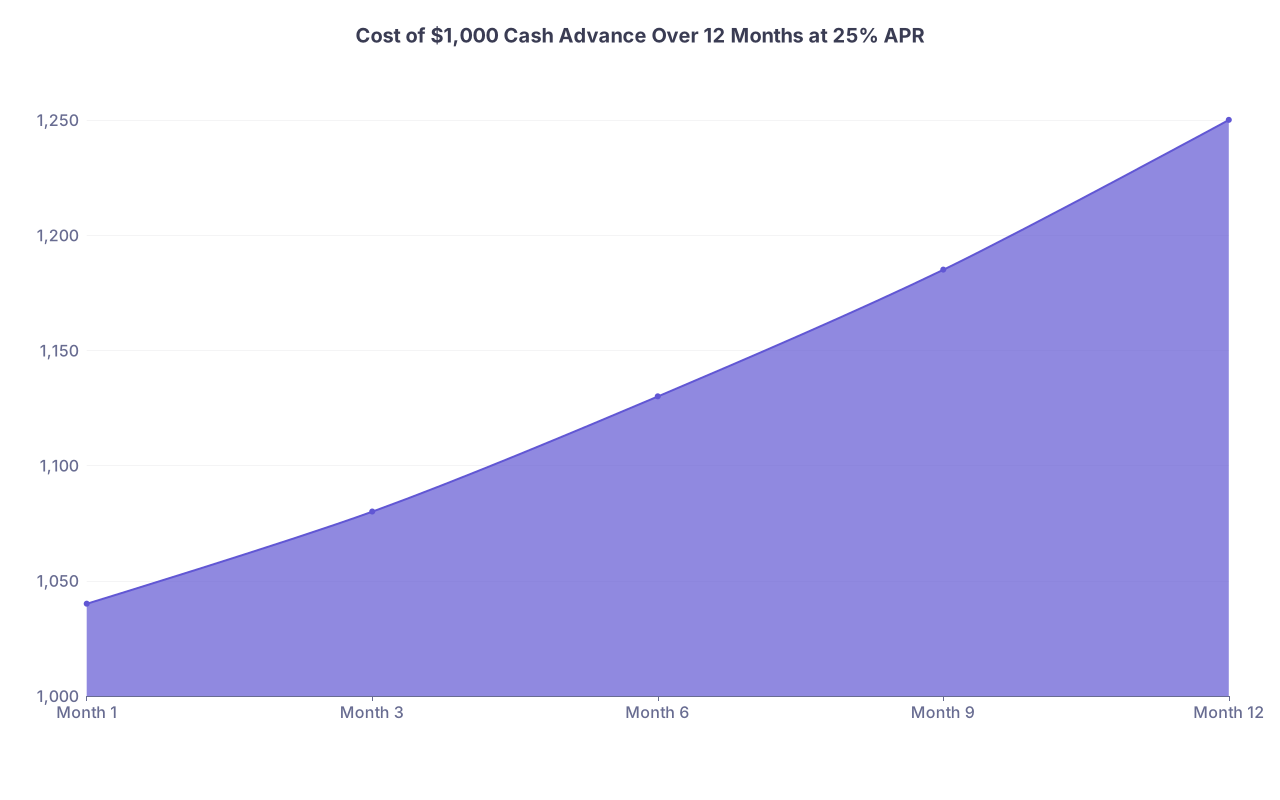
| Category | Value |
|---|---|
| Month 1 | 1040 |
| Month 3 | 1080 |
| Month 6 | 1130 |
| Month 9 | 1185 |
| Month 12 | 1250 |
That’s assuming you don’t add more. Reality: most people layer more debt on top while barely paying the minimum. I’ve watched balances double in 3–4 years from this alone.
You’re not bridging. You’re jumping into a hole with a rope that’s tied to a rock.
5. You’re Screwing Yourself Legally If Things Ever Go Really Bad
This is the dark side nobody talks about: legal consequences.
Student loans—especially federal—are notoriously hard to discharge in bankruptcy. But there are nuanced repayment, hardship, and rehabilitation options. You’re dealing with government or large servicers used to long-term arrangements.
Credit card debt in collections is different:
- Much faster to get sent to collections
- Easier for creditors to sue you in regular civil court
- Can lead to judgments, wage garnishment (depending on your state), bank levies
And here’s the kicker: if you ever do end up in a bankruptcy scenario, judges will absolutely look at what you did with your credit cards.
If it looks like:
- You knowingly transferred student loan obligations onto credit cards
- Used balance transfers or cash advances to push around student loan debt
- Then tried to discharge the cards while keeping the student loans
That can be seen as abusive or bad faith behavior. It doesn’t always kill your case, but it can absolutely complicate it. I’ve seen lawyers groan out loud reading those statements.
You basically created a paper trail that says: “I tried to convert protected debt into unsecured consumer debt, then walk away from it.”
That’s not the look you want if a judge or trustee is reviewing your finances.
The 0% Balance Transfer Mirage: The “Smart” Bridge That Still Backfires
I know what some of you are thinking:
“I’m not doing high-interest bridging. I’m using 0% balance transfer offers. It’s basically free money.”
Let me be blunt: these are the most dangerous of all, because they look sophisticated.
Yes, 0% promos can be used strategically in rare, very controlled situations. But here’s how they blow up 90% of the time:
- You pay a 3–5% transfer fee upfront. That’s not free.
- You underestimate how fast 12–18 months go by.
- You assume you’ll have the discipline to pay the whole thing off before the promo ends.
- Life ignores your plan and does what it always does—car repair, job shift, move, health issue, whatever.
Then the promo ends.
Now that $8,000 you moved at 0% jumps to 21.99%. You still haven’t paid off all of it. Maybe you’ve even added more on that card “temporarily.”
Congratulations. You turned a 6–8% loan into a 22% mess after paying a 3–5% entrance fee for the privilege.

Also, you just increased the complexity of your finances:
- More accounts to track
- More promo deadlines to remember
- More moving parts that don’t forgive mistakes
People don’t default because they’re stupid. They default because they’re juggling six things and drop the wrong one at the wrong time.
Hidden Side Effects People Don’t Realize Until It’s Too Late
There are several quiet side effects of bridging your student loans with credit cards that you do not feel immediately, but they hit later when you’re trying to move on with your life.
Side Effect 1: You Make Future Financial Milestones Harder
Want to:
- Rent in a half-decent neighborhood?
- Pass a landlord’s credit check?
- Qualify for a mortgage in 3–7 years?
High utilization, multiple balance transfers, and near-maxed cards all poison these goals. Underwriters don’t care about your clever explanation. They care about risk. And your reports will scream “risky.”
Side Effect 2: You Cut Off Your Own Emergency Slack
Credit cards, used carefully, are an emergency buffer. Not ideal, but sometimes necessary.
If you’ve loaded them up with “bridged” loan payments:
- You lose that buffer
- You have nowhere to go when something genuinely urgent happens
So you end up back where you started: short of cash. But this time, with fewer options and more interest compounding.
Side Effect 3: Mental Burnout and Financial Avoidance
I’ve watched people go from:
- “I’m on top of this, I have a spreadsheet, I know what I’m doing”
To:
- “I don’t even open the statements anymore, it makes me sick”
The constant spinning plates—loan servicer, two 0% cards, one regular card, checking balance timing—becomes too much. So they stop looking. And when people stop looking, the damage accelerates.
You do not need your financial life to feel like a part-time job. Bridging makes it one.
Better (Less Self-Destructive) Options When You’re Short
So what do you do if you’re staring at a due date and not enough cash?
Let’s talk about solutions that don’t make your future self hate you.

| Step | Description |
|---|---|
| Step 1 | See Loan Payment Coming |
| Step 2 | Check IDR or Payment Change |
| Step 3 | Call Lender About Hardship |
| Step 4 | Ask About Deferment or Forbearance |
| Step 5 | Adjust Budget Short Term |
| Step 6 | Enroll and Document |
| Step 7 | Prioritize Essentials First |
| Step 8 | Stop Using Credit Cards to Bridge |
| Step 9 | Federal or Private Loan |
| Step 10 | Still Short? |
| Step 11 | Hardship Options? |
If You Have Federal Loans
These are the most forgiving. Use that.
Steps you should take before even considering a credit card:
- Look at income-driven repayment (SAVE, PAYE, IBR, etc.). Many people qualify for dramatically lower payments, sometimes $0.
- If your income dropped recently, ask for a recalculation using current income, not last year’s.
- Ask about temporary hardship forbearance or unemployment deferment. Interest might accrue, yes—but that’s still better than 22% credit card interest.
- If it’s a one-off tight month, call your servicer and ask what options exist. They’d rather adjust your plan than watch you default.
If You Have Private Loans
Less flexible, but still not a reason to run to a credit card first.
Try:
- Calling the lender before you miss a payment. Explain the situation directly and early.
- Asking if they offer temporary interest-only payments or short-term reduced payments.
- Checking if you’re a candidate for refinancing (if your credit isn’t already wrecked).
And if none of that works? You still prioritize:
- Essential living (food, housing, utilities, necessary transportation)
- Minimum payments on existing unsecured debt
- Then private loans
You do not torch your entire future for one more “on-time” payment that you had to fake with a card.
When a Credit Card Might Be the Lesser Evil (Rare, But Real)
I’m not going to say “never” in an absolute sense. There are very narrow edge cases where using a card once, in an emergency, might be the least-worst option.
For example:
- You have a truly short-term gap (job start date in 2 weeks, signed offer, first paycheck guaranteed)
- You’ve already cut all non-essentials
- You’ve already adjusted your repayment plan as much as possible
- You have a very clear, written payoff plan within 1–2 months
- You use one card with a manageable limit and do not repeat it
But this is emergency glass, not a lifestyle.
If you’ve already done this more than two months in a row? You’re not bridging anymore. You’re in a pattern. You need to hit pause, not swipe again.

Concrete Rules So You Don’t Fool Yourself
Let me give you some hard lines, because fuzzy rules are where people self-justify.
Use these:
- If you’re planning to use a card to “bridge” more than once in 3 months → bad sign. Stop.
- If your card balance will not be fully paid off within 60 days → do not put a loan payment on it.
- If you’re considering a cash advance for a loan payment → that’s a flashing red alarm, not a strategy.
- If your credit utilization will go above 30% after the charge → you’re hurting your future self for a temporary win.
And the big one:
If you are relying on credit cards to make any recurring bill (loans, rent, utilities) for more than one month, you have a structural cash flow problem. Solving it requires changing the structure (income, expenses, repayment plan), not swiping plastic.
FAQ: Credit Card Bridging & Student Loans
1. Is it ever smart to put a student loan payment on a credit card for rewards or points?
No. Chasing 1–2% cashback or travel points on something you might not pay off in full is absurd. You’re risking 20%+ interest and future flexibility for a tiny rebate that can be wiped out by one bad month. If you can’t pay the full statement balance without blinking, rewards are a trap, not a benefit.
2. What if my servicer accepts credit cards with no fee—does that change things?
It changes nothing fundamental. The problem isn’t the fee; it’s converting safer, more flexible debt into high-interest revolving debt that can wreck your credit and be harder to manage. The transaction mechanics don’t fix the underlying mistake.
3. I already have a couple of months of loan payments sitting on my card. How do I unwind this?
Stop adding new loan payments to the card immediately. Call your loan servicer and reduce your required payment using IDR or hardship options. Then treat the credit card like an emergency fire you’re putting out: freeze spending on it, pay more than the minimum every month, and aim to get utilization under 30% as fast as humanly possible.
4. Are there any legal problems with using balance transfers to pay student loans?
Using balance transfers isn’t illegal by itself, but it becomes a legal headache if you later try to discharge the card debt in bankruptcy while keeping the student loans. Courts may look at your behavior and timing. If it appears you intentionally shifted student loan obligations onto dischargeable debt, that can be a problem. Do not play games assuming bankruptcy will clean it up.
5. What should I do first if I’m already struggling to make both credit card and student loan payments?
Start by stabilizing the highest-risk debt and protecting essentials. Make sure housing, food, utilities, and necessary transportation are covered. Then call your loan servicer to lower payments (especially for federal loans) through IDR or hardship. After that, talk to your credit card company about hardship programs or structured repayment plans. Do not keep using cards for recurring obligations. Freeze the damage, then rebuild.
Key takeaways:
- Putting student loan payments on credit cards is not “bridging”; it’s converting protected, lower-interest debt into volatile, high-interest consumer debt that can wreck your credit and shrink your options.
- Most “smart” strategies—0% promos, balance transfers, cash advances—still backfire once you factor in fees, human behavior, and life going sideways.
- If you’re tempted to bridge, hit pause and fix the structure with repayment plans and hardship options instead of using plastic to paper over a cash flow problem.