Here is the direct answer: a score is “late” when it arrives after programs have already started making decisions without it. That usually means one of three windows:
- After ERAS submission
- After interview season begins
- Near or after rank list building
Programs notice because timing is data. Not feelings. Data. A missing Step 2 CK or COMLEX Level 2 score forces a reviewer to decide whether your file is incomplete, whether you are hiding a weaker result, or whether your planning was sloppy. I have seen this play out in real application review meetings. Nobody says, “Let us wait patiently for this student’s life circumstances.” They say, “Do we have enough to invite now, yes or no?”
That is why “late” is not just about the calendar. It is about decision points. If your score posts after first-wave interview offers, the damage is already partly done. A later strong score can improve your file, but it cannot recover every missed early screen.
The risk is also not evenly distributed. The data shows that late scores matter more in:
- Competitive specialties
- Programs with heavy score-based screening
- Programs reviewing very high application volume early
- Settings where an incomplete file gets pushed aside rather than revisited
Dermatology, orthopedic surgery, ENT, plastics, radiology, and anesthesiology tend to punish missing early metrics more than lower-volume or less score-sensitive fields. Primary care is generally more forgiving. Not universally. But clearly more forgiving.
Step 2 CK timing matters because it has become one of the most portable, widely understood metrics in residency screening. Especially after Step 1 moved to pass/fail, programs leaned harder on Step 2 CK to sort large applicant pools. The data shows a simple pattern: if Step 2 CK is not available during the first review wave, interview yield drops.
Why? Because many programs use one of these operational rules:
- Review only complete files first
- Apply score thresholds before holistic review
- Prioritize applicants with available board data
- Delay incomplete files until later, if they revisit them at all
That fourth point hurts people more than they realize. “We will review it later” sounds harmless. It is not. Later usually means after a large chunk of interview slots is already gone.
The specialty spread matters. Competitive fields often have:
- More applicants per slot
- Earlier screening cutoffs
- Greater reliance on comparative metrics
- Less patience for uncertainty
Using the estimates above, a late Step 2 CK may reduce interview opportunity by roughly:
- 35% in dermatology
- 30% in orthopedics
- 28% in ENT
- 22% in radiology
- 10% in internal medicine
- 8% in pediatrics
These are not guarantees for any individual applicant. They are directional risk estimates. Still, the pattern is strong and useful.
For U.S. MD and DO applicants, the interpretation of a late Step 2 CK also depends on the rest of the file. The data shows programs read delay differently when:
- Step 1 was weak or borderline
- Clinical grades were uneven
- Shelf exam performance raised concern
- Letters are generic rather than enthusiastic
In that setting, a late Step 2 CK does not look neutral. It looks strategic. Sometimes that suspicion is unfair. Programs still make it.
On the other hand, if your Step 1 history was solid, clerkship grades were strong, and your letters are excellent, a late Step 2 CK creates less panic. Not no panic. Less. Reviewers may assume timing or logistics rather than academic risk.
A late but strong Step 2 CK can absolutely help once posted. I have seen applicants salvage a season with a high score released in October or November. But the numbers are clear: a strong late score helps more with later-cycle reconsideration than with first-wave interview generation. That distinction matters because first-wave interviews are where a lot of the match equity gets built.
What the data suggests about COMLEX Level 2 timing
Late COMLEX Level 2 follows the same basic statistical logic, but the market interprets it less uniformly. That is the key difference.
For many DO applicants, exam timing is more complicated because they may be balancing:
- COMLEX Level 2
- Step 2 CK
- Away rotations
- Dual application strategy
- Program lists with mixed DO and MD familiarity
I have seen plenty of DO applicants delay one exam because they are trying to optimize both. Reasonable? Sometimes. Risky? Absolutely.
Programs familiar with osteopathic applicants generally read COMLEX Level 2 without much friction. They know the scale, they know what a competitive result looks like, and they are comfortable comparing applicants in that framework. In those settings, a late COMLEX Level 2 is still a problem, but it is a straightforward timing problem.
At allopathic-heavy programs, the interpretation can get messier. If both Step 2 CK and COMLEX Level 2 are present, many reviewers anchor harder on Step 2 CK because it is their most familiar benchmark. If Step 2 CK is absent and COMLEX Level 2 is also late, the file may feel doubly incomplete.
That is where late COMLEX-only applications become vulnerable. Especially at programs with:
- Limited DO history
- Automated or semi-automated screening
- Large applicant volumes
- Heavy dependence on standardized academic signals

The data still shows the same directional truth: the later the score arrives, the narrower the interview access becomes. Not because COMLEX is inherently weaker, but because delayed standardized data slows review and introduces uncertainty. Programs do not like uncertainty when they have 4,000 applications and 80 interview slots.
Comparative analysis: Late Step 2 CK vs late COMLEX Level 2
If you want the blunt version, here it is: late Step 2 CK usually carries broader national downside than late COMLEX Level 2.
The reason is structural, not ideological. Step 2 CK is used more universally across allopathic programs, more consistently embedded in screening workflows, and more legible to every reviewer in the room. So when Step 2 CK is missing late, more programs care. Immediately.
Late COMLEX Level 2 can be equally important in osteopathic-friendly or DO-heavy environments. But across the full residency market, its impact is more uneven. Some programs understand it deeply. Some barely use it. Some will tolerate delay if Step 2 CK is present. Some will not.
Here is the best way to think about comparative risk:
Late Step 2 CK
- Broader effect across the national application market
- Higher impact in allopathic-heavy screening systems
- More damaging in competitive specialties
- More likely to affect first-wave interview access
Late COMLEX Level 2
- Strong effect in DO-focused or COMLEX-familiar settings
- More variable effect in allopathic programs
- Can be partly overshadowed by available Step 2 CK
- More dangerous when it is the only standardized score available
Dual applicants are judged by whichever metric carries the most interpretive weight at that program. In many places, that is Step 2 CK. So if Step 2 CK is available on time and COMLEX Level 2 is delayed, the practical damage may be modest. If Step 2 CK is missing and COMLEX Level 2 is also late, the file loses its main objective anchor.
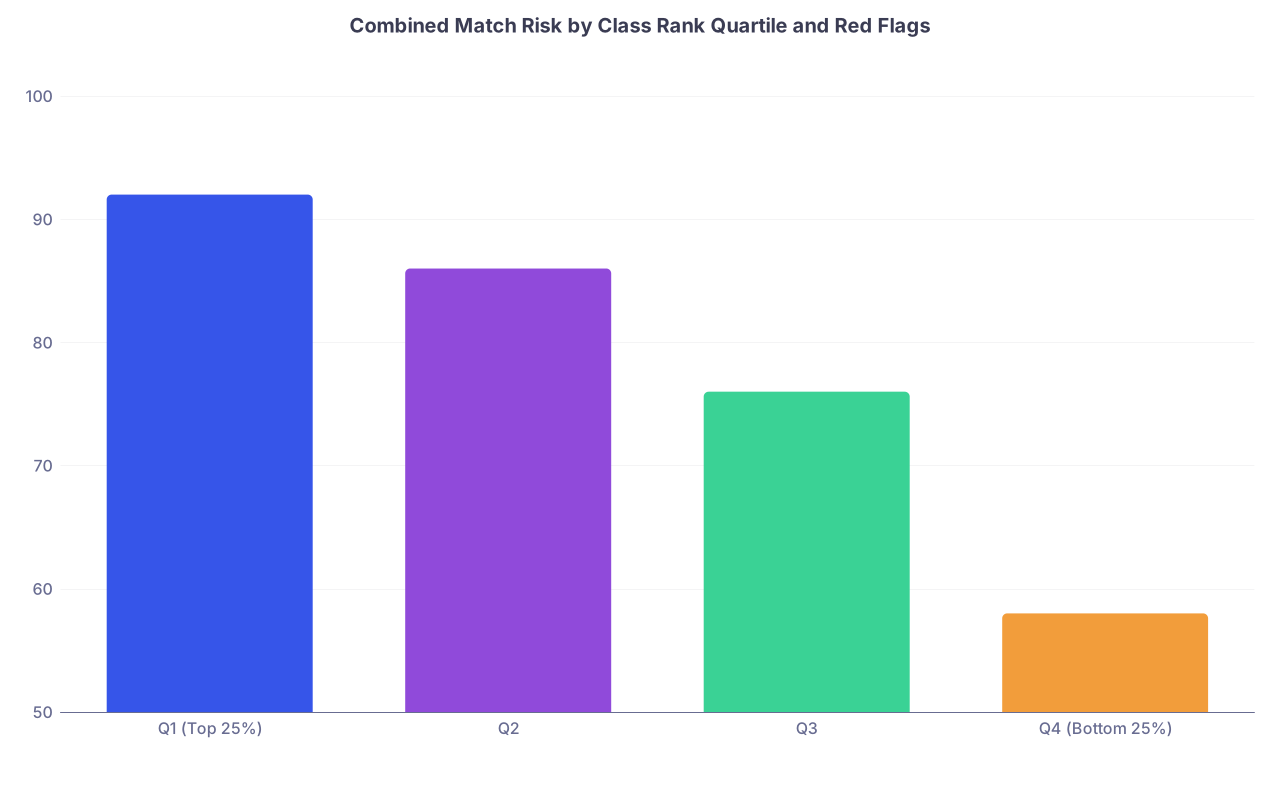
The chart captures the real takeaway. Program type moderates impact. Specialty competitiveness moderates impact. Prior academic trajectory moderates impact.
The data shows the highest disruption when all three stack together:
- Competitive specialty
- Early screening program
- Missing mission-critical score
That is the bad combination. I have seen applicants try to spin this as a harmless scheduling issue. Programs are not buying that if the rest of the file already looks fragile.
How applicants should respond when the score will be late
If your score will be late, do not panic. But do not be passive either. Passive applicants get buried.
Use this sequence:
Figure out whether the delay actually changes first-wave review
- Check expected score release date.
- Compare it to ERAS opening, specialty-specific interview timing, and known program behavior.
- Competitive field? Assume timing matters more.
Submit everything else early and clean
- Personal statement polished
- Letters in on time
- MSPE and transcript ready
- Signals used intelligently
- No sloppy errors
Decide whether a brief program update is appropriate
- This is more useful for programs seriously considering your file than for mass emailing 150 places.
- Keep it factual. No drama. No autobiography.
Update immediately once the score posts
- Assign the updated transcript.
- Send concise notifications where relevant.
- Prioritize programs where your file is otherwise competitive.
Do not overshare excuses
- Long explanations often make things worse.
- Programs want usable information, not emotional processing.
The most effective framing is short and neutral. Example:
- “My Step 2 CK score is scheduled to release on October 4, and my application will be updated immediately upon posting.”
- “My COMLEX Level 2 score will be available later this month; I wanted to let you know my file will be complete as soon as the score is released.”
Good. Clean. Adult.
Bad framing sounds like this:
- “I was under a lot of pressure and did not feel ready.”
- “I wanted to make sure I could perform at my full potential.”
- “There were many factors.”
That language confirms the exact fear reviewers already have. Uncertainty. Delay. Possible weakness.
Contingency planning matters too. The data shows late timing hurts more when other red flags pile on. So reduce the pile:
- Get stronger letters
- Avoid vague personal statements
- Tighten your program list
- Make sure geographic and specialty signaling are coherent
- Eliminate administrative delays
For future applicants, the fix is simple and boring. And very effective. Work backward from score release timelines, not just test dates. A mission-critical exam taken at the last possible minute is bad strategy. Full stop.
What programs are likely thinking behind the scenes
Behind the scenes, programs are usually asking three questions:
- Is this file complete enough to act on now?
- Does the missing score signal academic concern?
- Will waiting cost us an interview slot we could use on a clearer applicant?
That is the real logic. Cold, operational, and very consistent.
A late score gets worse when paired with other weaker data:
- Lower clerkship grades
- Visa sponsorship needs
- Weak geographic fit
- Thin research for a research-heavy field
- Professionalism concerns
- Prior failed or marginal board performance
One delayed test is not the same as a pattern. That distinction matters. If the rest of your file is strong, many programs will treat one late score as a timing issue. If your file also shows repeated delays, missing pieces, vague explanations, and uneven academics, the late score becomes a credibility problem.

That is the bottom line. Late scores are timing problems first. But stack them with other weaknesses and they become judgment problems. Programs forgive isolated logistics. They do not forgive patterns that look avoidable.
Summary
The data shows late Step 2 CK is usually the more broadly damaging delay because it matters across more programs and more screening systems. Late COMLEX Level 2 still matters, especially for DO applicants and osteopathic-friendly programs, but the effect is less uniform across the national market.
The biggest losses happen early. If your score posts after first-round interview decisions, a strong result can help, but it cannot fully restore missed access. That is why this issue is not about vanity. It is about timing economics inside residency recruitment.
My position is simple: if the score is important, get it in before programs need it. If that fails, keep the rest of the file excellent, communicate briefly, and give programs no additional reason to move on.