
Residency programs talk a big game about holistic review, but the data shows a harder truth: scores still dominate—until they do not. The nuance lives in the details of match statistics, not in feel‑good committee slogans.
If you have a “low” Step 2, COMLEX, or class rank and you are banking on holistic review to save you, you need to understand two things clearly:
- Where scores are still acting as a gate.
- Where the numbers show that “low” applicants actually match—when other parts of the file are strong.
Let me walk you through what the numbers really support, not what program websites claim in their diversity statement paragraph.
1. What Programs Actually Do With Scores
For all the talk about holistic review, most programs still use a two‑stage process:
- Quantitative screen (scores, fails, visa status, school type).
- Holistic read among those who clear the screen.
Holistic review is real, but it is usually conditional. You must get past the initial filter.
Even after USMLE Step 1 moved to pass/fail, survey data from NRMP Program Director Surveys and specialty organizations keep showing the same pattern: Step 2 CK, class rank, and failed attempts remain “highly important” for interview offers.
To make this concrete, here is a simplified view based on aggregated patterns from PD surveys and published match reports.
| Specialty Tier | Example Specialties | Common Soft Cutoff (Approx.) |
|---|---|---|
| Very High | Derm, Plastics, Ortho, ENT | 245–250+ |
| High | Gen Surg, Rads, Anesthesia | 235–240+ |
| Moderate | IM, EM, OB/GYN | 225–230+ |
| Lower | FM, Psych, Peds, Neuro | 215–220+ |
These are not official numbers. They are consistent patterns echoed by program directors when you get them off the record.
The main implication: “Holistic” almost never means “we ignore low scores.” It means “we may still consider you if other signals are strong enough to offset the risk.”
2. Low Scores in the Match: How Bad Is “Bad”?
“Low” is not a useful word without a baseline. The NRMP Charting Outcomes reports break applicants into Step score bands and show match rates by specialty and USMD/DO/IMG status.
You do not need the exact table in front of you to see the shape of the curves. They all look similar:
- Above a specialty’s median score → steep rise in interview and match rates.
- Near the median → plateau; incremental points buy you relatively little.
- Below a specialty’s informal cutoff band → match rates drop sharply.
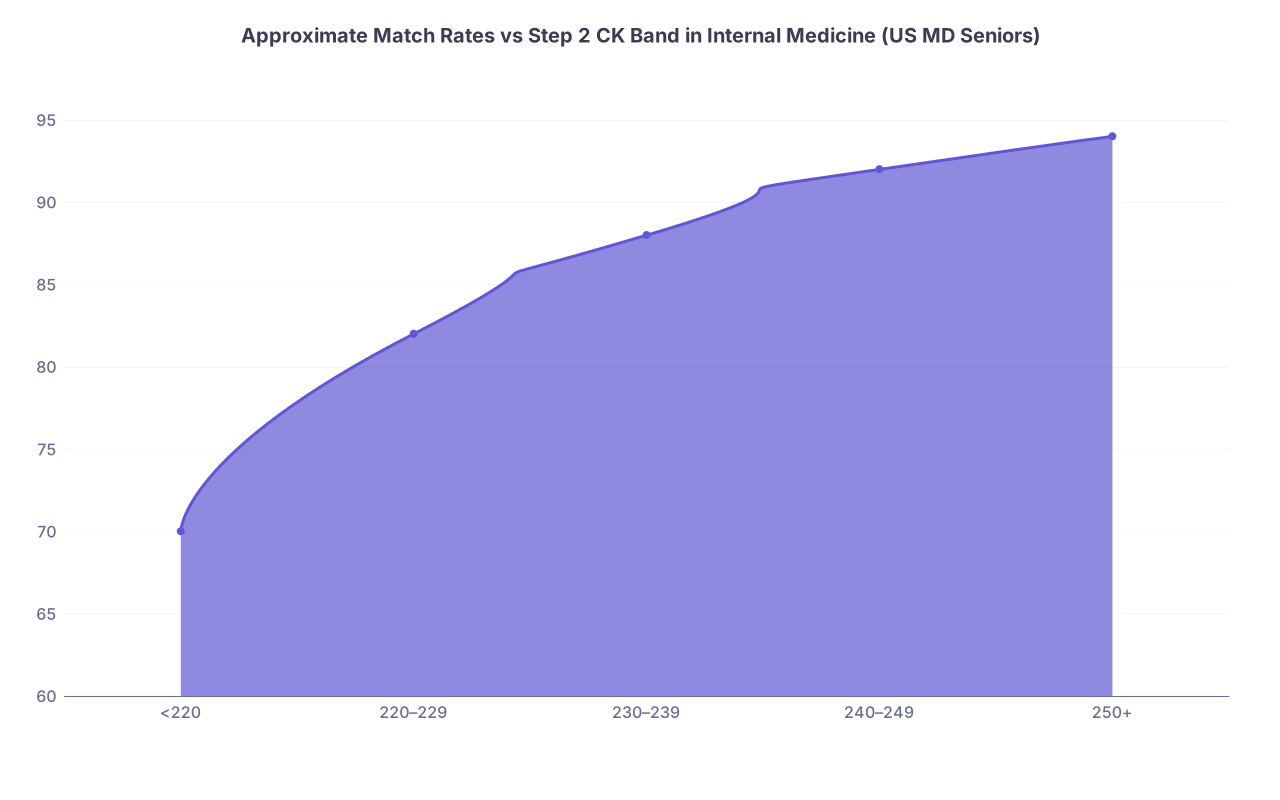
Here is a conceptual example using approximate patterns for Internal Medicine (Categorical) – US MD Seniors:
| Category | Value |
|---|---|
| <220 | 70 |
| 220–229 | 82 |
| 230–239 | 88 |
| 240–249 | 92 |
| 250+ | 94 |
The exact percentages vary year to year, but the shape stays similar:
- The jump from “sub‑220” to low 230s is massive.
- The jump from 240 to 250 is marginal.
That last part matters. A “low” score in a competitive mindset (e.g., 240 vs classmates sitting at 255) is not statistically low for matching in IM. A truly risky score is usually one or more SD below the specialty’s average matched scores.
As a rough mental model:
- For moderately competitive specialties (IM, EM, OB/GYN, rads, anesthesia), Step 2 CK below ~225 is where the data starts to look ugly unless compensated by something substantial.
- For very competitive specialties (ortho, derm, plastics, ENT, neurosurgery), even a 240 can behave like a “borderline” when the applicant pool clusters at 250+.
- For less competitive specialties (FM, peds, psych, neurology), serious risk starts more in the sub‑215 range, but DO and IMG status can push these lines higher.
The cruel part: a “single” low sitting can define your band for every specialty filter that uses hard numeric thresholds. That is where holistic review either rescues you—or does not.
3. Where Holistic Review Actually Bites: Three Levers
Once you clear an initial screen (or if a program genuinely reviews every file, which is uncommon in large programs), you start to see the effect of holistic review in three main domains: context, distinctiveness, and risk mitigation.
3.1 Context: Explaining the Outlier
Programs are human. Committees know scores fluctuate. But they are looking for patterns.
I have seen files where:
- Step 1: Pass on first attempt.
- Step 2 CK: 214, taken during a family crisis, with a narrative in the MSPE and strong third‑year evaluations.
Committee conversation in those rooms sounds like:
“This is a data point. Overall performance trend is solid. There is a documented acute issue around test day.”
Contrast that with:
- Preclinical grades: many marginal passes.
- Shelf exams: multiple low percentiles.
- Step 2 CK: 214, no explanation, no upward trend.
The same 214 is not the same risk.
Holistic review uses:
- Preclinical and clinical transcripts.
- Shelf exam trends.
- Narrative evaluations and any documented circumstances.
- Timing of the exam (e.g., taken early vs late).
Programs effectively ask: “Is this a one‑off outlier or the tip of the iceberg?”
If you have a low score, your job is to turn it into an outlier with:
- Clear trend data (later rotations stronger, other exams higher).
- A concise, credible explanation where appropriate (personal statement, advisor letter, MSPE comment).
- Evidence of remediation and current competence.
Without that, the low score becomes the anchor statistic. And anchors are hard to move.
3.2 Distinctiveness: Offsetting Risk With Value
Holistic review is not charity. It is risk–benefit analysis.
A program might tolerate a lower score if you bring something they value enough to compensate. This is where distinctiveness becomes a quantifiable offset, not fluff.
Examples I have literally heard PDs use to justify a lower‑scoring interview invite:
- “He has three first‑author ortho papers with our faculty.”
- “She is a former ICU nurse with five years of experience.”
- “He built the QI dashboard we all still use for readmission tracking.”
- “She did a year of NIH‑funded research in our exact area of interest.”
You can think of “value adds” in categories:
- Research density: number of pubs, first‑author status, relevance to specialty, national presentations.
- Operations/QI work: measurable impacts—reduced LOS by X%, implemented sepsis bundle, improved door‑to‑needle times.
- Prior careers: nursing, paramedic, engineering, data science—anything that directly maps to clinical work or systems.
- Niche skills: coding, advanced stats, language skills relevant to the patient population, curriculum design.
Programs implicitly do a cost–benefit:
- Cost: Potential risk of slower board pass, knowledge gaps, performance issues.
- Benefit: Distinctive contributions to research output, QI, patient communication, or program reputation.
Strong holistic review is simply a more nuanced regression model in the PD’s head: “Does the expected value outweigh the risk signaled by the low score?”
3.3 Risk Mitigation: Multiple Data Streams
A low Step 2 becomes survivable much more often when other hard data points are strong.
Think of it as building a counter‑dataset:
- Shelf exams in the same content area are high.
- In‑training exam during 4th‑year sub‑I (if available) is solid.
- COMLEX scores are stronger than USMLE or vice versa.
- For DOs: strong USMLE 2 partially offsets a weaker COMLEX 2, or the reverse.
Programs do look for these internal consistency checks. When all available knowledge assessments are weak, “holistic” rarely means “ignore them.”
4. Specialty‑Specific Realities: Low Score ≠ Same Risk Everywhere
Holistic review does not operate uniformly across specialties. The same Step 2 score lives in a very different statistical world in FM vs plastics.
Here is a compact snapshot using generalized, approximate patterns for US MD seniors with one lower‑than‑average score (say ~215–220):
| Specialty Tier | Example Fields | Typical Effect of ~215–220 Step 2 CK |
|---|---|---|
| Very High | Derm, Plastics, Ortho, ENT | Almost always fatal for that field |
| High | Gen Surg, Rads, Anesthesia | Major handicap; needs strong offsets |
| Moderate | IM, EM, OB/GYN | Risky; matchable with strong profile |
| Lower | FM, Psych, Peds, Neurology | Often matchable with good application |
Reality checks:
Derm, plastics, ortho, ENT, neurosurg
Holistic review here often means: “Among people with very strong scores, we now care a lot about research, letters, and fit.” A sub‑220 Step 2 is usually not in the room.General surgery, rads, anesthesia
A low score forces you into a narrow subset of programs: community‑heavy, new programs, or those with a track record of taking “borderline” applicants. Extensive home rotations, strong faculty advocacy, and regionally constrained targets are almost mandatory.Internal medicine, EM, OB/GYN
This is where holistic review has more statistical teeth. Low 220s are not automatic death, especially with:- Strong clinical grades.
- Good SLOEs (for EM).
- Research aligned with the specialty. But your target list must be broader and more realistic.
FM, psych, peds, neurology
The data consistently show higher match rates at lower score bands compared with more competitive specialties. Here, holistic review is genuinely integrated into selection. Personality, fit with patient population, and long‑term commitment to the field matter more. A 210 can still match easily if the rest of your file is compelling and you apply broadly and early.
5. DOs, IMGs, and the Myth of “Scores Still Don’t Matter for Us”
For DO and IMG applicants, the data are more unforgiving. The same low score is a larger problem, not a smaller one.
The NRMP and specialty‑specific match reports show two persistent patterns:
- At any given score band, US MDs have higher match rates than DOs, who in turn usually outperform IMGs.
- Programs that claim to be holistic often apply a stricter screen to IMGs and DOs simply due to volume and risk tolerance.
What that means in practice:
- A USMD with Step 2 CK 218 targeting FM can still match at a high rate with a strong application.
- A DO with the same score, limited geographic ties, and minimal research will see a much steeper drop in interview invites.
- An IMG at 218 often sits below the practical interview screen for many programs unless there is an institutional connection or very strong research.
Holistic review still operates, but after an initial numeric triage that is harsher for non‑USMDs.
For IMGs in particular, programs use holistic review more for differentiation among already strong applicants, not to rescue low scorers. IMGs with:
- High scores (often above the USMD mean).
- U.S. clinical experience with strong letters.
- Visa independence when possible.
get sorted holistically. Low scores in this group are often a non‑starter.
6. What Data‑Driven Strategy Looks Like If Your Scores Are Low
Let me be explicit. “Trusting holistic review” is not a strategy. Aligning your actions with how holistic review actually plays out statistically is.
Here is a more quantifiable, data‑aligned approach.
6.1 Benchmark Your Risk Honestly
Use your best knowledge of current trends (Charting Outcomes, program fill patterns, and PD survey data) and put yourself in a realistic risk category:
- Mildly below average for your target specialty (e.g., IM with Step 2 ≈ 225 when matched mean is ~240).
- Significantly below average (≥15–20 points under).
- Multiple low data points (low Step, poor shelves, weak class rank).
Then adjust:
- Specialty choice competitiveness.
- Number of programs applied to.
- How aggressively you must compensate with other parts of the file.
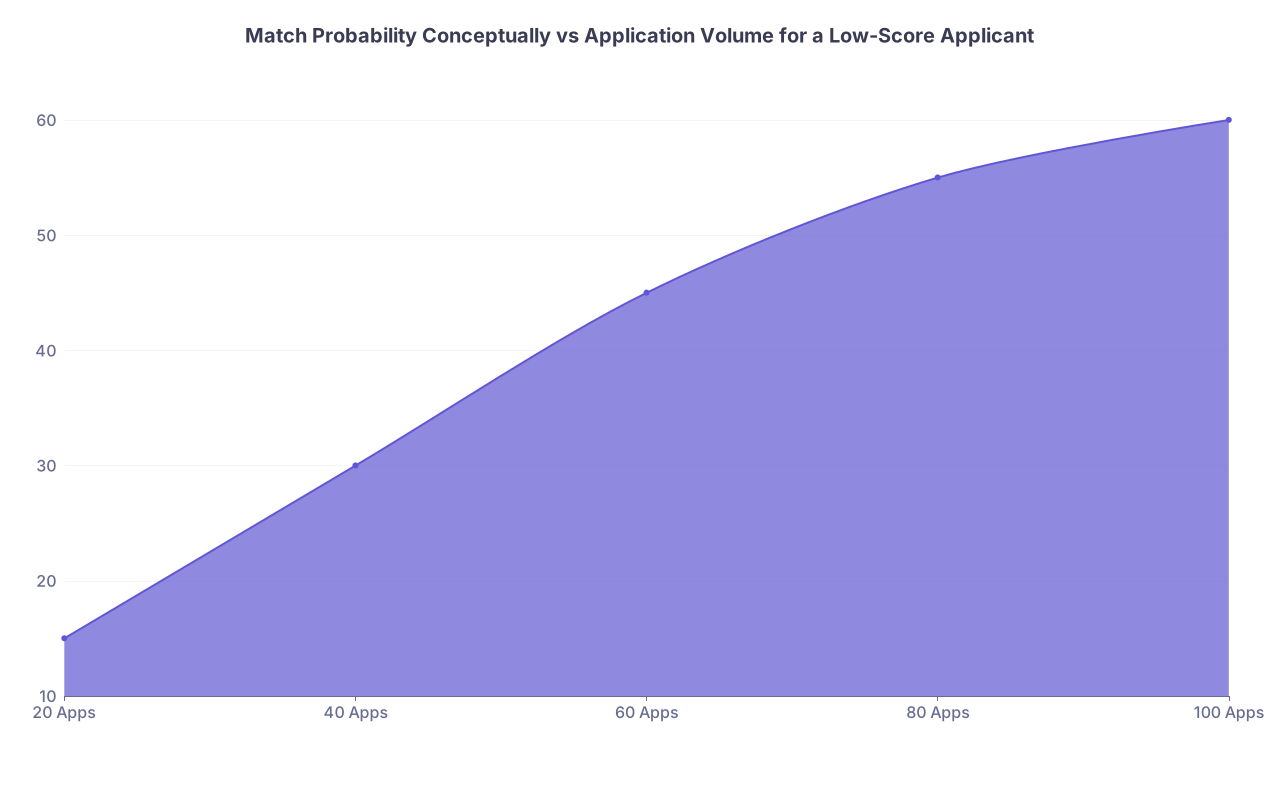
| Category | Value |
|---|---|
| 20 Apps | 15 |
| 40 Apps | 30 |
| 60 Apps | 45 |
| 80 Apps | 55 |
| 100 Apps | 60 |
This is not a literal curve, but a realistic shape. For lower‑scoring applicants, returns on additional applications diminish, but they do not flatten as fast as they do for high‑scorers. Broad application is not optional; it meaningfully shifts your odds.
6.2 Maximize “Offset Signals”
For each category, ask: what can I show that is measurable?
Academics:
- Honors in key clerkships.
- High percentile shelf scores after the low board score.
- Sub‑I performance documented in narrative form.
Research:
- Count of abstracts, posters, and publications.
- Clear link between your work and the specialty or program.
- Evidence of continuity (not a one‑off check box).
Fit and commitment:
- Multiple away rotations in that specialty.
- Longitudinal experiences (e.g., FM clinic over 3 years, psych outreach).
- Clear geographic or institutional ties.
Numbers and duration matter. “I am passionate about psych” does nothing. “I have 3 years of continuous volunteer work in a community mental health clinic and a QI project reducing no‑show rates by 18%” carries weight even in a committee that fixates on scores.
6.3 Decide Honestly Between “Rescue the Dream” vs “Secure the Match”
The harshest decisions are specialty choices. The data do not support magical thinking. If you have:
- A Step 2 in the low 210s.
- No major research.
- Average clinical performance.
and you are targeting derm or ortho because “holistic review,” you are not playing a data‑informed game. You are gambling.
A more rational approach:
- Identify a realistic primary specialty where your odds are materially higher (FM, IM, psych, peds, etc.).
- If you insist on a hyper‑competitive specialty, understand you are an outlier candidate and layer in:
- Massive research productivity with local mentors.
- A possible prelim year in a related field, then reapply.
- Focus on smaller or new programs, often outside major coastal hubs.
But do not confuse “possible in rare cases” with “likely.” Match data is clear: low‑scoring applicants who insist on the most competitive fields have dramatically lower match rates even when they “apply broadly.”
7. How Committees Actually Talk About “Low” Files
To bring this out of theory, let me translate typical selection meeting behavior into patterns.
Three anonymized archetypes:
USMD, Step 2 CK 218, strong IM clerkship honors, 3 IM‑related research abstracts, glowing sub‑I letter from home program.
- For IM: Often interviewed at a solid number of community and mid‑tier academic programs. Committee argument: “Scores are below our usual average, but clear upward trend and strong clinical performance. Let us meet them.”
- For cards‑focused, super‑academic IM: Often filtered out early.
DO, Step 2 CK 220, COMLEX 450s, average clinical comments, minimal research, applying Gen Surg.
- In a mid‑tier surgery program: Often screened out will be “borderline, no compelling positives.” Holistic review rarely activates without a hook (home rotation, strong faculty advocate, niche skill).
IMG, Step 2 CK 225, multiple years of U.S. research with 4 publications in the program’s subspecialty, strong LOR from a known faculty member.
- In that faculty member’s program: Very often granted an interview. Holistic review in action: research and institutional familiarity override slightly low scores for an IMG.
- In unrelated institutions: More mixed; some interviews, many silent rejections.
None of this is theoretical. It is a consistent pattern across years of selection cycles.
8. The Real Meaning of Holistic Review for Low Scores
Stripped of marketing language, holistic review in residency selection boils down to this:
- Scores define your starting position in the pool, not the entire race.
- For high‑volume specialties, a low starting position often means you never see the track.
- Where you do get on the track, non‑score factors can and do flip decisions—especially in moderately and less competitive specialties, and especially when your positive signals are quantifiable and relevant.
If you have a low score, here is what the data‑centered reality looks like:
- You must overcompensate on volume and targeting of applications.
- You must construct a credible, evidence‑based narrative that the low number is an outlier, not the norm.
- You must provide concrete value—research, clinical excellence, or systems work—that justifies the risk a program takes on you.
Holistic review is not your safety net. It is a lever you can pull—but only if you give programs enough hard evidence to pull it in your favor.
That is the actual story the match data keeps telling. Year after year.