
The mythology around “needing 15–20 interviews to be safe” is lazy and wrong. The data show something much sharper: interview yield is specialty‑specific, score‑dependent, and ruthlessly non‑linear.
You do not need 20 interviews to match Internal Medicine with a solid application. But 12 may not be enough for Dermatology, even if you are objectively strong.
Let’s quantify this properly.
The Core Reality: Interviews Are Your Currency
Programs do not rank applications. They rank interviews. Everything before the invite is just triage.
From an outcomes perspective, the match problem looks like this:
- You apply to N programs.
- You receive I interview invitations.
- You attend A of them (I minus conflicts / declines).
- Those A interviews produce R ranks on your list (not every interview results in a rank).
- The NRMP algorithm tries to match you based on that rank list against program lists.
So the question “How many interviews do I need to match?” is really: How many ranked programs do I need to reach a ≥90–95% probability of matching in my specialty, given my competitiveness?
We have reasonably clean data on step 4–5 from NRMP’s “Charting Outcomes in the Match” and “Results and Data” reports: probability of matching as a function of the length of your rank order list. Interview yield (interviews → ranks) sits just before that.
The shortcut most applicants ignore:
- Every interview you attend does not equal one rank.
- Every rank does not contribute equally; the early ones matter more.
- The match probability curve has steep gains from 1–10 ranks, then flattens aggressively.
So we need to anchor on ranks, then back-calculate the interview volume you should target.
What the NRMP Data Actually Say About Ranks
For U.S. MD seniors, the last several match cycles show remarkably stable curves: more ranked programs → higher match probability, but with diminishing returns.
Let me simplify typical probabilities (order‑of‑magnitude accurate, rounded to keep this readable).
Categorical Internal Medicine (U.S. MD)
For U.S. MD seniors in Internal Medicine categorical, NRMP data show something like:
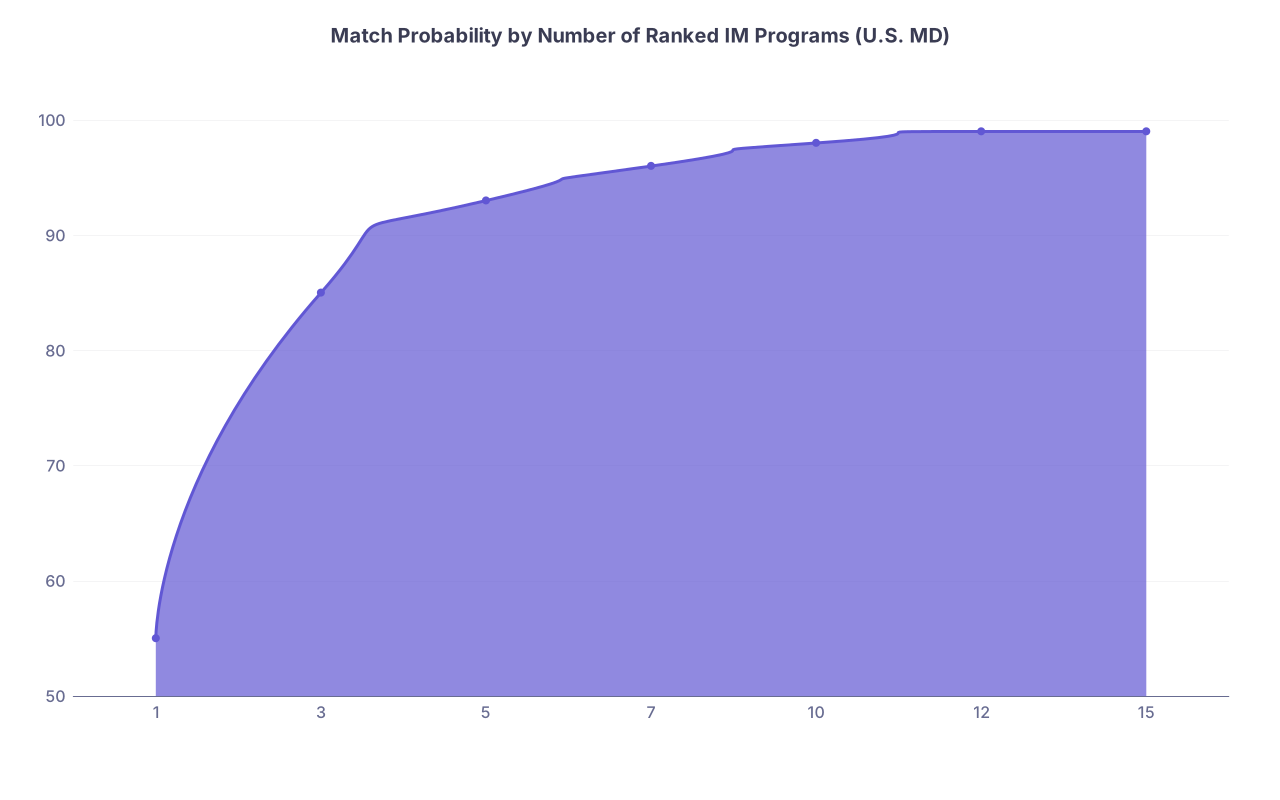
| Category | Value |
|---|---|
| 1 | 55 |
| 3 | 85 |
| 5 | 93 |
| 7 | 96 |
| 10 | 98 |
| 12 | 99 |
| 15 | 99 |
This is why faculty casually say, “You’ll be fine with around 10–12 ranks in medicine.” Statistically, they are not wrong.
General Surgery (U.S. MD)
Categorical Surgery is more competitive:
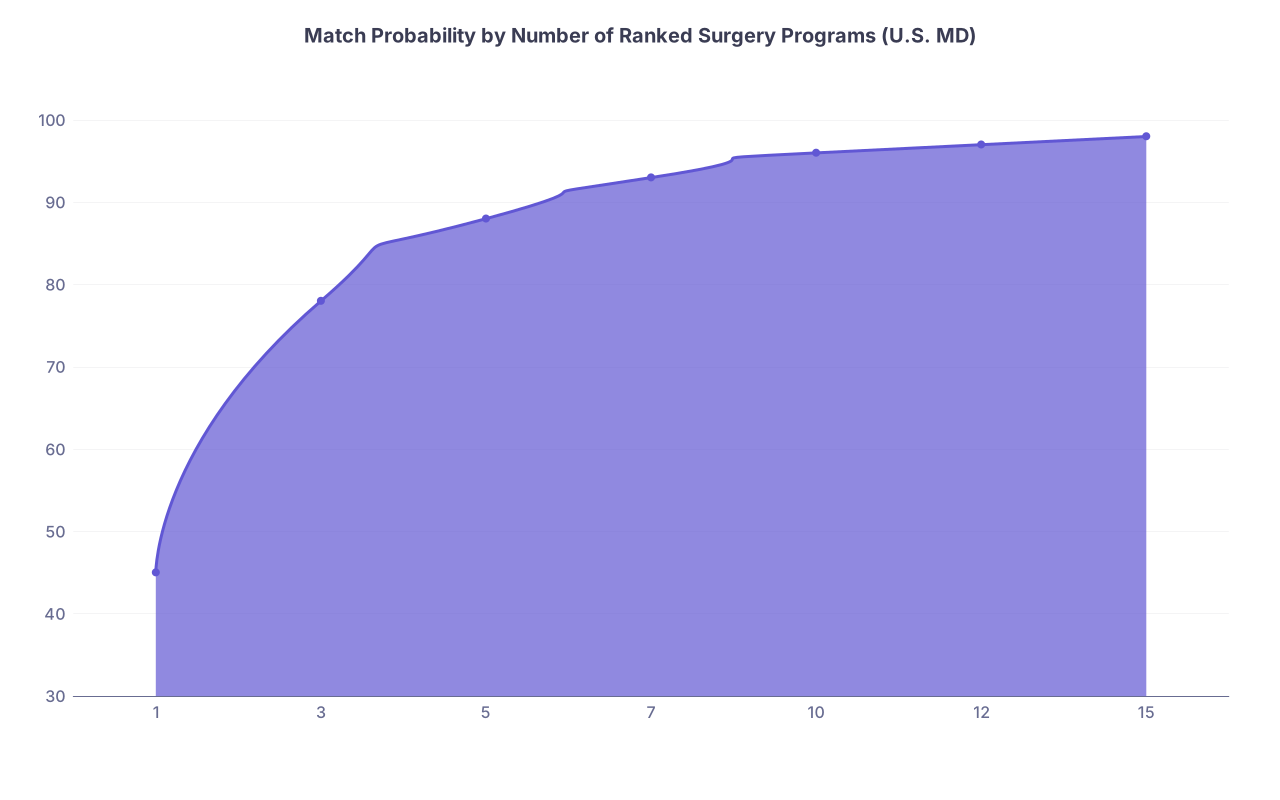
| Category | Value |
|---|---|
| 1 | 45 |
| 3 | 78 |
| 5 | 88 |
| 7 | 93 |
| 10 | 96 |
| 12 | 97 |
| 15 | 98 |
You do not see the same early saturation. Going from 5 to 10 ranks matters more.
Very Competitive Specialties (Derm, Ortho, ENT) – U.S. MD
These specialties show steeper penalties for short rank lists. Rough composite (directionally correct):
| Specialty (US MD) | 3 ranks | 5 ranks | 8 ranks | 12 ranks |
|---|---|---|---|---|
| Dermatology | ~65% | ~80% | ~90% | ~95%+ |
| Orthopedic Surg | ~60% | ~78% | ~88% | ~93%+ |
| Otolaryngology | ~58% | ~75% | ~87% | ~93%+ |
The upshot: for highly competitive fields, you usually need more ranks to get into the 90–95% comfort zone.
From Ranks Back to Interviews: Yield Assumptions
Here is where people get burned. They assume a one‑to‑one conversion:
“If I have 10 interviews, I’ll rank 10 programs.”
The data and experience say otherwise.
Programs do not rank every interviewee. You will not rank every place you interview. A realistic, conservative interview → rank yield looks like this:
- Strong fit / less competitive fields (IM, Peds, FM, Psych) for U.S. MD
~80–90% of interviews become ranks. - Moderate/competitive fields (Gen Surg, EM, OB/GYN, Neuro)
~70–85% yield. - Very competitive (Derm, Ortho, ENT, Plastics, Neurosurg, Rad Onc, IR‑integrated)
~60–80% yield, especially if you are not at the top of the applicant pool. - IMGs or DOs entering historically MD‑heavy fields
Yield is often lower, as some interviews function more like “backup” auditions; not all turn into ranks.
I have reviewed applicants’ post‑match spreadsheets where 12 interviews produced only 8 or 9 ranks. Nothing went horribly wrong. That is just the math after:
- Programs ghost‑ranking you low or not at all.
- You deciding a place is toxic and not ranking them.
- Communication delays or misunderstanding about “we will rank you” signals.
Let’s put some structure on the planning side.
A Simple Framework: Target Ranks, Then Inflate to Interviews
Step 1: Choose a desired match probability (realistically, ≥90% if you are anxiety‑averse).
Step 2: Look up typical ranks needed in your specialty for that probability.
Step 3: Choose a conservative interview→rank yield for your profile.
Step 4: Compute interviews needed:
Interviews needed = Desired ranks ÷ Yield
I will walk through by category.
1. Less Competitive Core Specialties (IM, FM, Peds, Psych)
For U.S. MD seniors:
- Getting to ~10–12 ranked programs generally gives you ≥95–98% match probability in these fields.
- Yield is high: assume 85–90% of interviews become ranks for most applicants with reasonable professionalism.
So:
- Target ranks: 10–12
- Yield: 0.85–0.9
- Interviews needed: 10 ÷ 0.9 ≈ 11.1; 12 ÷ 0.85 ≈ 14.1
Call it:
Core disciplines (U.S. MD): 10–14 interviews = very likely match.
For DOs or IMGs, the rank vs match curve shifts right. You usually need more ranks for the same probability. I would use:
- Target ranks: 12–15+
- Yield: 0.75–0.85
- Interviews needed: 12 ÷ 0.85 ≈ 14; 15 ÷ 0.75 = 20
Core disciplines (DO/IMG): 14–20 interviews is safer, especially without strong U.S. clinical experience or top scores.
2. Moderately Competitive (Gen Surg, EM, OB/GYN, Neurology, Anesthesia)
For U.S. MD seniors, typical curves:
- 8 ranks → ~85–90%
- 10–12 ranks → ~93–97%
Yield is lower than IM; interviews are more loaded.
Reasonable assumption: 75–85% of your interviews turn into ranks.
- Target ranks: 10–12
- Yield: 0.75–0.85
- Interviews: 10 ÷ 0.85 ≈ 12; 12 ÷ 0.75 = 16
So:
Moderately competitive (U.S. MD): 12–16 interviews is a smart target.
For DO/IMG:
- Target ranks: 12–15
- Yield: 0.65–0.8
- Interviews: 12 ÷ 0.8 = 15; 15 ÷ 0.65 ≈ 23
Moderately competitive (DO/IMG): 15–22 interviews is where match probability starts approaching “reassuring,” assuming a coherent application.
3. Highly Competitive (Derm, Ortho, ENT, PRS, Neurosurg, IR‑integrated, some Radiology/Optho)
This is where the “20 interviews” myth partially comes from, but again, that is too crude.
For U.S. MD seniors:
- 8 ranks → often only ~80–90%
- 10–12 ranks → ~90–95%+ depending on field and year
Yield is meaningfully lower, especially if your metrics are not top‑tier. Programs are interviewing many strong applicants, and a chunk of those interviews never convert into meaningful rank positions.
Conservative yield assumption: 65–80%.
- Target ranks: 10–12
- Yield: 0.65–0.8
- Interviews: 10 ÷ 0.8 = 12.5; 12 ÷ 0.65 ≈ 18.5
Competitive specialties (U.S. MD): 14–19 interviews is usually where I start to relax… a bit.
Below ~10–12 interviews, outcomes become heavily idiosyncratic.
For DO/IMG attempting these fields: the data are harsh. Match probability drops substantially; many match only with parallel planning (backup specialty).
Even if you somehow get 10–12 interviews, yield and rank positions can be weak. If you are not dual‑applying, the safe advice is blunt:
- Target ranks: 12–15 if you insist on “all‑in”
- Yield: 0.55–0.7
- Interviews: 12 ÷ 0.7 ≈ 17; 15 ÷ 0.55 ≈ 27
Competitive specialties (DO/IMG, all‑in): 18–25+ interviews needed for a high match probability.
Most will not get that many. Which is precisely why dual‑applying exists.
A Cross‑Specialty Comparison Table
Let’s pull this together into a clean, approximate target table for a ≥90–95% match probability band, assuming your application is not catastrophically off‑target for the field.
| Applicant Type | Specialty Competitiveness | Target Ranked Programs | Est. Yield (Interviews→Ranks) | Interview Range (Approx.) |
|---|---|---|---|---|
| U.S. MD | Less competitive (IM/FM/Peds/Psych) | 10–12 | 0.85–0.9 | 11–14 |
| U.S. MD | Moderate (Gen Surg/EM/OB/Neuro/Anes) | 10–12 | 0.75–0.85 | 12–16 |
| U.S. MD | Highly competitive (Derm/Ortho/ENT/etc.) | 10–12 | 0.65–0.8 | 14–19 |
| DO / IMG | Less competitive | 12–15 | 0.75–0.85 | 14–20 |
| DO / IMG | Moderate | 12–15 | 0.65–0.8 | 15–23 |
| DO / IMG | Highly competitive, all‑in | 12–15 | 0.55–0.7 | 18–27 |
These are not guarantees. But they are far more reality‑based than, “My classmate matched Ortho with 9 interviews, so 9 is fine.”
How Interview Counts Actually Relate to Match Rates
Let me give you something closer to the shape of the real curve. For U.S. MD seniors in moderately competitive specialties, if you normalize across several NRMP graphs and convert ranks to estimated interviews, you get something like this:
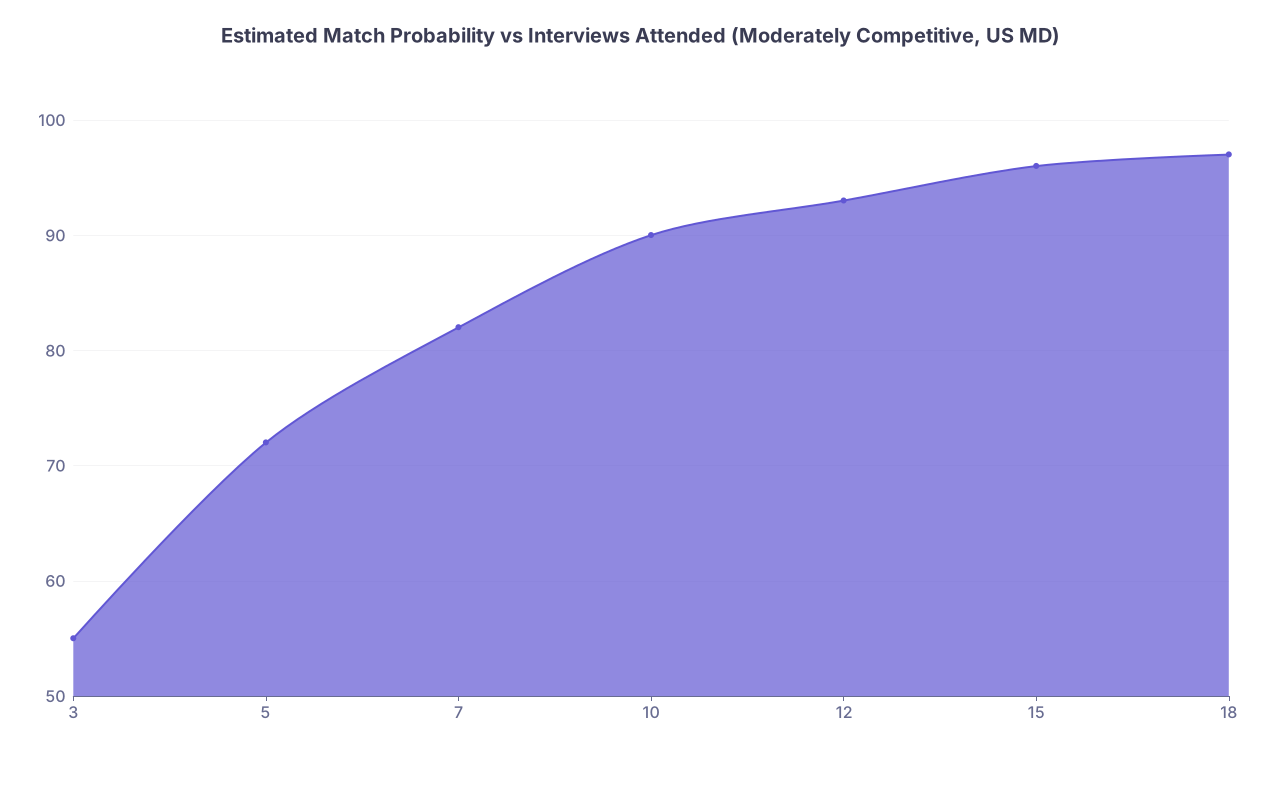
| Category | Value |
|---|---|
| 3 | 55 |
| 5 | 72 |
| 7 | 82 |
| 10 | 90 |
| 12 | 93 |
| 15 | 96 |
| 18 | 97 |
The key features:
- Huge jump: 3 → 7 interviews.
- Still meaningful: 7 → 12.
- Tiny incremental benefit beyond 15–18.
Your stress level, however, is not linear. People with 7–8 interviews in EM feel like the world is ending. Statistically, they are often sitting at 80–86% match probability.
Red Flags: When Your Interview Yield Is Dangerous
A raw count like “I have 10 interviews” means nothing without context. I have seen applicants with 10 interviews and a 95% realistic match chance. I have also seen 10 interviews where the odds were barely 50–60%.
Specific danger patterns:
All interviews are at extreme geographic or prestige reaches.
Example: A mid‑tier U.S. MD applicant in Gen Surg only getting interviews at super‑competitive coastal university programs. Yield will be lower; rank positions will be weaker.You are an IMG/DO with 8–10 interviews in a historically unfriendly specialty.
The rank list curve for your cohort is uglier. That 8–10 translates to much lower odds than the same number for a U.S. MD.You have a major application red flag (fail, professionalism issue).
Interviewers might “be nice” in the moment, but programs often quietly down‑rank or no‑rank these candidates. Your apparent yield is deceptively high; your effective yield is low.You applied absurdly broadly but invitations cluster at community programs with known instability.
Some of those places do not fill. Others rank erratically. Predictability goes down.
This is why counting invites is necessary but not sufficient. The quality and distribution of interviews matters for yield.
How to Monitor Your Interview Yield in Real Time
By mid‑season, you should stop doomscrolling and actually analyze your own data:
Track invites vs applications by program tier.
Tier is crude (Top 20 academic / mid‑tier academic / community), but you will quickly see where you are actually competitive.Track interviews attended vs “signals” of genuine interest.
- Post‑interview emails.
- Programs asking strategically about couples match or geographic ties.
- Explicit “we will rank you” statements (not always reliable, but they push odds up).
Build a rough yield estimate by December.
If you have attended 6 interviews and feel that 5 are likely rankable mutual fits, that is ≈83% yield so far. Reasonable.
If you have attended 8 and only 4 feel rankable, your functional yield is 50%. Suddenly 8 interviews look anemic.
Here is how those yield scenarios change your match odds in a moderate field:
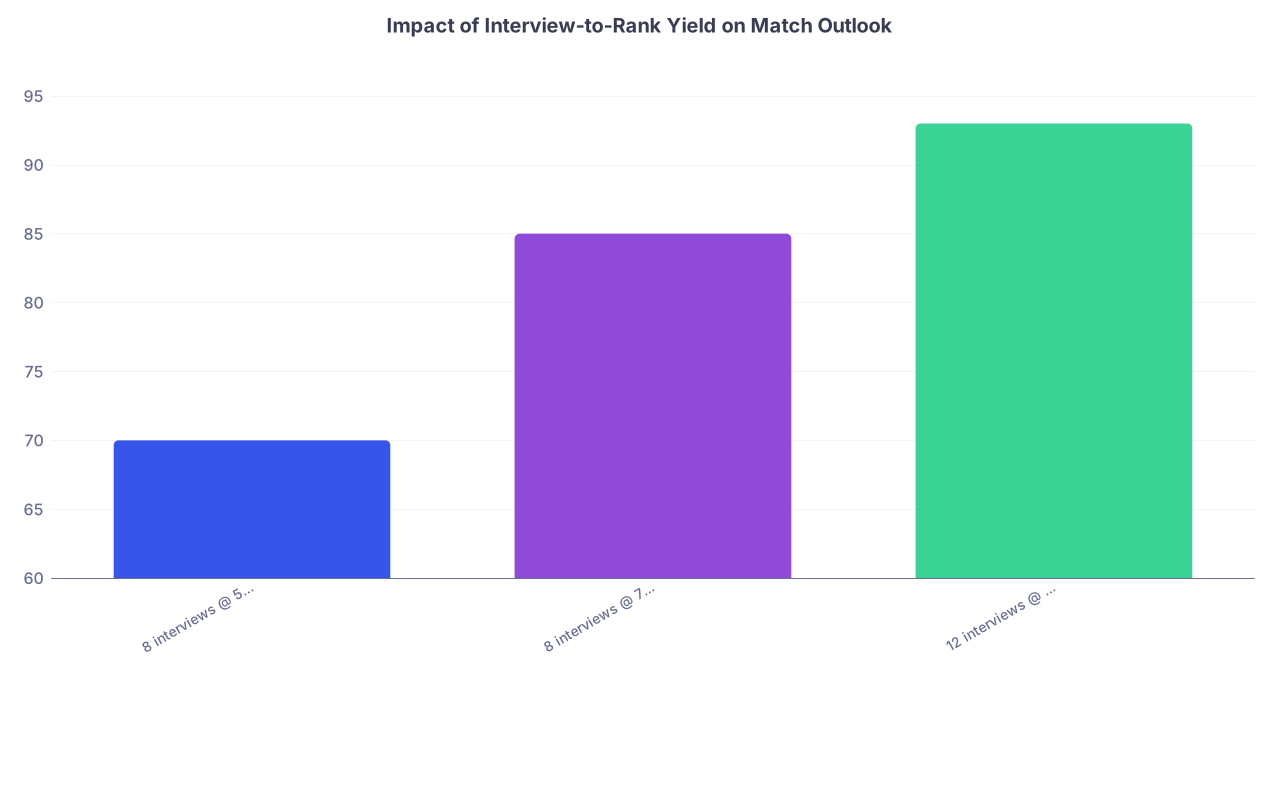
| Category | Value |
|---|---|
| 8 interviews @ 50% yield (4 ranks) | 70 |
| 8 interviews @ 75% yield (6 ranks) | 85 |
| 12 interviews @ 75% yield (9 ranks) | 93 |
Those probabilities are approximate, but the relative differences are real. Low yield quietly kills your safety margin.
What If You Are Below the “Safe” Interview Range?
Here is where people want comforting lies. I will not give you those.
Let’s say you are:
- U.S. MD, applying EM, with 6 interviews.
- DO, applying IM, with 8 interviews.
- IMG, applying Gen Surg, with 5 interviews.
Numerically, that is not ideal. But it is not an automatic disaster.
The data tell us:
- Match probability curves are steep in the 3–7 rank range.
- Moving from “no rank list” to “short rank list” is the biggest jump.
- Many applicants with 5–8 ranks still match, particularly if their list contains realistic options.
Your job with a sub‑optimal interview count is two‑fold:
Maximize yield.
Show up prepared, professional, and clear about fit. Do not casually decide to not rank a program unless there are serious concerns. Turning 6 interviews into 6 ranks is much more impactful than trying to squeeze out an extra invite in January.Be honest about contingency plans.
That may mean SOAP, a backup specialty, or a gap year. The earlier you accept that your numbers are marginal, the less reactive your decisions will be in March.
The “More Interviews Is Always Better” Fallacy
Past about 18–20 interviews in a single specialty for a U.S. MD, the marginal benefit becomes tiny. Yet people still hoard interviews. Hitting 22, 24, 27 interviews is not a sign of rational planning. It is usually a sign of fear.
From a data standpoint:
- Going from 10 to 15 ranks might move your match odds from 93% to 96–97%.
- Going from 15 to 20 ranks might add another 1–2% at best.
And that is ranks. For interviews, the diminishing return is even worse, because your yield drops as you start accepting every possible invitation, including clearly poor fits.
There is also an opportunity cost:
- Extra interviews force you to cancel rotations, miss school responsibilities, and show up exhausted.
- Performance declines. Yield may go down. Net effect on your actual match odds? Minimal or negative.
Use the “interview range” table as an upper bound as well as a lower bound. If you are sitting on 18 interviews for IM as a U.S. MD, you are no longer improving match odds. You are sampling your own anxiety.
How Many Invites You Really Need: Clean Takeaways
Strip off the noise and you get this:
Think in ranked programs, not raw interviews.
For most U.S. MDs in less or moderately competitive fields, being on track to rank 10–12 programs puts you in the >93–97% match probability band.
That typically corresponds to:
- 10–14 interviews for IM/FM/Peds/Psych.
- 12–16 for Gen Surg/EM/OB/Neuro/Anesthesia.
- 14–19 for highly competitive specialties.
DOs and IMGs need more interviews for the same comfort level, especially in non‑primary care fields. Ranges in the mid‑teens to low‑20s are not overkill; they are realistic compensations for bias baked into the system.
The only way to personalize this further is to add your specifics: specialty, degree type, exam history, research, school reputation, red flags, and interview quality. That is the next step—turning generic curves into your own probability distribution.
For now, treat your interview count as a data point, not a verdict. Compare it against the ranges, adjust your expectations, and then focus ruthlessly on yield. With your interview portfolio quantified and your targets clear, you are finally ready to think about what the rank list itself should look like. But that strategy is a separate analysis.