
The narrative that “hard work is all that matters” in the Match is outdated. The data since 2020 shows something harsher: where you went to medical school (US MD, US DO, or IMG) now predicts your odds of matching more strongly than it did before the pandemic.
Let me quantify that.
The Big Picture: Who Is Actually Matching?
We will anchor on NRMP Main Residency Match data from 2020–2024. The exact yearly percentages move a bit, but the pattern is consistent and statistically loud.
Here is the simplified snapshot across those years (rounded ranges based on NRMP reports and year-to-year variation):
| Applicant Type | Match Rate Range (2020–2024) |
|---|---|
| US MD Seniors | 92–94% |
| US DO Seniors | 88–92% |
| US-IMGs | 55–65% |
| Non-US IMGs | 55–62% |
Now look at it as a chart, because relative change matters more than static numbers.
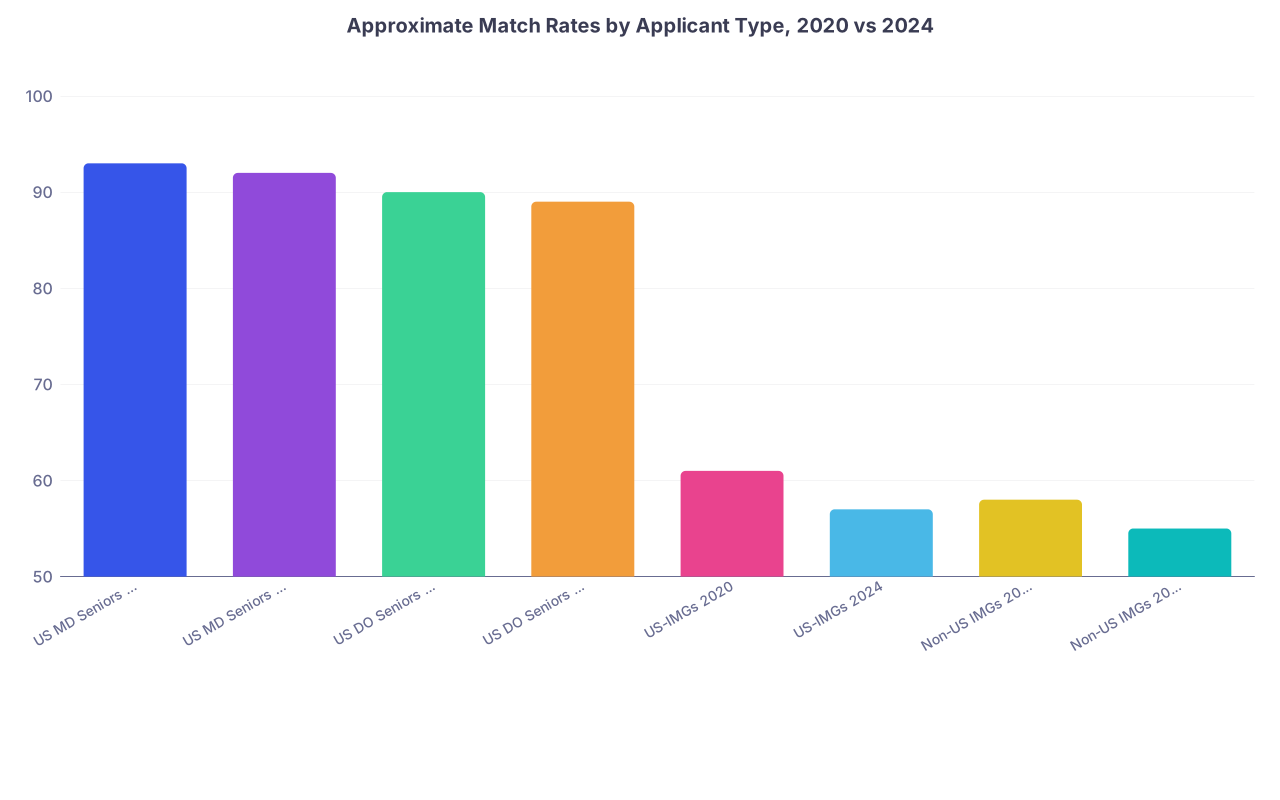
| Category | Value |
|---|---|
| US MD Seniors 2020 | 93 |
| US MD Seniors 2024 | 92 |
| US DO Seniors 2020 | 90 |
| US DO Seniors 2024 | 89 |
| US-IMGs 2020 | 61 |
| US-IMGs 2024 | 57 |
| Non-US IMGs 2020 | 58 |
| Non-US IMGs 2024 | 55 |
The data shows:
- US MD seniors remain heavily protected: match rate hovering in the low 90s.
- US DO seniors are slightly below MDs but still high and relatively stable.
- IMGs (both US and non-US) have seen more volatility and, in many specialties, a tightening of opportunities since 2020.
So when people ask “Has it gotten harder for IMGs?” the honest, data-driven answer is: yes, especially in competitive fields and preferred geographic locations. The macro match rate might only shift a few percentage points, but underneath that, the distribution of where IMGs match has shifted a lot.
How 2020 Broke the Old Pattern
2020–2021 were not normal cycles. COVID disrupted away rotations, Step 1 went pass/fail, interviews went virtual, and program risk tolerance changed.
From an analysis standpoint, three structural shifts matter most:
Interview virtualization
Programs could interview more applicants with lower marginal cost. That sounds good for IMGs, but it did not translate that way. Many programs simply expanded interviews for their “safer” pools: local school, regional ties, US MD/DO. The increased volume did not democratize access; it often amplified existing bias.Step 1 pass/fail transition
For IMGs, Step 1 used to be a blunt but powerful equalizer. A 250+ gave some programs a reason to read your file even if your school name meant nothing to them. As Step 1 shifted to pass/fail (and the anticipation of that shift began influencing behavior even before full implementation), programs leaned harder on:- Step 2 CK numeric score
- School type (US vs international)
- Perceived “risk” of onboarding someone from an unfamiliar system
Application inflation
Virtual interviews + uncertainty led to more applications per applicant. US MDs and DOs especially ramped up application volume. The denominator exploded; total positions did not. This raised the bar for IMGs to even be seen.
You end up with a structural disadvantage that is not subtle. It is measurable.
Specialty-Level Competitiveness: Where the Doors Closed First
If you look only at aggregate match rates, you miss the real story: distribution by specialty.
Let’s take a simplified cut of where IMGs had a non-trivial presence before 2020 and how the doors shifted afterwards.
| Specialty | Pre-2020 IMG Access | Post-2020 Trend for IMGs |
|---|---|---|
| Internal Medicine | High | Slightly tighter |
| Family Medicine | High | Tighter, more US grads |
| Pediatrics | Moderate | Tighter |
| Psychiatry | Moderate | Markedly tighter |
| General Surgery | Low | Even lower |
| Neurology | Moderate | Tighter |
| Pathology | Moderate | More volatile, tighter |
Psychiatry is the poster child. It used to be a realistic target for strong IMGs. Now it behaves more like a mid-to-high competitiveness specialty, with US MD/DO seniors crowding out many previous IMG spots.
Family medicine and internal medicine have not closed to IMGs, but the composition is shifting toward more US graduates. That matters. It is not just whether you match; it is where and in what environment.
To visualize the directional shift, think in terms of “IMG share of PGY-1 positions” in core specialties:
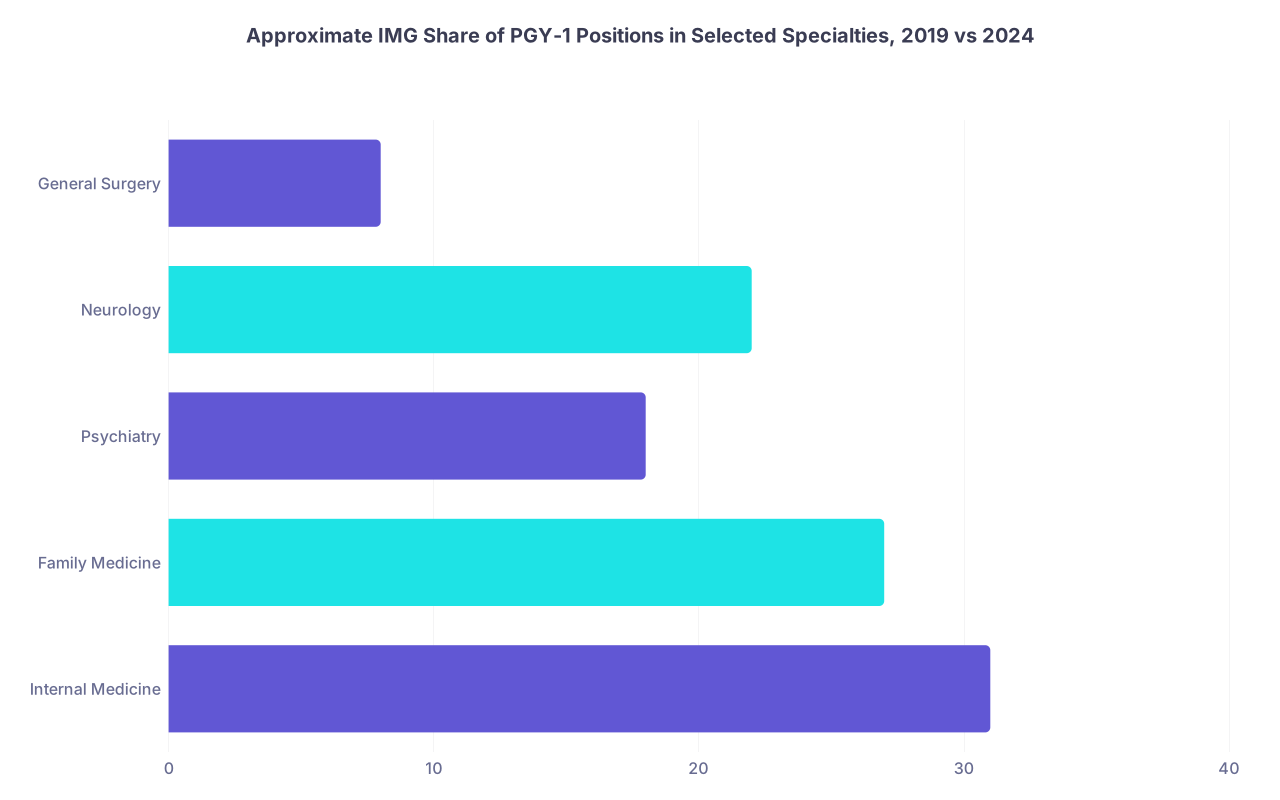
| Category | Value |
|---|---|
| Internal Medicine | 31 |
| Family Medicine | 27 |
| Psychiatry | 18 |
| Neurology | 22 |
| General Surgery | 8 |
Interpretation of that chart:
- Internal medicine and family medicine still have meaningful IMG representation, but the proportion is decreasing.
- Psychiatry’s relative IMG share fell faster as US MD/DO interest surged.
- General surgery, already low, has become even more resistant.
These are not random fluctuations. They track with:
- Increasing US MD/DO class sizes.
- Consolidation of DO and MD matches into a single NRMP system.
- Growing preference for specialties like psych and neuro among US graduates, shrinking the “leftover” space that used to be more accessible to IMGs.
US MD vs US DO vs IMG: Who Competes With Whom?
The old mental model was: US MDs compete at the top; DOs sit in the middle; IMGs pick up unfilled slots. That model is now wrong in several critical ways.
What the data shows:
US MD vs DO gap has narrowed but is not gone
DO seniors in competitive fields still face some bias, but:- DO match rates are now consistently just a few percentage points below MDs overall.
- In primary care, DOs are extremely competitive, sometimes nearly indistinguishable from MDs in program behavior.
DOs are crowding into historical IMG territory
As DOs gain more acceptance at previously MD-leaning programs, they also expand strongly into community and mid-tier academic programs that historically had larger IMG cohorts. This is especially visible in:- Internal medicine (community-heavy programs)
- Family medicine
- Psychiatry
IMGs are effectively pushed into the bottom of the distribution
That does not mean “bad” programs. It means:- More peripheral locations
- More visa-skeptical environments becoming outright no-visa policies
- More dependence on a small set of IMG-friendly institutions
You can summarize the competition structure like this:
- US MD vs DO: head-to-head for almost all specialties and tiers, small structural advantage to MD.
- US MD/DO vs IMGs: increasingly segregated, with IMGs heavily concentrated in certain programs and geographies.
The IMG Bottleneck: Interviews, Not Just Match Day
People obsess over “match rate,” but for IMGs the choke point is earlier: getting interviews.
I have seen many IMG applicants with solid Step 2 scores (250+), research, and US clinical experience end up with fewer than 5–7 interviews. Meanwhile, a mid-tier US MD with weaker metrics might have 15–20.
The mechanics:
- Many programs use school type and citizenship as hard filters.
- Once filters are applied, IMGs are massively underrepresented in the reviewed pool.
- The few programs that still look closely at IMGs get absolutely flooded with IMG applications, increasing intra-IMG competition.
If we roughly conceptualize interview yield (interviews received per 100 applications) across 2020–2024:
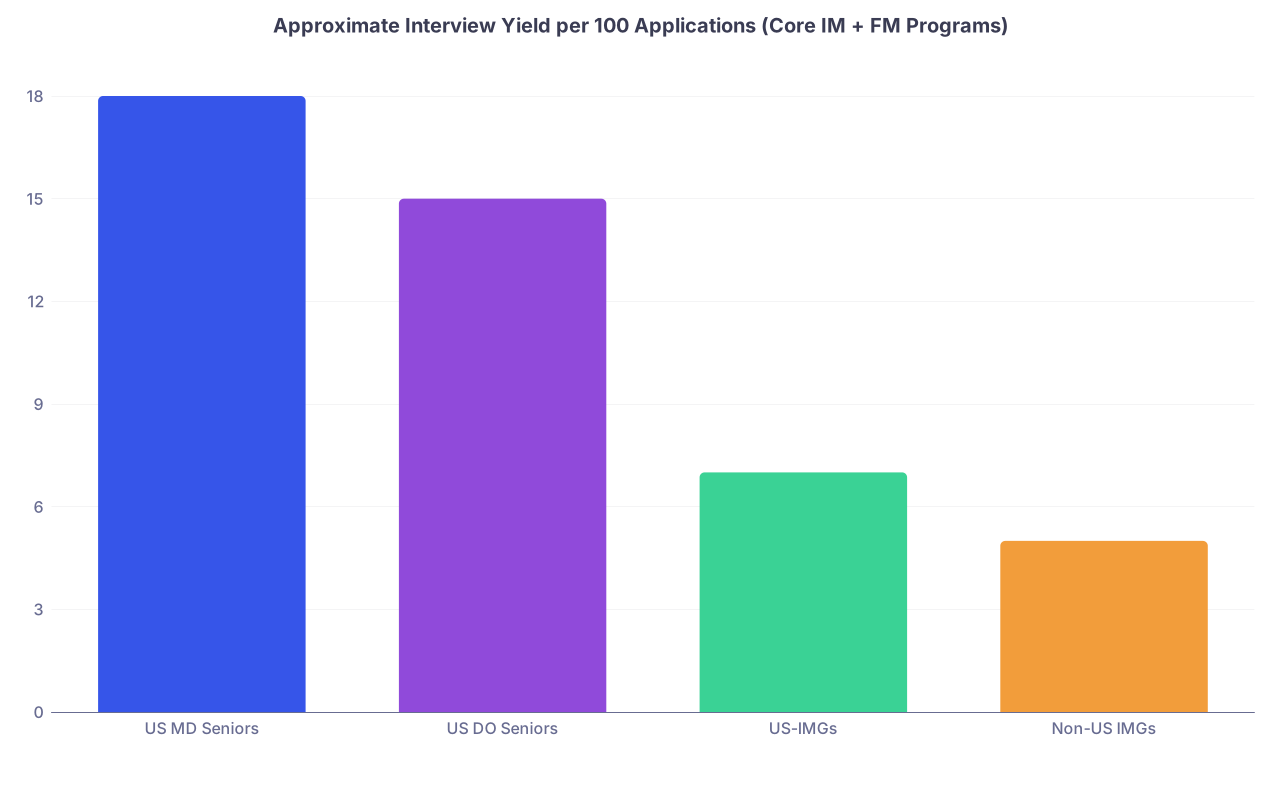
| Category | Value |
|---|---|
| US MD Seniors | 18 |
| US DO Seniors | 15 |
| US-IMGs | 7 |
| Non-US IMGs | 5 |
You can debate exact numbers, but the relative ratios are consistent with what applicants and program directors report:
- US MDs: high yield, often limited by self-selected target lists.
- DOs: slightly lower yield, but still robust.
- IMGs: low yield, highly dependent on targeting only IMG-friendly programs.
This is why “just apply broadly” is bad advice for IMGs. The data punishes random broadness. Targeted broadness wins.
Step 1 Pass/Fail: Who Lost the Most Leverage?
Step 1 going pass/fail did not hurt everyone equally. It hurt IMGs disproportionately.
Before:
- A stellar Step 1 score could brute-force an IMG’s way into consideration.
- Programs sometimes used score cutoffs but would still interview exceptional outliers from unknown schools.
After (and during the transition):
- Programs had less granular early sorting power.
- To control risk, they leaned on:
- School type (US vs international)
- Step 2 CK, but often only after initial filters
- Existing institutional familiarity (pipeline schools, former residents from same country/region)
Bottom line: the marginal benefit of an extremely high Step 2 CK score for an IMG is lower than the historical benefit of an extremely high Step 1. It still helps, but it no longer neutralizes school-type bias to the same degree.
So, competition has shifted from “outscore everyone” to “outscore everyone and overcome structural filters you cannot fully see.”
IMG vs US MD/DO by Strategy: What Works Now
Let us cut through the noise and talk strategy that actually reflects post-2020 data realities.
For IMGs
You are not competing evenly against US MDs and DOs. The numbers show that. So your strategy must be more ruthlessly data-driven.
Hyper-focused program list
You need to overfit to:- Programs with historically high IMG percentages
- Community and lower/mid-tier academic hospitals
- Locations that struggle to recruit locally (e.g., smaller cities, rural areas)
Overweight Step 2 CK and recency
Since Step 1 is pass/fail, Step 2 CK is effectively your only numeric separator. A mediocre Step 2 for an IMG is lethal. Aim to be clearly above the mean of US MD/DO seniors in your target specialty.US clinical experience as a non-negotiable
The bar is no longer “some observerships.” The realistic bar in many internal medicine and family medicine programs now looks like:- 2–3+ months of hands-on US rotations
- Strong US letters that explicitly compare you to US students or residents
Visa reality check
Many programs went from “open to visas” to “prefer not” or “no” post-2020 because bureaucracy got harder. Your effective pool of viable programs may be much smaller than the raw list suggests.
For US DOs
You sit in an interesting place. The competition has shifted in your favor relative to IMGs, but in some niches, you are still playing catch-up with MDs.
The data-backed moves:
- Treat yourself as functionally equivalent to US MD for:
- Community internal medicine
- Family medicine
- Psychiatry (though this is getting more competitive)
- Recognize lingering bias in:
- Highly academic university programs
- Integrated specialties (ortho, derm, plastics, etc.)
- In many specialties, your presence has directly displaced prior IMG slots. You are now the “safer alternative” from a US-based program’s perspective.
For US MDs
You remain the statistically protected class. But you are not immune to market tightening.
Trends that matter to you:
- More US grads chasing the same or only slightly expanded number of categorical positions.
- Psychiatry, neurology, and some IM subspecialty pipelines becoming more crowded.
- You benefit from the same structural shifts that harmed IMGs, which means your floor is higher. But your ceiling in ultra-competitive fields still depends on differentiation: research, letters, school reputation.
The Geography Problem: IMG-Friendly vs IMG-Hostile Regions
Geography is now as important as specialty for IMGs. The data is very uneven across states and regions.
Broadly:
- Northeastern and some Midwestern regions still have relatively high IMG representation in IM and FM.
- Certain Southern and Western academic hubs heavily favor US MD/DO and accept very few IMGs except in very specific programs.
- Rural and smaller-city programs are more open, but also more selective than they were five years ago because they are getting more US applicants.
If you map IMG presence across states (mentally, not literally here), you see clustering. And clustering tends to intensify over time. Once a program builds an IMG pipeline, it continues. Once a region closes, it rarely reopens quickly.
How Competition Has Shifted Since 2020: The Short Version
Compressing all of this, here is what has really changed:
- US MD and DO applicants have expanded into specialties and locations that were previously more accessible to IMGs.
- The interview bottleneck for IMGs has tightened, even when their final match rates look superficially “similar” to pre-2020.
- Step 1 pass/fail removed a major tool that top IMGs used to bypass institutional bias.
- Family medicine and internal medicine still anchor IMG matches, but with more competition from US grads, and more segmentation into specific programs and geographies.
You are not imagining it. The playing field is not just tilted. The tilt has increased since 2020.