The myth that “virtual interviews are just a temporary pandemic hack” is dead. The data shows they have permanently altered the Match—and not always in the ways people think.
If you are applying to residency now, you are competing in a market that is structurally different from 2019. Not vibes. Not anecdotes. Structural. The numbers since 2020 make that painfully clear.
Let me walk you through what has actually changed—offer rates, interview inflation, geographic distribution, NRMP outcomes—so you can make decisions based on data, not nostalgia from older residents who matched pre‑COVID.
1. The interview landscape: what changed after 2020
The pivot from in‑person to virtual did three big things simultaneously:
- Removed travel constraints
- Increased scheduling flexibility
- Flattened cost barriers
That combination completely rewired how many interviews people accept and where they apply.
Interview volume: inflation is real
Before 2020, there were hard physical limits: flights, hotel costs, and missed rotations. That capped how many interviews an applicant could realistically attend. Post‑2020, those constraints essentially vanished for virtual‑first specialties.
Based on NRMP, AAMC, and specialty‑specific surveys, you see consistent patterns:
- Applicants attend more interviews when virtual
- Programs offer more interviews to hedge against no‑shows and uncertainty
- The match rates remain similar overall, which means interviews are being redistributed, not magically creating more positions
To visualize the shift, here is a simplified but representative comparison (family med / internal med / psych style competitiveness):
| Applicant Type | Era | Approx. Interviews Attended |
|---|---|---|
| US MD senior | Pre-2020 | 10–12 |
| US MD senior | 2021–2024* | 14–16 (virtual-heavy) |
| US DO senior | Pre-2020 | 8–10 |
| US DO senior | 2021–2024* | 11–13 |
| IMG | Pre-2020 | 5–7 |
| IMG | 2021–2024* | 7–9 |
*Ranges vary by specialty; surgical subs and derm / ortho / ENT patterns are more extreme.
The pattern is consistent: the virtual environment allows a higher ceiling. And when some people take more interviews, others get squeezed.
Cost: the single biggest structural advantage of virtual
Travel costs used to function as a crude “soft cap” on over‑interviewing. Now look at typical cost profiles:
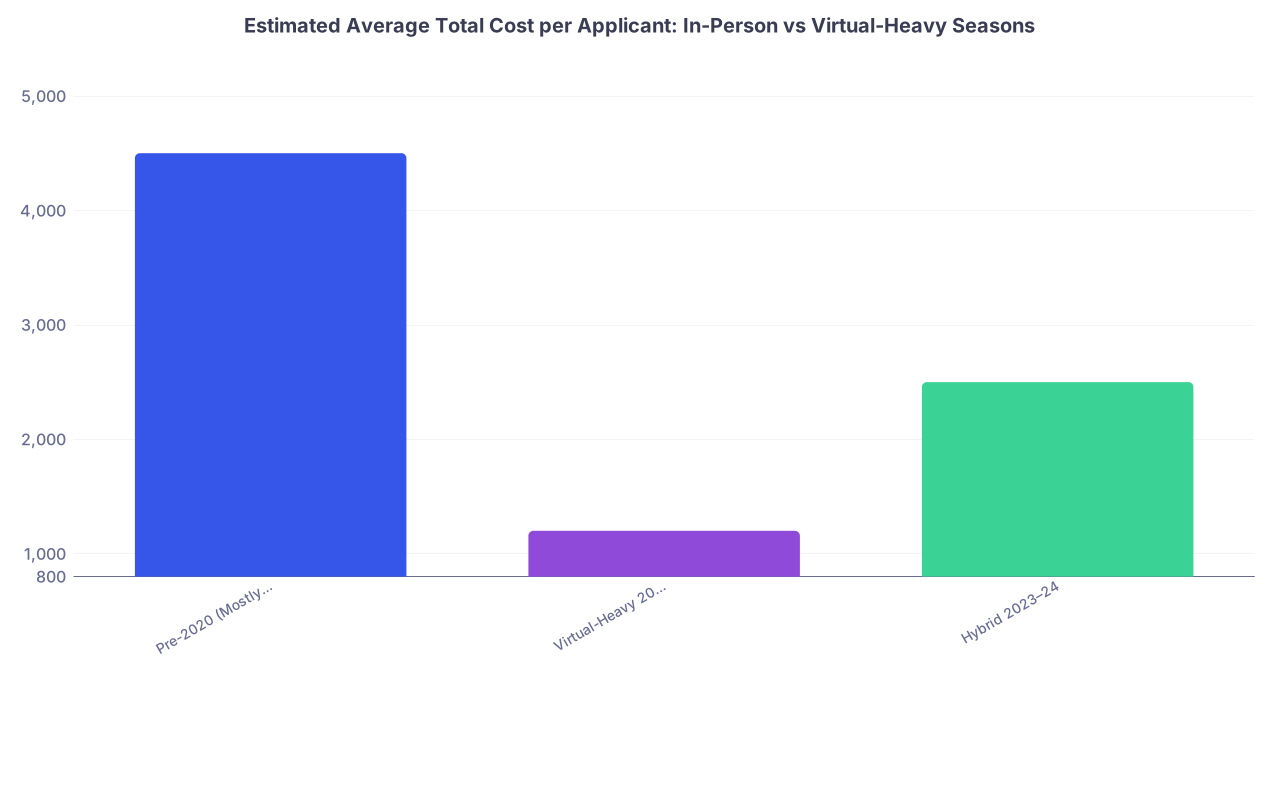
| Category | Value |
|---|---|
| Pre-2020 (Mostly In-Person) | 4500 |
| Virtual-Heavy 2021 | 1200 |
| Hybrid 2023–24 | 2500 |
These are ballpark but realistic:
- Pre‑2020: $4,000–$6,000 was typical for students interviewing at 10–15 programs
- 2021 (fully virtual): often under $1,500 total, including ERAS fees
- Hybrid years: creeping back up but still below pre‑COVID for most specialties
The data is obvious: virtual lowers financial barriers, especially for students without strong family support. That is the single clearest “win” of virtual interviews: access.
2. Match rates: did virtual hurt or help outcomes?
Let’s cut through the noise. Did virtual interviews make it harder to match?
Looking at NRMP Main Match data from 2018 through 2024, the answer is: globally, not really. The distribution shifted slightly, but the system did not collapse.
Here’s a simplified snapshot for US MD seniors across all specialties:
| Match Year | Interview Format Dominant | Match Rate (US MD Seniors) |
|---|---|---|
| 2018 | In-person | ~94% |
| 2019 | In-person | ~93% |
| 2020 | Mixed (pandemic onset) | ~93% |
| 2021 | Fully virtual | ~92–93% |
| 2022 | Virtual-dominant | ~92–93% |
| 2023–24 | Hybrid variants | ~92–94% |
Tiny fluctuations. Nothing like the apocalypse some attendings predicted.
For DO seniors, match rates also trended upward over time, driven more by AOA merger and position growth than interview format.
For IMGs, the story is more nuanced. Virtual removed travel advantages for those who could afford to visit many programs pre‑COVID. But it also removed visa and scheduling obstacles. Net effect: modest shifts, but not a universal disaster or miracle.
The key takeaway: changing to virtual did not drastically change your odds of matching somewhere given similar application strength.
What did change was:
- How many interviews you “need” to feel safe
- Which programs you are more likely to match at (geographic spread, academic vs community, etc.)
3. Virtual vs in‑person: effect on applicant behavior
The data shows virtual interviews fundamentally changed how applicants behave.
3.1 “Hoarding” interviews
Because marginal cost of “one more interview” dropped (no plane ticket, no hotel), high‑stat applicants often accept more interviews than needed.
NRMP and specialty orgs have repeatedly shown:
- For many core specialties, your probability of matching plateaus after a certain interview count.
- Example bands (varies by year/specialty but directionally correct):
- Internal medicine categorical: ~12–14 interviews → ~95%+ match probability for a typical US senior
- General surgery: ~14–16
- Psych / FM: ~10–12
Once you cross that threshold, each additional interview mostly reduces opportunities for others.
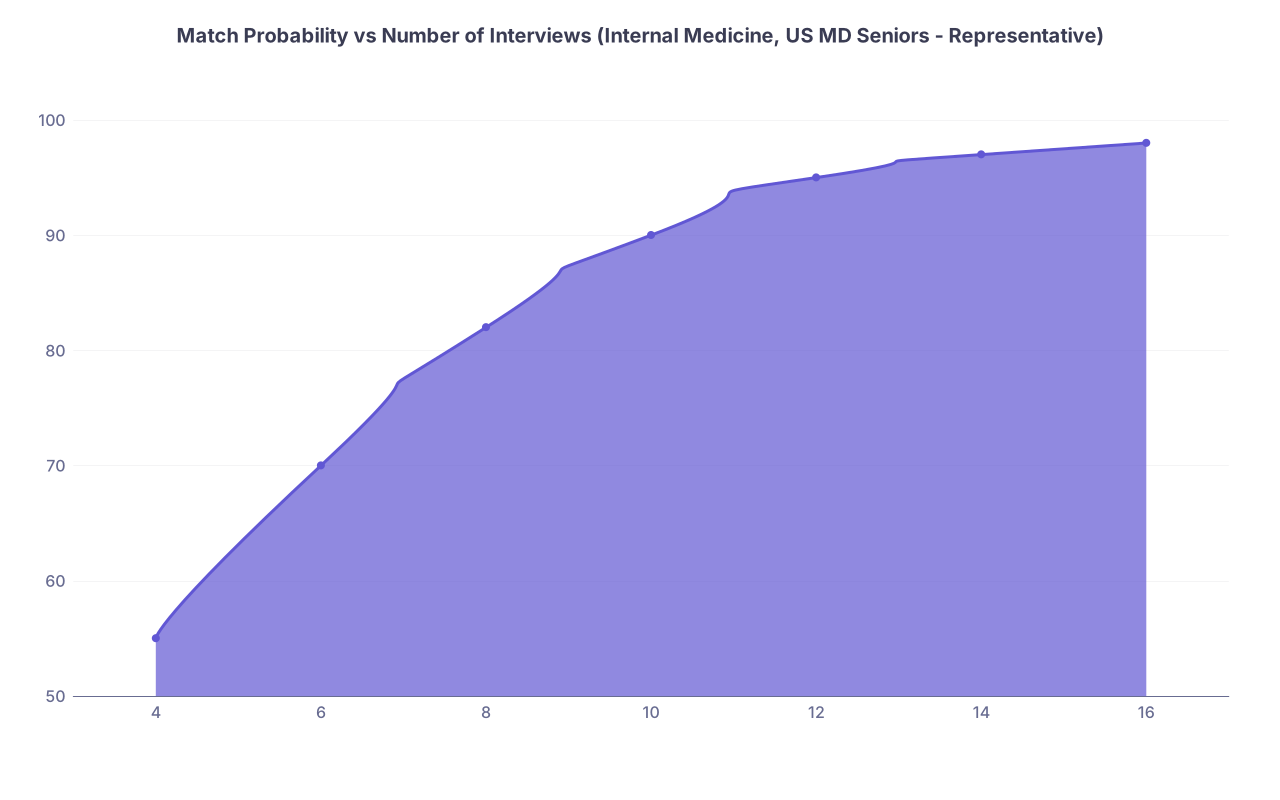
| Category | Value |
|---|---|
| 4 | 55 |
| 6 | 70 |
| 8 | 82 |
| 10 | 90 |
| 12 | 95 |
| 14 | 97 |
| 16 | 98 |
This curve is stylized but matches NRMP’s “Charting Outcomes” and “Interactive Charting Outcomes” trends.
Pre‑2020, travel and stamina limited how far along that curve many people could go. Virtual removed that friction, especially for those already competitive.
Net effect:
- Top and mid‑tier applicants often reach or exceed the “plateau” zone.
- Lower‑tier applicants find it harder to get enough interviews to reach their own comfort threshold.
3.2 Overapplying and geographic spread
Virtual interviews and ERAS one‑click lists produce predictable behavior:
- Applicants apply to more programs “just in case”
- They feel freer to apply outside of their region
- Many add reach programs because… why not, it is virtual
This pushed up the median number of applications per applicant in many specialties since 2020. That was already trending up, but virtual poured fuel on it.
Result:
- Programs in historically less popular regions report more out‑of‑region applicants interviewing.
- But “signal” about true interest becomes weaker. A New York student interviewing at 10 programs in Texas may have 0 real intent to move if they also have 20 local interviews.
For you, the important data‑driven strategy is to accept that:
- Geography is more variable in interview offers than it used to be
- But your rank list behavior still largely drives where you land, especially if you have 10+ interviews
4. Program behavior: how PDs say virtual changed their decisions
The other side of the table: program directors and selection committees.
Surveys from NRMP, AAMC, and specialty organizations (e.g., APDIM for internal medicine, APGO for OB/GYN) consistently show a few themes:
- Programs can interview more people for the same or lower cost.
- Faculty are less likely to cancel or be unavailable when interviews are virtual.
- PDs feel less confident about their ability to assess “fit” and professionalism virtually.
- Many programs now use more pre‑screening and filters to manage volume.
A lot of PDs admitted, sometimes bluntly, that they struggle with:
- Reading interpersonal dynamics over Zoom
- Evaluating subtle professionalism cues (arrival, pre‑session behavior, hallway interactions)
- Gauging genuine interest in the program or location
So they lean harder on measurable signals and early filters:
- USMLE Step 2 CK score (with Step 1 pass/fail)
- Class rank / AOA / grades
- Home / away rotation performance
- Letters from known faculty
Virtual interviews did not eliminate bias. They shifted it earlier: more reliance on numbers and pre‑interview screens to decide who even gets a virtual slot.
5. Hybrid and “second look” strategies: what the numbers suggest
Many specialties and programs are now in a hybrid or evolving model:
- Interviews officially virtual or mostly virtual
- Optional in‑person “second look” days
- Some programs flipping back to full in‑person, others staying virtual only
Here is the key misconception:
Applicants often assume attending a second look or in‑person event massively boosts ranking. The data and PD surveys suggest the impact is more modest and highly program‑dependent.
What second looks realistically do
From a selection standpoint, PDs report that second looks:
- Rarely rescue a weak application
- Can confirm concerns (unprofessional behavior, poor interpersonal skills)
- Sometimes help distinguish between a few similar candidates near the top or middle of the rank list
- Often matter more for small, tight‑knit programs (rural FM, some surgical programs) than massive academic IM departments
If I translate that into probabilistic language:
- Going to a second look does not transform a 10% match probability into 70%.
- It might turn a 50/50 tie between you and someone similar into a 60/40 in your favor if you click with people there and avoid red flags.
Is in‑person “better” than virtual if you have a choice?
From the applicant side, in‑person gives you:
- Much better signal about culture, resident morale, and workload reality
- More accurate read on whether you would actually be happy living there
- Stronger feel for program hierarchy, autonomy, and teaching atmosphere
From a pure match‑probability standpoint, though, the data so far does not show a massive systematic advantage for applicants who only interview in person versus virtual.
The main differences show up in:
- Geographic cohesion: in‑person heavy seasons correlate with more regionally clustered matches.
- Satisfaction and “fit”: survey data suggests applicants who saw programs in person feel more confident in their rank lists.
So in‑person is less about “will I match?” and more about “will I like where I match?”
6. Equity, bias, and hidden pitfalls of virtual interviews
A lot of people confidently claimed virtual would democratize the process and solve equity issues. The data is more complex.
Clear equity gains
Virtual absolutely reduced direct financial barriers:
- Travel and lodging costs dropped dramatically.
- Students from lower‑income backgrounds report less need for loans or family assistance for interviewing.
- IMGs and DOs save heavily on travel to multiple states.
Those are real gains. You are less likely to go into additional debt just to show your face at 12 programs.
New inequities and less obvious bias points
But virtual introduced new, quieter disparities:
Technology and environment:
- Stable high‑speed internet vs laggy connections
- Quiet, professional‑looking space vs crowded or noisy home
- Good webcam and lighting vs grainy, shadowed image
Nonverbal communication bandwidth drops:
- Some applicants rely more on in‑person presence, charisma, and interpersonal warmth that does not transmit as well through Zoom squares.
- Others benefit from being able to carefully script and control their environment.
Disability and chronic illness:
- For some, virtual interviews are a huge benefit (mobility issues, fatigue, immunosuppression).
- For others, long back‑to‑back screen days are uniquely punishing.
Programs are also not immune to “background bias”—subconscious judgment of your surroundings, audio quality, or family interruptions, despite official guidance.
The point is simple: virtual fixed some old inequities and created some new ones. Do not treat it as a magic equalizer.
7. Practical, data-driven strategy for you
You cannot control whether a program is virtual, hybrid, or in person. You can control how you respond strategically.
7.1 How many interviews is “enough”?
Use NRMP data and specialty‑specific charts, but rough bands for US MD/DO seniors (typical, not hyper‑competitive or severely at‑risk) look like:
- Family Medicine: 8–10 interviews → high match probability, 11–12 very safe
- Internal Medicine: 10–12 solid, 12–14 very safe
- Pediatrics: ~10–12
- Psychiatry: 10–12
- General Surgery: 12–15
- EM and competitive surgical subs: highly variable and volatile; follow your specialty org’s most recent guidance
If you cross into the “plateau” zone where marginal benefit per extra interview is low, consider releasing later offers or canceling early enough that another applicant can use the slot. Not altruism—just efficient use of your time and focus.
7.2 Virtual vs in‑person choice when you have options
If a program offers both options for the same interview (rare, but some do), think like this:
- If the program is in a city or region you have never experienced: in‑person is usually worth the cost for programs high on your realistic list.
- If you have lived there or know the region well: virtual is often enough.
- If you are already interview‑saturated (15+ in a core specialty): prioritize time and sanity. Virtual will usually suffice.
For “second looks”:
- Only attend where you are genuinely likely to rank the program in a competitive position.
- Do not bankrupt yourself visiting mid‑tier backups you are unlikely to put near the top.
- One or two targeted in‑person visits often beat scattershot travel to five places you barely care about.
7.3 Optimizing your virtual setup
Because the medium itself now matters, strip this down to data‑backed basics:
- Camera at eye level, stable connection, neutral background
- Test lighting so your face is clearly visible (front‑facing light beats overhead shadows)
- Good audio (USB mic or good headset) reduces miscommunication and “what did you say?” moments
No, this will not magically get you ranked number one. But poor tech and presentation can absolutely drag you down to “do not rank” territory easier than you think.
8. Where this is all heading
The pattern from 2020–2024 is clear:
- Virtual is not going away.
- Some specialties will stay almost entirely virtual (psych, peds, FM, many IM programs).
- Some will keep flirting with hybrid models (OB/GYN, gen surg, EM, many surgical subs).
- A minority will push back to in‑person for perceived “fit” and procedural evaluation.
Programs are watching three numbers closely:
- Their fill rate
- Their resident satisfaction and retention
- Diversity and geographic spread of their incoming classes
As long as virtual formats do not hurt those metrics, most programs will keep them. They save time and money for faculty and administrators too.
For you, the practical takeaway is simple: you must be excellent in both environments. Relying only on your “in‑person charm” or only on your polished Zoom persona is a losing bet.
FAQ (5 Questions)
1. Do applicants who interview in person match at higher rates than those who interview virtually?
The aggregate data so far does not show a large, systematic advantage in overall match rate for in‑person versus virtual interviews. Match probability is far more strongly linked to interview number and application strength (scores, letters, experiences) than the modality itself. Where in‑person tends to matter more is in helping applicants refine their rank lists and avoid mismatched programs, which can improve satisfaction but not necessarily the raw chance of matching.
2. How many virtual interviews do I really need?
Use specialty‑specific numbers, but for a typical US MD/DO senior in core fields, you see steep gains in match probability up to around 10–12 interviews, with diminishing returns beyond 12–14. For more competitive surgical or lifestyle specialties, the plateau shifts higher, but the same shape holds. Once you are in the plateau zone for your specialty cohort, adding more virtual interviews has small marginal benefit compared with improving your performance and building a rational, well‑ordered rank list.
3. Are virtual interviews worse for IMGs or DOs?
They are not uniformly worse. IMGs and DOs benefit significantly from reduced travel costs and the ability to attend more interviews than they could afford in person. However, they may lose some of the “in‑person advocacy” advantage—showing commitment by flying across the country, spending a day in the hospital, and interacting deeply with the team. On net, outcomes have not collapsed for these groups. The bigger drivers of match success remain exam scores, clinical performance, and strategic program selection rather than the interview format itself.
4. Should I spend money traveling to second looks or save it?
From a cold, data‑driven perspective, second looks rarely rescue a weak candidacy. They are best viewed as tie‑breakers and information‑gathering tools. If a program is already realistically within your top tier and you are uncertain about fit or location, an in‑person visit can meaningfully refine your rank list and marginally help you if the program is also uncertain. But spreading yourself thin across many second looks has poor return on investment. One to three carefully chosen visits usually beat a scattered approach.
5. Will programs hold virtual interviews against me if they offer in‑person options too?
Most programs publicly commit to not disadvantaging applicants who choose virtual, and surveys suggest most PDs make a serious effort to honor that. In practice, bias is possible at the margins, particularly in small programs that heavily value interpersonal dynamics. But the larger and more academic the program, the more likely they are to standardize evaluation and treat virtual and in‑person formats equivalently. If cost or logistics make in‑person tough, you are generally better off doing a polished, technically clean virtual interview than forcing a strained, rushed in‑person visit.