
The way away rotations are discussed in selection meetings is far more blunt—and far less “holistic”—than anyone tells you.
You’ve heard the polite version: “We value your performance on away rotations” or “Audition electives help us get to know you.” That’s brochure language. What actually happens behind those closed doors when your name comes up is sharper, faster, and sometimes brutal.
Let me walk you into that room.
What an Away Rotation Really Is in Their Eyes
Programs don’t see an away rotation as “extra experience.” They see it as a live audition with witnesses. Witnesses they trust more than any letter, any Step score, any personal statement.
On the committee, away rotations usually fall into one of four mental buckets:
- Rockstar on home turf (our place) – “We know this one. Bring them back.”
- Neutral but acceptable – “Didn’t annoy anyone. Good enough if the rest of the app is solid.”
- Red-flag behavior – “Absolutely not ranking. Next candidate.”
- Invisible – “Wait, did they rotate here? I don’t remember them.”
You want to be Bucket 1. Bucket 2 is survivable. Bucket 3 ends your chances at that program. Bucket 4 means your entire month did nothing for you.
The surprising part? Most students land in Bucket 2 or 4. Very few in 1. And every year a painful number fall into 3.
What Actually Gets Said in Selection Meetings
Here’s what people won’t tell you: the conversation about your away rotation is usually short, and the first words out of someone’s mouth about you become your label.
Picture this: It’s 7:15 pm, Monday. They’ve already gone through 40 names. Someone pulls up your application.
The program director: “Did this person rotate here?”
Resident rep: “Yeah, August.”
Now the critical moment. One of three things happens:
Instant enthusiasm.
“Oh yeah, she was great. Super solid. Always stayed late, asked good questions, no drama.”
Translation: You just got a quiet bump up the rank list.Awkward pause, then lukewarm.
“Uh… yeah, I remember him. He was fine. Nice. Don’t remember anything specific.”
Translation: The away rotation will not save you. You’re now judged like everyone else.Immediate negative reaction.
“Yeah… that student. Came late a few times. Kind of disappeared when work needed to be done.”
Translation: You’re done at this program. They may still read your file for five seconds out of politeness. It won’t matter.
Notice what’s missing? No one is saying: “Their Step 2 is 254 and they published 4 papers, so forget the rotation issues.” The behavior they saw in real time almost always beats the numbers.
The Hierarchy of Voices: Who Actually Shapes Your Fate
Not everyone in the room carries the same weight. You need to understand whose opinion of your away rotation matters most.

Program Director
The program director pretends to be impartial, but there’s one thing they trust more than anything: patterns. If two or three people on the team say, “This student was great to work with,” the PD doesn’t argue. If multiple people roll their eyes at your name, it’s over.
You’ll hear PDs say things like:
- “If you worked with them and you’re not excited, I’m not either.”
- “We’ve been burned before by ignoring resident feedback.”
They are thinking: Did this person make my residents’ lives easier or harder for a month?
Core Faculty
That trauma surgeon who rounded with you twice? If they remember you, their impression carries weight. Especially if they’re loud in meetings. There’s always one or two attendings whose “gut feeling” on rotators quietly sets the tone.
I’ve heard:
- “He was teachable. Didn’t know everything, but I’d trust him on my service as an intern.”
- “She was defensive with feedback. That doesn’t get better as a resident.”
Faculty rarely give you a full speech in the meeting. It’s usually one or two sentences. But those sentences stick.
Chiefs and Senior Residents
These are the most honest voices in the room. They see how you behaved at 5:30 am when everyone was tired and stressed. They don’t care about your research. They care whether you wrote your notes and helped with admissions without whining.
Typical lines:
- “She actually checked back on the patients we admitted. That’s rare for a rotator.”
- “He disappeared whenever there was scut. The med students did more than he did.”
When the chiefs talk, everyone listens, because chiefs are the ones actually living with the consequences of a bad intern match next year.
Junior Residents and Interns
They don’t carry the most weight, but their comments can tip the scale if others are on the fence.
The PD might say, “Any strong feelings about this one?” and a PGY-2 will chime in, “They were nice but passive” or “Actually, that student worked their ass off.” Not as decisive as a PD’s opinion, but it colors your file.
The Three Silent Questions Every Committee Asks About Your Away
They don’t say these out loud, but I’ve watched them play out over and over.
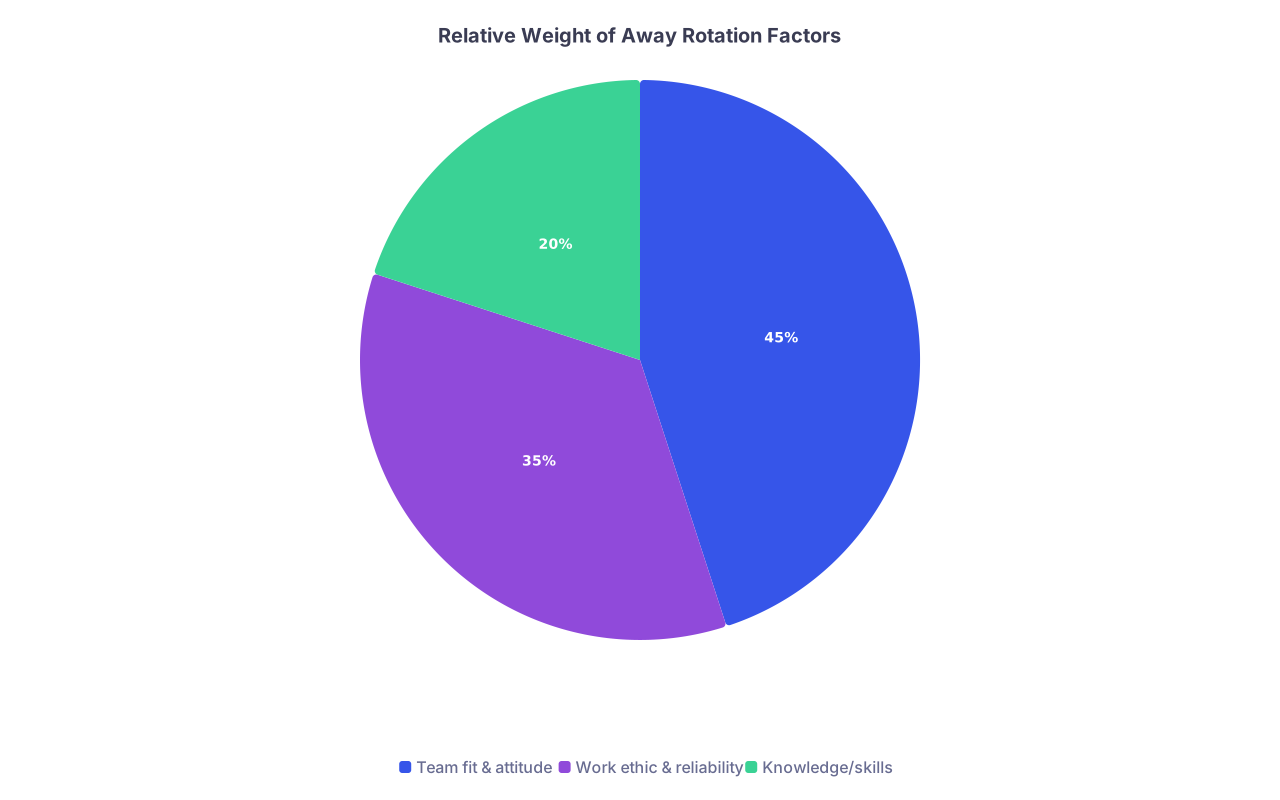
| Category | Value |
|---|---|
| Team fit & attitude | 45 |
| Work ethic & reliability | 35 |
| Knowledge/skills | 20 |
1. “Would I trust this person on my service at 2 a.m.?”
This is the real question. Not “Are they smart?” Everyone assumes you’re smart enough. They want to know: when things get ugly, are you dead weight or backup?
How that shows up in discussion:
- “She stayed until the work was done. Didn’t clock out at 4:59.”
- “He stepped up on busy call nights. Didn’t need babysitting.”
If someone in the room says, “I’d be fine with them on my team at 2 a.m.,” you’re in very good shape.
2. “Did they make my team’s life better or worse?”
They remember small things that never get written down:
- You grabbed the pager when an intern was drowning.
- You pre-rounded on a sick patient without being told.
- You volunteered to help the other med student with discharges.
And the opposite:
- You were on your phone during sign-out.
- You vanished when it was time to transport a patient.
- You needed constant reminders to do basic tasks.
The language they use is telling:
- Good: “Low maintenance,” “self-directed,” “easy to work with.”
- Bad: “High maintenance,” “needed hand-holding,” “kind of entitled.”
Translation: Does this person increase or decrease the cognitive and emotional load on the team?
3. “Do they actually want to be here or just using us?”
Programs are not stupid. They know when you’re treating them like a “backup” or a name on a list.
They notice:
- Did you know anything about the program beyond geography?
- Did you ask questions that showed you were picturing yourself there?
- Did you come to conferences, journal club, resident dinners?
Comments you do not want associated with your name:
- “Felt like they were just here for a letter.”
- “I asked where else they were applying and it was all ‘higher tier’ programs.”
Programs want residents who want them. If you give even a whiff of “I’m just here in case my dream place rejects me,” that sticks.
How Different Outcomes Are Actually Framed
Let’s be blunt: away rotations can put you in three very different categories on the rank list.
| Rotation Outcome | Typical Committee Label | Rank List Effect |
|---|---|---|
| Strong, memorable | "We want this one" | Moves up significantly |
| Neutral/forgettable | "Fine, like everyone else" | No major change |
| Negative impressions | "Do not rank / low" | Drops dramatically or NR |
The Strong Away: How They Talk About You
When you crush an away, your name comes up and someone immediately advocates for you.
“Yeah, she rotated with us in September—honestly one of the best students we had all year.”
Notice what matters in the follow-up:
- “Showed up early every day.”
- “Never complained, even on brutal days.”
- “The nurses liked him.” (This is huge when it gets mentioned.)
- “Picked up things quickly.”
Then what happens? The program director starts framing you as a “get”:
- “If we can match her, that’d be great.”
- “Let’s make sure we don’t lose him to another program.”
Your away rotation just gave them a mental picture of you in their system. That mental picture is more powerful than your CV.
The Neutral Away: Faint Praise, Faint Support
Neutral is not a disaster—but it’s not a win.
You get lines like:
- “He was fine. Quiet, did what was asked.”
- “She was solid. Nothing concerning.”
Then the pivot: “What are their scores, research, letters like?” In other words, the away did not move the needle. You’re put back into the big pool, judged by the same criteria as the thousands of others who never rotated there.
If your rest of the application is strong, that’s okay. If you were depending on the away rotation to rescue a mediocre file, neutral won’t cut it.
The Negative Away: How You Quietly Get Deleted
When you mess up an away, nobody screams or slams the table. It’s quieter than that.
“Any thoughts on this one? They rotated here in October.”
Long exhale. Someone says, “I’d rather not.” Another says, “Had some professionalism issues.” A chief adds, “We had to talk to them about being late multiple times.”
The PD doesn’t argue. They just say some version of:
- “Okay, sounds like not a good fit for us.”
- “We’ll move on.”
Sometimes your name gets literally tagged “DNR” (do not rank) in whatever software they use. Other times you’re parked at the absolute bottom of the list, functionally the same thing.
Either way, your month turned into a red stamp.
Things They Notice That You Think Are “Small”
You think they’re not watching. They are. And they talk about it.

| Step | Description |
|---|---|
| Step 1 | Away Rotation |
| Step 2 | Work habits |
| Step 3 | Attitude |
| Step 4 | Team interactions |
| Step 5 | Reliable or flaky |
| Step 6 | Teachable or defensive |
| Step 7 | Team player or solo operator |
The Way You React to Feedback
I’ve sat in meetings where the only comment about a student was:
“Got defensive whenever we corrected him. That’s going to be a problem.”
No one cared what the specific feedback was. They cared that you argued, deflected, or shut down.
The opposite is gold:
- “She actually changed her approach after we talked.”
- “He asked for feedback and followed through.”
That makes you sound like someone who will grow fast as an intern, which programs love.
How You Treat “Unimportant” People
Nurses, front desk staff, techs, the unit clerk. These people talk. Not in formal evaluations. In casual hallway conversations that end up in selection meetings as “vibes.”
Comments like:
- “The nurses loved her. She always helped out.”
- “He was condescending with the staff.”
Take one guess which one gets pushed down the rank list without ceremony.
Absences, Tardiness, and Disappearing Acts
Nobody cares that you were “technically excused” to go to a dentist appointment. What they remember is pattern.
- “He was always ‘running behind’ in the morning.”
- “Where was she during that codes call? Oh right, ‘reading.’”
They’re asking: Is this how you’ll be as an intern when no one’s grading you?
The Subtext: Away Rotations and “Fit” (The Word They Hide Behind)
“Fit” is the most abused word in residency selection. It’s also one of the most honest. Away rotations are where “fit” gets decided—on both sides.
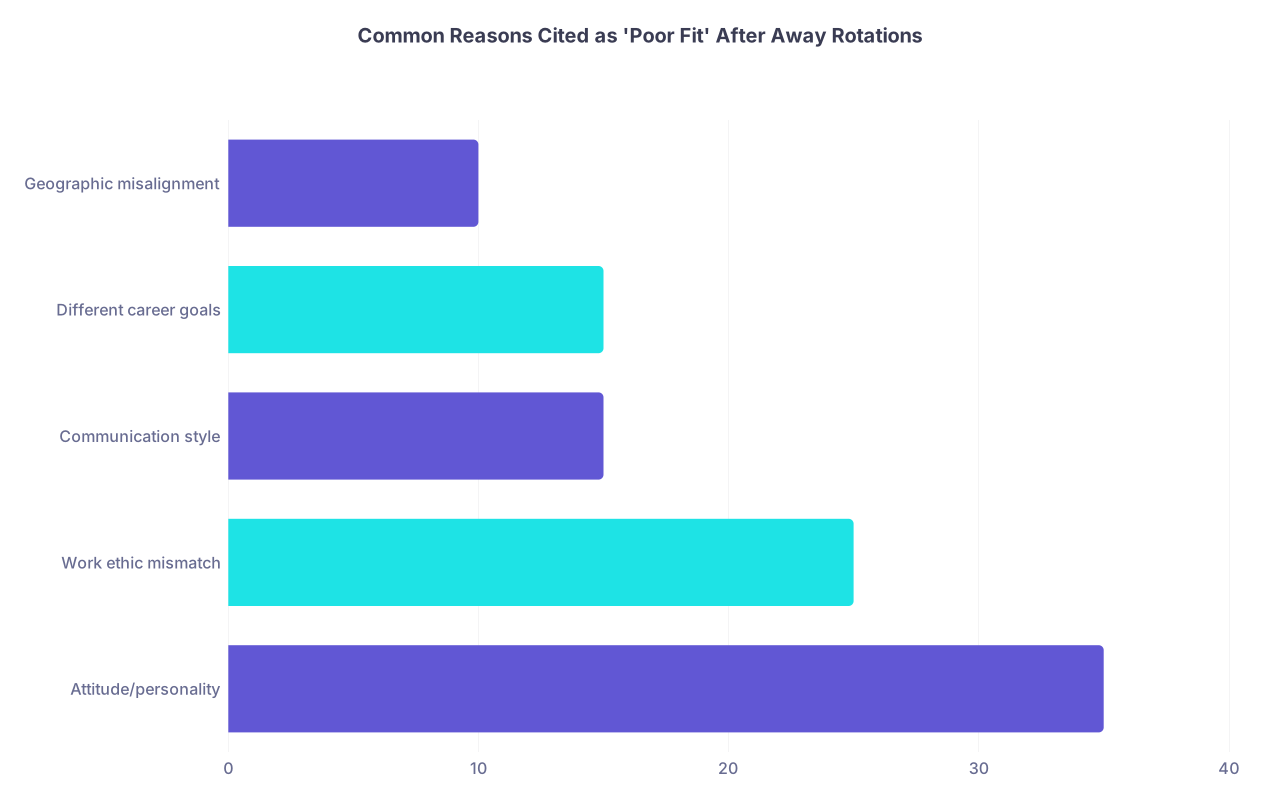
| Category | Value |
|---|---|
| Attitude/personality | 35 |
| Work ethic mismatch | 25 |
| Communication style | 15 |
| Different career goals | 15 |
| Geographic misalignment | 10 |
When someone says, “I just don’t think they’re a fit,” they usually mean one of these:
- Your humor clashed with the team’s vibe.
- You complained a lot about hours or location.
- You acted like you were above certain tasks.
- You gave off “I’m too good for this place” energy.
They rarely spell that out in the official file. But they absolutely say it in the room.
The flip side is true too:
- “Felt like they’d slide right into our culture.”
- “Hung out with residents, came to dinners, meshed with the group.”
That’s “fit” in action. And away rotations are their favorite tool to judge it.
How Programs Use Away Rotations Strategically
Here’s the part few students grasp: programs use your away rotation to manage their own risk.
They’re thinking:
- We’ve been burned by big scores and terrible work ethic.
- We’ve had charming interviewees who turned toxic as interns.
- We can’t see the real person in a 20-minute interview.
So they treat your away like a stress test.
If you pass it, they’re willing to rank you higher than your paper stats might “justify.” I’ve seen mid-230s applicants beat 250+ applicants on the rank list simply because the mid-230s person rotated and crushed it.
If you fail it, no one fights for you. Even if you look phenomenal on ERAS.
The Harsh Truth About “Needing” an Away
Some specialties basically expect away rotations (ortho, derm, neurosurgery, ENT). Others see them as a strong plus (EM, rads, many surgical fields). For less competitive fields, they’re optional but still powerful.
But the harsh truth is this: an away rotation is a high‑risk, high‑reward move. It’s not neutral.
- Strong outcome: Huge boost at that program, often at similar programs in the region.
- Neutral: Wasted month in terms of match leverage.
- Negative: You’ve actively shut a door.
So if you’re not ready—burned out, disorganized, unsure you want that specialty or that region—an away can hurt more than help.
Frequently Asked Questions
1. If I rotate at a place and don’t get an interview, does that mean I’m doomed?
No, but it’s not a good sign. Sometimes it’s just numbers—they don’t interview every rotator, especially in hyper-competitive specialties. But here’s the behind-the-scenes part: if you made a strongly positive impression, someone almost always pushes to at least get you an interview. If you didn’t get one, you were either neutral and squeezed out by volume, or someone actively felt you weren’t a good fit. You’re not “doomed” for other programs, but you probably didn’t help yourself there.
2. Do programs ever rank someone highly who had a mediocre away rotation?
Rarely. “Mediocre” usually translates to “forgettable,” and forgettable doesn’t get you pulled up the rank list. That said, if your away was truly neutral—no one remembered you much, no red flags—and your application is strong, you can still end up in their mid‑rank range. But the people they’re excited to get? Those are usually either stand-out interviewees or stand-out rotators.
3. Can a great away rotation overcome a low Step score or weak research?
At many programs, yes—with limits. I’ve seen applicants with modest scores and minimal research land at excellent programs because their away performance convinced the committee they’d be fantastic interns. But “great away” doesn’t magically erase everything. If your score is far below the program’s usual range or you clearly can’t keep up with the knowledge level, even the nicest rotation reviews won’t fully save you. What it does do is move you from “auto-screened out” to “we should seriously consider them.”
4. How do they view someone who doesn’t do any away rotations at all?
For hyper-competitive specialties, no aways can be a mild red flag: “Why didn’t they rotate? Did they not plan ahead? Were they not sure of the specialty?” But it’s not automatically fatal, especially at your home program where they already know you. For less competitive specialties, many programs don’t care at all. What they don’t like is the applicant who does an away, behaves poorly, and then tries to explain it away. No away is usually better than a bad away.
Years from now, you won’t remember the exact wording of your evaluations or who said what in that selection meeting. What will stick with you is this: the month you spent somewhere, how you showed up, and whether you left a team quietly thinking, “I’d want them next to me at 2 a.m.” That’s what really gets discussed—and that’s what you can control.