
The biggest red flags in residency applications aren’t the ones you fear. It’s the quiet, boring ones that get you deleted before anyone ever thinks about interviewing you.
Let me tell you what really happens on the other side of ERAS.
A program gets 3,000 applications. They have maybe 60 spots. Maybe 2–3 weeks of true review time if you add up all the hours faculty actually spend. That means your “comprehensive” application gets about 45–90 seconds on first pass. If that.
So nobody’s hunting for excuses to love you. On that first pass, they’re hunting for reasons to put you in the discard pile. And the red flags that do this most reliably are not dramatic. They’re subtle patterns, inconsistencies, and signals that say:
“This applicant is going to be a headache.”
You’ve heard about Step failures and professionalism violations. Those are obvious. I want to walk you through the red flags that quietly kill applications long before interview invites go out—the ones faculty complain about in the workroom but never put on their website.
The Unforced Errors In Your Application Structure
The first set of red flags has nothing to do with your scores. It’s how your application reads in 60 seconds.
Sloppy, rushed, or obviously recycled content
Faculty can smell a copy-paste job in two lines. They see hundreds.
I’ve sat in rooms where someone shares screen and reads:
“Thank you for reviewing my application to your esteemed program…”
And someone else says, “Next,” before they even finish the sentence.
Quiet red flags here:
- Personal statement that clearly wasn’t tailored to the specialty
- Discussing the wrong specialty or wrong program type ("I look forward to training in your Internal Medicine program" on an FM app)
- Typos in the first paragraph (we stop reading; it’s that simple)
- Generic cliché soup: “lifelong learner,” “passion for medicine,” “compassionate care” with zero concrete stories
These don’t look “fatal” to you. To a PD they mean: “This person did not care enough to do basic quality control.”
Disorganized, bloated, or dishonest CV
There’s a quiet pattern reviewers notice: chaos.
You cram 25 “research projects” into ERAS, half with no clear role, no outputs, no mentor name that anyone recognizes. Or you list five “leadership” positions that are really just you being a member of a club.
The red flag isn’t that your CV is light. It’s that it looks padded.
You know what gets more respect? Three solid, clearly described activities with defined outcomes, time frames, and roles. Versus a wall of fluff that screams insecurity.
Even worse: inconsistent dates between experiences, publications, and MSPE. Reviewers do cross-reference. They’ll be scrolling, then pause:
“Wait, they said they were in this lab for 2 years, but the MSPE says they joined halfway through third year.”
Then someone says what always comes next: “If they’re loose with this, what else are they stretching?”
The Academic Signals That Make People Nervous
Most of you already know low scores are a problem. But it’s the pattern and context that really matter.
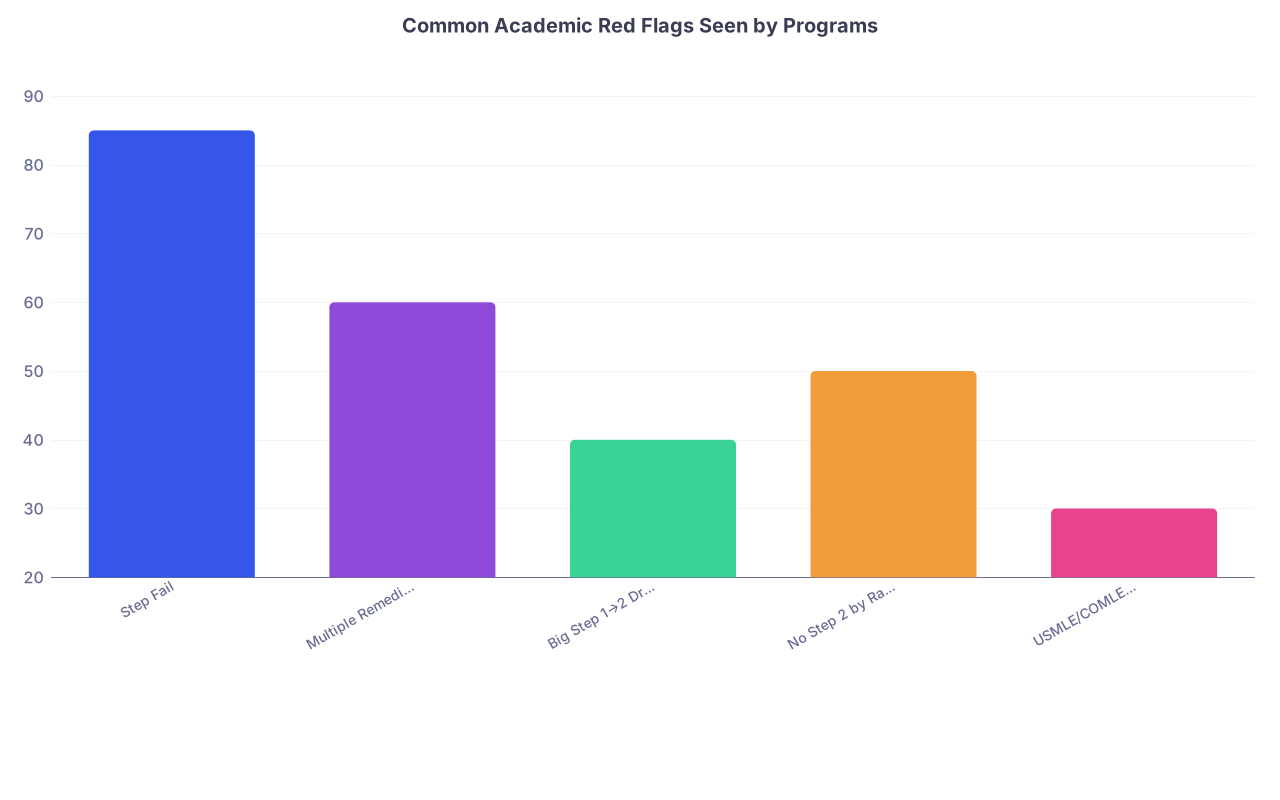
| Category | Value |
|---|---|
| Step Fail | 85 |
| Multiple Remediations | 60 |
| Big Step 1→2 Drop | 40 |
| No Step 2 by Rank List | 50 |
| USMLE/COMLEX Mismatch | 30 |
Step 1 vs Step 2: it’s the trajectory
Now that Step 1 is pass/fail, committees lean heavily on Step 2 CK. The real red flag isn’t just a “low” score. It’s the shape of your testing history.
Here’s what quietly scares them:
- Failed Step 1 + borderline Step 2
- Reasonable Step 1 (when it was scored) + big drop on Step 2
- Late Step 2 (released after most interview invites) with an unexpectedly poor score
At selection meetings I’ve heard this more than once:
“I don’t care that they passed on the second try; I care that they barely passed. That suggests a ceiling.”
Programs can work with a story of improvement. A student who struggled early then crushed Step 2 often gets a second look. But a downward trajectory? That’s where doubts creep in.
Shelf exams and clerkship inconsistencies
You think “Honors in 3 rotations, High Pass in the rest” is fine. It is. What bothers people is when the narrative doesn’t match the numbers.
For example:
- Fantastic narrative comments in MSPE with mediocre grades across the board
- One rotation with outlier bad comments (unprofessional, unreliable, dismissive of staff)
- Repeated shelf exam failures with no explanation anywhere in your application
Program leadership cares more about patterns of reliability than raw brilliance. They’ll forgive a tough OB shelf once. They don’t love “failed three shelves, remediated each” without a clean, believable story.
Letters of Recommendation: What They Really Look For (and Fear)
Letters sink more applications than students realize, and sometimes the red flag is what’s missing.
Vague, lukewarm letters that say nothing specific
Here’s the dirty secret: faculty know how to damn with faint praise.
When a letter reads:
“[Name] was a pleasure to work with. They showed up on time and were eager to learn. I am confident they will be a solid resident in any program.”
That sounds innocuous to you. On a selection committee, that’s a soft “no.” You know what a strong letter looks like; it has:
- Concrete stories
- Direct comparisons (“top 5% of students I’ve worked with in 10 years”)
- Clear endorsement (“I would be thrilled to have them in our residency”)
The red flag is vanilla language. Repeatedly. Across all your letters.
The infamous “reading between the lines” phrases
Faculty learn the code. Here are phrases that quietly tank people:
- “With appropriate supervision, they will be able to…”
- “They respond well to clear structure and expectations.”
- “They are working on improving their efficiency and independence.”
- “Given more time, I believe they will grow into a competent resident.”
On the surface, they sound supportive. In a room of attendings, people wince. They’ve all written versions of those lines when they were trying to be kind about someone who struggled.
Wrong letter mix for the specialty
Another subtle red flag: your letters don’t match your claimed interest.
You’re applying to Internal Medicine but your letters are from:
- Two surgeons
- A psychiatrist
- Your basic science PI
No core IM letter from an inpatient service.
That reads as:
- Either you didn’t impress anyone in IM, or
- You didn’t understand the game well enough to even ask.
Same for EM without a standardized SLOE, or psych without at least one strong psych letter. Programs notice the absence like a flashing light.
Professionalism and “Will This Person Be a Problem?”
This is where quiet red flags really multiply. Because programs are terrified of problem residents.
Nobody wants to match the intern who ends up in the GME office every other month. So they screen hard for small signals.
The MSPE “one-liners” that haunt your file
You might have one bad day on a rotation. You snapped at a nurse. You were late to a case. You thought it blew over. Then the MSPE arrives and there it is:
“On one rotation, the student required feedback regarding interpersonal interactions with staff.”
From your perspective: minor note. From theirs: this one line will get read and re-read by three different people in the program leadership.
They’ll say things like:
“We can teach medicine. We can’t fix professionalism.”
I’ve seen applicants with Step 2 scores 260+ pushed way down the list because of a single, consistent thread of “difficult to work with” in their comments.
Email tone, timing, and content
You probably don’t believe this matters. It does.
Things that quietly get remembered:
- Overly aggressive emails asking, “Why haven’t I received an interview yet?”
- Mass cold emails to every faculty member at a program with copy-paste text
- Overly familiar tone with the coordinator (“Hey girl,” “Hi dear,” etc. — yes, people actually send this)
- Repeated follow-up emails every few days about the same question
Coordinators talk. When an applicant is being discussed, I’ve heard:
“That’s the one who sent me four emails in a week asking if we got their application. Hard pass.”
You’ll never see that in your rejection. But it absolutely influenced it.
The Personal Statement Red Flags That Aren’t About Grammar
Let’s talk about the essay, because it’s more of a filter than you think—especially at smaller programs where PDs actually read them.
Trauma dumping with no reflection
There’s a difference between a powerful, vulnerable story and using your personal statement like therapy.
What scares PDs:
- Graphic descriptions of trauma that feel unprocessed or overwhelming
- Essay reads as a cry for help, not as a professional narrative
- No clear connection between what you lived through and how you function at work now
People will never say this publicly, but I’ve heard it behind closed doors:
“I respect what they’ve been through. I’m just not convinced they’re stable enough yet for intern year.”
Brutal, unfair at times, but real.
Angry, bitter, or self-pitying tone
You think you’re “being honest” about how unfair the system is, how bad your school is, how toxic certain rotations were.
Programs hear:
- Blame-shifting
- Poor insight
- Professionalism risk
The quiet red flag is the applicant who spends most of the statement explaining why other people or systems held them back. Versus owning their choices, their growth, and how they responded.
The “Does This Application Make Sense?” Problem
A lot of committee discussion is basically: “Does the story add up?”

| Step | Description |
|---|---|
| Step 1 | Open ERAS Application |
| Step 2 | Check for Context/Explanations |
| Step 3 | Lower Priority |
| Step 4 | Red Flag Pile |
| Step 5 | Invite Consideration |
| Step 6 | Scores Reasonable? |
| Step 7 | Letters Strong/Specific? |
| Step 8 | Narrative Coherent? |
Specialty switch with no explanation
Here’s a classic quiet killer:
- Third year: deep in surgery, publishing in ortho, scrubbed so much you barely saw daylight
- Fourth year ERAS: you’re applying to Psychiatry
- Nowhere in your application do you explain that change
What committees actually say:
“So either they couldn’t match surgery or they had a crisis and bailed. And they didn’t think enough to tell us why.”
You don’t have to confess every detail, but you do need a coherent narrative. “I discovered X, re-evaluated, found genuine fit in Y, here’s what I did to confirm it” goes a long way.
Research or experiences that look suspiciously inflated
Example: an applicant claims 15 publications, 7 first author, from a single year with no research background before. In a mid-tier med school without a heavy research footprint.
Someone on the committee who knows the field will say, “That’s… unlikely.”
They may not accuse you of dishonesty, but they stop trusting the rest of the file. Which is fatal. The subtle move is they just drop you lower on the priority pile because they don’t want to untangle it.
Social Media, Google, and The Silent Background Check
Here’s something most students don’t believe: a non-trivial number of PDs and APDs will Google you. Especially if something feels off.

They’re not hunting for bikini photos. They’re looking for:
- Openly unprofessional posts about patients, colleagues, or your school
- Aggressive, hostile public commentary that suggests poor judgment
- Involvement in publicly documented conflicts, lawsuits, or disciplinary issues
If your name is uncommon, this gets easier. If your Instagram is public and you’ve got a whole highlight reel of drunk rants about how “residency is a scam,” don’t assume nobody will see it.
I’ve watched PDs show a social media screenshot in a selection meeting, then quietly say, “We’re not bringing this person here.”
You’ll never hear why. But that was it.
Program Fit Red Flags: “This Person Won’t Be Happy Here”
Sometimes the red flag isn’t that you’re weak. It’s that you clearly don’t belong at that particular program.
| Signal | How Programs Interpret It |
|---|---|
| Zero ties to region | Likely to leave, especially in community programs |
| Applying only to reach programs | Won't be satisfied here, flight risk |
| No mention of key program features | Didn’t research us, we’re just a backup |
| Extreme research focus to a no-research program | Mismatch of priorities |
| Strong urban preference applying to rural | Resident dissatisfaction risk |
No geographic or personal anchor
Community and smaller academic programs especially worry about retention. They do not want to train you for three years just so you leave miserable and bad-mouth them.
Red flags they notice:
- You’re from coastal big cities, trained at big-name institutions, and apply to a small rural program with zero explanation
- Personal statement and experiences scream “I need a major metro area,” but you’re applying to programs in the middle of nowhere
A PD at a midwestern program once said flat out:
“I don’t care how strong they are. If there’s nothing tying them to the region, we’re not wasting an interview.”
You can overcome this, but only if you actually address it: family nearby, partner’s job, genuine interest in that population, etc. Silence looks like lack of thought.
Not matching the culture they’ve clearly advertised
If a program’s website and residents emphasize “very high-volume, hands-on, gritty, blue-collar medicine,” and your entire application screams “I only care about bench research and NIH funding,” you get silently filtered.
Same the other way around: you pitch yourself as a clinician-educator who loves patient interaction applying to an ultra-research-heavy program that brags about 90% of grads doing fellowships at top-10 institutions.
They’re not angry at you. You’re just clearly not their person. So your file goes to the bottom without discussion.
How To Fix Or Mitigate These Quiet Red Flags
You can’t erase everything, but you can absolutely stop compounding the damage.
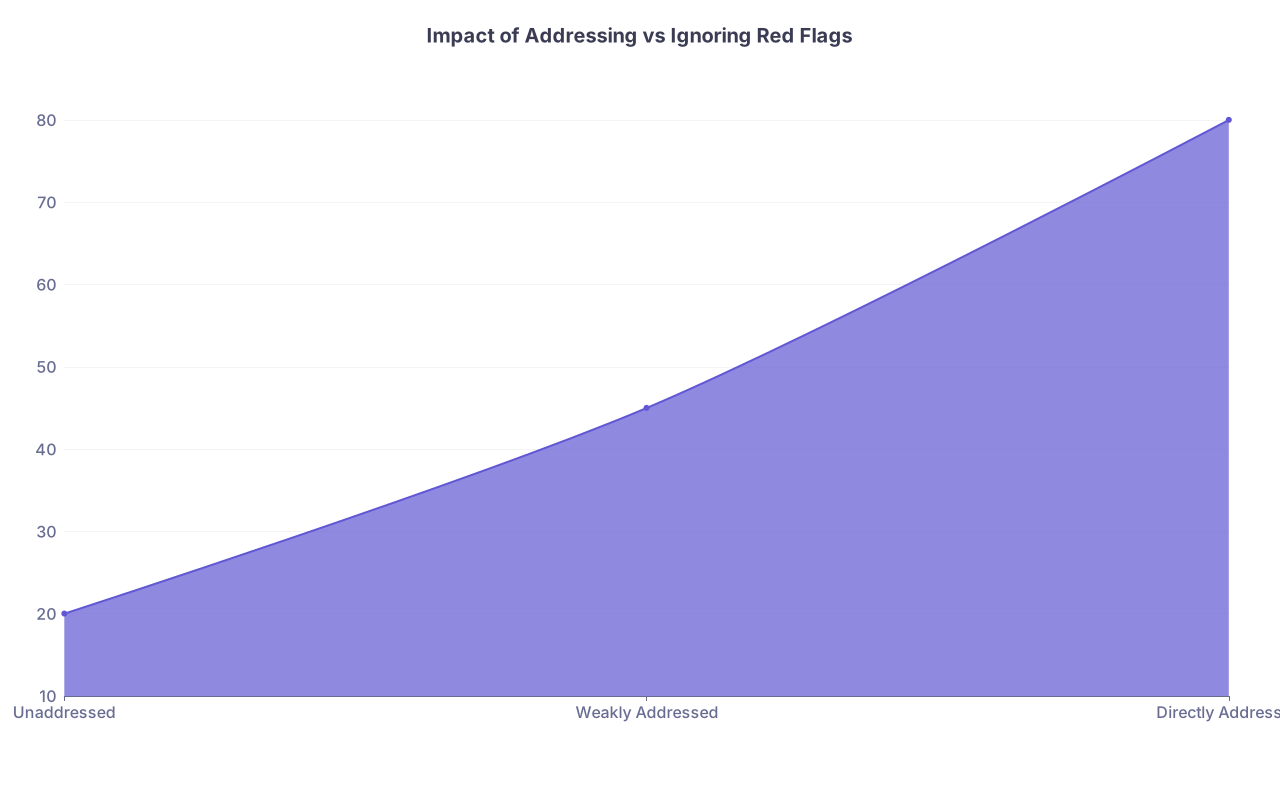
| Category | Value |
|---|---|
| Unaddressed | 20 |
| Weakly Addressed | 45 |
| Directly Addressed | 80 |
Be ruthlessly honest with yourself about your weak points
You already know where your file is soft. The worst move is to pretend those issues don’t exist and hope programs “won’t notice.” They will.
Instead:
- If you switched specialties late, explain it briefly but clearly in your personal statement and maybe an advisor letter.
- If you had academic struggles, mention what changed and show concrete improvement (Step 2, later clerkships, sub-I’s).
- If there’s a professionalism blip in your MSPE, don’t relitigate it—but show maturity and growth in how you talk about teamwork and communication.
Programs don’t expect perfection. They expect insight.
Upgrade your letter strategy
If you suspect a lukewarm letter, do not use it. I know that’s awkward. Use faculty who:
- Actually know you well
- Supervised you clinically
- Can talk about you with specific stories
And tell them directly (in a respectful way):
“I’m aiming for a strong residency program, and I’d really appreciate an honest, strong letter if you feel you can write one. If not, I completely understand.”
That gives them a graceful out. You’d be surprised how many will quietly say, “I might not be the best person for that,” and you just avoided a quiet torpedo.
Bring coherence to the narrative
Read your entire application out loud in one sitting. Ask:
“If I were a stranger, could I summarize who this person is, what they want, and why they’d fit my program in two sentences?”
If the answer is no, you’ve got work to do.
Tighten:
- Align your personal statement with your experiences and letters
- Make sure your activities support the specialty you’re claiming to love
- Remove obviously padded or dubious entries
You’re not writing a mystery novel. Clarity wins.
FAQ (Exactly 3 Questions)
1. If I have a known red flag (Step failure, professionalism comment), should I address it directly in my personal statement?
Briefly, yes—but with discipline. One to three sentences, max. Acknowledge what happened without self-pity, state what you changed, and point to concrete improvement (better performance on later exams, strong sub-I feedback, etc.). Do not make your entire personal statement a defense memo. Programs want to see insight and growth, not a court case.
2. How do I know if one of my letters is lukewarm or hurting me?
If you’re not sure the writer knows you well, that’s already a problem. People who supervised you closely, gave you positive direct feedback, or invited you back to work with them again are generally safer bets. If possible (and culturally acceptable at your school), ask your dean’s office quietly whether a certain letter is recommended; they often hear patterns across multiple students. If you have any doubt and can get a better letter elsewhere, do it.
3. Can strong Step scores or a big-name school completely override these quiet red flags?
Sometimes they can buy you a second look, but they don’t erase serious concerns—especially professionalism, poor fit, or scary letters. I’ve watched 260+ applicants get passed over for 230s who seemed reliable, teachable, and aligned with the program. Numbers are the first filter, not the final decision. If your metrics are good, your job is not to coast; it’s to make sure you don’t trigger those subtle “this person will be a problem” alarms.
Key points, so you do not miss them:
First, programs are looking for reasons to cut you, not to rescue you. The quiet, boring inconsistencies and patterns are what kill you before the invite.
Second, you can’t hide your weak points, but you can frame them—with honesty, coherence, and letters that actually say something real.