Residency programs absolutely Google you, and yes—social media has gotten people dropped. Fast.
Programs will not send you an email saying, “We rejected you because of your Instagram.” But I have watched applicants mysteriously disappear from rank lists right after someone on a selection committee said, “Did anyone else see their Twitter?” You do not want to be that story.
This is not paranoia. It is pattern recognition. And it is preventable.
Below are the real types of social media mistakes that have actually hurt applicants—sometimes fatally—and what you must do now so your online footprint never becomes the quiet reason you do not match.
The Biggest Lie: “Programs Are Too Busy To Look Me Up”
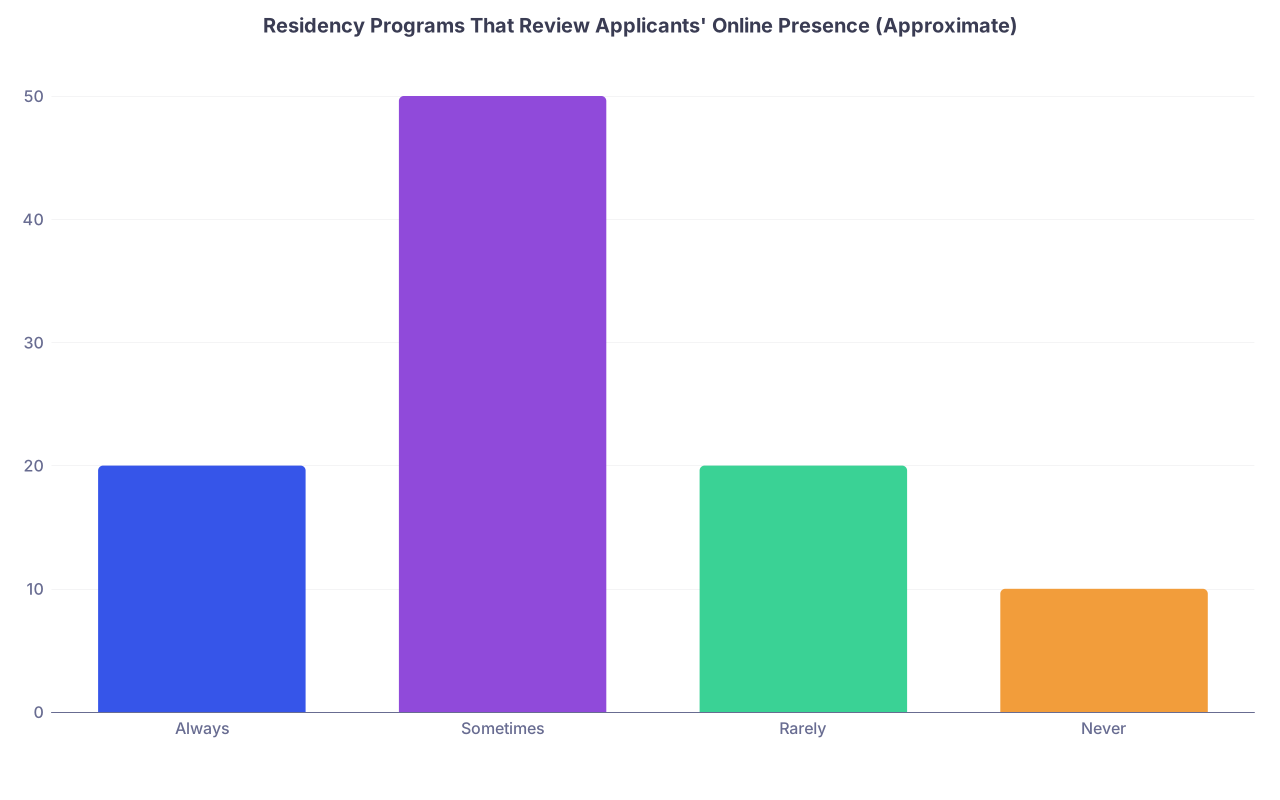
| Category | Value |
|---|---|
| Always | 20 |
| Sometimes | 50 |
| Rarely | 20 |
| Never | 10 |
The comforting myth is this: “Program directors are overwhelmed, they do not have time to stalk me online.”
False. They do not have time to review everyone online. They have plenty of time to review you once:
- You are on the fence.
- You are ranked high and someone wants to double-check “professionalism.”
- A red flag appears in your application and someone is curious.
- A resident recognizes your name from Twitter/Reddit and says, “Wait… is this the same person who posted that thread about hating patients?”
Here is what actually happens:
- A chief resident pulls up an applicant’s Instagram on their phone during rank meeting.
- A program coordinator googles you after receiving a weird email from you.
- A PD sees your name in a Reddit fight screenshot a resident forwards them.
- A faculty member casually checks LinkedIn during lunch before advocating for you.
If you are thinking, “Well, my accounts are private,” good—but do not relax yet. Screenshots from years ago, group chats, tagged photos from friends, residency meme pages, and anonymous accounts are all landmines.
The mistake is assuming obscurity is the same as safety. It is not.
Mistake #1: “It Was Just a Joke” – Dark or Cynical Humor About Patients

This is the quickest way to go from “solid applicant” to “hard no.”
Examples I have personally seen cause problems:
- Instagram Story: A blurry ED hallway with the caption: “If one more drunk comes in I’m leaving them in the waiting room.”
- Twitter/X: “Love when patients google their symptoms and think they know more than me. Enjoy your CHF readmission.”
- Private Facebook post, screenshot by a classmate: “Pediatrics is just tolerating crazy parents long enough to drug their kids.”
Selection committees do not find this edgy or funny. They see:
- Poor judgment with protected spaces (clinical environments).
- Disrespect for patients, families, or vulnerable populations.
- A professionalism time bomb waiting to explode during residency.
Make no mistake: even implied patient information or a de-identified photo in a clinical area can trigger HIPAA/professionalism alarms in people who actually supervise residents.
Avoid this mistake by:
- Banning all clinical photos from your social media. No scrubs selfies in patient areas. No half-covered monitors. No hallway shots.
- Never posting anything that could be interpreted as mocking, belittling, or resenting patients or families. Your “intended tone” does not matter. Their interpretation does.
- Not engaging with or liking disrespectful memes from specialty meme pages using your real name. Yes, people check who liked things.
If your humor depends on punching down at patients, nurses, or colleagues, you are not being edgy. You are broadcasting a professionalism problem.
Mistake #2: “Anonymous” Accounts That Aren’t Actually Anonymous
You are not as anonymous as you think you are.
Things that have outed applicants:
- Reusing the same username across platforms (Twitter, Reddit, Discord).
- Complaining in detail about a rotation, faculty member, or school that is trivially identifiable.
- Posting your Step scores, school region, specialty, and “unique” research topic in the same thread.
- Sharing screenshots between platforms that include your icon or handle.
I have watched a PD say, “Is this the same person who wrote that Reddit post trashing our program?” A resident then pulled up an old thread: detailed rant about “Program X,” specific rotation, specific faculty, timestamp right after that rotation. Applicant’s city and specialty matched. It was not hard to connect.
Result: applicant moved down the rank list “due to concerns about fit and professionalism.” No one said, “Because of Reddit.” They do not have to.
Avoid this mistake by:
- Assuming anything you post in public under a consistent handle is linkable to you.
- Not ranting about specific programs, rotations, or attendings—even on “anon” accounts.
- Not sharing scores + school + region + niche interests in a way that uniquely identifies you.
- Leaving specialty-specific shitposting and venting to truly disposable accounts that do not overlap with your real identity at all (and even then, careful).
If you would be horrified to see a screenshot of the post with your legal name at the top, do not post it.
Mistake #3: Openly Trashing Other Specialties, Programs, or Colleagues

| Step | Description |
|---|---|
| Step 1 | You post negative comment |
| Step 2 | Friend or classmate sees it |
| Step 3 | Shares or screenshots |
| Step 4 | Resident or alum recognizes someone or program |
| Step 5 | Shared in group chat |
| Step 6 | PD or faculty becomes aware |
| Step 7 | Your name flagged in ranking discussion |
This one catches otherwise strong applicants who think they are “just being honest.”
Examples that have caused real damage:
- Twitter thread: “IM is for people who could not cut it into competitive specialties. Enjoy your notes while I’m in the OR.”
- Reddit post: “Heard from students that [Program Name] is malignant trash, would never go there, they’re desperate for applicants.”
- Facebook comment under a news article: “Nurses complain too much, they just do what we tell them.”
Why this gets you dropped:
- Programs need residents who collaborate. Trashing nurses, other specialties, or programs screams “difficult colleague.”
- Residents and faculty from those very specialties and programs sit on committees. They take this personally.
- Medicine is small. The person you casually mocked might be reading your file two months later.
Avoid this mistake by:
- Never publicly labeling a program “malignant,” “toxic,” or “garbage.” Discuss concerns privately with advisors.
- Not posting about how “easy” or “inferior” other specialties are. That “joke” makes you look arrogant and uninformed.
- Staying far away from inter-professional flame wars online—especially involving nurses, NPs/PAs, or other allied health professionals.
You can think whatever you want. But turning those thoughts into searchable text under your name is asking to be filtered out as a risk.
Mistake #4: Political and Controversial Content That Crosses Into Professionalism Red Flags
Let’s be blunt: having political opinions will not sink you. Many faculty are politically engaged. Some are extremely outspoken.
You run into trouble when your content crosses into:
- Hate speech or slurs.
- Mocking vulnerable or marginalized groups.
- Aggressive, threatening language.
- Conspiracy-theory, anti-vax, or anti-science rants.
Real examples that raised alarms:
- Instagram Story with anti-vaccine propaganda posted by a med student, under their real name, then applying to pediatrics.
- Public Facebook posts calling certain ethnic or religious groups “animals” or “invaders.”
- Threads framing mental illness or addiction as “weakness” or “moral failure” in crude, mocking terms.
You are applying for a profession that exists to serve everyone. PDs do not want to explain to their hospital why they matched the person who posted that.
Avoid this mistake by:
- Scrubbing or locking down any old posts containing slurs, demeaning language, or hateful speech—no matter how old.
- Deleting anti-science or anti-vax content if your views have evolved (and being prepared to explain that evolution if ever asked).
- Keeping your political posting focused on policy, not dehumanizing individuals or groups.
You do not need to be politically neutral. But you do need to be professionally safe.
Mistake #5: Alcohol, Drugs, and “Party Persona” Accounts

No, a photo of you with a glass of wine at dinner will not destroy your chances. Residency selection committees are not made of monks.
The problem is pattern and extremes:
- Multiple posts of obvious intoxication, vomiting, blackouts, or being carried.
- Captions bragging about “still drunk on rounds” or “showed up hungover to the ED, LOL.”
- Explicit drug use in photos or videos—weed is legal in some states, but program policies vary and hospitals are conservative.
Stories I have seen:
- Applicant with a public TikTok making jokes about “popping a Xanax before every shift.” Committee questions their reliability and safety.
- Instagram Reel compilation of “craziest blackout nights of MS3.” Faculty asks, “Do we want to be on the hook for this person during 28-hour calls?”
Avoid this mistake by:
- Removing or archiving any content that glamorizes being out of control—especially in proximity to clinical work.
- Deleting posts that depict illegal drugs or misusing prescription meds, even as “jokes.”
- Locking your personal accounts and being selective with followers during application season.
You are applying for a job that requires people to trust you with real lives at 3 a.m. Do not give them reasons to wonder what state you will be in at 3 a.m.
Mistake #6: Publicly Complaining About Your School, Faculty, or Classmates
This one is quieter but deadly.
Residency programs are wary of applicants who:
- Constantly complain about their med school.
- Call deans or faculty “idiots,” “clowns,” or “corrupt.”
- Air internal conflicts or scandals with lots of details.
- Mock classmates by name or easily-identifiable description.
Here is why this scares programs:
- Whatever you are doing to your school today, you might do to them tomorrow.
- It signals poor boundaries and judgment about what belongs online.
- It raises concern about how you will handle conflict, feedback, and disappointment.
Sample progression I have seen:
- Applicant posts a long Twitter thread trashing their school’s administration after a scheduling issue.
- Resident at that school sees it, screenshots it.
- Resident now at another program forwards it to their PD when the applicant’s name appears in the interview list.
- PD quietly flags the applicant as “high risk” and they slip down (or off) the rank list.
Avoid this mistake by:
- Keeping detailed institutional complaints off public channels. Discuss with trusted mentors, not Twitter.
- Never naming individuals (deans, attendings, classmates) in negative posts.
- Recognizing that even if everything you say is true, it can still look like instability and poor judgment.
You may be 100% right about your school’s failures. Residency programs do not want to become the next target.
Mistake #7: Lying Online About Achievements or Identity
Many applicants forget that their online persona and ERAS file can be cross-checked.
Bad scenarios:
- LinkedIn lists a research coordinator role at a hospital you never worked at.
- Twitter bio says “Future neurosurgeon @ [Program Name]” before Match—PD sees it and is not amused.
- Instagram says “MD, PGY-1 Internal Medicine” when you are an MS4 who has not graduated yet.
- Personal website lists publications that do not exist in PubMed or are credited to different names.
Programs see this as dishonesty, not “aspirational branding.”
Avoid this mistake by:
- Ensuring your LinkedIn, website, and other professional profiles match your ERAS content.
- Not prematurely claiming titles (doctor, resident, PGY-1) before they are actually true.
- Removing exaggerated or fabricated roles, responsibilities, or publications.
If your online profile inflates your status, do not be surprised when people question everything you say about yourself.
What Programs Actually Look For Online
| Category | Level of Concern |
|---|---|
| Patient-disrespectful posts | Very High |
| Hate speech / slurs | Very High |
| Substance misuse content | High |
| Program/faculty trashing | High |
| Heavy political extremism | Moderate-High |
| Mild party photos | Low |
You do not need a perfectly sterile internet presence. But you do need to avoid looking like:
- A professionalism risk.
- A future HR nightmare.
- A disruptive or toxic teammate.
Programs are asking one question when they see your accounts:
“If something from this person’s social media ended up on the front page of the local paper with our program name next to it, would I regret matching them?”
If the honest answer is “maybe,” that applicant quietly drops on the list.
A Practical Social Media Audit You Can Do Today
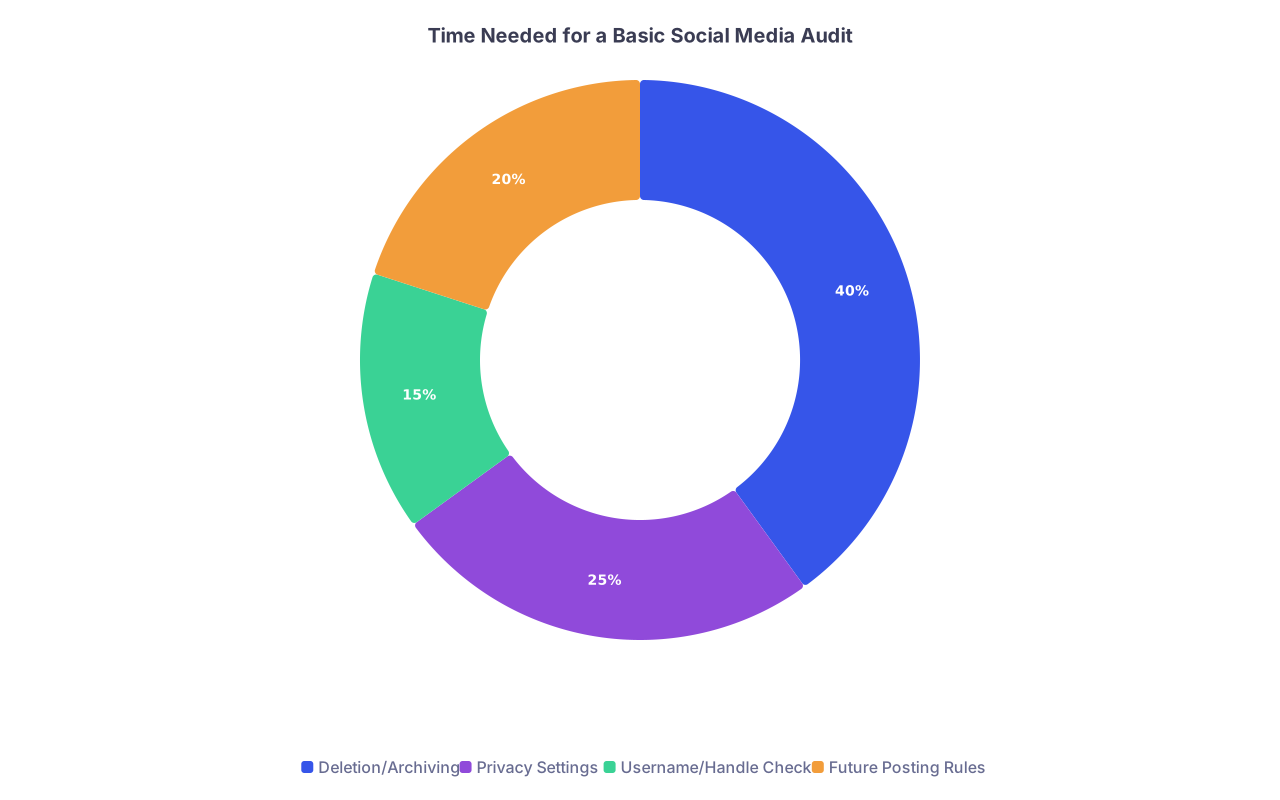
| Category | Value |
|---|---|
| Deletion/Archiving | 40 |
| Privacy Settings | 25 |
| Username/Handle Check | 15 |
| Future Posting Rules | 20 |
Do not guess. Audit yourself systematically.
Google your full name + “MD,” “med student,” school name, and city.
- Open every result on the first 2–3 pages.
- Check images as well.
Review all major platforms:
- Facebook, Instagram, TikTok, Twitter/X, Reddit, LinkedIn, YouTube, Discord handles, old blogs.
- Also any portfolio sites, Medium pages, or school-affiliated profiles.
On each platform, look for posts that could be:
- Disrespectful to patients or colleagues.
- Indicative of substance misuse or out-of-control partying.
- Hate speech, slurs, or demeaning to any group.
- Aggressively trashing schools, programs, or named individuals.
- Revealing confidential or sensitive clinical information.
Decide for each item: Delete, Archive, or Lock Down
- If you hesitate and think, “Maybe this is fine,” that is often your answer: remove or hide it.
- Lock personal accounts and be selective about who can see Stories.
Align your professional profiles
- Make sure LinkedIn, personal website, and any public CVs exactly match ERAS.
- Scrap any “aspirational” titles or exaggerated roles.
Set future posting rules
- No clinical content, period.
- No posting while angry or intoxicated.
- 24-hour rule: if a post could be controversial, save as draft and review next day.

FAQs
1. Do residency programs really reject applicants because of social media?
Yes, they do, but they almost never say so explicitly. Instead you hear vague phrases like “professionalism concerns,” “questions about judgment,” or “possible fit issues.” Social media is rarely the only factor, but it can easily become the deciding tiebreaker between two similar applicants—or the reason someone drops from “rank to match” to “do not rank.”
2. Should I delete all my social media accounts during application season?
You do not need to disappear from the internet. A completely blank online presence can even look odd for someone in their 20s–30s. The smarter move is to:
- Lock personal accounts.
- Clean up anything questionable.
- Maintain a minimal, consistent professional presence (LinkedIn, maybe a simple Twitter with neutral or academic content).
Erasing everything is overkill; erasing the problems is mandatory.
3. What if an old post resurfaces that I already deleted?
If it ever comes up directly—say, someone confronts you in an interview—own it without being defensive. Acknowledge the mistake, state clearly that your views or judgment have evolved, and be specific about what you have learned. “I was wrong, I removed it when I realized how it could be perceived, and it does not reflect how I practice or think now” is far better than denial or minimization. But do not volunteer this if no one asks.
4. Is it safe to follow meme accounts or like edgy content if I do not post it myself?
Less risky than posting, but not zero risk. On some platforms, your likes are public or can be screenshotted. Liking content that mocks patients, spreads hate, or glorifies unprofessional behavior can still paint a picture of your values. During application season, assume that anything associated with your real-name account might be inspected. When in doubt, stop engaging and just observe.
Open your most-used social media account right now, scroll back 2–3 years, and remove the first thing that would make you uncomfortable if it were shown on a big screen at your rank meeting. Then keep going.