
What do you think happens to your “urgent” email to a residency program when the subject line looks like spam and the tone sounds either desperate… or entitled?
Let me be blunt: bad emails get ignored, mocked, or quietly filed under “avoid.” I’ve seen all three.
If you’re in the residency application phase and you’re emailing programs—about interest, interview cancellations, waitlist updates, couples match, whatever—there are two areas where people keep stepping on landmines:
- Subject lines
- Tone
You can have great scores, strong letters, and a solid application, and then lose credibility in a single poorly written message.
Let’s go through the mistakes that actually hurt you—and how to avoid them.
1. Subject Lines That Get You Ignored (or Filtered)
Programs get flooded with emails during ERAS season. Coordinator inboxes are war zones. You cannot afford a sloppy subject line.
Mistake #1: Vague, generic subject lines
Examples I’ve actually seen:
- “Question”
- “Hello”
- “Follow-up”
- “Application”
- “ERAS”
These scream: “You’ll have to open this and dig through text to know what it’s about.” Nobody has time for that.
Better approach: make the subject line do the work.
Use a format that tells them instantly:
- Who you are
- Why you’re writing
- What action (if any) is needed
Examples that work:
- “ERAS Application Update – John Smith (AAMC #12345678)”
- “Interview Cancellation – Jane Lee, IM Applicant 2025”
- “Thank You – 1/12/25 Interview, Internal Medicine Applicant”
- “Couples Match Information – John Smith & Emily Davis”
If you’re asking a specific thing:
- “USMLE Score Update – Request to Add to File (AAMC #12345678)”
- “Second Look Availability – 1/25–2/10, John Smith”
Mistake #2: Clickbait or emotional subject lines
No, you’re not writing a YouTube title.
Subject lines I’ve seen that instantly hurt the sender:
- “PLEASE READ – THIS IS VERY IMPORTANT”
- “Desperate for an interview”
- “My dream program – please consider”
- “Last chance?”
This looks unprofessional and immature. You’re applying to be a physician colleague, not trying to win a pity contest.
Use calm, factual language. If the subject line sounds like a crisis but the content is routine, you immediately lose trust.
Mistake #3: Overly long, messy subject lines
Another way to get ignored is to turn the subject line into a paragraph:
- “Internal Medicine Residency Applicant Hoping to Discuss My Application and Explain Unique Circumstances Regarding Step 2 Score and My Strong Interest in Your Program”
No one’s reading all that in the subject line. It gets cut off on phones and just looks chaotic.
Keep it clear and controlled:
- “Application Question – Step 2 CK Score Timing (AAMC #12345678)”
Short. Focused. Respectful of their time.
Mistake #4: Missing key identifiers
Here’s what program coordinators often say:
“If I have to go hunting for who you are, I’m already annoyed.”
At minimum, your subject line should include:
- Your full name
- Either “Applicant” or “Interviewed Applicant”
- Often your AAMC ID or ERAS ID if it’s about your file
| Type | Bad Example | Better Example |
|---|---|---|
| Vague | Question | Application Question – John Smith (AAMC #12345678) |
| Emotional | PLEASE READ, VERY IMPORTANT!!! | Interview Inquiry – Jane Doe, FM Applicant |
| Messy | URGENT NEED TO EXPLAIN MY STEP SCORE SITUATION | Step Score Update – Request to Add to File |
| Missing ID | ERAS Question | ERAS Question – John Smith (AAMC #12345678) |
If your email relates to an interview date, include it:
- “Interview Schedule Question – 1/15/25 Date, John Smith”
Make it effortless for them to know who you are and what the email is about before they even open it.
2. Tone That Makes You Sound Desperate, Demanding, or Detached
Content matters, yes. But tone kills more emails than grammar ever will.
You’re walking a narrow line:
- Confident, but not arrogant
- Interested, but not needy
- Professional, but still human
People mess this up constantly.
Mistake #5: Writing like you’re texting a friend
I see this more every year.
Do not send this:
Hi!
Just wanted to check in and see if there’s any update on my application. Super excited about the program!!
Thanks so much :)
You are applying for a professional job, not confirming brunch.
- “Hi!” with no name
- “Just wanted to check in” (filler phrase)
- “Super excited!!” (overly informal)
- Smileys/emojis
Better version:
Dear Dr. Smith and Residency Selection Committee,
I hope you are well. I’m writing to express my continued strong interest in [Program Name]. I remain very enthusiastic about the opportunity to train at your program and would be grateful to be considered for an interview if additional invitations are extended.
Sincerely,
John Smith
AAMC #12345678
Still human. Still warm. But professional.
Mistake #6: Over-apologizing or sounding pathetic
This one’s brutal but honest: programs do not want residents who sound like they’re crumbling under mild stress.
Things that sound weak and hurt you:
- “I know I’m not as competitive as other applicants, but…”
- “I’m begging you to consider me…”
- “I understand if I don’t deserve an interview, but I thought I’d try…”
- “I know my application is terrible, but…”
You think you’re being humble. You’re actually telling them not to bother.
If you have a weakness to explain, do it cleanly and briefly. Example:
I recognize that my Step 1 score is below your program’s typical range. Since that time, I have demonstrated significant improvement, reflected in my Step 2 CK score of 252 and strong clinical evaluations during my third-year clerkships.
Own it. Don’t grovel.
Mistake #7: Entitled or demanding language
The other extreme is just as bad.
Examples that raise red flags:
- “Given my Step 2 score and research background, I believe I deserve an interview at your program.”
- “I expect a response regarding my application status.”
- “I am ranking your program highly and would appreciate a reciprocal response.”
- “I have multiple interview offers and need to know if you intend to interview me so I can plan.”
You are not negotiating a contract. You’re applying for a job in a field where teamwork and humility matter.
Rewrite that last one as:
I understand how busy this season is for your team. I’m currently in the process of finalizing travel plans, and if my application is still under consideration, I would be grateful for any update on my status when convenient.
Same request. Completely different tone.
3. Over-Emailing, Bad Timing, and Annoying Follow-Ups
You can have a perfect subject line and tone and still hurt yourself by sheer volume or timing.
Mistake #8: Treating programs like customer service
Coordinators are not your personal status portal.
Don’t send:
- “Just checking in on my application status.”
- “Any update?”
- “Still waiting to hear if I got an interview.”
If the website, FAQ, or ERAS communication says “we do not respond to status inquiries,” they mean it.
You only email when:
- You have new, relevant information (new score, publication, visa status, couples match info)
- You’re expressing genuine, specific interest (especially after an interview)
- You need to confirm or change logistics (interview date, travel issue)
- You’re dealing with a clear error (wrong track, missing document, mis-typed email)
Not just because you’re anxious.
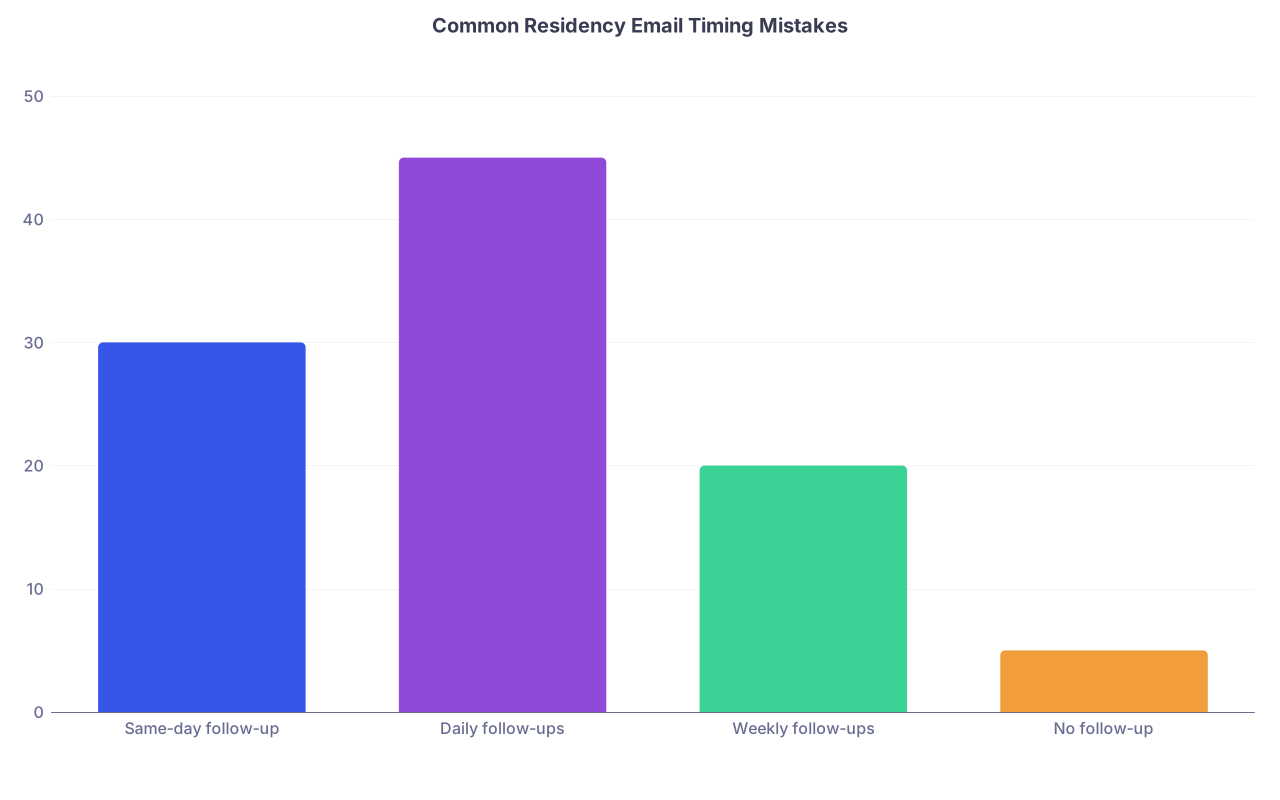
Mistake #9: Rapid-fire follow-ups
Here’s the ugly truth: many program emails don’t get a reply. At all. Especially cold “I’m interested” emails from non-interviewed applicants.
The mistake is thinking silence means “try again tomorrow.”
Bad pattern:
- Day 1: “I’m very interested in your program…”
- Day 3: “Just following up on my previous email below…”
- Day 7: “I’m not sure if you received my prior emails…”
- Day 10: “I’ll assume you’re not interested if I don’t hear back.”
You just moved from “unknown” to “do not want to deal with this person.”
Reasonable follow-up rule:
- For an urgent logistic issue (interview link, schedule problem): follow up after 24–48 hours
- For a routine email (interest, update): no follow-up needed unless they explicitly asked you to send something and it affects scheduling or ranking
If you must follow up once (e.g., critical step score update), wait at least 7–10 days and be understated:
I’m following up briefly on my email from January 3rd regarding my Step 2 CK score update. I recognize this is a very busy time and fully understand if you’re unable to respond; I simply wanted to ensure my prior message reached you.
One follow-up. Not a campaign.
| Category | Value |
|---|---|
| Same-day follow-up | 30 |
| Daily follow-ups | 45 |
| Weekly follow-ups | 20 |
| No follow-up | 5 |
(Those percentages aren’t official data—but that’s about how often I see each behavior. And only the last one is consistently safe.)
Mistake #10: Weekend and late-night drama emails
You’re stressed. It’s 1:37 a.m. You write a long, emotional email about how much this program means to you and how your whole life depends on it.
Then you hit send.
Programs will see:
- Time stamp: 1:37 a.m.
- Tone: anxious, rambling
- Impression: not stable under stress
Even if your content is good, the time and vibe matter.
Safer pattern:
- Write the draft whenever you need
- Sleep on it
- Edit in the morning when you’re calm
- Send during normal business hours (roughly 8 a.m.–5 p.m. local program time, weekdays)
You’re applying for a job with overnight calls and high stakes. Showing impulse control actually matters.
4. Content Red Flags: What You Put Inside the Email
Tone and subject lines set the stage. Content finishes the job—good or bad.
Mistake #11: Sending long, unfocused essays
Programs don’t want your autobiography in email form. They have your personal statement already.
Common offenders:
- Multi-paragraph explanations of life story
- Detailed justifications of every low grade or gap
- Emotional narratives trying to “win them over”
Your email should:
- Have one main purpose
- Be short enough to fit on one phone screen or close
- Be scannable—short paragraphs, clear request
Bad example:
I just wanted to explain more about why my application might not fully reflect who I am. Growing up, I faced numerous challenges including financial hardship…
Stop. That’s personal statement territory.
Better:
I’m aware that my second-year transcript includes a leave of absence. This was due to a temporary family health situation that has since fully resolved. I returned to school without further interruptions and have been performing well clinically.
One sentence of context. Done.
Mistake #12: Generic copy-paste “interest” emails
Programs can smell copy-paste from a mile away.
This is useless:
Your program is my top choice because of your strong clinical training and dedication to patient care, research, and community service.
That could describe 90% of IM programs.
If you’re going to email to express interest, it must be specific and believable:
- Name a specific feature: unique track, rotation, curriculum structure
- Mention a person you actually met or faculty with relevant work
- Tie it to your career goals
Example:
I was particularly impressed by your program’s global health track and the opportunity for a longitudinal continuity clinic in a refugee population. My prior work with refugee communities in [city] and my goal of pursuing a career in global health make this a unique fit for me.
If you can’t write something specific, don’t send the email.
Mistake #13: Being too casual about cancellations and changes
Programs take interview scheduling seriously. You should too.
Bad cancellation email:
Hi,
Something came up so I need to cancel my interview this Friday.
Thanks.
That’s how you close doors. Not just at that program—word spreads.
Better:
Dear [Coordinator Name],
Thank you again for the opportunity to interview with [Program Name] on January 10th. Due to a scheduling conflict that I unfortunately can’t resolve, I need to respectfully withdraw from this interview.
I’m very grateful for your consideration and apologize for any inconvenience caused.
Sincerely,
John Smith
Short, respectful, no unnecessary details.
5. Formatting, Signatures, and Small Stuff That Signals “Not Ready”
Last set of mistakes: the little things that quietly tell programs you’re not professional yet.
Mistake #14: Sloppy formatting and no structure
Long walls of text are a guaranteed way to exhaust the reader.
Don’t:
- Write one giant 15-line paragraph
- Mix fonts, colors, or sizes
- Use casual fonts like Comic Sans or script
- Send from an email that looks like: [email protected]
Clean structure:
- Greeting line
- 2–4 short paragraphs
- Clear closing line
- Professional signature
Mistake #15: No signature or missing identifiers
Your signature should always include:
- Full name
- Medical school and class year
- AAMC/ERAS ID
- Contact info (email, phone)
Example:
John Smith, MS4
University of X School of Medicine, Class of 2025
AAMC ID: 12345678
[email protected] | (555) 123-4567
Do not make them dig for who you are.
Mistake #16: Weird or unprofessional email address
Yes, this still happens:
- partyguy89@
- ballerMD@
- soccerqueen22@
Make a normal one for applications:
- firstname.lastname@
- firstinitial.lastname@
And stick to that.
6. Putting It All Together: A Safe Template Structure
I’m not giving you a one-size-fits-all template. That’s how we get copy-paste disasters. But here’s a skeleton that doesn’t get people into trouble.
Subject line:
- “Post-Interview Thank You – 1/12/25, John Smith”
- “Application Update – New Publication, Jane Lee (AAMC #12345678)”
Body:
Address
“Dear Dr. [PD Last Name] and Residency Selection Committee,”
or
“Dear [Coordinator First Name] [Last Name],”Opening line – One sentence:
- “Thank you again for the opportunity to interview at your program on January 10th.”
- “I’m writing to provide a brief update on my application.”
- “I’m reaching out to express my continued strong interest in your program.”
Main point – 2–4 sentences, max:
- Interest, update, clarification, or specific question
- No life story, no flattery marathon
Closing sentence:
- “Thank you for your time and consideration.”
- “Thank you for all the work your team does during this busy season.”
Signature (as above)
If you stay inside those rails, you avoid 90% of the disasters I see.

| Step | Description |
|---|---|
| Step 1 | Need to email program? |
| Step 2 | Do NOT email |
| Step 3 | Draft concise message |
| Step 4 | Check subject line: clear & professional? |
| Step 5 | Check tone: respectful, not desperate or entitled |
| Step 6 | Include identifiers & signature |
| Step 7 | Send during business hours |
| Step 8 | Is there a clear purpose? |

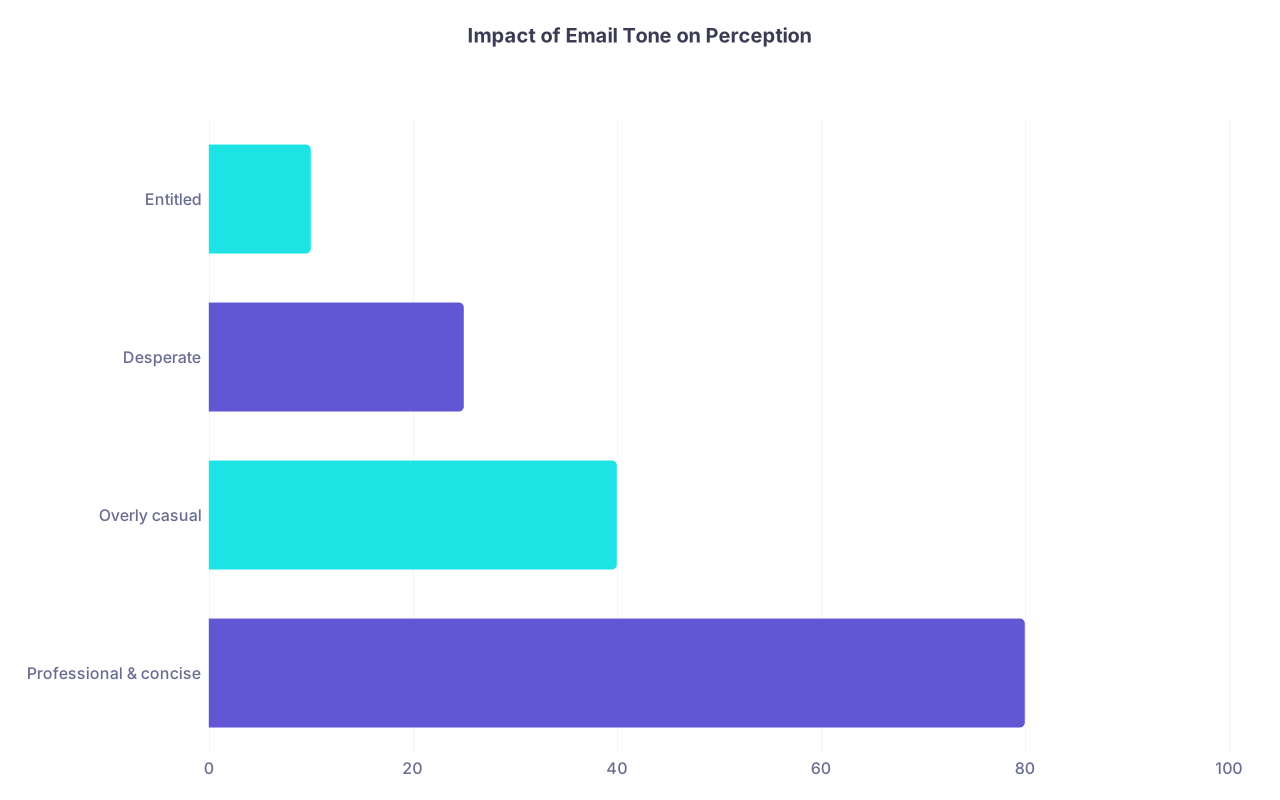
| Category | Value |
|---|---|
| Professional & concise | 80 |
| Overly casual | 40 |
| Desperate | 25 |
| Entitled | 10 |
Here’s your next step, and do it now:
Open one email you’ve already sent or drafted to a residency program. Look only at the subject line and the first two sentences. Ask yourself:
- Would a busy coordinator know exactly who I am and why I’m writing—before opening it?
- Do I sound calm, professional, and specific—or anxious, vague, or over-eager?
If the answer’s anything but “yes, this is solid,” fix that email style before you send another word this season.