
The biggest damage to your residency application often happens after your interview day.
Residency open houses and second looks are where otherwise strong candidates quietly sink themselves. Not because of grades, not because of board scores. Because of behavior. Off-the-record impressions. The stuff no one formally teaches you.
You are told, “Come be yourself, it’s informal, it won’t affect your ranking.” Do not believe that literally. Programs say that to keep things collegial and reduce pressure. But faculty and residents are still watching. They still talk. And yes, their impressions show up in rank meetings.
Let me walk you through the mistakes I have seen torpedo applicants at open houses and second looks—and how to avoid becoming the cautionary story retold every application season.
1. Misunderstanding What Open Houses and Second Looks Actually Are
The first mistake is conceptual: treating these events like social extras instead of extended interviews.
Open houses and second looks are not:
- Casual meet-and-greets where nothing counts.
- Free chances to “hang out with residents” off the record.
- Opportunities to “fix” a bad interview or “beg” your way onto a rank list.
They are:
- Additional data points on your professionalism, judgment, and fit.
- A live stress test of how you behave when things feel informal.
- A chance for programs to confirm positive impressions—or find red flags.
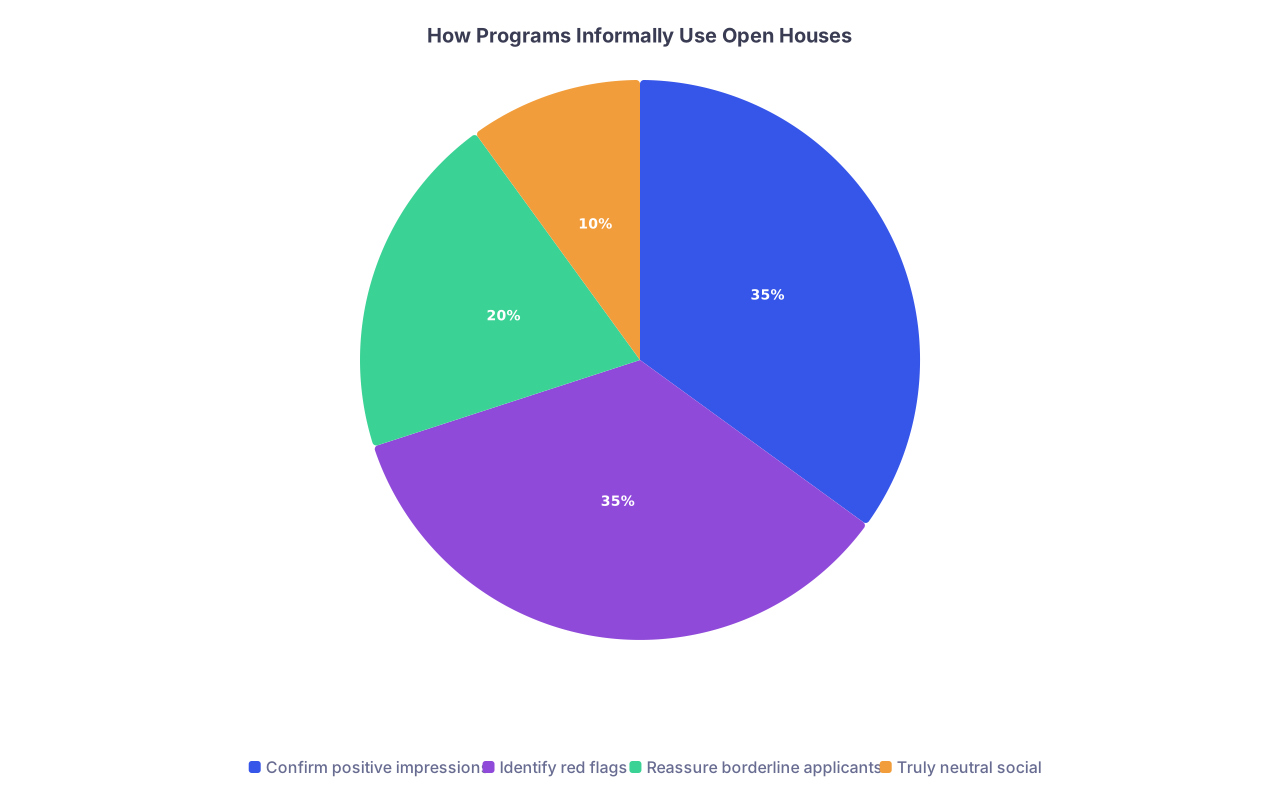
| Category | Value |
|---|---|
| Confirm positive impressions | 35 |
| Identify red flags | 35 |
| Reassure borderline applicants | 20 |
| Truly neutral social | 10 |
When you walk into an open house or second look, assume:
- Every interaction can reach the program director.
- Residents’ comments carry more weight than you think.
- “We don’t use this for ranking” means “We will absolutely talk about anyone who stands out—positively or negatively.”
Do not make the mistake of relaxing into “this doesn’t count” mode. It absolutely counts when you screw up.
2. Over-Attention: Coming Off as Desperate, Clingy, or Performative
Here is one of the most common ways applicants backfire: trying too hard to show interest.
You want to signal that you are excited about the program. Good. But there is a line. Cross it, and you slide from “interested” into “clingy,” “awkward,” or “emotional risk.”
Red flag behaviors:
Attending every single optional event for one program
If you show up to every open house, every zoom social, the second look, and send multiple “update” emails, you can unintentionally signal:- You are obsessed with only this place.
- You may not have other interviews.
- You may struggle with boundaries.
Hovering around the program director or chair
Shadowing leadership like a lost puppy—waiting to jump into every conversation, interrupting others to insert your question, or repeatedly circling back—is noticed. And remembered. Faculty do not need constant reminders that you are “very interested.” Once is enough.Performing your enthusiasm instead of being normal
Overly rehearsed comments, exaggerated praise (“This is literally my dream program since first year”), constantly name-dropping faculty or fellowships you “researched in depth”—when it feels theatrical, people recoil.
Better approach:
- Show up to a normal number of events (1–2 is plenty for most programs).
- Have one or two genuine, specific things you like about the program ready to mention if asked.
- Ask questions, then let conversations breathe.
- Say “I’m definitely very interested in this program” once, sincerely. Stop there.
If you feel yourself trying to “convince” them that you love them, you are already overdoing it.
3. Under-Attention: Looking Disengaged, Distracted, or Too Cool
The opposite problem also hurts you: acting like the open house is beneath you.
I have watched applicants:
- Spend half the session on their phone.
- Sit at the back, arms crossed, not engaging.
- Offer one-word answers when residents try to chat.
- Skip all optional events at their true top choice program because “it doesn’t affect ranking.”
Here is the ugly reality: programs may say “attendance is optional,” but they notice absences, especially for highly competitive specialties and small programs.
The mistake is not missing a zoom social because you were on call. The mistake is the pattern:
- No open house.
- No second look.
- Minimally responsive to emails.
- No thank-you notes.
- Then a long love-letter “you’re my number one” after rank lists are due.
You do not need to attend everything, but you must avoid looking indifferent.
Basic rules to avoid the under-attention problem:
- If this is a top program, attend at least one event (virtual or in-person) beyond the interview, if offered.
- On site, put the phone away. Complete pocket exile.
- Make eye contact, ask at least a couple of questions, and join conversations without being forced.
If you act like you would rather be anywhere else, they will help you achieve that.
4. The Social Behavior Traps: Alcohol, Oversharing, and Friend-Mode
Where most applicants self-sabotage is not in conference rooms. It is in bars, restaurants, and “casual social” settings.
Do not let the word “social” fool you. Residents are still evaluating you—even if they say they are not.
Alcohol: The Fastest Way to Get Quietly Blacklisted
Every year, someone:
- Has “just one more” at the resident dinner.
- Gets loud, interrupts, or dominates conversation.
- Starts oversharing about bad grades, professionalism issues, or talking trash about other programs.
- Looks unstable or impulsive.
And then wonders why their “amazing” interview did not translate into a strong rank position.
Hard rule:
- If alcohol is involved, one drink maximum, and zero is even safer. You are not there to relax; you are there to be observed.
Oversharing and Inappropriate Honesty
You are not among friends. Not yet. Over-sharing personal issues or trauma, unloading about your toxic med school, or telling residents which other programs you hated makes people uncomfortable and nervous.
Watch for these mistakes:
- Talking about mental health in detail in a casual group setting.
- Complaining about past attendings, med school administration, or other programs.
- Offering negative opinions about specific hospitals, cities, or patient populations.
If a resident asks, “So how has med school been?” they are not inviting a 10-minute breakdown of your worst rotations. Keep it balanced. You can be honest without being heavy or chaotic.
Slipping Into Friend-Mode
Residents may be close in age. They may be casual, swear, joke about night float, tell you “nothing is off limits.” That does not mean you are peers.
Major missteps I have seen:
- Matching their most unfiltered language.
- Telling edgy jokes, dark humor that crosses the line, or anything remotely prejudiced or punch-down.
- Teasing or mocking residents, staff, city, or patient population, even “playfully.”
Use this mental rule: behave like the most professional version of yourself you would show on a clinical team with an attending present. Because what you say at dinner will often be repeated to an attending later.
5. Asking the Wrong Questions (and Asking Them the Wrong Way)
You can absolutely hurt yourself by asking poorly chosen or poorly timed questions at open houses and second looks.
Questions That Sound Entitled or Clueless
Examples that land badly:
- “How many days can I take off for interviews in fellowship?”
- “What is the absolute minimum number of calls we take?”
- “How protected is my time off? Can I say no if I feel burned out?”
- “How easy is it to moonlight and make extra money as a PGY-2?”
Do programs care about wellness? Yes. But if your first or main questions all focus on how little work you can do, you signal that your priorities may not align with theirs.
Questions That Put Residents in an Awkward Spot
Another mistake: forcing residents to trash their own program or leadership-in-front-of-you.
Things like:
- “What do you not like about the PD?”
- “Is the program actually malignant?”
- “Would you come here again if you could redo the match?”
They may be thinking all sorts of things internally. But if you ask in a group setting, they must pretend it is all perfect—or risk professional consequences. You look tone-deaf if you push them there.
Better strategy:
- Ask open, neutral questions: “How responsive is leadership to feedback?”
- “Can you give an example of something that changed based on resident input?”
- “What kind of resident tends to thrive here?”
Watch their answers and non-verbal reactions. You will learn plenty without forcing them into a corner.
Questions That Are Obviously Answered in Public Materials
Another subtle way to hurt yourself: asking questions that reveal you did not read anything.
If the website clearly lists:
- Number of residents per year
- Rotation schedule
- Call structure
- Research opportunities
and you ask basic questions about those, you look lazy. Ask questions that build on what you already read:
Instead of: “Do you have a night float?”
Try: “I saw you use a night float system—how does that affect continuity with your patients on the wards?”
That difference matters.
6. Second Look: Overplaying Your Hand or Violating the Rules
Second looks are more dangerous than people realize.
Some programs discourage or explicitly prohibit them. Others allow them but claim they are “purely informational.” Either way, you can hurt yourself by mishandling this.
Going to a Second Look Where It Is Discouraged
If the program explicitly says “we do not offer or encourage second looks,” and you:
- Email repeatedly asking,
- Try to arrange “unofficial” visits via residents, or
- Show up under some flimsy pretext,
you have just flagged yourself as someone who does not respect boundaries or instructions. That is exactly the opposite of what a PD wants in an intern.
Treating Second Look as a Chance to Lobby
The fatal error: using your second look as a campaign stop.
Examples I have seen:
- Applicants cornering the PD to say, “You’re my number one, can you tell me where I’ll be on your list?”
- People trying to “negotiate” ranking by asking how high they are or hinting they will rank the program highly if given some assurance.
- Hand-delivering long letters of intent, portfolios, or extra materials.
Programs are bound by NRMP rules. PDs are trained to freeze when they sense someone trying to manipulate the rank conversation. At best, it is awkward. At worst, it makes them nervous about having you as a resident.
Use second looks for what they are actually good for:
- Getting a realistic feel for workflow, commute, and culture.
- Clarifying questions you truly cannot answer online.
- Meeting potential mentors or seeing subspecialty clinics you care about.
Do not treat it as an audition to impress them again. If you are there, you already interviewed. You are not going to rescue a disastrous interview day with an “amazing” second look performance. But you can wreck a good impression with a pushy, boundary-violating visit.
7. Digital Behavior Around Open Houses and Second Looks
Another trap: what you post and message around these events.
Common missteps:
- Live-posting from events with photos of residents or faculty without permission.
- Complaining in group chats or social media about the program, city, or people you met—screenshots travel.
- Sending multiple DMs to current residents on Instagram/Twitter/LinkedIn pushing for inside information, rank advice, or “honest” evaluations.
Assume anything negative you say about a program, its residents, or its city can and will make its way back. Residency worlds are small. People talk across institutions, and residents forward things.
Quick digital rules:
- Do not post photos from events that clearly identify other people unless you are sure it is welcome and anonymized.
- Never complain or mock programs in writing, even in “private” group chats.
- If you message residents, keep it brief, respectful, and non-invasive—and drop it if they do not respond.
8. Red-Flag Behaviors Residents Report Behind Closed Doors
Here is the part applicants never get to hear directly. After open houses and second looks, residents will huddle and talk. Then they send impressions to leadership, formally or informally.
The comments that kill you sound like:
- “Seemed arrogant / dismissive.”
- “Talked over people; did not listen.”
- “Something felt off—very intense / desperate.”
- “Made a weird comment about patients / other programs.”
- “Seemed uninterested in anything except fellowship outcomes.”
Notice these are not about your CV. They are about your vibe.
Here are specific behaviors that often feed into those comments:

- Dominating every Q&A with multiple follow-up questions.
- Interrupting other applicants or residents when they speak.
- Being weirdly competitive with other applicants instead of collaborative.
- Making strange or tone-deaf jokes.
- Bragging about scores, research, or prestigious mentors.
- Talking about “escaping” certain patient populations or cities.
You do not need to be the funniest, smartest, or most charismatic person in the room. You just need to avoid being the one they remember for the wrong reason.
9. A Simple Framework to Stay Out of Trouble
You do not need a complex strategy. You need a few guardrails.
Think through this simple lens:
Professional floor
Always act like you are on a clinical team with attendings present—even at dinner, even on zoom after hours, even at the bar. No behavior below that floor.Moderation in engagement
Not the loudest, not the quietest. Ask some questions, answer some questions, then let others speak. If you are dominating, dial back. If you are invisible, step up slightly.Boundaries with emotion and disclosure
Be genuine, but do not spill your entire psychological history or trash prior institutions. Keep it stable, balanced, and forward-looking.Respect for stated policies
If they discourage second looks, accept it. If they say no photos, listen. If they do not answer rank questions, stop pushing.
If you follow those four, you avoid 90 percent of the disasters I have seen.

| Step | Description |
|---|---|
| Step 1 | At open house/second look |
| Step 2 | Do NOT do it |
| Step 3 | Dial back, listen more |
| Step 4 | Ask a question, join conversation |
| Step 5 | Maintain |
| Step 6 | Safe to proceed |
| Step 7 | Is this behavior professional on a team? |
| Step 8 | Am I dominating or invisible? |
| Step 9 | Am I pushing boundaries or rules? |
FAQs
1. Do I hurt my chances if I skip an open house or second look?
Skipping a single event almost never kills you, especially if travel, schedule, or cost are issues. The problem is the pattern. If this is a top program and you: skip everything, barely engage on interview day, and do not send any follow-up, you look less interested compared to applicants who clearly showed up. Attend what you reasonably can, but do not wreck your life or finances chasing every optional event.
2. Can a great open house or second look save me if my interview was weak?
Unlikely. Programs still anchor heavily on the formal interview day. Open houses and second looks are more about confirming fit or surfacing red flags, not rewriting your entire file. You should approach them as “do no harm” opportunities with a modest upside, not as a Hail Mary.
3. Should I tell a program during a second look or open house that they are my first choice?
If you choose to communicate that, do it once, in a brief, professional email, not in person in a way that pressures them about ranking. During events, it is enough to say you are “very interested” and that the program is high on your list. Keep anything more specific for a single clear, non-desperate written communication.
4. How much should I drink at resident dinners or social events?
Zero to one drink. That is it. You are not there to relax; you are there being evaluated in a looser environment. One drink, slowly, with food is the absolute cap. If you feel even slightly buzzed, you have already gone too far. Many of the worst applicant stories I have heard started with “They just had a couple of drinks…”
Key points, so you do not miss them:
- Open houses and second looks are extended interviews, not social freebies.
- You can damage a strong application much faster than you can rescue a weak one at these events.
- Aim for professional, moderate, and boundary-respecting behavior every single time.