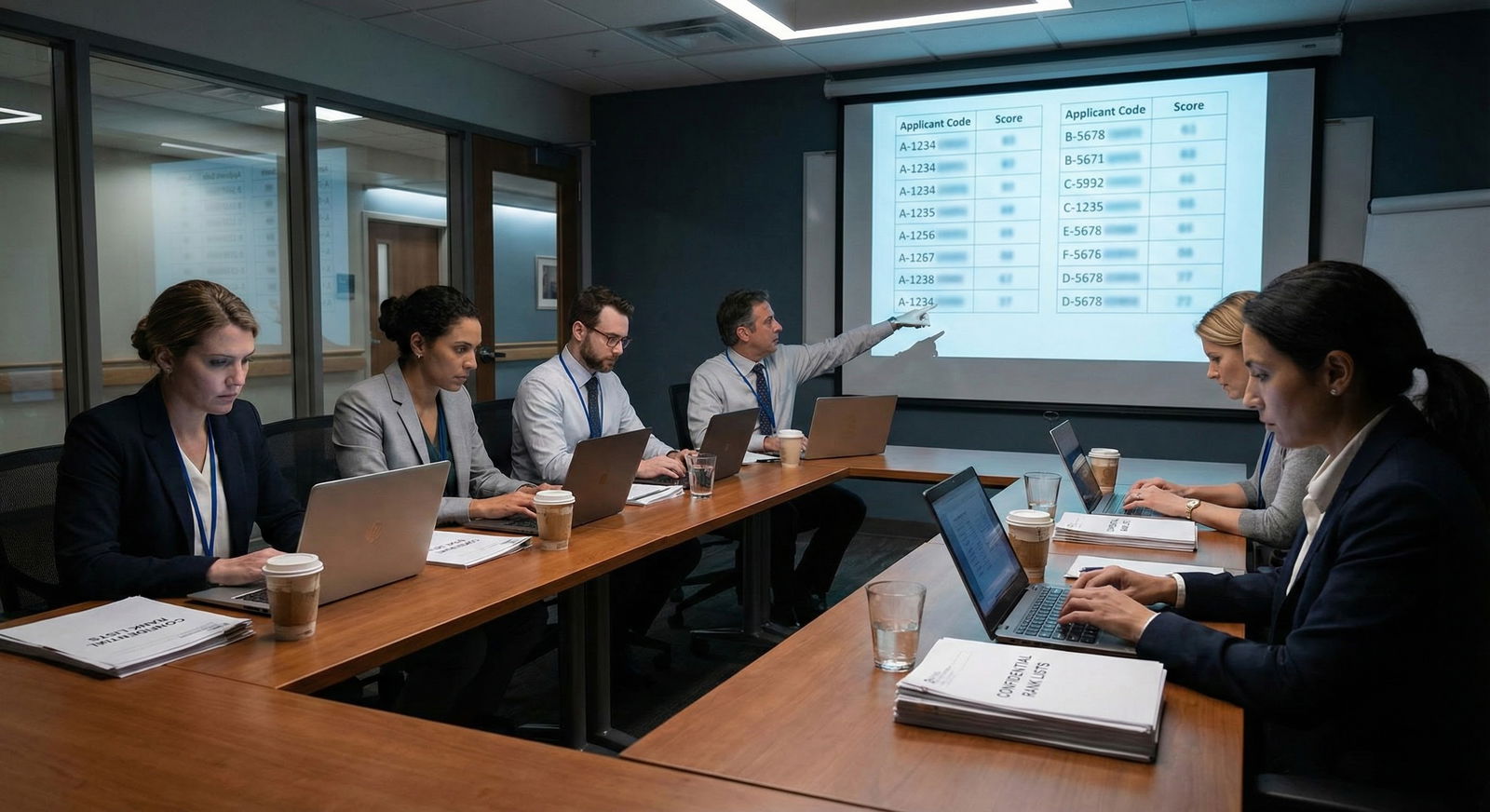
The rank meeting is not fair, not purely objective, and yes—one offhand comment can absolutely move you up or down ten spots. I’ve watched it happen more times than anyone will admit on the record.
You’ve been told, “Just be yourself. If they like you, they’ll rank you highly.” That’s cute. The truth is uglier and more human: people are tired, biased, rushed, and trying to remember who you are while flipping through a stack of 70 applicants they met 6 weeks ago. In that environment, a single confident voice saying, “I would trust this person with my sickest patient” carries more weight than your Step score or your glowing MSPE.
Let me walk you inside that room, because once you understand how the rank meeting really works, you’ll understand how to interview, how to follow up, and how to protect yourself from getting torpedoed by one careless comment.
What Actually Happens in a Rank Meeting
First, strip away the fantasy. There isn’t some perfectly calibrated algorithm where faculty enter data and the machine spits out a rank list from heaven. There is usually a “preliminary list” based on some scoring system. Then there’s the real process: humans fighting about you.
At a mid-sized categorical IM program—say 12–18 spots—here’s the pattern I’ve seen every single year:
- The coordinator projects a spreadsheet of applicants on a screen: name, med school, board scores, interview “score,” maybe a “global impression” column.
- Program director sits at the head. Associate PDs, core faculty, maybe chief residents, sometimes a psychologist or GME rep fill the room. Everyone has coffee; half have no idea who 60% of the names are.
- The PD says some version of: “Okay, let’s start from the top and see if there are any strong objections or moves.”
That’s where you live or die.
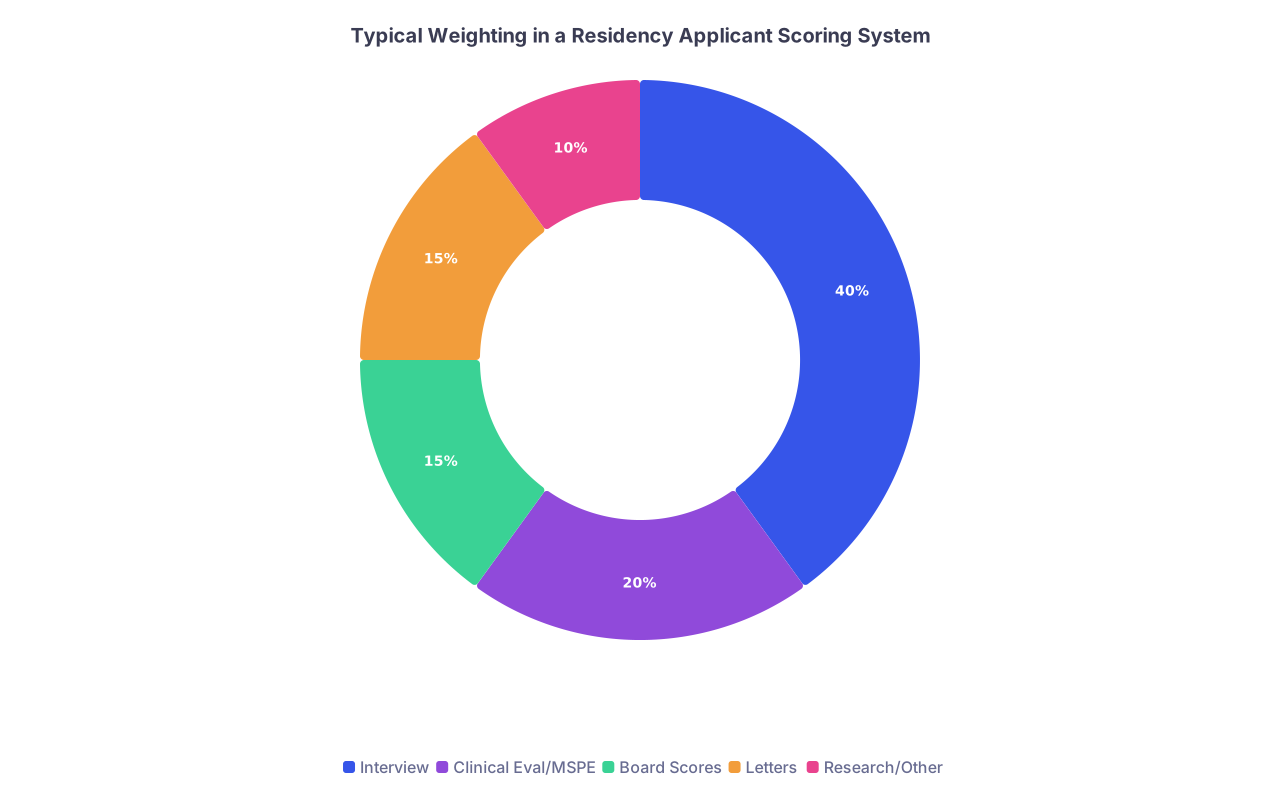
| Category | Value |
|---|---|
| Interview | 40 |
| Clinical Eval/MSPE | 20 |
| Board Scores | 15 |
| Letters | 15 |
| Research/Other | 10 |
The pre-meeting composite score might look “objective,” but here’s the secret: nobody really believes in it. It’s a convenience tool. A starting point. The PD will override it the second a trusted faculty member says, “No way, this person is much better than their score suggests.”
Or worse: “I did not get a good vibe. I wouldn’t put them in my top 30.”
That is how a single comment changes your spot.
The Power Dynamics You Don’t See
The biggest mistake applicants make is thinking every interviewer’s opinion is equal. That’s fantasy. There’s a hierarchy in those rooms just like there’s a hierarchy on rounds.
At a typical program, influence in the rank meeting looks something like this:
| Role | Influence Level |
|---|---|
| Program Director | Very High |
| Associate PDs/Core Faculty | High |
| Longstanding Key Faculty | Moderate-High |
| New Faculty/Community Preceptors | Low-Medium |
| Chief Residents | Variable |
The PD has veto power. They may use it rarely, but everyone knows they have it. If the PD loves you, it takes a lot to push you down. If the PD is neutral, one sharp negative comment from a trusted associate PD can sink you.
I’ve sat in meetings where:
- A well-liked core faculty said, “This is my top candidate this year,” and that applicant jumped 10 spots instantly.
- A chief resident said, “They were fine but seemed a bit fragile. I’m worried about resilience,” and the room cooled on the candidate in 15 seconds.
- A PD said, “We’re not taking anyone else from that school this year,” and the room stopped arguing—those candidates were quietly nudged down.
Let me translate that: your fate is attached not just to how you did, but to how powerful your interviewers are in that room and how clearly they remember you.
So when students ask me, “Does it matter who interviews me?” I tell them flat out: yes. It matters a lot. Not because of the title next to the name on your schedule, but because of how loudly that person’s voice carries on rank day.
How “One Comment” Actually Moves You: Real Scenarios
Let’s pull the curtain back and walk through how a single statement shifts an applicant’s rank.
Scenario 1: The Quiet Negative that Sinks You
You’re sitting around #18 on a program’s preliminary list for 12 spots. On paper: strong Step 2, mid-tier US MD, solid letters. Interviewed with a core faculty, a hospitalist, and a chief.
During the meeting, when your name pops up, the PD glances at the sheet: “Anyone want to move them up? Down?”
Silence for three seconds. This matters. Silence is death.
Finally the chief says, “They were okay. Seemed a bit rehearsed. I didn’t get a great sense of who they are. I’d be fine with them, but not super excited.”
The PD will hear: no one is going to fight for this person. They don’t get moved up. And here’s the ugly part—they might get pushed down just because someone else is more memorable. You slowly slide from #18 to #25 as others get bumped up.
That one tepid comment from a single chief resident didn’t “trash” you. It just failed to create urgency to keep you high. And in that room, no urgency = drift downward.
Scenario 2: The Strong Advocate That Saves You
Flip it.
You had a borderline Step 1, good Step 2, small DO school, but you rotated there as a visiting student and killed it. One core faculty absolutely loved you.
In the meeting, you start at #24 for 12 spots. The list is crowded with big-name med schools, 250+ scores.
Your faculty advocate cuts in: “I’m going to fight for this one. This was the best rotator I’ve had in years. They stayed late, asked great questions, handled feedback. I would be happy to have them as my intern.”
The PD: “Okay, where do you think they belong?”
“Top 15 minimum. Closer to 10.”
That’s it. You just jumped a dozen people who had better scores than you.
I’ve watched this exact line—“I would be happy to have them as my intern”—almost always trigger an upward move. Because that’s what the PD is solving for: “Will my faculty be happy working with this person at 2 am?”
Scenario 3: The Subtle Red Flag That Torpedoes You
You interviewed great with faculty. But on the social dinner, you were looser. You made one off-color joke, or visibly checked out early, or said “honestly this city is kind of boring” to the wrong resident.
Rank meeting, your name appears around #10.
PD: “Any concerns on this one?”
Core faculty: “Interview was excellent. Good insight.”
Resident rep: “Interview day was fine… but at the social, they came off as a little arrogant. Talked a lot about using residency to ‘build their brand.’ Some of us were turned off.”
Room mood shifts. I’ve seen PDs literally lean back and say, “Hmm. That’s not the culture we want.”
You might survive that hit. But you won’t move up. And if there are several candidates in that #8–15 range, guess who slips quietly to #18.
That one comment about “arrogant” or “poor fit” lodges in people’s heads. They won’t trust you as much without even realizing it.
The Mechanics: How Much Movement Really Happens?
You’re probably wondering: is this just a few spots or are we talking major reshuffling?
It varies by program, but at many mid-sized programs, the “preliminary list” is only loosely related to the final list outside the top 5–7 and the bottom trash tier.
Here’s a rough pattern I’ve seen firsthand:
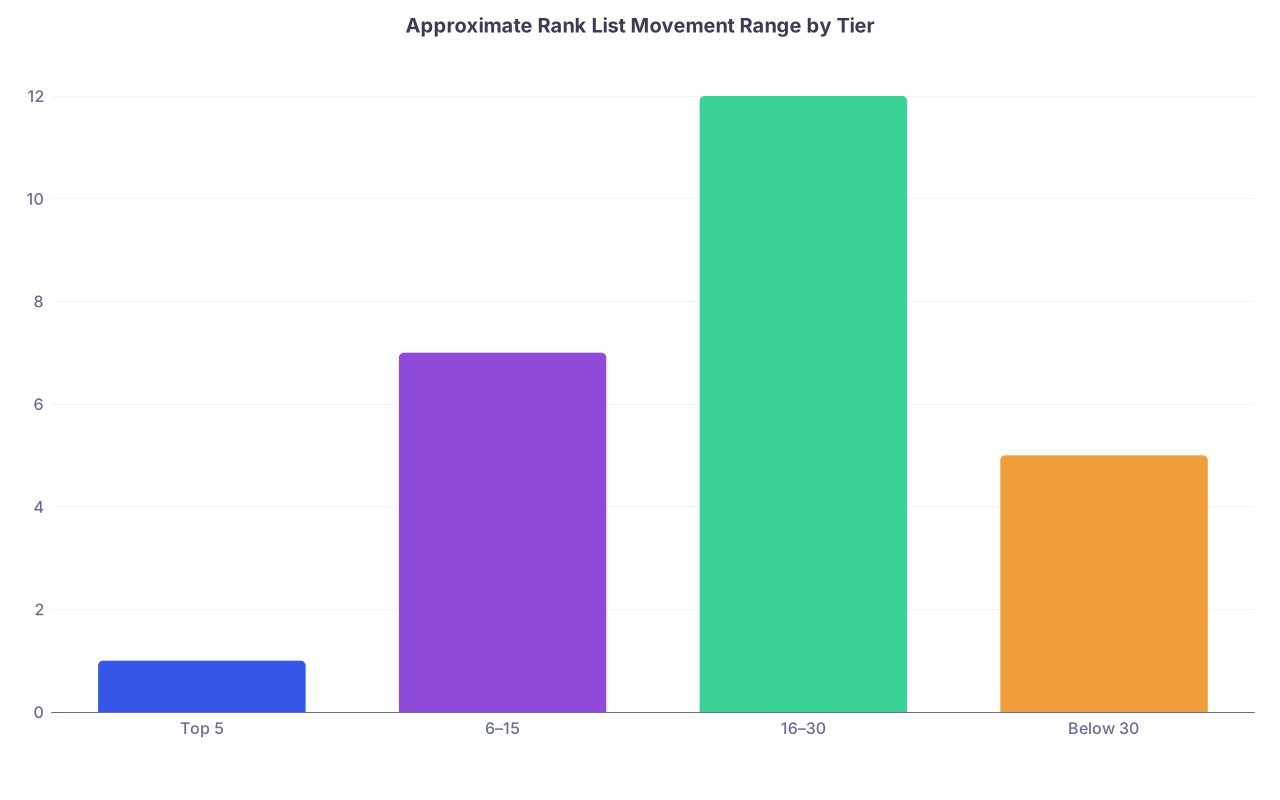
| Category | Value |
|---|---|
| Top 5 | 1 |
| 6–15 | 7 |
| 16–30 | 12 |
| Below 30 | 5 |
What that means in plain language:
- Top 5: Minor shuffling. One or two spots, not much drama unless there’s a strong negative comment.
- #6–15: This is where the real fights happen. People can move up or down 5–10 slots based on how strongly someone advocates or objects.
- #16–30: Huge movement. This is the “mushy middle” where vague impressions and random comments matter disproportionately.
- Below #30: Mostly noise. They’ll shift around but rarely jump into the top matchable range unless there’s a strong late advocate.
So yes, if you’re anywhere in that 6–30 band, a single clear, strong statement from someone who remembers you can absolutely move your spot enough to determine whether you match there.
What Makes Someone Speak Up for You (Or Against You)
You cannot control the politics in the room. You can absolutely influence whether someone feels compelled to say something memorable when your name shows up on the screen.
Here’s what actually pushes people to speak:
Emotional memory. Did you say something in the interview that stuck with them 6 weeks later? A specific patient story. A very clear “why this specialty, why this program” anchored in real details.
Reciprocity. Faculty are human. If they felt respected, listened to, and intellectually engaged by you, they’re more inclined to defend you. If you treated them like “just another interviewer” and looked bored, they won’t burn political capital to help you.
Similarity. Don’t underestimate this. A faculty member who went to a DO school, came from a low-resource background, or did a non-traditional path will often go to bat for the candidate who reminds them of themselves—with similar grit.
Red flags. Anything that smells like “workload problem,” “attitude problem,” “unreliable,” or “culture clash” will provoke people to speak out, even if they barely remember your academic metrics.
This is why your goal is not just to be “pleasant” on interview day. You need to become defendable. Give your interviewers specific reasons and language they can use in that room.
Lines that stick in faculty minds:
- “They stayed late on their sub-I to help with a crashing patient. Didn’t have to. Just did it.”
- “They talked about that code that went wrong and took real responsibility for their learning.”
- “They’ve been working as a CNA for years—clearly comfortable with bedside care, not just lab work.”
You’re feeding them ammunition.
How to Shape the Comments You’ll Get
If you’re smart, you’re already thinking: okay, so how do I make sure the comment that defines me is a good one?
1. Build Three Anchors: Competence, Work Ethic, Culture Fit
Every interaction should reinforce three big ideas about you:
- This person is clinically sharp (or will be quickly).
- This person will not make my life harder at 3 am.
- This person fits our culture.
You do that with repeated, concrete signals:
When asked about challenges: you talk about systems, communication, and what you changed about your behavior.
When asked about weaknesses: you pick something real that touches work habits or knowledge gaps and then demonstrate how you systematically improved it.
When asked about why this program: you cite specific program features—patient population, structure, educational style—and connect them to your experiences. Not “I like the collegial culture” nonsense. Everyone says that.
The faculty won’t remember your exact words later. They’ll remember the gestalt: “strong, reflective, easy to work with.” Or they won’t.
2. Use the Social Events Wisely
The pre-interview dinner and post-interview resident chats are not optional. They’re scouting missions. Residents have less raw power than PDs, but their comments are heavily weighted when it comes to “will this person be miserable here?” or “will they burn out and leave?”
I’ve seen PDs say, “Residents loved them, that matters to me,” and bump applicants up on that alone.
Rules residents quietly enforce:
- Don’t talk down about other programs or cities.
- Don’t flex money, prestige, or “I have other higher options” energy.
- Don’t treat interns like administrative staff.
Residents will absolutely mention, “They seemed disengaged at the dinner,” or “They were on their phone a lot,” and that translates directly into “culture fit concerns” on rank day.
Behind the Scenes: Program Politics That Affect Your Rank
Here’s the part students never see: not all movement in the rank list is about you at all. Some of it is about the program’s strategy that year.
Common hidden factors:
- Geographic pressure. “We’ve lost a lot of grads to the coasts; we want people with ties to this region.” Your mention of family nearby can quietly lift you over an otherwise stronger applicant with no ties.
- Diversity goals. Some programs will explicitly say, “We need to improve representation,” and will preferentially bump certain candidates up the list. They’re not shy about it in the room, even if they’re careful on paper.
- Home vs. away balance. Some years programs overmatched home students and got burned. PDs then say, “We’re capping home at X this year.” Your home status can either save you or hurt you depending on that year’s politics.
- “We need a researcher / we need workhorses.” If the program’s chair is angry their research numbers are down, the PD might get nudged to bump research-heavy candidates. In other years, after a few “superstars” flamed out, the message becomes: “Give me grinders.”
You can’t control these crosswinds. But you can give them excuses to let you ride them. Talk clearly about your connection to the region. Show consistent clinical work ethic. Make it easy for them to justify bumping you up for some strategic reason.
What You Should Actually Do Differently
Let me boil all this into behavior you can control.
Before Interviews
Know your own “headline” you want people to repeat in that room. Short, sharp, memorable. For example:
- “Non-trad with real-world work ethic and strong clinical presence.”
- “Quiet but deadly competent, high emotional intelligence.”
- “Heavy research but surprisingly down-to-earth, good team player.”
Then your stories, answers, and questions should all support that headline. People in that room will not construct it for you. You have to hand it to them.
During Interviews
Be specific. Generic answers are unrememberable and therefore undefendable.
Faculty love:
- Concrete patient stories.
- Specific moments of failure and how you changed afterward.
- Evidence you understand what residency actually feels like.
Avoid canned, “I want to work with the underserved” with no story. That phrase is white noise. Half the applicants say it; no one remembers who meant it.
After Interviews
For programs you care about, send a brief, targeted thank-you email. One or two very specific callbacks:
- “I’ve been thinking about your question about balancing autonomy and supervision on night float…”
- “I looked up the QI project you mentioned; the idea of standardizing discharge instructions really resonates with what I saw on my sub-I.”
Why? Because a month later, when your interviewer is half-dozing in the rank meeting and your name pops up, that email jogs their memory: “Oh yeah, that was the one who followed up on our QI discussion. They’re thoughtful.”
And once they remember you, they’re more likely to say something. And one comment—positive or negative—really can change your spot.

| Step | Description |
|---|---|
| Step 1 | Interview Day |
| Step 2 | Faculty & Resident Impressions |
| Step 3 | Informal Comments & Notes |
| Step 4 | Preliminary Composite Score |
| Step 5 | Rank Meeting Discussion |
| Step 6 | Move Up List |
| Step 7 | Move Down List |
| Step 8 | Stay Near Composite Rank |
| Step 9 | Final Rank Position |
| Step 10 | Strong Comments? |