
The way program directors actually read ERAS would probably horrify you.
They are skimming your “life’s work” in 90 seconds the first time through. Two minutes if you’re lucky. And they are absolutely not reading it in the order ERAS shows it to you. They’re hunting for specific signals, specific red flags, and specific shortcuts to decide: invite, maybe, or trash.
I’ve sat in offices at 11:30 p.m. watching a PD flip through 200 applications like he was sorting junk mail. I’ve heard the exact lines they say when they see a weird gap, an overstuffed experiences section, or a “passion for the specialty” paragraph that looks suspiciously like all the others.
Let me walk you, line by line, through how your ERAS really gets read.
The Actual Reading Order (Not What ERAS Shows You)
Here’s the first truth: no serious PD is reading your application top-to-bottom in sequence.
They develop their own “pattern” over years. It’s almost muscle memory. They open, eyes go to one part, then another, then another. Same order. Same filters.
Most programs use some version of this order on first pass:
- USMLE/COMLEX scores and attempts
- Medical school name / graduation year
- Applicant type (US MD / US DO / IMG, visa needs)
- Failures, leaves, extensions, remediation
- Most recent clinical experience (date and location)
- Letters of recommendation (who signed them, not what they said… yet)
- Personal statement (for fit or red flags, not literature review)
The stuff you obsess over—beautifully worded descriptions of your volunteer work, clever titles for your research, your “other interests” section—most PDs do not see that on the first pass. It gets looked at after you clear the initial filters.
Let me show you how each of these pieces really gets dissected.
Step Scores: The First Guillotine
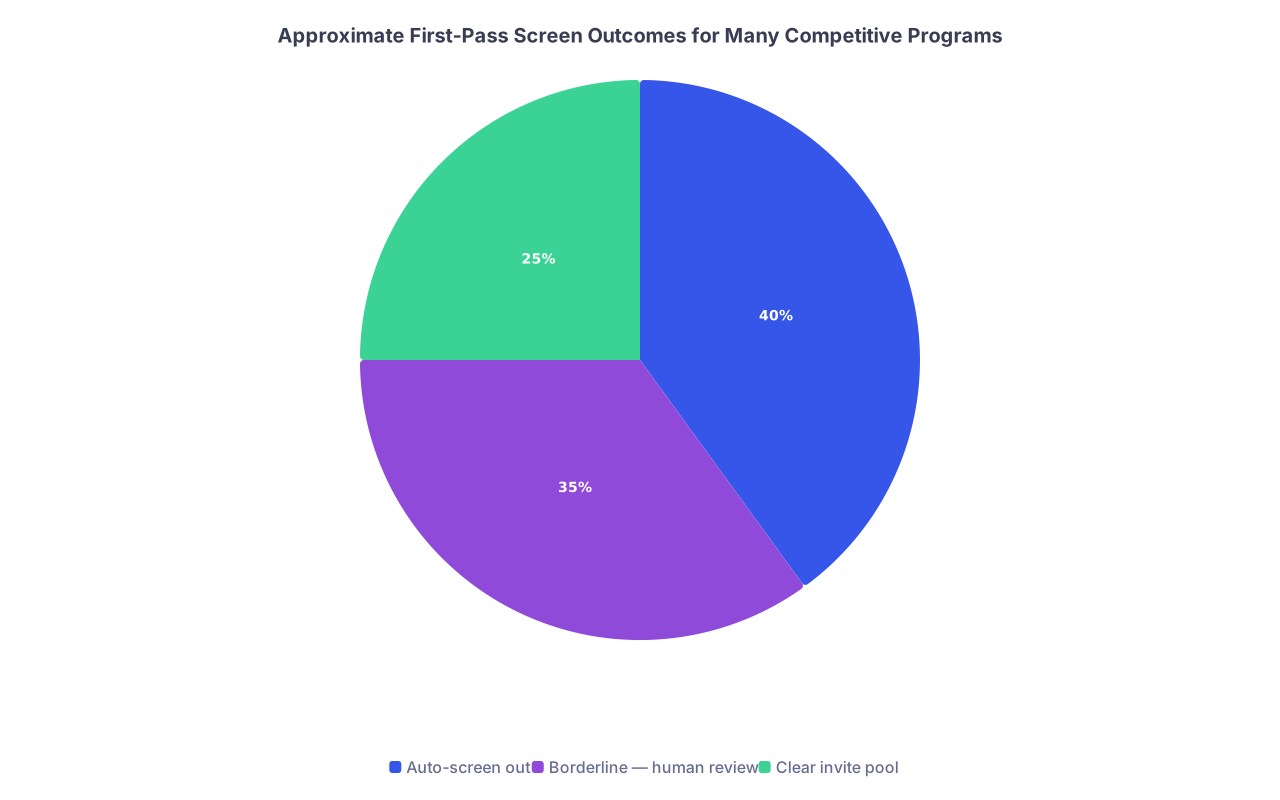
| Category | Value |
|---|---|
| Auto-screen out | 40 |
| Borderline — human review | 35 |
| Clear invite pool | 25 |
They open your app. Their eyes go straight to your USMLE/COMLEX section. They barely glance at anything else until they know which bucket you’re in.
There are three buckets that matter:
- Below program’s comfort zone
- Borderline
- Comfortably above
Each program has different numbers, but for most mid- to upper-tier IM, EM, anesthesia, gen surg, psych, peds, you’ll hear something like this in closed-door rank meetings:
“We generally don’t look below 210–215 unless there’s something compelling.”
“Below 220 we need a story.”
“Below 230 for derm/ortho/neurosurg? That’s basically dead unless it’s the PD’s cousin.”
Here’s the part no one tells you: the pattern of your scores matters more than you think.
Step 1 low, Step 2 clearly higher
This is survivable. PDs will literally say, “Okay, they turned it around. Good. They can learn.”
The line you’ll see them mumble: “Step 1 208… Step 2 236. Okay, fine.”Step 1 okay, Step 2 equal or lower
This makes them nervous. “Why did they stall? Peak too early?” If Step 2 drops sharply, it will get mentioned.Multiple attempts / failures
This is never ignored. They scroll down to see where the explanation is. If there’s no decent explanation anywhere else, that’s often a hard pass unless you’re at a community program that’s desperate.
And yes, they notice if Step 2 is “pending” way past when it should be. A PD I know in IM literally keeps a sticky note on her monitor: “No Step 2 by November = Not serious.”
Medical School: The Quiet Sorting Mechanism
No one is going to admit this on a webinar, but they mentally tier schools within 0.2 seconds of reading the name.
The rough subconscious algorithm looks like this:
- “Top-tier US MD / big-name academic center” → benefit of the doubt, even with a few bumps.
- “Ordinary US MD” → neutral starting point. Must see that you’re competent and not a headache.
- “US DO” → depends hugely on the specialty and how DO-friendly the program already is.
- “Caribbean / foreign IMG” → you start in a hole and have to climb out of it.
I’ve heard this exact exchange:
Faculty: “Step 1 222, Step 2 234, Caribbean.”
PD: “Next.”
Faculty: “Same scores, but from [state MD school].”
PD: “Okay, put them in ‘maybe.’”
Same numbers, different school, completely different reaction.
If you’re at a lesser-known or foreign school, they immediately look for compensating strengths:
- Strong Step 2
- US-based clinical experience at reputable sites
- Recognizable letter writers
- No unexplained gaps
If you don’t have those, you’re depending on luck or a desperate program.
The “Type” Filter: US MD vs DO vs IMG vs Visa
This is colder than you think.
On some PD desktops, there’s literally a column view: “Applicant Type” and “Visa Needed.” They’ll pre-filter the list before even clicking into applications.
Typical behind-closed-doors policies:
- “We’re not sponsoring visas this year.”
- “We’ll consider J-1, no H-1B.”
- “We’ll interview a few IMGs we know personally or who rotated here, but we can’t fill our list with them.”
They’re rarely talking about you as a person at this stage. You’re just a row in a spreadsheet.
If you’re IMG or need a visa and not from a US or “known” foreign school, they go hunting for anchors that justify the work of sponsoring you:
- US clinical experience in their region
- Letters from US faculty they recognize
- A concrete reason you’d rank them (ties to area, previous rotation, prior observership)
No anchors? Most of the time: click, close, next.
Red Flags: What Makes Them Scroll for Explanations
Before they ever read your beautiful prose, they’re scanning your chronology for problems.
Things that trigger a deeper check:
- Leaves of absence
- Extended time to graduation
- Course remediation
- Failed rotations
- Board exam failures
- Gaps of more than a few months with vague “other” descriptions
You’ll see this pattern in real time: PD sees a failure, immediately jumps to:
- MSPE (Dean’s letter) for the official language
- Personal statement or “education interruptions” text for your version
- Experiences to see if you have recent, stable clinical work
They’re asking themselves two questions, bluntly:
- “Is this going to be a problem resident?”
- “Do I want to deal with this for 3–7 years?”
If your explanation feels evasive, overly dramatic, or like a lawyer wrote it, they’ll move on. They’re not looking for perfection; they’re looking for predictability and maturity.
A simple, direct explanation + clear evidence of recovery is what plays best.
Experiences Section: How They Actually Read Your Laundry List
You spend hours wordsmithing every bullet. They read none of that the first time.
On first pass, here’s what they’re scanning for in your Work/Research/Volunteer:
- Recent, meaningful clinical experience in their specialty or setting
- Continuity: did you stick with things or bounce every 3 months?
- Leadership or initiative vs passive membership
- Strong signals of professionalism or service
| What They See | How They Interpret It |
|---|---|
| 12–15 “experiences”, all short | Padding, insecurity, no clear priorities |
| 5–8 substantial roles, multi-year | Reliable, likely mature, can commit |
| 3–4 research roles with pubs | Academic potential, depends on specialty |
| Heavy non-clinical work | Good story if coherent, or distraction if random |
I watched one PD scroll down an app, see 18 experiences, and literally say, “Come on. Nobody cares this much about your premed volunteer day trip.”
They click open only a few items:
- Recent clinical work (especially US, especially in the specialty)
- Major leadership roles (chief of something, founder, meaningful officer positions)
- Serious research, if they’re an academic program
The rest is noise unless they’re trying to break a tie between two very similar applicants.
Overwritten entries are a quiet red flag.
If every activity description sounds like you’re auditioning for a humanitarian award, your credibility drops. They know what a free clinic actually looks like. “Provided culturally competent, patient-centered care to marginalized communities” in every other line makes you look like you copied from a template.
What they like to see in descriptions:
- Plain language
- Specific actions and scope
- Occasional outcomes, not buzzwords every sentence
Something like: “Coordinated weekly scheduling for 25 volunteers; implemented a sign-out system that cut missed follow-ups by ~30%” impresses more than “Developed strong leadership and teamwork skills working with an interdisciplinary team.”
Research: The Real Weight It Carries
For road-to-derm, ortho, neurosurg, rad onc, ENT, plastics, research is practically a second currency.
For IM, peds, psych, EM, anesthesia, surgery (non-super-competitive spots), the script changes.
The real questions PDs ask looking at research:
- “Is this real or fluff?”
- “Is there continuity with a mentor?”
- “Any publications or abstracts that actually made it out into the world?”
- “Does this match the type of program we are?”
I’ve watched a PD in academic IM do this:
- See “15 abstracts/posters” from random community conferences → shrug
- See “One first-author paper in a legit journal” → pause, open PubMed
- See “Working with Dr. [Name known to them]” → immediate interest regardless of publication count
Community-based programs? Many of them don’t care heavily, and some are actually wary of a hyper-research candidate they assume will leave for a fellowship at a bigger institution.
If your research section is long, they expect you to talk about it intelligently at interview. If you cannot, and it looks like CV-padding or gift authorship, that’s the fastest way to tank halfway decent impressions.
Letters: Name and Affiliation Matter Way More Than You Think
On first read, they’re not “reading” your letters. They’re doing a 10-second triage.
They look at:
- Who wrote it (title, specialty, reputation)
- Where they work (home program, big academic name, community partner)
- What role they had with you (PD, clerkship director, research mentor, random attending)
The patterns:
- Letter from your specialty’s PD or chair at your home institution = expected and heavily weighted
- Recognizable name at a well-known program = boosts credibility even if they don’t know that person personally
- Generic letter from an unrelated specialty = often ignored unless it’s glowing and specific
- “To whom it may concern,” 1 paragraph, full of clichés = might as well not exist
Later, for serious interview candidates, some PDs actually open and read the letters closely. They’re hunting for:
- Concrete statements of clinical performance
- Comparison language (“one of the top students I have worked with in 5 years”)
- Any hint of concern (“with supervision”, “will continue to grow”, “pleasant to work with” with no comment on skill — that’s code)
Here’s a line I’ve heard more than once:
“If the letter from the PD is tepid, there’s a reason.”
So yes, who writes your letters matters as much as what they say. And no, involving a “famous name” who barely knows you can backfire when the letter is obviously generic.
Personal Statement: What They Really Use It For

The mythology around personal statements is wildly out of proportion to how they’re actually used.
On the first pass, one of three things happens:
- They don’t open it at all.
- They skim the first 3–6 lines.
- They scroll quickly to see length and basic structure.
What are they looking for, if they bother?
- Red flags: wildly off-topic, unprofessional, victim narrative with no growth
- Consistency with the rest of the app: does your “lifelong passion” match your experiences?
- Clues about geography, family, or long-term plans that intersect with their program
A PD told me this outright:
“I open the personal statement when I’m trying to decide if this person is a headache, or when I need a tie-breaker.”
They are not grading your writing like an English teacher. They want:
- Clear, readable, not pretentious
- No glaring grammar issues that suggest you’re careless
- A sense of why you’re choosing this specialty and what kind of resident you’ll be
The worst offenders they roll their eyes at:
- Trauma-dump essays with no arc of resilience or insight
- Overly dramatic “I knew I wanted to be a surgeon at age 6 when I held a suture kit” clichés
- Name-dropping of their program in an obviously copy-pasted way
The single most useful thing your statement can do is answer, quietly and maturely: “Why this specialty, why now, and what kind of colleague will I be at 2 a.m. on a bad call night?”
If they get that, without wincing at your prose, it’s done its job.
“Other Interests” and Hobbies: More Important Than You Think, But Not How You Think
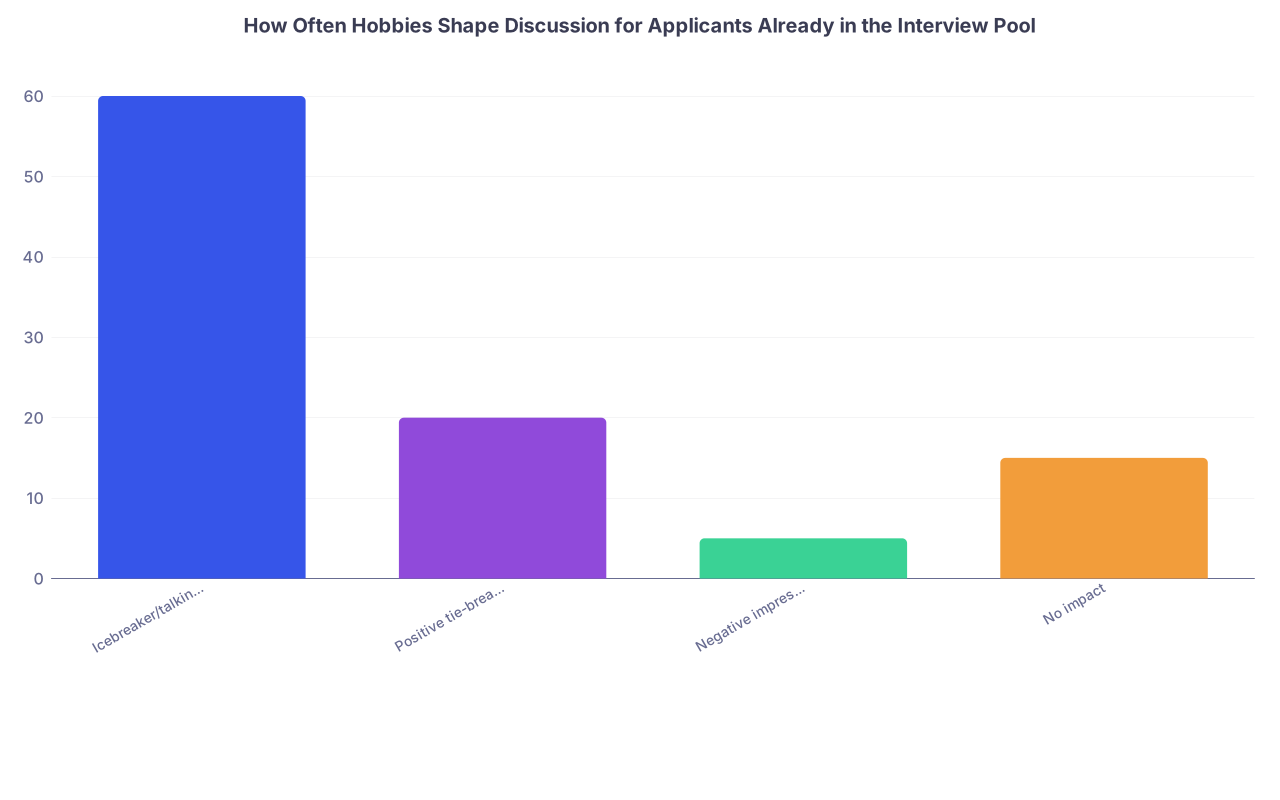
| Category | Value |
|---|---|
| Icebreaker/talking point | 60 |
| Positive tie-breaker | 20 |
| Negative impression | 5 |
| No impact | 15 |
These sections almost never decide whether you get an interview. They do decide how memorable you are once you’re in the “maybe” pile.
Faculty scanning through will often pause here and say:
“Oh, this one bakes sourdough and does long-distance cycling. At least they’re human.”
What they don’t like:
- Over-curated, obviously fake lists (“world travel, fine dining, mindfulness, philosophy”)
- Edgy or polarizing hobbies that suggest poor judgment (you’d be surprised what people put)
- Hobbies that all sound like LinkedIn buzzwords instead of a real person
If you mention something unique, be prepared to talk about it. I’ve watched interviews where the only reason someone was remembered positively was, “That’s the guy who restores old motorcycles. I liked him.”
Hobbies are where a lot of PDs get a sense of whether they want to sit next to you on a 14-hour shift.
The Second Pass: How Applications Get Sorted for Interviews
Once they’ve done the quick-and-dirty filters, they circle back to the top few hundred.
This is where more detailed reading happens.
Typical second-pass behavior:
- Reading the MSPE for professionalism comments and “summary” language
- Actually opening a few experience descriptions, especially clinical ones
- Looking at the timeline of your training for consistency
- Reading personal statement more thoroughly if the rest looks good

| Step | Description |
|---|---|
| Step 1 | Initial Download |
| Step 2 | Score/School/Type Filter |
| Step 3 | Red Flag Scan |
| Step 4 | Auto or Near-Auto Reject |
| Step 5 | Secondary Review List |
| Step 6 | Require Strong Compensating Factors |
| Step 7 | Detailed Review by Faculty/PD |
| Step 8 | Interview List |
| Step 9 | Reject or Hold |
| Step 10 | Invite? |
During this stage, borderline applicants live or die on nuance:
- The tone of the Dean’s letter
- Consistency between your story and your record
- Small details that hint at work ethic and reliability
This is where those “little things” you think do not matter actually start to matter: continuity of service, leadership roles, thoughtful descriptions. Not on the first pass. On the second.
How To Write ERAS For How It’s Actually Read
You cannot control their biases. You can absolutely control how “skimmable” and coherent your application is for someone reading 80 files in a night.
Practical, insider-facing principles:
- Make the top of your app (scores, school, type, recent clinical) as clean and strong as reality allows. Take Step 2 early enough to help you if Step 1 was weak.
- Treat any red flag like a professional problem you’ve already solved, not a fresh wound. Direct, calm explanations.
- Prune your experiences. Better 6–8 strong, clearly described roles than 15 forgettable ones.
- Use plain, professional English. If your descriptions sound like brochure text, they’ll tune out.
- Get at least one letter from someone whose name or title will mean something to PDs in your specialty.
- Use the personal statement to answer “why this, why you, why us” in a calm, grounded way—not to impress with your vocabulary.
And above all, accept that you’re not writing a novel. You’re assembling a credibility packet designed to survive a 90-second triage and a 5-minute second look.