
It’s 10:45 p.m. A program director is scrolling through ERAS on a second monitor while half-watching a game on mute. They’ve already clicked through 110 applications today. They open yours.
US MD. Step 2: 245. Strong letters. Then their eyes land on it:
“Leave of Absence: 01/2022–08/2022.”
Then: “Extended curriculum – five-year completion.”
The game is forgotten. They lean in, scroll to your MSPE, your personal statement, the transcript. Now the question is not “Are you smart enough?” It’s “Do I trust you enough to put you in our call pool?”
Let me tell you exactly what happens next.
The Unspoken Truth: Gaps Are Risk Calculations, Not Moral Judgments
Program directors are not moral police. They are risk managers.
They look at your board scores and grades and think, “Can this person do the work?”
They look at your gaps, LOA, and repeated years and think, “Will this person disappear on us, crack under pressure, or cause an accreditation problem?”
Every unexplained deviation from the clean 4-year timeline triggers one of three internal reactions:
- “This is fine.”
- “This is manageable with some support.”
- “Nope. Too much risk for the reward.”
You want your story to live solidly in bucket #1, or at worst, #2.
The mistake applicants make? They either hide the issue, under-explain it, or over-share to the point that they sound destabilized. PDs hate all three.
How PDs Actually Scan for Gaps and LOAs
Stop imagining that everyone is reading every line of your PS with candles lit and classical music playing. Here is what really happens.

| Step | Description |
|---|---|
| Step 1 | Open ERAS Application |
| Step 2 | Check Scores & School |
| Step 3 | Scan Transcript & MSPE |
| Step 4 | Quick Sort by Scores/Letters |
| Step 5 | Look for Official Explanation |
| Step 6 | Proceed - Consider Interview |
| Step 7 | Risky - Often Screened Out |
| Step 8 | See LOA/Gap/Repeat? |
| Step 9 | Explanation Clear & Reassuring? |
The order is roughly:
- They glance at Step 2 (and Step 1 school context if they care).
- They note your med school and general academic pattern (honors vs passes).
- Then they skim the transcript and MSPE for bolded or boxed text: LOA, extension, repeat, professionalism issues.
If something stands out, they pause and hunt for:
- The official school explanation in the MSPE (or its absence).
- Any mention by you in the personal statement.
- Context from letters if they hint at “overcoming challenges.”
If they can understand the what, why, and why this is not likely to recur in under 45–60 seconds, you are probably safe. If they are confused, uneasy, or it smells like you are hiding something—your file gets mentally moved to the “only if we’re desperate” pile.
Types of Gaps and How They’re Interpreted
Different gaps land differently. Some barely register. Others are torpedoes.

Let’s sort them out.
1. Pre-med and pre-matriculation gaps
Gap years before med school, even multiple, are basically fine now. Nobody cares that you worked as a scribe for 2 years or took care of family.
These only matter if:
- You strung together 3–5 years with nothing remotely structured or clinical
- You show similar interruptions again in med school
Pattern is what worries PDs, not a single pre-med gap.
2. Short gaps during med school (weeks to 1–2 months)
These often don’t even get labeled as “gaps” if they’re within official block sizes.
Typical examples:
- Taking a month off for Step 1 or Step 2 study
- Brief medical leave for surgery or acute illness
- A short “personal leave” that the school compresses into summer time
How PDs see it: If your school doesn’t flag it as a formal LOA and your graduation date is normal, most PDs will never go hunting for this. Unless your performance tanked around it, this is background noise.
3. Formal LOA during pre-clinical or clinical years
This is where the antennae go up.
Common reasons:
- Medical (physical or psychiatric)
- Family emergency / caregiving
- Academic difficulty (failed courses, Step failure)
- Conduct / professionalism issues
- Pregnancy / parental leave
- Burnout / “personal reasons”
Here’s the ugly truth: “Personal reasons” with no additional clarity is often interpreted as “mental health or professionalism issue we’re not being told.” PDs are not entitled to your full psychiatric history, but vague euphemisms are red flags.
What they want to see instead is something like:
- Clear category (medical, family, academic)
- Evidence of resolution or stable management
- Solid performance after the LOA
When the LOA is medical or mental health and cleanly handled, many PDs are more understanding than applicants think. The fear is not that you have depression. The fear is that you will crash during PGY-1, go on extended leave mid-year, and leave cores uncovered.
4. Repeat years / extended curriculum
There are two main flavors:
- Curricular extension: 5-year track or decelerated program, often planned with the school
- True repeat: You failed or could not progress and repeated an entire year
PDs distinguish between those. They do not see them as the same.
If your school explicitly describes a “decelerated curriculum” for health/personal reasons, with good performance once the pace changed, that is much more acceptable than:
“Student repeated M2 year after multiple course failures.”
I have watched PDs do this live:
They see “5 years.”
Then they flip straight to the MSPE summary.
If the dean’s letter says, “Student completed an extended curriculum due to personal medical reasons; performance during the remainder of the program was satisfactory with no further concerns,” most shrug and move on.
If they see “multiple remediation and repeated coursework,” they start mentally categorizing you as:
- At risk for in-training exam struggles
- Possible board failure risk
- Someone who may require disproportionate remediation time
You can overcome that. But you are no longer competing on equal footing.
The Quiet Hierarchy of Red Flags
Let me put the unwritten hierarchy into something concrete.
| Issue Type | Typical Concern Level (1–5) |
|---|---|
| Planned research year | 1 |
| Family-related LOA (well-explained) | 2 |
| Single failed class, then solid | 2–3 |
| Medical/mental health LOA, stable | 3 |
| Repeated year for academics | 3–4 |
| Multiple fails/Step failure + LOA | 4–5 |
This is not official. Nobody writes this into policy. But you feel it in rank list meetings when someone says, “I like them, but do we really want another remediation project this year?”
Now layer on competitiveness: a 3–4 concern level might still fly in Family Medicine at a community program. That same profile is almost dead on arrival in Derm or Ortho unless offset by something extraordinary.
What Makes PDs Relax vs. Worry
There are three questions sitting in the back of every PD’s mind when they see your break in training:
- Do I understand what actually happened?
- Is there convincing evidence that the underlying problem is now stable or resolved?
- Has their performance after the problem been consistently strong?
If all three are “yes,” most PDs will move on and judge you primarily by the rest of your file.
The following patterns calm them down:
- Your LOA or repeat is explicitly, neutrally explained in the MSPE.
- Your transcript after the event shows no more failures and maybe even improvement.
- Your Step 2 CK is comfortably solid for the specialty.
- A letter writer casually references that you “returned to full function and excelled.”
On the flip side, these drive them crazy:
- The MSPE is vague and evasive.
- You never mention the LOA anywhere, even though it’s clearly there.
- Your performance after return is still shaky—marginal passes, low shelf scores.
- You blame others (school, faculty, “toxic environment”) anywhere in your narrative.
Once you sound like a liability or a future complaint-generator, you’re done.
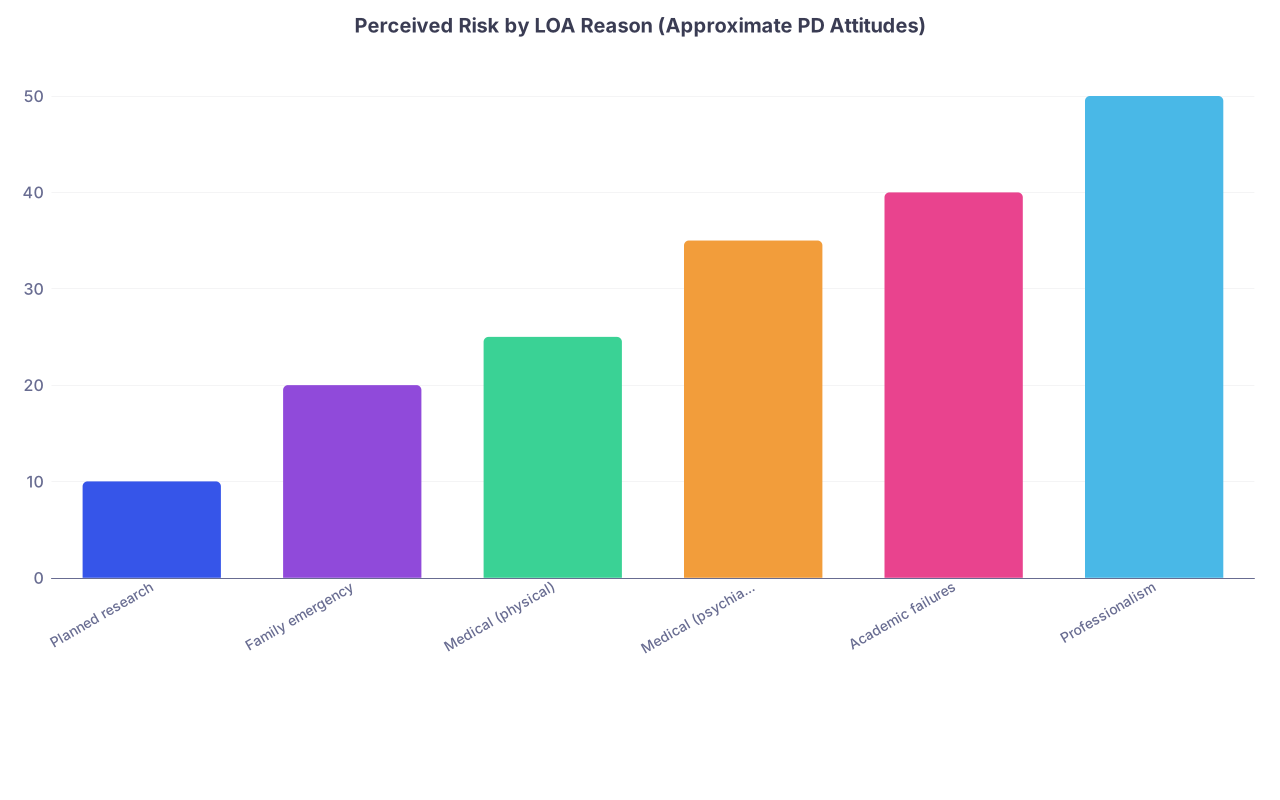
How Different LOA Reasons Really Land
Let’s go deeper, because this is where applicants misunderstand PD psychology.
| Category | Value |
|---|---|
| Planned research | 10 |
| Family emergency | 20 |
| Medical (physical) | 25 |
| Medical (psychiatric) | 35 |
| Academic failures | 40 |
| Professionalism | 50 |
Think of those values as “percent chance a PD hesitates hard or screens you out,” not as published stats. This is mood.
Research year
Not a red flag. Often a positive.
If you took a formal research year, got publications, and your school notes it as planned, PDs don’t consider that a “gap.” The risk is that you look like you were trying to beef up a weak application but didn’t produce anything. But in most cases, this is neutral or good.
Family emergency / caregiving
This is usually socially acceptable, especially in IM, peds, FM, psych. The more you make it sound like a time-limited, finite event that is now resolved, the better.
Bad: “I had ongoing family obligations over several years that required frequent travel.”
Better: “I took a defined leave of 6 months to assist with a specific acute situation, which has since stabilized and no longer affects my ability to commit fully.”
Again: resolution and finality.
Medical – physical illness
Serious illness that required surgery, chemo, rehab. PDs are often surprisingly compassionate here.
They’ll focus on:
- How long ago it was
- Whether there’s any chronic limitation
- If you kept functioning at a high level after recovery
If your MSPE shows that you returned and performed consistently with your peers, many PDs will quietly admire you for it and move on.
Medical – psychiatric / mental health
Here is where the optics matter the most, even if everyone pretends otherwise.
No PD wants to be the one discriminating against mental health. At the same time, they’ve all watched residents crash mid-year.
They’re looking for:
- Stability over time: at least 1–2 solid years of functioning
- No repeated leaves for the same issue
- Mature, non-dramatic language when you reference it (if you choose to)
If your narrative sounds like a crisis still in progress rather than a chapter you’ve processed and moved through, you will make them nervous.
Academic failure / Step failure
Pure academic LOA or repeat year for multiple fails is high-risk in competitive fields. The fear is you’ll fail in-training or board exams, which is a direct hit to the program’s metrics.
You can partially neutralize this with:
- Strong Step 2 CK compared to peers
- Clear upward trend after remediation
- A dean’s letter that frames you as someone who “learned how to learn” and then did well
Programs with lower board pass rate pressure or more supportive cultures will sometimes take this on. Surgical subspecialties almost never will unless there’s a very compelling counterweight.
Professionalism / conduct
This is the real nuclear red flag. If your LOA is even hinted to be tied to professionalism, probations, or “professional conduct concerns,” PDs hear:
- Angry patient letters
- HR involvement
- Legal exposure
- Headache
If your school documented this in any way, your best-case scenario is usually a lower-tier or less competitive specialty that’s more forgiving, and even then you’ll need a very strong redemption story and letters explicitly vouching for your professionalism now.
How You Should Present Gaps, LOA, and Repeat Years
You do not control what happened. You control the story PDs walk away with in under a minute.

Rule #1: Never let the MSPE be the only voice
If the MSPE mentions an LOA or repeat year, and you say nothing anywhere, PDs assume:
- You’re either ashamed and hiding, or
- You lack insight and maturity
You don’t need a sob story. You do need one controlled, professional, concise explanation somewhere—personal statement or the “additional information” section—on your terms.
Think structure:
- One line on what happened (at a high level).
- One to two lines on what changed / what you learned.
- One to two lines pointing to evidence of stable performance since.
Example for a mental health LOA:
During my second year, I took a medical leave to address a depressive episode. With treatment and support, I returned to full-time coursework the following semester and have since completed all clinical rotations on schedule, with strong evaluations and consistent performance. This experience forced me to build more sustainable habits and communication strategies, which I now bring consciously to my work with patients and teams.
That’s enough. No diagnostic codes. No graphic detail.
Rule #2: Align your story with the official record
If your MSPE says “LOA for personal health reasons,” and you write a long narrative about a family emergency, expect raised eyebrows.
PDs compare across:
- MSPE
- Transcript timing
- Your description
Those three have to tell the same story, just at different levels of detail. Any mismatch smells like either deceit or lack of insight.
Rule #3: Show the rebound, not just the event
The event itself is rarely what kills you. It’s the lack of convincing comeback.
So in everything you write, subtly highlight:
- Shelf scores after return
- Strong clinical comments
- Step 2 CK done and solid
- Long stretch (12–24 months) with no further issues
Your message: “Yes, this happened. It is over. Here is the objective proof.”
Specialty Differences: Who Cares and How Much
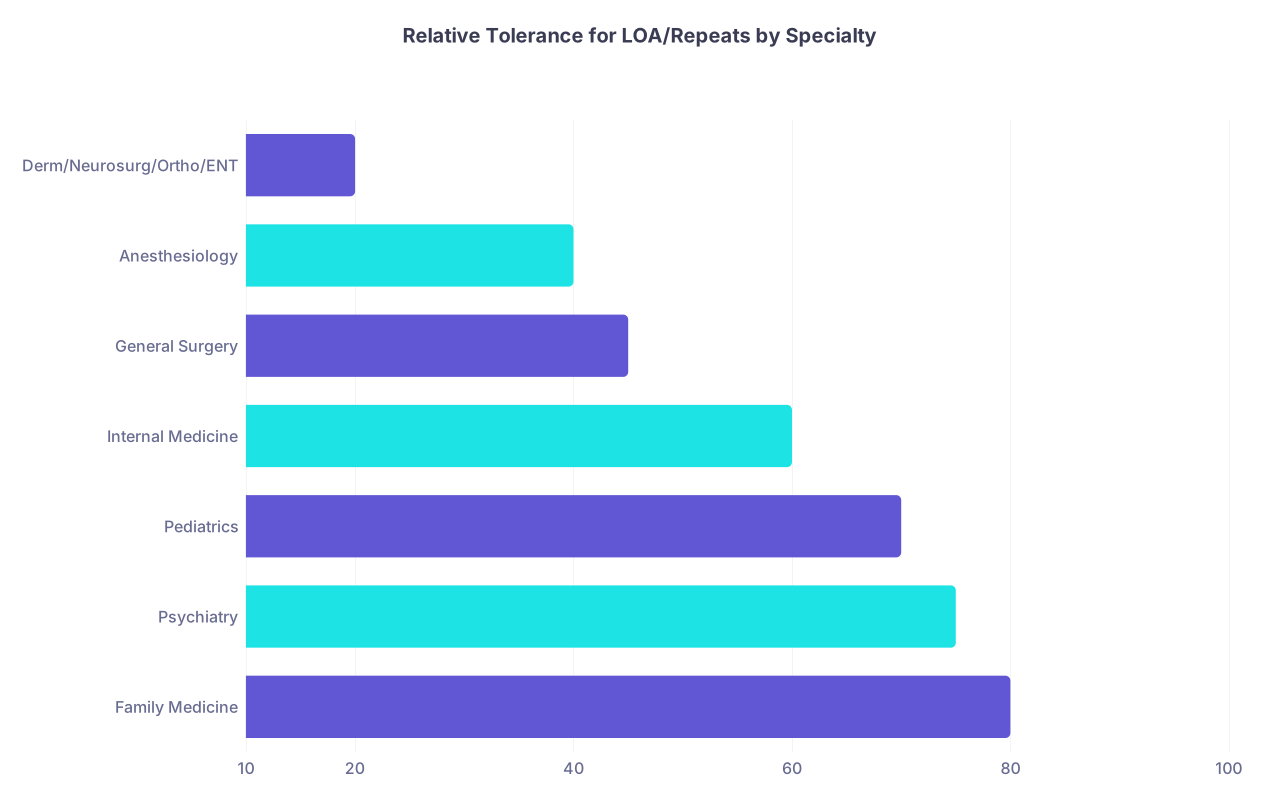
Some specialties are naturally more willing to work with a bumpy path. Others want a perfectly paved freeway.
| Category | Value |
|---|---|
| Family Medicine | 80 |
| Psychiatry | 75 |
| Pediatrics | 70 |
| Internal Medicine | 60 |
| General Surgery | 45 |
| Anesthesiology | 40 |
| Derm/Neurosurg/Ortho/ENT | 20 |
Think of those values as “relative tolerance” out of 100, not acceptance rates.
High tolerance: FM, Psych, Peds
You’ll find PDs who openly say, “We like people who’ve been through things.” They may even value your resilience if your performance now is solid.Moderate: IM, Neuro, OB/GYN
They’ll look closely at boards and ITE risk. One LOA with strong recovery is often fine. Multiple red flags are tough.Low tolerance: Ortho, Derm, Neuorsurg, ENT, Plastic, some surgical subspecialties
They already have more applicants than they can use. Any major academic or professionalism red flag is usually an easy cut.Mixed: Surgery, Anesthesia, EM (pre-EM-recession era vs. now)
Some community programs are more forgiving; elite ones have their pick and will default to “clean” applications.
You can absolutely still match with an LOA or repeated year, but you need to be brutally realistic about where you apply and how your explanation lands in that specialty’s culture.
Common Mistakes I See Over and Over
I’ve watched applicants sabotage themselves in predictable ways.

Three that keep coming up:
Vague, evasive language
“I took time off for personal reasons” with no frame or resolution. PDs assume the worst.Over-sharing raw, unresolved trauma
Turning the personal statement into a therapy session about ongoing instability. That scares people.Blaming the institution
“I disagreed with how my school handled…” or “unfair faculty…” Even if you’re right, PDs picture you forwarding every conflict to GME and legal.
You want clear, contained, and mature. Not evasive. Not confessional. Not antagonistic.
Bottom Line: What PDs Actually Remember About You
By the time a PD finishes scrolling your file, one of three narratives is sitting in their head:
- “Solid candidate, had a bump, clearly recovered. Safe.”
- “Good on paper, but something about this story feels unstable. Risky.”
- “Too many issues, we have cleaner options. Pass.”
Your job is not to pretend the bump does not exist. Your job is to script category #1 so well that they stop worrying and start thinking:
“Who cares about that LOA? Did you see their last two years and letters? Let’s interview.”
Years from now, you will not be defined by the semester you stepped away or the year you repeated. You’ll be defined by how you explained it, what you did after, and who was willing to bet on your trajectory instead of your detour.