
Last October, a fourth-year sat in my office with a printout of an email from a big-name academic program. “We look at the whole application,” it said. She’d just been rejected, with board scores and grades that were above that program’s posted averages. She looked at me and asked, “So what does that even mean?”
Let me tell you what it means—because I’ve heard that phrase used in faculty meetings for over a decade, and it does not mean what students think it means.
When program directors say “we look at the whole application,” they’re not reciting some holistic-careers-office mantra. They’re describing a triage system. A survival mechanism. A way to filter thousands of applications without missing the people who will actually make the program work at 2 a.m. when the ED is backed up and the EMR is crashing.
You want the truth? Here’s how that phrase really plays out in rooms you will never be invited into.
What “Whole Application” Really Means in Practice
Let’s strip the marketing language off.
“Whole application” almost never means, “We carefully read every word of every ERAS application equally.” That’s fantasy. The volume killed that years ago.
Most mid- to large-sized programs use a three-layer structure:
- A hard or soft initial screen (scores, fails, visa status, graduation year, occasionally school).
- A quick gestalt pass (30–90 seconds per application if you’re lucky).
- A deep read—but only for a fraction of applicants who survive the first two stages.
Where “we look at the whole application” begins to be true is at stage 2 and 3—for people who make it through the initial filters. For everyone else, it’s a polite euphemism for: “You got screened out before anyone cared about your publications or your heartfelt personal statement.”
Here’s the first ugly secret: in most moderately competitive specialties, you’re not either “numbers” or “holistic.” You’re numbers until you clear the cutoff, and only then do you become “a whole person.”
Stage 1: The Gatekeeping No One Wants to Admit
Every PD knows saying “we have filters” will start a small riot. So they don’t say it publicly. But in the selection committee meeting, the conversation sounds very different.
I’ve sat in on meetings that went like this:
Coordinator: “We have 3,200 applications this year.”
PD: “Okay, set the Step 2 filter at X. Exclude graduation more than 5 years out. Flag any fails.”
APD: “What about research-heavy applicants with a lower score?”
PD: “We can manually pull those by keyword later. I just need this pile smaller.”
That’s the reality.
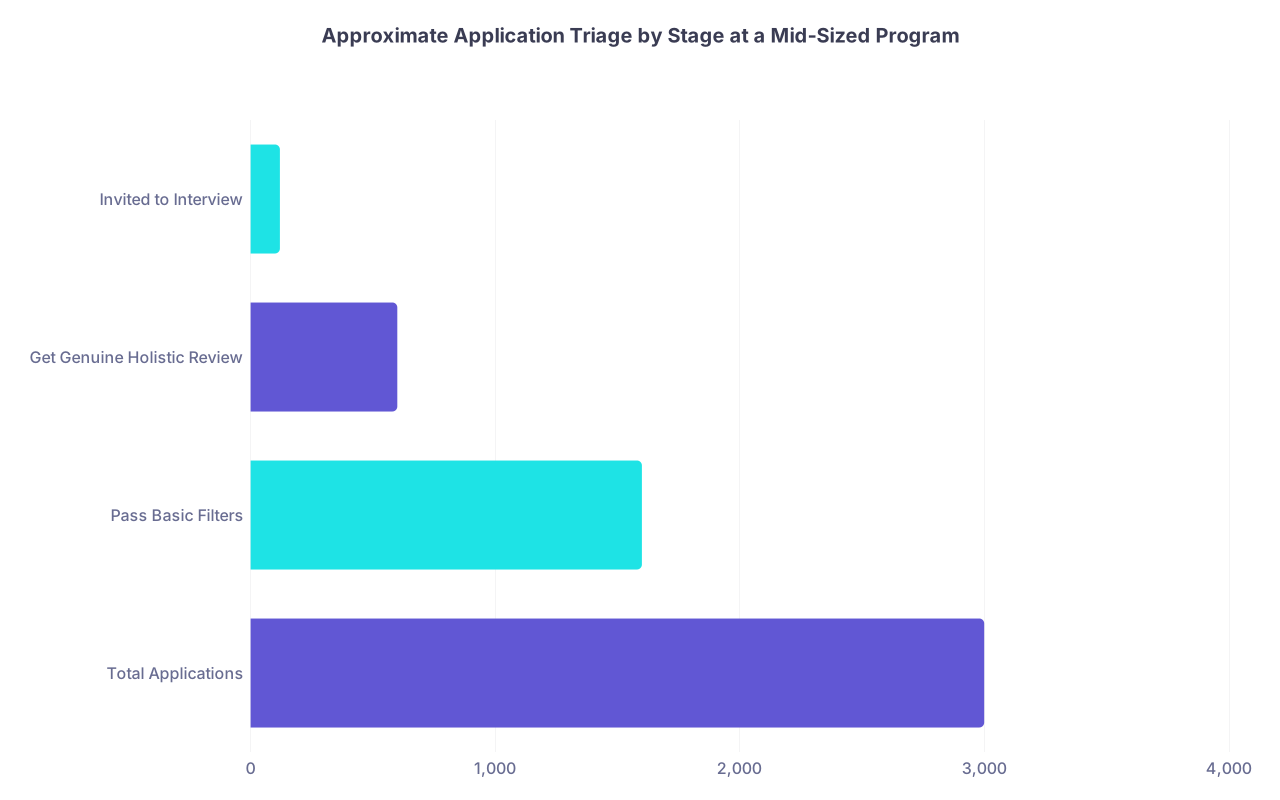
| Category | Value |
|---|---|
| Total Applications | 3000 |
| Pass Basic Filters | 1600 |
| Get Genuine Holistic Review | 600 |
| Invited to Interview | 120 |
At a typical internal medicine or surgery program:
- 2,500–4,000 applications.
- They can interview maybe 80–150 people.
- Nobody is reading 3,000 applications in-depth. Not even close.
So what’s actually used at the gate?
| Filter Type | Common Use Case |
|---|---|
| Step 2 CK score | Hard/soft threshold or flags at extremes |
| Exam failures | Auto-flagged, many auto-screened out |
| Graduation year | Cutoff (e.g., >5 years since graduation) |
| Visa requirement | Many programs limit or cap |
| Home/affiliated MS | Often fast-tracked rather than filtered |
No, this doesn’t mean you’re dead if you’re below the average. But it does mean your application behaves differently:
- Above a certain score band: You’re safely past the gate; now other factors matter a lot.
- In the gray zone: They might still pull you if something else is strong (home student, rotated there, strong letter from known faculty).
- Far below or with fails: Now they really mean “we look at the whole application”—as in, they’re looking for something extraordinary to justify pulling you out of the reject pile.
If you’re coming from a Caribbean or newer DO school and you think “whole application” means your volunteer work will balance out two exam failures, you’re being lied to. Not maliciously—just by omission. The PD on the podcast is not going to say on record what they say off the record.
Stage 2: The 60-Second Gut Check
Once you’re through the basic filters, this is where the “whole application” line is closer to the truth—but still not the way you picture it.
Picture the PD at 10 p.m., clicking through ERAS at home on a laptop, kids asleep, their own clinic notes unfinished. They’re not writing a literary critique of your personal statement. They’re scanning for very specific signals.
Roughly in this order:
- Red flags / yellow flags
- Fit signals
- Differentiators
Let’s break that down.
1. Red and Yellow Flags: The Silent Killers
This is the stuff they will absolutely not put in an email, but it’s what stops your “holistic” review in its tracks.
Examples I’ve heard called out in real meetings:
- “Repeated professionalism comments in the MSPE.”
- “Several marginal clerkship comments—‘needed frequent reminders’, ‘struggled with time management’.”
- “Odd gap year with no clear explanation.”
- “Two different schools in med school without a conventional transfer story.”
- “Personal statement hints at burnout or resentment.”
If the narrative around your struggles is sloppy or vague, they assume the worst. That’s how the human brain works under time pressure.
Yellow flags don’t automatically kill you, but they force your file into the “needs faculty discussion” pile. Which is smaller. And more competitive. You do not want to be in that pile without something else that’s exceptionally strong.
2. Fit Signals: The Part No One Teaches You
Fit is the most misused word in all of residency recruitment. Here’s what PDs actually mean when they talk about “fit” as they scan your application:
- Does this person want our type of program? (Community vs academic, research-heavy vs clinically intense.)
- Do they actually know what we are, or did they spam-apply?
- Will this person be happy here or leave after one year?
- Do they have some believable tie to the region or type of patients we serve?
That’s where “whole application” matters. They’re checking if your story, your geography, your letters, and your experiences coherently point toward them.
This is why you see people with perfect scores rejected from programs they thought were “safeties.” Their application screams “I want elite research-track cardiology” and they applied to a community-heavy program where their profile makes no sense.
3. Differentiators: Why They Remember You
After the filters and fit, then the more nuanced parts matter:
- A letter from someone they know—and trust.
- A sub-I at their institution with comments that sound like, “We want this person back.”
- A coherent niche interest that matches a strength of the program (QI, underserved care, specific research focus).
- Evidence you can carry the load: strong comments on busy rotations; leadership that actually involved work, not just titles.
This is where “whole application” can rescue a mediocre score. A known, trusted letter writer calling or emailing the PD saying, “You want this one,” will get you pulled out of the middle pile. I’ve seen that happen repeatedly.
Stage 3: When They Truly Do Read Everything
The fully holistic read? That happens for a much smaller group than you think.
Usually:
- Home students
- Rotators
- People already pre-flagged by faculty (“I worked with her, she’s excellent”)
- Top of the filtered pool they’re choosing interviews from
For these people, yes, someone actually goes through:
- Every experience description
- The personal statement (fully)
- The detailed MSPE narrative
- Research in context, not just as a raw number
- Patterns: leadership, consistency, progression
This is where nuance matters:
- A lower score but with an upward trend plus strong clinical narrative.
- An exam failure followed by clear remediation, excellent letters, and no further concerns.
- Nontraditional paths that are clearly explained and anchored to a mature story.
At this stage, they’re asking a different question: “Is there any reason not to interview this person?” rather than “Is there any reason to?” That’s a crucial difference.
How Different Parts of the Application Actually Get Weighted
You’ve heard “we look at everything.” Fine. But everything doesn’t count equally.
| Component | Realistic Impact (After Filter) |
|---|---|
| Step 2 CK score | High to Moderate |
| MSPE / Clerkship evals | High |
| Letters of rec | High (if specific/known writer) |
| Personal statement | Moderate (major if bad) |
| Research output | Moderate to High (academic) |
| Volunteer/extracurriculars | Low to Moderate |
A few unfiltered truths:
- Scores open doors; they rarely seal the deal. Once you’re in-range, the narrative and the letters carry more weight.
- MSPE and narrative comments are king for many PDs. They’re hunting for words like “outstanding,” “top 10%,” “eager worker,” “team player,” not just grades.
- Letters from unknown community docs that say ‘hardworking and compassionate’ blend into white noise. You think they’re gold; PDs see 500 almost identical versions.
- Personal statements almost never help you as much as you think—but they can absolutely hurt you. Overly dramatic trauma dumps, martyr complexes, or vague resentment toward the system raise eyebrows fast.
The Code Words PDs Use When They Talk About You
You’ll never hear this recorded on a podcast, but in the back room, the language is blunt. Let me translate some common phrases you’d hear around the selection table.
“Strong but generic.”
Translation: Good scores, decent letters, nothing makes them stand out, no obvious reason to choose them over 50 others just like them.“Quiet on paper but excellent letter from X.”
Translation: This person is going to get an interview because someone trusted vouched for them.“Doesn’t make sense for us.”
Translation: Stats or background are fine, but their stated interests or trajectory obviously align better with a different type of program.“Could be high-maintenance.”
Translation: Personal statement or narrative hints at drama, entitlement, or lack of resilience. Big risk for call-heavy programs.“Story makes sense.”
Translation: Scores, experiences, geography, and goals line up into a believable, coherent path. These people get interviews at a much higher rate than their raw scores would suggest.
Your job is to make the decision easy. To give them reasons to say “story makes sense” instead of “strong but generic.”
What You Can Actually Control To Benefit From “Whole Application”
You can’t fix your med school name or retroactively erase a Step failure. But you have more levers than you think.
1. Tighten Your Narrative
If your application reads like a collection of random jobs and hobbies, you’re forcing them to work to see your value. They will not work that hard.
Instead, you want a through-line:
- A clear interest (not “I love everything,” but “I’m drawn to X types of patients or Y settings”).
- Repeated signals in that direction: a project, a volunteer role, a sub-I, maybe a QI project.
- A personal statement that reinforces that direction without sounding like you googled “why I love internal medicine” and rewrote it.
I’ve watched PDs toss aside people with better stats because someone with slightly lower numbers had a narrative that matched the program’s mission on page one.
2. Upgrade Your Letters From “Nice” to “Powerful”
Most students treat letters as a checkbox. PDs don’t.
The difference between:
“She was a pleasure to work with, arrived on time, and was well-liked by staff.”
and
“She was among the top 5 students I’ve worked with in the last 5 years. I would be thrilled to have her as a resident here.”
is the difference between “generic” and “flag this for interview.”
If you want strong letters, you need:
- To give your letter writers specific examples of what you did.
- To politely remind them of patient encounters, projects, or feedback they gave you.
- To choose writers who actually saw you work under pressure—not just the biggest name you can find.
This is one of the hidden levers where “whole application” really can override mediocre numbers.
3. Stop Writing Boring Personal Statements
No, you don’t need to write the Great American Novel. But if your personal statement reads like 95% of the others (“I first became interested in pediatrics when…”) you’re wasting real estate.
Your goals:
- Be clear, not cute.
- Show maturity, not melodrama.
- Connect your experiences to the way you’ll function as a resident, not just retell your resume.
The question in the PD’s mind is always: “What will this person be like at 3 a.m. on a post-call day?” Not “Did they overcome hardship in a way that would make for a good TED talk?”
4. Align Your List With Your Actual Profile
This is where a lot of people who “believed in holistic review” crash and burn.
Programs vary wildly in what they secretly care about:
- Some academic IM programs will tolerate mediocre clinical comments if your research is strong and aligned.
- Some community programs do not care about your posters; they care if your evals say you grind and get along with staff.
- Some highly competitive specialties are now score-heavy again with Step 2, despite all their “holistic” talk.
If your whole application screams “I want to be in Boston doing hematology research,” and you apply to a community-heavy program in the Midwest with no research infrastructure, don’t be shocked when they pass. You didn’t fail. Your fit signal was wrong.
How “Whole Application” Changes for Different Applicant Types
Not everyone gets the same version of “holistic.” You should know which lane you’re in.
U.S. MD with solid scores, no major flags
You’re the default. PDs assume you can do the work. Now:
- Fit, narrative, letters, MSPE comments decide whether you’re in the top or middle of the pool.
- A bland file here kills you more than a single low shelf exam.
DO or Caribbean with in-range scores
You’re scrutinized more harshly, whether people admit it or not.
- Now “whole application” is about proving you can perform at the same level as their prior strong DO/IMG residents.
- Rotations and letters from known quantities matter disproportionately.
- Any red flag becomes heavier. Clean, strong clinical narratives become gold.
Applicant with a failure or low Step 2
You are the only group where “we look at the whole application” can be literal survival—if you handle it correctly.
- You must explain the failure directly, briefly, and maturely.
- You need a convincing track record afterward: improved exam performance, strong clinical comments, no more academic issues.
- You’ll likely need volume in your application list and targeted programs that historically interview applicants with similar histories.
If you pretend the failure didn’t happen, you look evasive. PDs hate evasive more than they hate a single honest stumble.
FAQ: The Blunt Answers You Actually Want
1. Can a strong “whole application” really make up for a low Step 2?
Sometimes. But not everywhere. At programs drowning in applications, a very low Step 2 will keep you out of the room, no matter how soulful your personal statement is. Where it helps is at mid-tier or smaller programs that actually have the bandwidth to do a genuine holistic read and that have seen low-score residents succeed before. Pair that with strong letters and narrative, and yes, you can absolutely match.
2. Do PDs actually read my personal statement?
Some do. Many skim. Almost all read it if you’re being seriously considered for an interview or rank. Here’s the uncomfortable part: more personal statements harm than significantly help. If yours is clear, mature, and consistent with the rest of your file, you’re fine. If it’s rambling, bitter, or strangely intense, it can quietly drop you a tier.
3. How much does research really matter in “holistic” review?
It matters a lot at research-heavy academic programs and much less at community-focused ones. PDs look at what you did and who you did it with, not just the number of abstracts. A scattered list of case reports with no theme doesn’t impress as much as one sustained, meaningful project that ties into your stated interests. Research is a tie-breaker and a signal of your future trajectory, not a magic key.
4. If I have a red flag, should I try to hide it and hope they “look at the whole application”?
No. They will see it. And if you’re vague or avoidant, they’ll assume the story is worse than it is. A concise, responsible explanation backed by clear improvement afterward is the only play that works. “Whole application” helps you here only if your subsequent performance, letters, and narrative convincingly support the idea that the problem is resolved and not a pattern.
Two things to remember. First, “we look at the whole application” is usually code for “once you clear our basic screens, we care a lot about who you are, what others say about you, and whether you actually fit what we do here.” Second, you’re not powerless: the way you shape your story, your letters, and your program list can turn that vague phrase into a real advantage instead of a comforting myth.