
It’s August. You just got the email from your school about “preference signaling” and now everyone in your class is in panic mode. Group chats are full of: “Which programs are signal-only?” “Is sending a signal a guarantee for an interview?” “My advisor said don’t waste signals on reaches; another said only reach. What’s the truth?”
You’re staring at a list of 80 programs… and 25 signals.
And you know—because people are saying it out loud now—that if you screw this up, you might never even get in the door at places you love.
Let me walk you through what actually happens on the other side of the screen.
Not the glossy public statements about “holistic review” and “signals are just one piece of the puzzle.”
How program directors actually use them. What they say in their offices. What gets you tossed into the “no interview” pile in 3 seconds flat.
What Preference Signaling Really Is (Behind the Curtain)
Let’s strip the marketing off.
Preference signaling is not a cute way to “express interest.” It’s a triage tool for overwhelmed programs and a filter for you.
They started it in ENT, then rolled it out to ortho, IM, EM, etc., because programs were drowning. Top programs getting >1,000 applications for 12–20 spots. Directors were literally opening ERAS, sorting by Step 2 score, and calling it a day.
Now they use signals to answer one question:
“Among the six hundred people who look basically interchangeable, who actually cares enough about us to use a scarce token?”
Here’s the part nobody tells you:
At a lot of programs, signals are not “one factor among many.” They’re the first gate. No signal means you’re starting in the basement.
I’ve watched this happen:
Coordinator prints out a list of all applicants.
PD: “Filter to signals only first.”
They build the entire first draft of the interview list off that subset.
Only after they’ve mostly filled the interview slots from the signal pool do they go back and cherry-pick a few “no-signal” wildcards. Legacy, home school, insane research, or someone with a strong faculty advocate.
So if you’re thinking, “I’ll just apply broadly without thinking too hard about where I signal; it’s just a little bonus,” you’re already behind.
How Programs Actually Use Signals (Not the PR Version)
Let’s make this concrete.
There are roughly four ways programs use signals, depending on how competitive they are and how overwhelmed they feel.
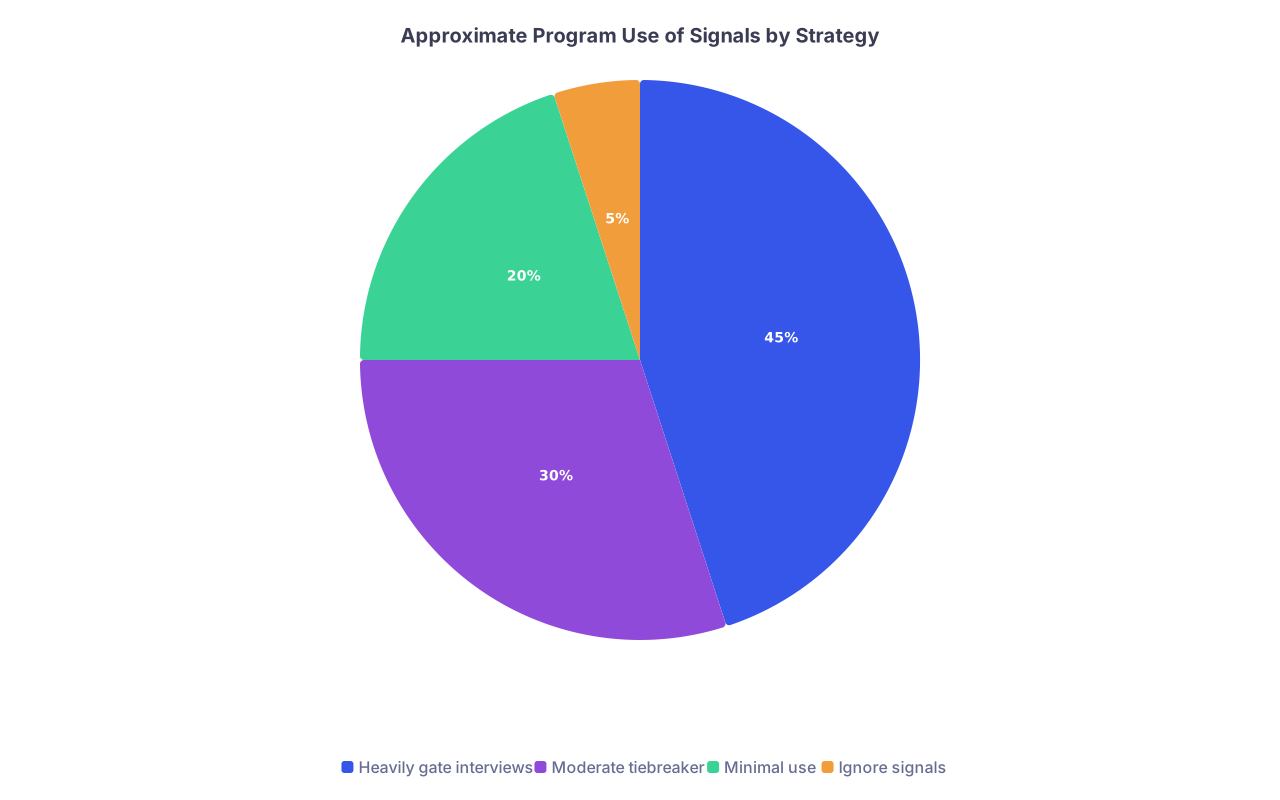
| Category | Value |
|---|---|
| Heavily gate interviews | 45 |
| Moderate tiebreaker | 30 |
| Minimal use | 20 |
| Ignore signals | 5 |
Do not memorize those numbers; they’re illustrative. But the proportions are roughly what I’ve heard in director meetings across specialties.
1. The “Signal or No Interview” Programs
These are mostly mid-to-high tier academic programs, at least in competitive metros or specialties.
Internal medicine in big cities, EM in desirable locations, ENT, ortho, derm, you know the list.
Their logic is brutally simple:
- “We have 60 interview spots and 400 signals. Why on earth would we invite non-signals first?”
So their rough process looks like:

| Step | Description |
|---|---|
| Step 1 | All Applicants |
| Step 2 | Filter: Home / Rotators |
| Step 3 | Filter: Signaled Applicants |
| Step 4 | Auto-Review & Likely Invite |
| Step 5 | Score & Rank by Criteria |
| Step 6 | Fill Majority of Interview Slots |
| Step 7 | Exceptional No-Signal Bucket |
| Step 8 | Committee Review for Rare Invites |
If you’re not home, not a rotator, not an insane standout, and you didn’t signal them? You’re done. They’re just not going to say that on their website.
You’ll hear the line: “We review all applications holistically, with and without signals.”
And technically they’re not lying. They did look at your ERAS. It just happened to be in a pile marked “no signal, low priority.”
2. The “Signals as Priority” Programs
These are often solid academic or strong community programs that still get a lot of apps but not complete insanity.
Their move:
- Create an A-pile: signal + decent stats + reasonable fit.
- Create a B-pile: no signal but strong metrics or connection.
- Create a C-pile: no signal, mediocre fit, or obvious mismatch.
Signals get bumped to the front of the A-pile.
B-pile gets reviewed, especially if class size is big.
C-pile rarely sees daylight unless the season is going poorly.
This is where signals can turn a maybe into a likely.
3. The “We Don’t Depend on Signals Because We’re Not Drowning” Programs
Smaller community programs. Less desirable locations. Newer programs still building a name.
They get fewer applications, often review a higher percentage of them.
Here, a signal is a nice-to-have—especially if they’re worried about people flaking on interviews—but it doesn’t dictate the whole list.
I’ve heard PDs at these places say:
“I like signals to know who might actually rank us. But I’m not going to skip a great no-signal applicant just to invite a weaker one who signaled.”
So at these spots, a strong fit without a signal can still easily get an interview. The signal just nudges you up the order.
4. The “We Say We Use Them But We Barely Do” Programs
Usually legacy-heavy or niche programs with established pipelines:
- Tons of home students
- Strong preference for regional schools
- Heavy reliance on word-of-mouth or faculty emails
They’ll accept signals, ERAS will show they “participate,” but behind closed doors the PD shrugs:
“I care way more about whether someone’s from our region, knows our alumni, or did research with us than whether they used one of their lottery tickets.”
The catch: you don’t always know which programs fall in this category. Some you can guess; but a lot you can’t.
How Many Programs Treat Signals as “Almost Required” for Interview?
If you want a real sense of things, here’s how I’ve heard different program types talk in ranking meetings and PD calls.
| Program Type | How Often Signals Are Critical |
|---|---|
| Top-tier academic in major city | Very often / near-essential |
| Mid-tier academic in competitive region | Often important |
| Strong community with good reputation | Helpful but not mandatory |
| Newer or less popular community | Nice but low-weight |
| Home program (your own med school) | Usually irrelevant |
Again, not a rulebook. Just how it tends to shake out.
The Biggest Myths Students Believe About Signals
Let me kill off a few fantasies you hear on Reddit and in hallways.
Myth 1: “If I signal, I’ll get an interview.”
No. Absolutely not.
Here’s how PDs frame it mentally:
“A signal means I should look harder at you, not that I owe you anything.”
If your application is clearly off for that program—weak Step 2 for a super competitive place, zero research for a research powerhouse, weird LOR mix—your signal does nothing.
At some places, they’ll actively resent it.
I’ve heard:
“Why did this person waste a signal here? They clearly don’t understand what we do.”
(Related: Signal misuse and how it harms cycles)
Myth 2: “If I don’t signal, I have no chance.”
False, but it depends on the kind of program.
You absolutely can get interviews without signals at:
- Your home program
- Places where you rotated
- Programs in your region with strong ties
- Community programs that aren’t oversubscribed
- Programs where a faculty advocate is pushing your name
Where no-signal really hurts is at big-name, high-volume programs that don’t know you from Adam and need some reason to pick you out of 800.
Myth 3: “Signals should all go to reaches.”
This is how people quietly tank their cycles.
If you send every signal to hyper-competitive, top-10 type places where your odds are low even with a signal, you’ve just turned a real tool into a lottery ticket.
The unspoken PD view:
“If your numbers don’t match our usual interview pool and you signaled us, I might respect the hustle, but I’m not bending our bar for you.”
There’s a balance: a couple of aspirational signals are fine. But an all-reach strategy is just self-sabotage dressed up as “confidence.”
How You Should Actually Pick Where to Signal
This is the part you’re not going to hear from official advisors, because they’re afraid of being “too strategic” or “gaming the system.”
Everyone is gaming the system. You might as well do it intelligently.
Think of your signals in three tiers:
- Anchor programs – places where you’re reasonably competitive and genuinely want to be.
- Smart reaches – above your median, but with some hook: geographic tie, mentor connection, specific research overlap.
- Solid safeties – programs that are more likely to interview you if you show interest, and where you’d actually go if it came to it.
The mistake I see constantly:
Students send most of their signals to fantasy reaches and almost none to strong-but-realistic anchors. Then they’re shocked when they end up with very few interviews and are forced to lean hard on lower-tier backups they never signaled at all.
You want your signals to do one thing:
Increase your probability of getting enough high-quality interviews to match safely, at places you could see yourself actually training.
Not impress your classmates. Not look “ambitious.”
What PDs Look For When Matching Your Signal to Your File
Let’s talk about how your application interacts with the signal.
Most PDs do something like this:
They see the signal icon pop up in their dashboard. They click your name. They’re asking:
- “Is this a plausible fit based on our usual numbers?”
- “Is there any obvious reason this person would come here?”
- “Does their file look consistent with what we value?”
If the answer to 1 is a hard no (for that specific program), your signal is wasted.
If the answer to 2 is no, your signal can feel random. Risky.
If the answer to 3 is no, they question your judgment.
Examples.
- You signal a heavy research powerhouse with zero meaningful research and generic letters. They assume you’re just name-chasing.
- You signal a county hospital with a strong underserved mission, and your entire file screams private practice, zero underserved exposure, and no mention or experience in that population. They question sincerity.
- You signal a place three states away with no geographical ties, no mention in your personal statement, and nothing in your experiences implying interest in that region. You look scattered.
Where signals work beautifully is when the story is coherent:
- You’re from that region.
- You have family nearby.
- Your mentor trained there and wrote a strong letter.
- Your experiences align with their specific strengths (VA-heavy, county-heavy, research-heavy, global health, etc.).
Everything lines up and the PD thinks:
“Okay, if we interview this person, there’s a real chance they’ll rank us high and be happy here.”
(See also: How away rotations are discussed in selection meetings for more details.)
Special Situations: Who Needs to Treat Signals Like Oxygen
There are groups of applicants for whom signals matter more than average.
1. You’re Slightly Below the “Stats Bar” for Your Target Tier
If the median Step 2 for their interviewees is 245 and you’re sitting at 234, but you’re otherwise strong, a signal helps get you a look.
You’re not miles off, but enough that you might be dropped if you were anonymous. A signal says: “At least open the file.”
2. You’re Switching Regions
From East Coast but want to end up in the Pacific Northwest, without prior training there.
Programs see tons of random “I’d love to move there” applications. A signal plus a clear geographic story (family, partner, lifestyle reasons backed by electives or experiences) distinguishes you from vacationers.
3. You’re Coming From a Lower-Visibility School
DO schools, newer MD schools, Caribbean grads—signals matter more.
Not because PDs hate you by default, but because you don’t benefit from the “We know their dean, we trust their grading” pipeline. A signal pushes them to read more deeply instead of skipping to the next big name.
How Signals Play With Away Rotations, Home Programs, & Emails
Short version:
- Home program: Most of the time you do not need to burn a signal here. They already know you. If your home PD is telling you they strongly prefer a signal, fine. But usually it’s wasteful.
- Away where you rotated: Similar logic. Your rotation is the signal, if you didn’t tank it.
- Cold programs where your mentor has pull: If your mentor is emailing the PD and vouching for you, a signal on top of that can be powerful. Shows alignment from both sides.
- Mass emails from you to PDs: Do not think you can replace a signal with a generic interest email. They see through it instantly. An email has leverage when it’s backed by a real connection or story. A signal has leverage when it’s backed by a coherent file.
A well-placed signal plus a quiet email from a respected faculty member to the PD? That moves the needle. I’ve watched it happen.
How Many Signals Should Go to “Reach” vs “Realistic” vs “Safety”?
You want rough proportions, I know. Fine. Use this as a starting frame, not a script.
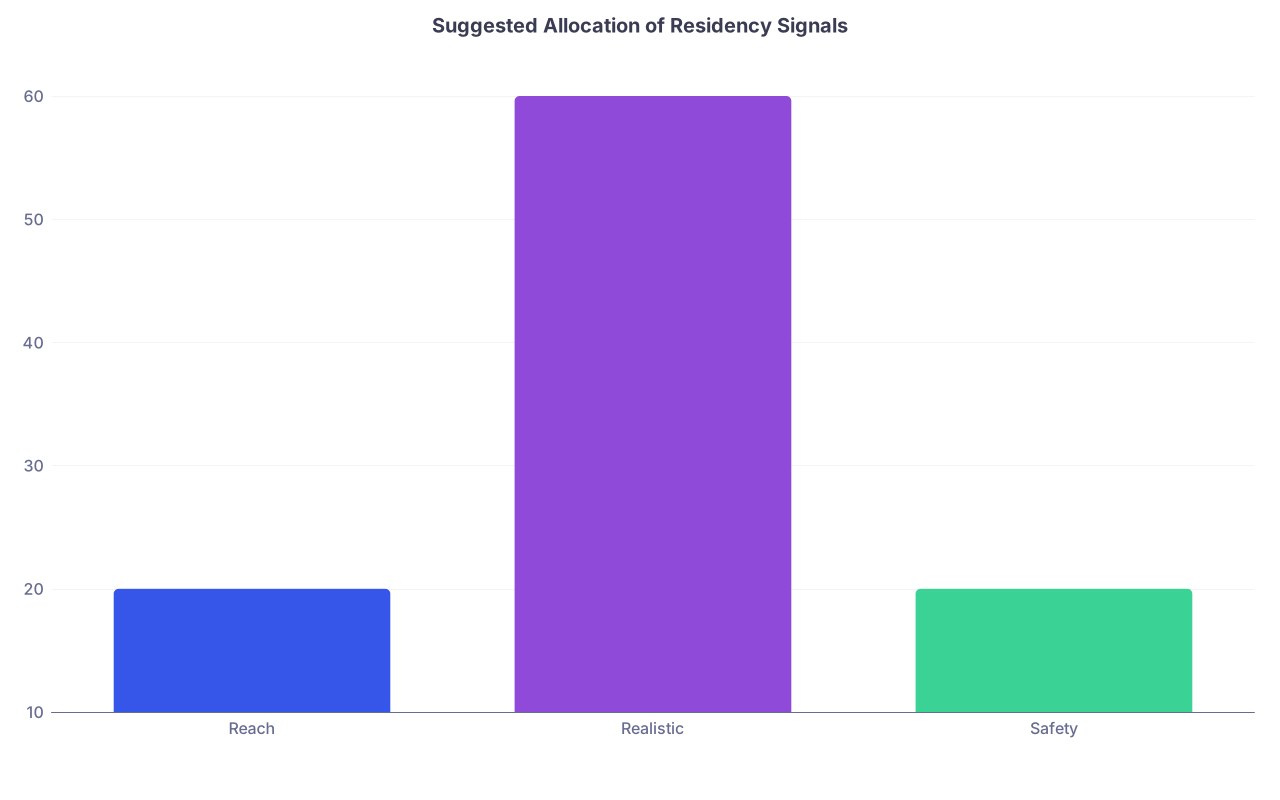
| Category | Value |
|---|---|
| Reach | 20 |
| Realistic | 60 |
| Safety | 20 |
Let me translate that:
- Around 60% of your signals should go to programs where your stats and experiences are in range and you’d honestly be happy.
- Maybe 20% to aspirational places where you have some plausible hook.
- And 20% to “safeties” that you’d accept without feeling miserable and where interest really matters.
If you’re extremely competitive on paper, your curve shifts more toward reach/realistic. If you’re borderline for your specialty, you should bias toward realistic/safety.
What you do not do is send:
- 80–90% to fantasy reaches “just to see”
- 0 to realistic mid-tier academic or good community programs that could anchor your cycle
That’s how people end up in SOAP wondering what happened.
How This Plays Into Matching, Not Just Interviews
Here’s a quieter downstream effect.
Programs know that signalers are more likely to actually want them. That shapes rank lists.
I’ve heard this exact line in rank meetings:
“We have two very similar applicants. One signaled us, one didn’t. If we go deep into our list, who’s more likely to come here?”
So your signal still has relevance months later, if you interview well.
It’s not decisive against a clearly stronger applicant. But as a tiebreaker, especially for borderline positions on their rank list, your signal can still pay dividends.
If You’re Non-Traditional, Low-Stat, Or Coming From a Weaker Position
Signals are magnifiers, not miracles.
If your file is disastrous, no number of signals is saving you. But if you’re in that gray zone—maybe a red flag, a gap, a lower Step 2 but strong improvement—signals can buy you a closer read at the right places.
The key is being brutally honest about where you are competitive.
You’re better off:
- Signaling one very reachable solid urban community program
than - Wasting it on three marquee university hospitals that have not taken anyone with your Step score in years.
This is where real advising matters. Not the “apply broadly and hope” nonsense. But targeted “where have people like you actually matched” conversations.
Ask your school. Ask recent grads. Ask residents in your specialty. Compare their profiles to yours honestly. Adjust signal targeting accordingly.
Quick Reality Checks Before You Submit Your Signals
Before you lock them in, ask yourself for each program:
- “If they looked at my Step score, clerkship grades, and school alone—am I in their interview range or way outside it?”
- “Can I give a credible, specific reason I’d be happy there if they asked me in an interview?”
- “Does my file show any alignment with what this program is known for?”
- “If this were my only match, would I sign the contract without feeling sick?”
If you say “no” to 2, 3, or 4, that’s a terrible place for a signal. You’re advertising commitment where you do not actually have it.
PDs are not stupid. They can smell when applicants are just shotgunning brand names.
Key Takeaways (If You Skimmed Everything Else)
- Signals are not cute expressions of interest; at many programs, they’re the first gate for interviews.
- A signal only helps where you’re a plausible fit and your story makes sense for that program; it is not a magic override for bad fit or wildly low stats.
- Most of your signals should go to realistic anchor programs you’d happily attend, not just fantasy reaches that look good on your list.