Behind Closed Doors: How Advocacy From Your Home PD Really Works
It’s late November. You just hit “submit” on ERAS weeks ago, and your email refresh habit is getting pathological. Half your classmates are swapping interview invites in the group chat. You’re staring at a quiet inbox and thinking: Should I ask my home PD to make a call? Does that even do anything?
Let me tell you exactly what happens on the other side of the door. The stuff nobody writes in official “advice” guides because it would make some people very uncomfortable.
I’ve sat in those ranking meetings. I’ve watched PDs text each other mid-committee. I’ve heard the “I owe him one, I’ll move this kid up” comments.
You want the truth? Here it is.
The Hierarchy of Advocacy: Not All PDs Are Equal
First thing you need to understand: “PD advocacy” is not one thing. It’s a spectrum. And the influence depends on three variables that almost no student bothers to think through:
- Who your PD is in the national pecking order
- The relationship between your PD and the target program
- When the advocacy happens in the cycle
Let’s break that down. Because this is where the real power (or lack of it) lives.
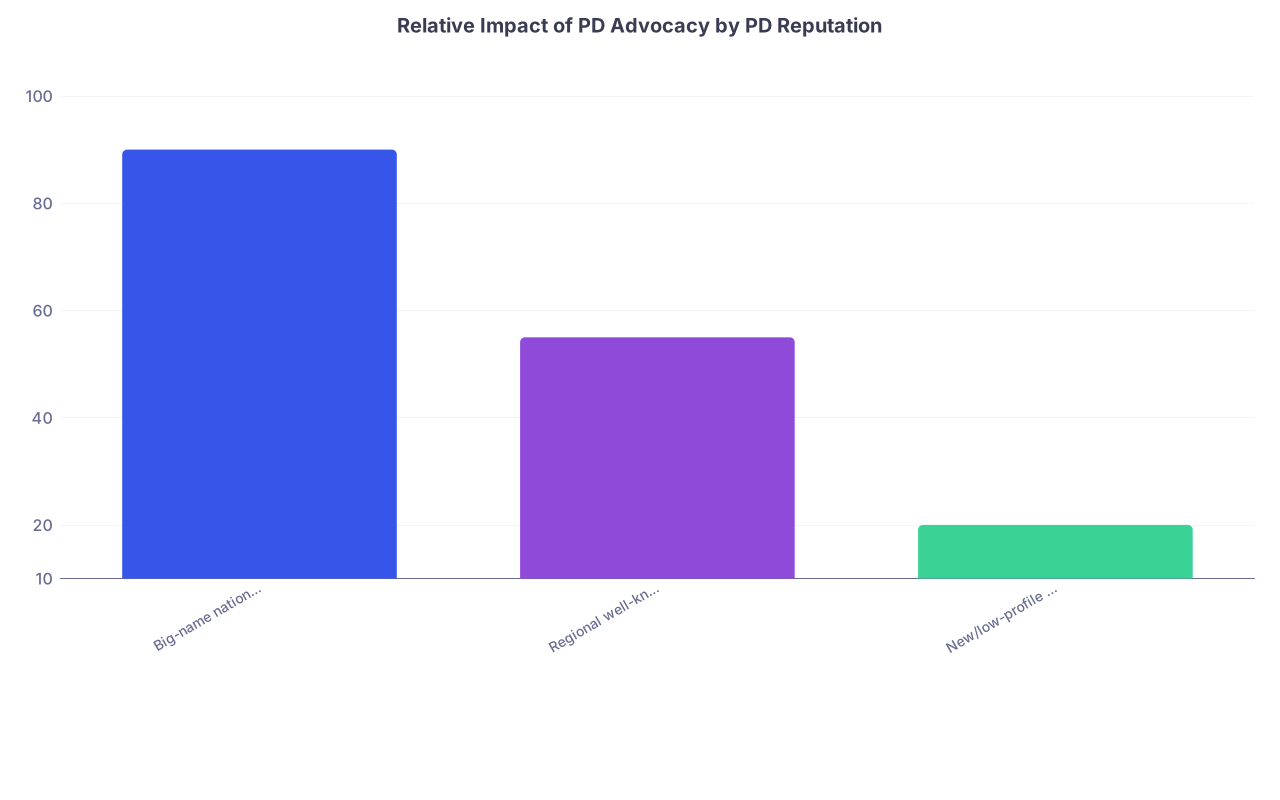
| Category | Value |
|---|---|
| Big-name national PD | 90 |
| Regional well-known PD | 55 |
| New/low-profile PD | 20 |
That bar chart? That’s about right in effect size, not “morality.” A big-name PD with national roles (NRMP, ACGME committees, national society leadership) can absolutely move mountains for a borderline applicant. I’ve seen it done. Repeatedly.
A few concrete realities:
- A PD who has been around 10–20 years, speaks at national meetings, and has sent residents to a given program for a decade? Their email gets read. Their calls get returned. Quickly.
- A brand-new PD at a small, non-academic community program? Their advocacy is more like a “character reference.” Respected, but it will not override major red flags or weak applications.
- A PD who is trusted by other PDs (this part matters more than status) can move you from “we might not interview” to “we should at least bring them in.”
Behind closed doors, this is the language:
“He’s a bit of a stretch on Step, but [Big-Name PD] called me personally. Said he’s legit. I’m not going to ignore that.”
Notice something? They’re not blindly overriding the file. They’re using the relationship as a tiebreaker or a reason to take a chance, not as a command.
If you’re counting on advocacy to rescue a truly catastrophic application, you’re misunderstanding how risk-averse most programs actually are.
What Advocacy Actually Looks Like (Not the Fantasy Version)
Most students imagine some dramatic “phone call that changes everything.” That’s not how it works 90% of the time.
Here’s the reality: advocacy usually falls into 4 types.

1. The Pre-Interview Nudge: “You Should Look at This One”
Used when: You haven’t gotten an interview but should be in range.
Medium: Email, sometimes phone, often text if they’re close.
Example lines I’ve literally heard read aloud:
- “This is one of my top 3 this year. Strong work ethic, no drama, would fit your place really well.”
- “Scores are not reflective of clinical ability. I’d trust her with my own family.”
Impact: Moves you from “maybe/no” pile to “offer an interview.” Especially at places that haven’t fully filled interviews yet.
If you’re already way below their usual metrics, this kind of note might get you a courtesy look. But don’t expect miracles. PDs remember when their colleagues vouch for weak candidates who flop.
2. The Post-Interview Bump: “We Really Believe in This Applicant”
This one is more powerful than the pre-interview nudge.
Used when: You’ve already interviewed. You’re somewhere in the middle of their rank list universe.
Medium: Phone call or direct email to the PD or APD.
The message is basically: “Not just good. One of ours. Please rank them decently.”
Internally, committees translate this as: “This isn’t random flattery. This PD is putting their name on the line. They’ll notice if we toss this kid at the bottom.”
Impact: Moves you up within your tier. So if you were mid-middle, you might become high-middle or even creep into the low-upper tier. That’s the difference between matching and not sometimes.
Seen it happen: at a strong IM program, we had 40 very similar mid-tier applicants. One had a PD call: “If he doesn’t match at our place, yours is our first hope.” That resident ended up at our program. He was not initially in the top third before that call.
3. The Damage Control Call: “Here’s What Really Happened”
This is for students with a story. Leave of absence. Red flags. Rocky start in M3. Remediation.
Most programs do not take your “personal statement explanation” at face value. They want an attending or PD to confirm.
Advocacy here sounds like:
- “He owned his mistake and has been rock solid for 2 years. I’d take him in my program without hesitation.”
- “Her LOA was truly for medical reasons, now resolved. No professionalism issues whatsoever.”
Impact: This does not rocket you to the top, but it can keep you from being auto-screened out. It can turn “hard no” into “okay, we can consider them fairly.”
Without this type of advocacy, many programs just won’t gamble.
4. The Nuclear Option: “This One Is a Personal Favor”
This is rare. And you should not assume your PD will use it for you.
Used when: Relationship between PDs is very strong, and you’re someone your PD would literally hire themselves but can’t (no spot, specialty mismatch, geography).
Language (behind closed doors):
“I owe him. He asked me to take a serious look. I’m going to try to make this happen if rank space allows.”
Impact: You’re now under a warmer light. It does not mean you jump 100 spots. But if you’re competitive and in their “could-rank” pile, this can bump you into the “we really should rank them reasonably high” territory.
But here’s the catch: PDs don’t use this card often. Because every time they push too hard for a weak candidate, they burn a little credibility.
Who Actually Gets Strong Advocacy (and Who Thinks They Deserve It)
This is where students are often delusional. Not malicious. Just clueless about how PDs think about political capital.
PDs don’t go all-in for every student who asks nicely. They just don’t.
The ones who get real, enthusiastic, follow-up-3-times advocacy usually fall into categories like:
- Top third of the class clinically with consistently strong evaluations
- Residents/clerks who made the PD’s life easier: chief-type personalities, no drama, good team energy
- Students who’ve been honest and transparent early about their struggles and ambitions
- Home institution “success stories” that the PD wants to associate with their program’s reputation
Then there are the others:
- The student who never once showed up to the PD’s office in 4 years, then emails in January: “Can you call MGH for me?”
- The student with mediocre performance, professionalism concerns, and the belief that a call will erase all that
- The one applying to 12 “reach” programs, all of which are sick of being used as fantasy options
Do PDs still sometimes place a call for these folks? Yes. But it’s softer language. More guarded. And the receiving PD can hear it.
Here’s the difference in subtext, which PDs are very good at decoding:
Strong advocacy:
“If you have room for one more person in that range, I’d put them in it. I’d be surprised if you regret it.”
Lukewarm advocacy:
“They rotated with us and did fine. No issues. Worth a look if you have space.”
Only one of those moves your position significantly.
Timing: When Advocacy Helps and When It’s Too Late
You’d be shocked how many students ask for PD help at the worst possible time. Or in the wrong way.
Let’s talk about the cycle in real terms.
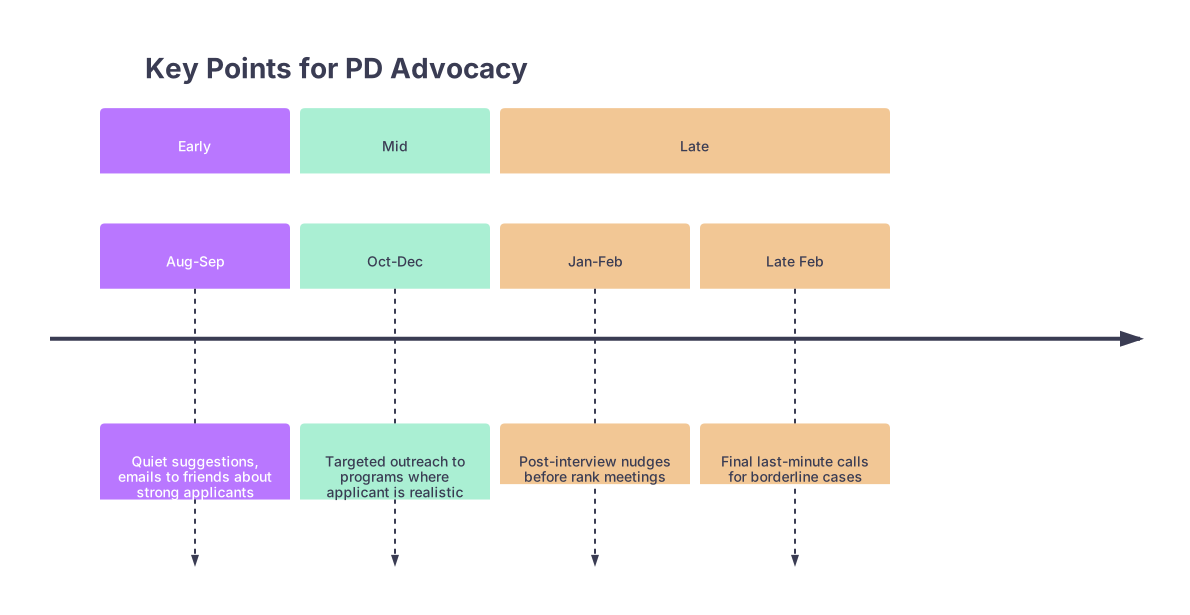
| Period | Event |
|---|---|
| Early - Aug-Sep | Quiet suggestions, emails to friends about strong applicants |
| Mid - Oct-Dec | Targeted outreach to programs where applicant is realistic |
| Late - Jan-Feb | Post-interview nudges before rank meetings |
| Late - Late Feb | Final last-minute calls for borderline cases |
Early (Aug–Sep):
PDs are just getting a sense of their own pool. If they already know you well and you’re a star, they may casually mention you to a few close colleagues. This is subtle. Often this is where the “superstars” get advance positioning.
Mid (Oct–Dec):
This is where most meaningful pre-interview advocacy happens. PDs might reach out to:
- Programs that have historically taken their grads
- Places where your profile is competitive
- Colleagues who specifically ask, “Anyone from your place this year I should look at?”
If you come to them in November with a shortlist and a focused plan, they can actually do something.
Late (Jan–Feb):
Battlefield is different now. Interviews done. Files reviewed. Rank list discussions are happening.
Advocacy now is about rank positioning, not interview offers (with rare exceptions if a program has cancellations).
I’ve seen last-minute calls in late February that went like this:
“We’ve got her ranked middle. How serious is she about you?”
“Very. She’d be thrilled to match there.”
“Okay, we’ll bump her up a few spots. We like her too, just didn’t have clarity on her interest.”
That’s the kind of shift that matters. Students never see any of this, of course.
The Quiet Politics: PD Reputation and Trust
Here’s the part everyone pretends doesn’t exist: not all PD voices carry equal weight because not all PDs are equally trusted.
There are PDs known for:
- Over-selling every single one of their applicants as “amazing”
- Glossing over professionalism concerns
- Calling in “favors” twice a week
Those PDs get politely acknowledged. Then largely ignored.
Then there are the ones where, when we get an email, the room quiets down a bit. Because their word tends to match reality.
I remember one surgery PD saying during a rank meeting:
“[X PD] called me about this guy. You know she doesn’t advocate unless it’s the real deal. I’m inclined to listen.”
That one sentence moved a borderline applicant into a safe match zone.
Your PD knows this ecosystem. They know where their opinion actually matters. They will be strategic about which colleagues they push harder with and where their word is just one among many.
Which means: if they seem hesitant to “call Hopkins and MGH and UCSF for you,” it may be because they actually understand the landscape. Not because they don’t like you.
How You Actually Approach Your PD About Advocacy
Let me be blunt: most students do this badly. Either too entitled or way too vague. Or they wait until the end when the structure is already set.
Here’s how the smart ones do it.
| Approach Type | Example Behavior |
|---|---|
| Good | Meets PD early, brings realistic list, asks targeted help |
| Good | Provides CV + context, is honest about red flags |
| Bad | Vague email asking for 'any help' in January |
| Bad | Demands calls to top programs way out of reach |
| Bad | Disappears for years, then asks for huge favors |
They set the groundwork before ERAS:
- Meet with the PD when you’re planning your application strategy, not after it fails.
- Be honest: “I know my Step is below your usual range for X programs. If my clinical grades and letters are strong, would you be willing to support me to a couple of places where you think I’m realistic?”
- Ask targeted questions: “Are there programs you have good relationships with where you could see me fitting?”
When they ask for advocacy later, they come in with:
- A short, prioritized list (5–10 programs), not a scattershot spreadsheet of 50 places
- Clarity: “These 3 are my top realistic choices. If you felt comfortable reaching out to any of them, I’d be really grateful.”
- An understanding that the PD may say, “I have no connection there,” or “I can email, but I don’t have much pull with that institution.”
The behind-closed-doors reaction to that student?
“This one gets it. I’ll help.”
The student who emails in February: “Can you please call any of my top 20 programs?” gets… less enthusiasm.
What PDs Will Not Tell You Directly
There are a few truths PDs almost never say to students’ faces.
I will.
- If you’ve been unreliable, unprofessional, or a headache for the department, the PD is not going to go to war for you. You might get a bland letter. You will not get real advocacy.
- If you’re applying far above your weight class, they may quietly not advocate because they’d rather save credibility for applicants who are in range.
- Some PDs don’t advocate much for anyone. Either by philosophy (“meritocracy”) or lack of connections. You may have to rely more on other attendings or chairs.
- Advocacy is easier when you’re honest about your ranking intentions. If you say, “Your program is in my top 3 and if I end up at X or Y, I’ll be happy,” they’re more comfortable putting their name on you to those places.
I’ve seen PDs get burned when they push hard for someone to match at a particular program, only for that student to rank another place higher. Next year? They’re more cautious. Word spreads.
The Other Players: When Non-PD Advocacy Matters
One more layer you probably haven’t considered: PDs are not the only ones who can advocate.
Sometimes, their voice is actually not the strongest for you.
Other influencers:
- A division chief who trained with an outside PD
- A subspecialty faculty member who’s deeply trusted nationally
- The chair of the department who has more seniority and reach than the PD
Example: You’re an IM applicant gunning for a cardiology-heavy academic program. Your cards attending who’s a “name” in cardiology and friends with several PDs? Their call might carry more weight than the PD’s, depending on the relationship.
Behind the scenes, those calls sound like:
“I’ve worked with this student on research and on the wards. Great future cardiologist. Would love to see them at your place.”
Program committees hear that and think, “Oh, [Cardiology Big Shot] actually knows this person. That means something.”
So when you’re thinking advocacy, do not fixate on PD only. Think ecosystem.
The Hard Limit: Advocacy Cannot Completely Rewrite Reality
Let me cut through the magical thinking.
Advocacy:
- Can get you an interview you were on the bubble for
- Can help contextualize red flags
- Can move you within a stratum on a rank list
- Can serve as a tiebreaker between similar applicants
- Can sometimes rescue you in borderline match scenarios
Advocacy cannot:
- Turn a bottom-of-the-class, professionalism-problem student into a top-tier match
- Make a program ignore the fact that you failed multiple exams and never showed improvement
- Overcome a nonexistent track record from your school at ultra-competitive programs where they already have 200 excellent applicants begging to get in
Behind closed doors, the conversation sometimes sounds like:
“I know [PD X] likes him, but we’ve got 30 others with stronger files and similar support. We just don’t have space.”
That’s not malice. That’s math.
FAQ: What You’re Probably Still Wondering
1. Should I directly ask my PD to call specific programs, or wait for them to offer?
Ask. Directly but respectfully.
Something like: “Would you feel comfortable reaching out to any of these programs on my behalf?” Then show them a short prioritized list. If your PD is reasonable, they won’t be offended. They’ll either say yes, qualify where they have pull, or explain why advocacy might not help much in your situation.
2. Is it better for my PD to advocate before I get an interview or after?
Both matter, but if you have to choose, post-interview advocacy often has more precise impact. Pre-interview advocacy gets you in the door. Post-interview advocacy can move you to a safer position on the rank list. The ideal: pre-interview nudge for borderline places + post-interview check-in where you truly care about matching.
3. Can multiple people from my home institution advocate for me, or does that look pushy?
Multiple advocates can help, if it’s not chaotic. PD + one key subspecialty faculty or department chair is normal. Five random attendings emailing the same PD? Annoying. The best setup is coordinated: your PD knows who else might reach out, and they’re aligned on the message. Behind the scenes, that looks like a coherent chorus, not noise.
4. My PD isn’t well-connected nationally. Am I just out of luck for advocacy?
No. The absolute clout of your PD matters less at mid-tier and regional programs than you think. A sincere, specific, honest email from a less-famous PD still carries weight. And you can supplement with advocacy from other attendings, chairs, or mentors who are plugged in. The lack of a big-name PD might limit your odds at a tiny handful of hyper-elite programs; it doesn’t ruin your chances of a solid match.
Years from now, you won’t remember exactly which PD called whom or which email shifted your spot on some rank list spreadsheet. You’ll remember whether you dealt with this process strategically or by wishful thinking. Advocacy is real. It’s powerful. But it’s not magic. Understand how it truly works behind closed doors, and you stop gambling and start playing the game like an insider.