
What exactly do you think your program director sees when they read, “performed at the expected level for training” in your dean’s letter?
Because I’ll tell you: it is not “solid, reliable student.”
It is: “We are telling you they are average, and we are being polite.”
If you are counting on your dean’s letter (MSPE) to be a quiet, neutral document that no one reads closely, you are making a serious mistake. Program directors absolutely read them. Many of them go straight to the narrative and “comparative performance” sections looking for subtle red flags, coded language, and missing pieces.
This is not about paranoia. It is about pattern recognition. PDs have read thousands of these. They know what normal praise looks like. They know what strong looks like. They also know what a carefully worded warning looks like.
Your job is to avoid being that warning.
How Programs Actually Use the Dean’s Letter
Let me clear up one myth right away: the MSPE is not just a formality. It is triage.
Most programs use it for at least four things:
(See also: How PDs interpret gaps, LOA, and repeat years on ERAS applications for guidance.)
- To verify there are no professionalism disasters.
- To check for unexplained leaves, gaps, or remediation.
- To calibrate comments from your other letters.
- To see how your school really rates you compared with your peers.
They are not reading it like a personal essay. They are scanning like this:
- Drop to the Summary / Noteworthy Characteristics.
- Scan Clerkship Narratives, especially Internal Medicine, Surgery, EM, Psych, and any sub-I.
- Check for comparative statements: “among the top X%,” “performed at the level of peers,” etc.
- Look for anything that sounds off: faint praise, hedging, passive voice, euphemisms.
You may think, “But my school only uses standardized language.” So do many schools. PDs still know what those codes mean.
Let’s talk about the phrases that move applications from “looks good” to “maybe not worth the risk.”
The Subtle “Not That Impressed” Phrases
These are not outright insults. That is not how this game is played. Most red flags in dean’s letters are polite, neutral on the surface, but obviously cautious to anyone who has read them for more than one cycle.
1. “Performed at the expected level for training”
Translation in PD brain: “Not exceptional. Nothing special. Not a problem, but not a standout.”
Harsh? Yes. True? Also yes.
Most programs do not have unlimited interview spots. They want enthusiastic, positive, comparative language for the people they bring in. So when the dean’s letter says you met expectations and that is the strongest comment anywhere, you fall into the forgettable middle.
Problem is, many students think “met expectations” sounds good. It does not. It is a B-.
Mistake to avoid:
Assuming “no negative comments” equals competitive. If your MSPE is filled with lukewarm, standardized “met expectations” language and no one ever labels you “among the top” or “one of our stronger students,” competitive programs will move on.
2. “Initially struggled with…”
You will see this in phrasing like:
- “Initially struggled with clinical reasoning but improved with feedback.”
- “Initially had difficulty with time management but demonstrated progress.”
- “Initially required close supervision but became more independent over time.”
Every PD has seen the pattern: the problem is rarely the second half of the sentence (“improved with feedback”), it is the first clause.
They immediately wonder:
- How bad was the initial struggle?
- Did this affect patient care?
- Why did it stand out enough to earn a line in the MSPE?
How this burns applicants:
I have watched PDs read one of these and say out loud, “There are enough students who did not ‘initially struggle.’ We will take them first.”
If you know you had a rough early rotation and there is a risk this language will appear, you need to:
- Get strong, specific letters from later rotations that clearly state you are functioning at or above the expected level.
- Talk with your dean’s office before the MSPE is finalized to make sure any “struggle” language is balanced and not exaggerated.
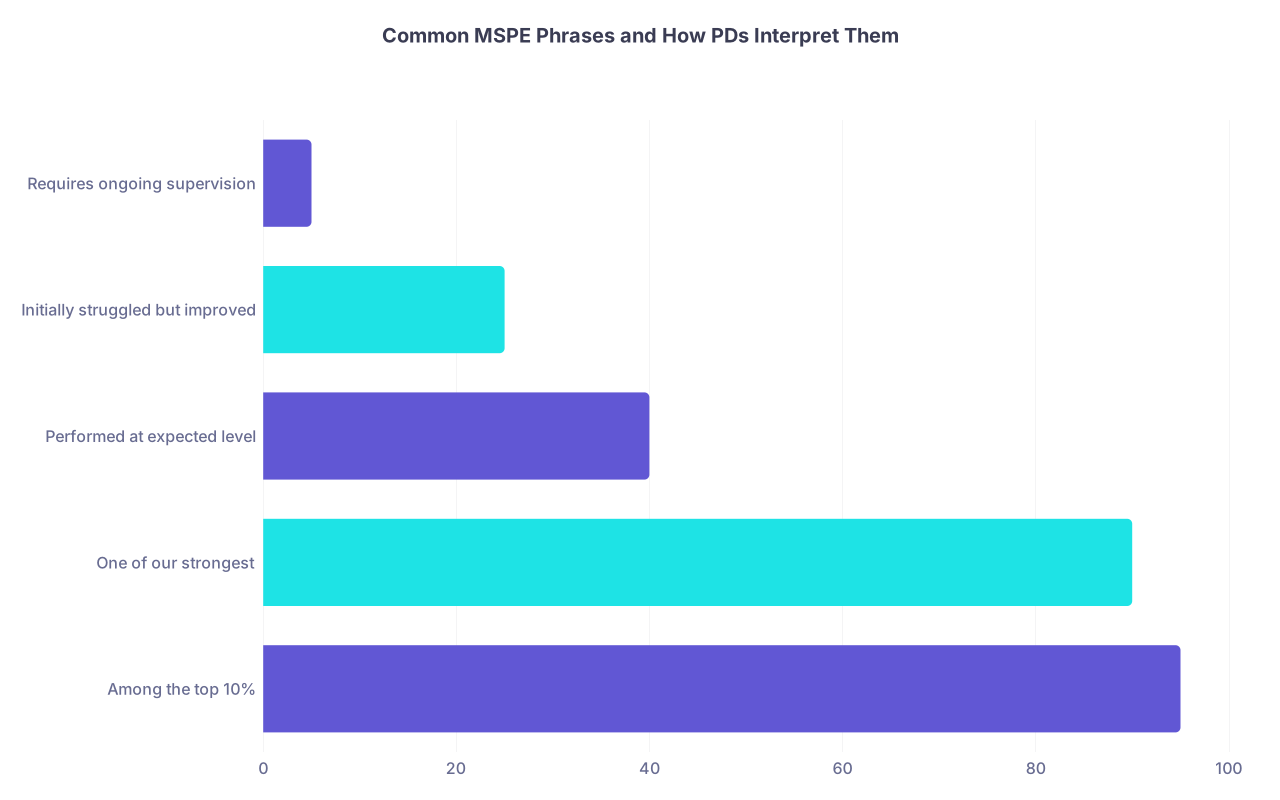
| Category | Value |
|---|---|
| Among the top 10% | 95 |
| One of our strongest | 90 |
| Performed at expected level | 40 |
| Initially struggled but improved | 25 |
| Requires ongoing supervision | 5 |
The “Professionalism Concern” Code Words
Programs are ruthless about professionalism. One yellow flag in that area weighs more than two lines of praise about clinical skills. They can teach you medicine. They do not want to teach you how to show up.
Here is the problem: schools rarely write “unprofessional” in the MSPE. They use softer language that still conveys the message clearly to anyone used to reading between the lines.
3. “Required additional feedback in…”
Typical wording:
- “Required additional feedback in professionalism.”
- “Benefited from ongoing coaching in communication with staff.”
- “Needed reminders regarding punctuality and documentation.”
This is Dean’s Office code for: “We had to repeatedly talk to this person about behavior that should not be an issue at this stage.”
Programs notice:
- “Additional feedback”
- “Ongoing coaching”
- “Reminders”
Those are not neutral words. They signal pattern, not one-off event.
4. “Had an incident involving…”
Red flag language often looks like:
- “Had an incident involving communication with a nurse that was addressed with feedback.”
- “Was involved in an incident related to documentation which was resolved with additional oversight.”
- “There was a professionalism concern earlier in training that was remediated.”
If they use the word “incident” or “concern,” PDs assume:
(See also: Red Flags That Quietly Sink Applicants Before the Interview Invite for related reading.)
- It was serious enough to require documentation.
- There may be more behind this than the single sentence describes.
- Your school is legally protecting itself by mentioning it.
Critical mistake:
Not asking your dean’s office exactly how any professionalism issue will be described in the MSPE. I have seen students blindsided by a single sentence that tanked their chances at competitive programs because they assumed “all is forgiven” meant “all is erased.”
If you had any formal write-up, remediation, or disciplinary review, you must:
- Ask what your school is obligated to disclose.
- Request to see the wording early.
- Have strong, recent letters that explicitly vouch for your reliability and professionalism.
The “We Do Not Fully Trust Their Independence” Signals
Programs want to know whether you can function at an intern level with appropriate supervision. Anything that implies you need more handholding than your peers is a problem.
5. “Will benefit from close supervision as an intern”
This is the kiss of death in some specialties.
Variants include:
- “Will benefit from a structured, supportive environment.”
- “Will do best in a residency with clear supervision and expectations.”
- “Would thrive in a program that provides close oversight early in training.”
Sounds kind. Sounds supportive. PDs hear: “We do not think this person is safe to be left alone.”
Will some community programs be more forgiving? Yes. But if you are shooting for a high-volume, high-acuity residency in EM, surgery, or IM, that phrase will push your file to the bottom of the pile.
6. “Needs to continue developing…”
Everyone is “continuing to develop” something. That is not the issue. The problem is what exactly they pair that with and how strongly.
Benign:
- “Will continue to develop efficiency, like all learners at this stage.”
Bad:
- “Needs to continue developing clinical judgment before functioning independently.”
- “Needs to continue developing reliability and follow-through on tasks.”
- “Needs ongoing development in communication with patients and staff.”
Programs look for what you are still “developing.” If it is fine motor skills for a procedural specialty as an M3, that is normal. If it is clinical judgment, reliability, or communication in late M4, that is not.

The Omission Red Flags: What Is Not Said
Sometimes the loudest red flag is silence.
Program directors know what a normal, strong MSPE from a school looks like. They see hundreds. When yours deviates, they notice.
7. No comparative language anywhere
Most schools will use some comparative framework:
- “Top third of the class”
- “Upper quartile”
- “Among our above-average students”
- “Performed at or above the level of peers”
If your letter has none of that, PDs wonder:
- Did the school decide not to rank this student?
- Did they intentionally avoid comparison because it would be unfavorable?
- Is there something they do not want to say out loud?
Sometimes schools have strict policies against comparative language for all students. That is fine. PDs know the usual patterns from each school. But when your letter looks distinctly more neutral than your classmates’, that is a problem.
Your move:
Ask older students from your school to share anonymized MSPE language (many will). If theirs all say “top third” and yours says nothing comparable, you need to have a conversation with Student Affairs about why.
8. Glowing praise… that never becomes specific
This is a subtle, but common one.
You get language like:
- “Pleasure to work with.”
- “Well-liked by peers and staff.”
- “Will be an asset to any program.”
But then, in your clerkship narratives:
- No “top student” language
- No concrete examples of excellence
- No mention of leadership, initiative, or specific strong performance
PDs have learned to see generic praise with no details as filler. It sounds friendly, but it often means: “Nice person, average performance.”
| MSPE Phrase | Program Director Interpretation |
|---|---|
| "Among the top 10% of students I have taught" | Strong positive signal |
| "Performed at the expected level for training" | Average; not a standout |
| "Initially struggled but improved with feedback" | Concern; avoid if plenty of other options |
| "Required additional feedback in professionalism" | Professionalism red flag |
| "Will benefit from close supervision as an intern" | Questionable independence; potential risk |
The Rotation-Specific Landmines
Certain specialties and rotations carry extra weight. If the dean’s letter contains odd language in these areas, programs care much more.
9. Internal Medicine and Surgery narratives
For most students, IM and Surgery are your core “can they handle wards and call?” rotations. PDs scrutinize these carefully.
Red flag wording:
- “Had difficulty managing multiple patients simultaneously.”
- “Needed redirection on several occasions regarding follow-through on tasks.”
- “Required more supervision than typical for this level of training.”
Even if later rotations were better, PDs worry that the underlying problem (organization, follow-through, stamina, attention to detail) may persist under PGY-1 pressure.
10. Emergency Medicine or Sub-I comments like:
- “Relied heavily on seniors.”
- “Needed frequent prompting to consider full differential diagnoses.”
- “Struggled to prioritize tasks in a fast-paced environment.”
Programs know students are not interns yet, but this kind of language signals you were noticeably behind your peers when the expectations were highest.
If you see any of this coming:
- You need at least one other letter from a different setting that explicitly describes you as independent, organized, and ready for intern responsibilities.
- You should be realistic about the level of program you are targeting.

| Step | Description |
|---|---|
| Step 1 | Open MSPE |
| Step 2 | Summary & Noteworthy Characteristics |
| Step 3 | Clerkship Narratives |
| Step 4 | Check comparative performance |
| Step 5 | Assess severity & pattern |
| Step 6 | Likely screen out |
| Step 7 | Weigh with rest of application |
| Step 8 | Overall impression |
| Step 9 | Any red flag phrases? |
| Step 10 | Professionalism or safety? |
Late Changes, Leaves, and “Personal Circumstances”
Life happens. Leaves of absence, course repeats, and personal crises are not automatic death sentences. The mistake is letting them appear vague or unexplained in your dean’s letter.
11. “Took time away from training for personal reasons”
On its own, that line is not the problem. The problem is when there is:
- No consistent explanation in your application.
- No one vouching for your current stability and reliability.
- A pattern of other soft red flags (lateness, missed rotations, repeated courses).
PDs are risk-calculators. They do not need every detail of your life. They do need to know:
- Is the issue resolved or actively managed?
- Has this affected performance or professionalism?
- Do we have to worry about them disappearing in October of PGY-1?
You should never overshare sensitive details in a dean’s letter. But you and your dean’s office must at least align on a clear, honest, and reassuring one- or two-line description that matches the rest of your application.
12. “Required additional time to complete…”
As in:
- “Required additional time to complete the third-year curriculum.”
- “Completed the clerkship year over an extended period.”
PDs will immediately look for:
- Fails?
- Remediations?
- Health or family issues?
- USMLE/COMLEX delays?
If the MSPE does not clearly tie this extended time to a straightforward, understandable reason (illness, family emergency, etc.), they assume academic or professionalism trouble.
Do not assume they will “get it” without explanation.

How To Protect Yourself Before the MSPE Is Finalized
You cannot fully control what goes in your dean’s letter. But you absolutely can avoid the biggest self-inflicted wounds.
Here is what I see students fail to do every single year:
- They never ask fourth-years or recent grads what “normal” MSPE language from their school looks like.
- They do not meet early enough with Student Affairs to discuss potential red flags.
- They assume that “passed rotation, no one yelled at me” means the narrative will be glowing.
Better approach:
Early M4: Meet with your dean / advisor. Ask bluntly:
- “Are there any concerns that may show up in my MSPE?”
- “Are there any professionalism or academic issues that must be mentioned?”
- “Can we discuss how those will be phrased?”
If you had issues:
- Own them. Provide a concise, mature explanation that can guide language: “resolved,” “no further incidents,” “subsequent strong performance.”
- Make sure your recent rotations are rock solid, and ask attendings who truly saw your improvement for letters.
Before submission:
- Review the MSPE for internal consistency with the rest of your application.
- Make sure any leave, delay, or struggle is at least intelligible and not cryptic.
What you must not do: pretend that if you ignore a problematic phrase, no one else will see it. They will. Quickly.
Final Thoughts: What Programs Actually Care About
Program directors are not hunting for perfection. They are hunting for risk.
The dean’s letter is one of their best tools for spotting it. That is why those little phrases carry so much weight. They compress years of faculty impressions into a handful of coded sentences.
If you remember nothing else, remember this:
- Neutral is not always neutral. “Performed at expected level” and “met expectations” are not compliments in a crowded applicant pool.
- Anything hinting at professionalism, reliability, or supervision concerns will outweigh almost every other strength. You must know if that language is coming and counterbalance it with recent, strong support.
- Silence and vagueness are their own red flags. Unexplained leaves, missing comparative language, and generic praise with no specifics all make programs nervous in ways you cannot afford to ignore.
You do not get to rewrite your dean’s letter. But you can stop being surprised by what is in it—and stop letting quiet red flags sink your application before you ever walk into an interview room.