
It is late. You are on your third cup of coffee, ERAS is open, and you are staring at that one USMLE score that still makes your stomach drop. You have another tab with a “draft explanation paragraph” that is now 600 words long, packed with details about the breakup, the illness, the move, the bad preclinical block, the family drama, the test center noise, the everything.
You keep thinking: “If I just explain it thoroughly enough, they will understand.”
This is where people get themselves into trouble.
Let me be blunt: over‑explaining low scores in ERAS is one of the most common, and most damaging, self‑inflicted wounds I see every application season. You are worried about one red flag. Program directors become worried about five.
You are not trying to hide anything. You are trying to be honest. But the way you frame and how much you say can easily turn a manageable concern into a deal‑breaker.
Let’s walk through the mistakes that escalate concern instead of calming it—and how to avoid doing this to yourself.
The Core Problem: Your “Explanation” Becomes New Evidence Against You
Most applicants think of an explanation as a fire extinguisher.
In reality, if you overdo it, it behaves more like gasoline.
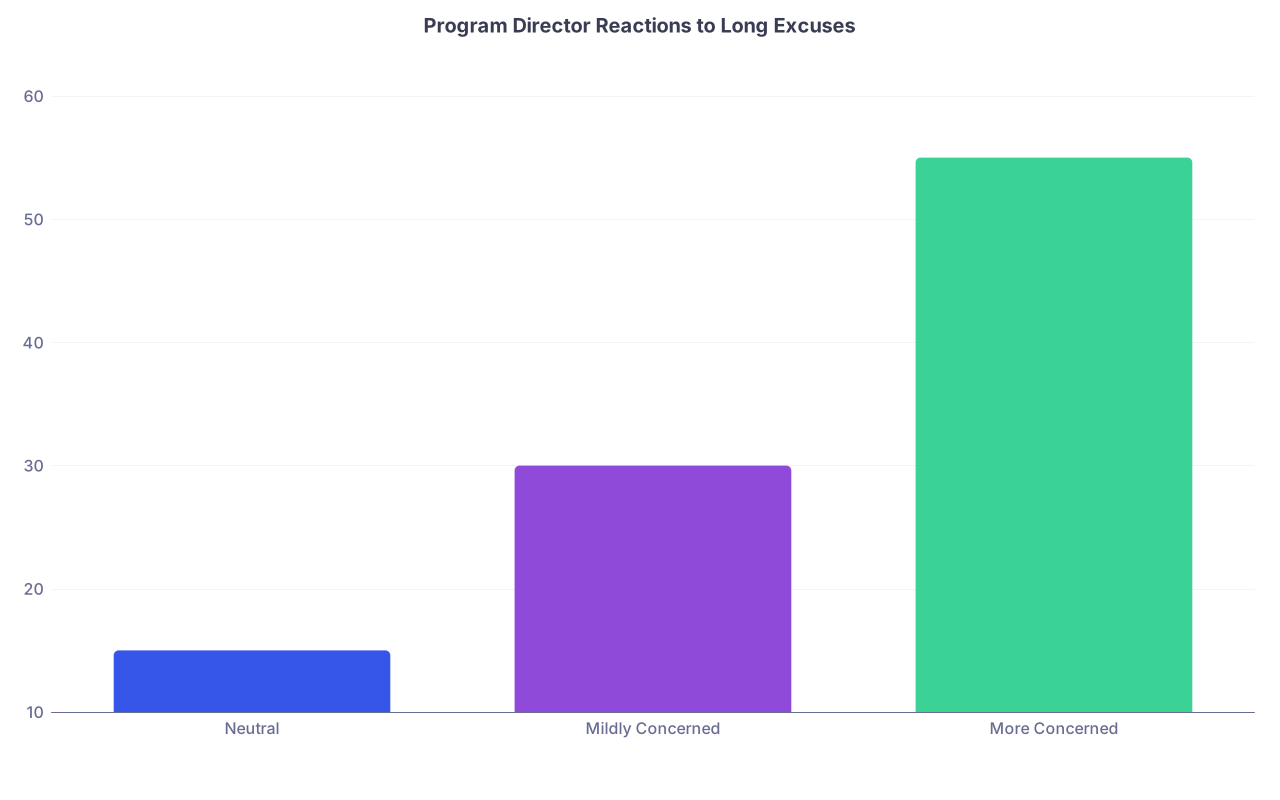
Here is what actually happens in program directors’ heads when they hit a wall of text about your bad test:
They start asking:
- “Why is this so long?”
- “Why are there three separate reasons for one score?”
- “Why is this person telling me about their relationship drama?”
- “Is this someone who externalizes blame?”
- “If I have this much trouble reading this explanation, what will their notes look like?”
You think more detail equals more understanding. They think more detail equals more instability.
| Category | Value |
|---|---|
| Neutral | 15 |
| Mildly Concerned | 30 |
| More Concerned | 55 |
I have watched committee meetings where a 2–3 sentence, focused explanation got a nod and a shrug—“seems reasonable”—and a 300‑word story from another applicant, with a very similar score, triggered a 10‑minute debate about judgment, resilience, and professionalism.
Same objective data. Very different reactions. The explanation made the difference.
The central mistake: assuming the more you talk, the safer you are. You are not in therapy. You are in a selection process.
Mistake #1: Turning a Single Red Flag into a Pattern of Instability
This is the most dangerous trap.
You have one low score or one failed attempt. It is fixable. Then you decide to “give full context”—and suddenly the file reads like a pattern.
A familiar example:
You write something like:
“During M2, I was going through significant personal stress from a breakup, financial issues, and a sick grandparent, which caused me to struggle with anxiety and time management. Then on the morning of my Step 1, I did not sleep well, my car broke down, and I arrived to the test center late and panicked…”
Stop. You just told them:
- Emotional turmoil
- Financial instability
- Significant anxiety
- Time‑management issues
- Difficulty performing under stress
- Car logistics problems
- Panic
For one exam.
Program directors do not say, “Wow, poor thing.” They say, “What happens on call?” “What happens when three sick patients and a family meeting hit at the same time?” “What happens in a rough ICU month?”
You intended to explain a single bad day. You accidentally described a recurrent vulnerability.
How to avoid this:
- Pick one or two key contributing factors.
- Avoid laundry lists of every bad thing that was happening.
- Do not stack multiple domains of instability (emotional + financial + logistical + mental health) unless absolutely unavoidable.
If it reads like a pattern, they will treat it like a pattern.
Mistake #2: Making It Sound Like an Excuse Instead of Accountability
Program directors are not idiots. They know life happens. Illness, family death, acute crisis—these things are real. They will absolutely accept a brief, grounded explanation.
What they will not accept: excuses.
Lines that set off alarms:
- “The exam did not reflect my true knowledge.”
- “The questions were unusually vague.”
- “The proctor was distracting, which made it hard to focus.”
- “I was still adjusting to the US system / remote testing / new environment.”
Every version of “it was not my fault” without explicit ownership reads poorly. You can have legitimate external factors, but if there is zero self‑reflection, the message is: “If anything goes wrong, I will point outward.”
Much better pattern:
- Brief context: “During that period, I was managing X.”
- Direct ownership: “I did not adjust my study strategy appropriately.”
- Evidence of change: “I then did Y and Z, which you can see reflected in my later performance on A/B/C.”
A lot of applicants avoid the ownership sentence because it feels like self‑indictment. It is the opposite. It shows maturity.
The mistake is believing that any mention of your own role makes you look weak. It makes you look like someone who can improve.
Mistake #3: Using the Wrong Place in ERAS to “Explain”
Another way people shoot themselves in the foot: using the personal statement as a damage‑control document.
If a quarter of your personal statement is about your Step score, that is exactly how you come across: as your Step score.
Program directors read hundreds of statements in a row. The ones that stand out:
- Show insight into the specialty
- Demonstrate fit with the program’s style of training
- Convey grounded self‑awareness and growth
The ones that get quietly written off:
- “I am not my Step score” essays
- Detailed test performance narratives
- Emotional deep dives into the day of the exam
Use the correct channel:
- The dedicated explanation box in ERAS (if you truly need one)
- A brief note in the MSPE / dean’s letter if pre‑approved by your school
- Occasionally a 1–2 line mention in the personal statement if the issue is central—but not the main topic
Do not convert your entire PS into a Step defense piece.

| Step | Description |
|---|---|
| Step 1 | Low Score or Failure |
| Step 2 | Do Not Mention |
| Step 3 | Use ERAS Explanation Box |
| Step 4 | 1-2 lines in PS + MSPE note |
| Step 5 | Brief MSPE note only |
| Step 6 | Needs Explanation? |
| Step 7 | Is there a dedicated ERAS box? |
| Step 8 | Central to your story? |
If you cannot say it cleanly in 3–5 sentences, your problem is not how to explain it. Your problem is that you are trying to do too much with the explanation.
Mistake #4: Oversharing Sensitive Personal or Mental Health Details
I have seen this far too often: someone tries to be fully honest about their depression, anxiety, trauma, or family situation, and ends up writing something that terrifies a committee.
Reality: there is still stigma. There are real concerns about reliability, call coverage, and safety. You can hate that and still need to be smart about what you disclose and how.
Common oversharing patterns:
- Graphic descriptions of panic attacks, self‑harm, or suicidality
- Lengthy accounts of past abuse or trauma as the main content
- Detailed psychiatric history with multiple medications and hospitalizations
Does that mean “never mention mental health”? No. But you absolutely must keep it:
- Non‑graphic
- Stable and contained
- Clearly resolved or well‑managed
- Tightly linked to concrete evidence of success afterward
Compare these two:
Bad:
“I have struggled with severe anxiety and panic attacks since college, which became overwhelming during my Step 1 preparation. On the day of the exam, I had a full panic attack in the bathroom and almost left the test center…”
Better:
“During my Step 1 preparation, I was diagnosed with an anxiety disorder. At that time it was not well controlled, and my performance on that exam suffered. Since then, with treatment and consistent follow‑up, my symptoms have been stable, and my subsequent clinical evaluations and exam performance better reflect my abilities.”
One invites, “Are we going to be calling security at 3 AM in the ICU?”
The other signals a defined problem, addressed, with evidence.
Do not turn the explanation box into a mental health memoir. It is not the right audience, and it can backfire badly.
Mistake #5: Writing Too Much and Saying Very Little
People are afraid of under‑explaining, so they start padding.
You see paragraphs that say:
“This was an extremely challenging time for me, and I learned a lot about resilience, time management, and prioritization. I grew as a person and as a future physician…”
This is cotton candy: fluffy, sticky, and provides nothing of substance.
Program directors see “I learned resilience” about 500 times per season. They stop believing it. What they are actually looking for:
- Timeline clarity (what happened, when)
- Mechanism (in broad strokes—why it affected performance)
- Concrete evidence of recovery or improvement (scores, clerkship comments, leadership, research productivity)
If your explanation has zero data and only adjectives, it does not reassure. It reads as filler, or worse, as an attempt to manipulate.
Structure that works:
- One sentence: what happened.
- One sentence: how it affected performance.
- One to two sentences: what you changed and evidence of improvement.
Example:
“During the months leading up to my initial Step 2 CK attempt, I was caring for a seriously ill family member and underestimated the impact this would have on my preparation. As a result, I did not complete adequate practice questions and my score was below my potential. After that, I arranged additional support at home, created a structured study plan with my advisor, and increased my weekly practice questions, which contributed to my improved performance on my second attempt and strong clinical evaluations on my sub‑internships.”
Four sentences. Clear narrative. Acknowledges the issue, shows change, ends on data.
Mistake #6: Explaining Problems That Are Not Actually Problems
Another trap: feeling the need to explain anything that is not perfect.
I routinely see applicants trying to justify:
- A single B in preclinical
- One slightly weaker clerkship grade among mostly honors
- A Step 2 score that is “just average”
- A pass in a notoriously harsh rotation at a demanding institution
This is how you create concerns that did not exist.
Remember: not every dip is a red flag. Most PDs are reading fast. If you shine a giant spotlight on a barely noticeable blemish, you invite scrutiny.

Rough rule of thumb for whether you should consider an explanation:
- A failure (USMLE/COMLEX, course, or clerkship)
- A major score drop that contradicts the rest of your record
- A leave of absence or delayed graduation
- A disciplinary action or professionalism issue
Not: “I got a 233 and my friends got 250+.”
Not: “I only got High Pass in Surgery.”
Not: “My research output is low compared to others.”
Do not flag data they would have accepted as normal variation.
Mistake #7: Failing to Show Clear Upward Trajectory After the Problem
Another way explanations backfire: you talk a lot about causes and emotions, and never actually point to evidence that the concern is now resolved.
If your story is “I had a rough time and I learned so much,” but:
- Your Step 2 score is similar or lower
- Your clerkship comments are mixed
- There is no later marker of excellence or even steady competence
Then the explanation just confirms the risk.
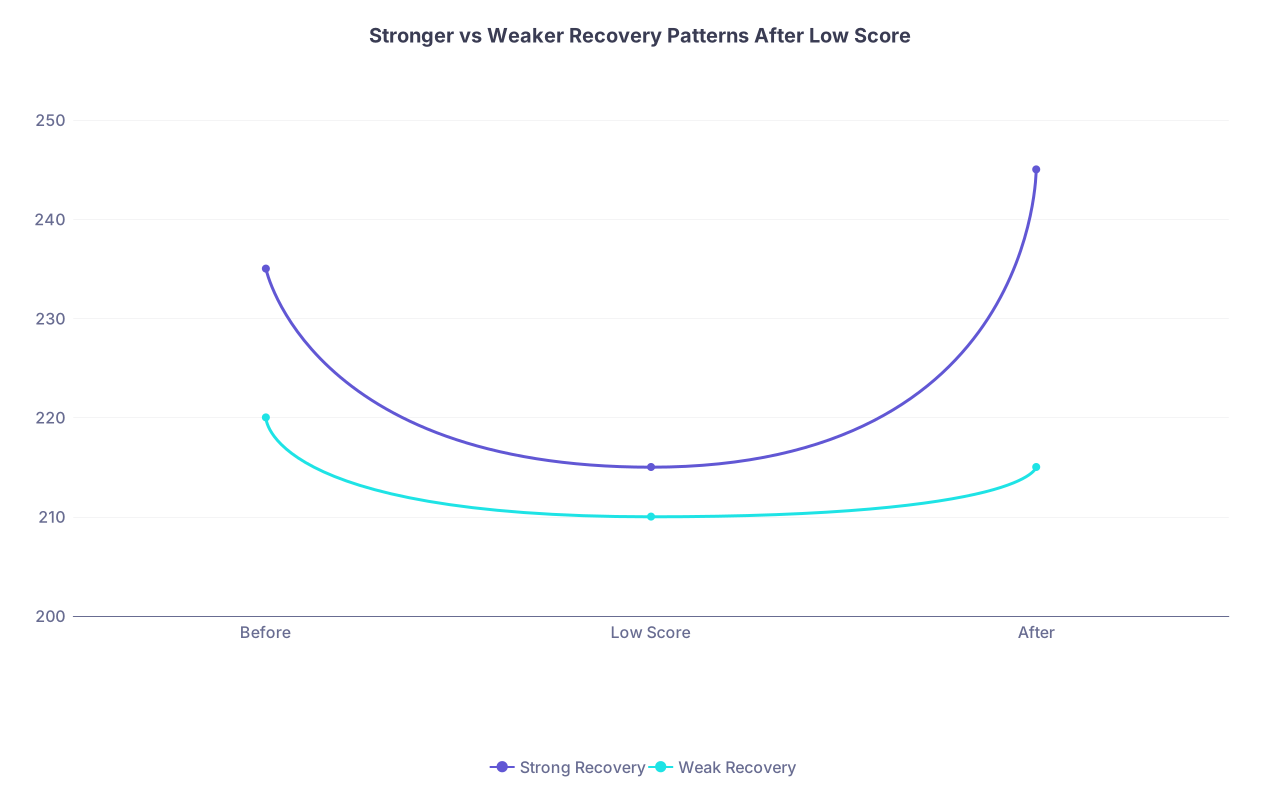
You must tie the narrative to trajectory.
| Category | Strong Recovery | Weak Recovery |
|---|---|---|
| Before | 235 | 220 |
| Low Score | 215 | 210 |
| After | 245 | 215 |
Your task is not to convince them the low score never mattered. Your task is to prove the underlying skill set and reliability now.
Example of what to include:
- “My clerkship evaluations since that time consistently describe me as organized and reliable.”
- “My Step 2 CK score of 248 more accurately reflects my test performance ability.”
- “On my medicine sub‑internship, I received honors and strong comments about managing complex patients independently.”
If you lack any upward marker, your priority is not wordsmithing the explanation. Your priority is creating real evidence—strong away rotation, improved exam, solid letters.
No explanation can patch a flat or declining trajectory.
Mistake #8: Ignoring How Human Readers Actually Process Applications
A lot of applicants write like they are sending a brief to a neutral robot. You are not. You are writing to tired attendings who are skimming 80 files in an evening after work.
They do not have time or patience to decode convoluted stories.
Common reader reactions to bad explanations:
- “Too much drama.”
- “This feels like a lot of excuses.”
- “If this is how they communicate under pressure, I am worried.”
- “This took me a full minute to read and I still do not know the point.”
You need to write like you respect their time.
That means:
- Short paragraphs
- Clear causal sequences
- No “mystery reveal” at the end
- Plain language over poetic language
If you find yourself getting flowery or emotional on the page, step back. This is not an essay contest. This is risk assessment.

A Practical Framework: How to Explain Without Making Things Worse
You want a template that keeps you out of trouble. Use this as your ceiling, not a minimum.
Decide if this even needs explaining.
- Failure / major anomaly / leave / professionalism → probably yes.
- Minor variation → usually no.
Draft 3–5 sentences total.
Structure:
- Sentence 1: Name the issue and time frame directly.
“During my second year, I failed my initial Step 1 attempt.” - Sentence 2: Brief cause with partial ownership.
“At that time, I was managing [X] and also did not adopt a sufficiently structured study plan, which impacted my performance.” - Sentence 3–4: Concrete changes you made.
“I subsequently met regularly with my advisor, used question banks more systematically, and adjusted my schedule to allow for focused preparation.” - Sentence 4–5: Evidence of recovery.
“These changes are reflected in my passing Step 1 score on retake and my later honors in Medicine and Surgery clerkships.”
- Sentence 1: Name the issue and time frame directly.
Remove:
- Emotional over‑descriptions
- Blame‑shifting language
- Long backstory unrelated to the problem or the fix
Have someone with residency selection experience read it. Not your roommate. Not your parent. Someone who has sat on a committee or at least knows what PDs talk about.
If your reader says, “This makes me more worried than I was before,” listen to that.
When Silence Is Better Than a Bad Explanation
You will not like this part, but you need to hear it.
Sometimes, the best move is not to explain at all.
Examples:
- An older but isolated low preclinical grade with a perfect clinical record and strong Step 2.
- A single slightly below‑average Step score in an otherwise consistent file, for a less competitive specialty.
- A smaller dip that admissions at your school has explicitly told you is common and not a red flag.
Every extra word you put in ERAS is another chance to make them more anxious.
If you cannot produce a concise, calm, contained explanation that ends in clear evidence of recovery, silence often does less harm than a defensive or chaotic explanation.
That is not “hiding.” The data are right there. You are simply choosing not to editorialize in a way that could be misinterpreted.
| Scenario | Best Approach |
|---|---|
| Single Step failure, strong later scores | Brief explanation |
| Leave of absence for medical reason | Brief, factual note |
| One low clerkship grade, others strong | Usually stay silent |
| Slightly below‑average Step 2 in FM/Peds | Usually stay silent |
FAQs
1. If I do not explain my low score, will programs assume the worst?
They will notice the score, but they will not automatically imagine a soap opera. Most programs see far more numerical variation than you think and are primarily looking at the pattern. A single low or modest score with solid clinical performance often does not need narrative at all. Explaining badly can indeed create a “worst case” in their minds that they did not originally have.
2. Should I have my dean’s office mention my situation in the MSPE?
If the issue was significant (leave of absence, failure, serious illness), a brief, factual note in the MSPE is usually better than a long personal explanation in your statement. Keep it institutional and neutral: what happened, what was done, and that you returned in good standing. Avoid emotional language or speculative commentary. Let the dean’s office carry that messaging with professional tone.
3. Can I talk about my low score in interviews if they bring it up?
Yes, and you should be ready. Your spoken explanation should follow the same rules: short, direct, accountable, and ending with evidence of improvement. Do not launch into a five‑minute story. Two or three clear sentences, then pivot to how you have grown and what your recent performance shows. If they want more detail, they will ask.
4. Is it ever okay to center my personal statement on overcoming a low score or failure?
Almost never. Personal statements built around “I failed and then overcame it” tend to frame you as The Failure Applicant rather than as a promising future resident. If the failure is truly central to your development, you can include a brief, matter‑of‑fact reference, but the core of your PS should be your motivation for the specialty, your clinical growth, and your fit. Do not let a bad test become your whole story.
Key points to keep in your head while you finish ERAS:
- Over‑explaining low scores often amplifies concern instead of reducing it.
- Keep any necessary explanation short, accountable, and backed by clear evidence of recovery.
- Do not create new red flags by oversharing, dramatizing, or explaining things that are not actually problems.