
The ERAS Experience section can quietly destroy your application by making you look dishonest—without you ever telling a single outright lie.
Let me be blunt: program directors are not just reading for content. They’re reading for credibility. The second they suspect you’re exaggerating, inflating, or gaming the system, you’re done. Not “moved slightly down the list.” Done.
You don’t need to fabricate anything to look dishonest. You only need to make the same sloppy choices hundreds of applicants make every year.
Let’s stop you from being one of them.
1. Inflated Hours: The Fastest Way To Look Like You’re Lying
If there’s one mistake that screams “dishonest” to anyone who’s read more than 50 ERAS applications, it’s ridiculous hours.
You know the kind of thing I’m talking about:
- “Free Clinic Volunteer – 1,200 hours”
- “Student Government – 900 hours”
- “Tutoring – 1,000 hours”
On paper it looks impressive. To anyone who’s done this before, it looks fake.
Here’s what goes wrong:
- You confuse total possible time with actual time.
- You don’t adjust for exam blocks, away rotations, holidays, or burnout.
- You fudge numbers “a little” that end up looking off by a lot.
Programs don’t need your hours to be perfect. But they need them to be believable. There’s a difference.
How to not blow your credibility with hours
Use a conservative, reality-based structure:
- Pick a realistic average per week (not your best week ever).
- Multiply by actual weeks engaged (subtract heavy exam periods, dedicated Step time, etc.).
- Round slightly down, not up.
If you think you did 4–6 hours per week, don’t write 6. Write 4. That small buffer protects you from looking inflated.
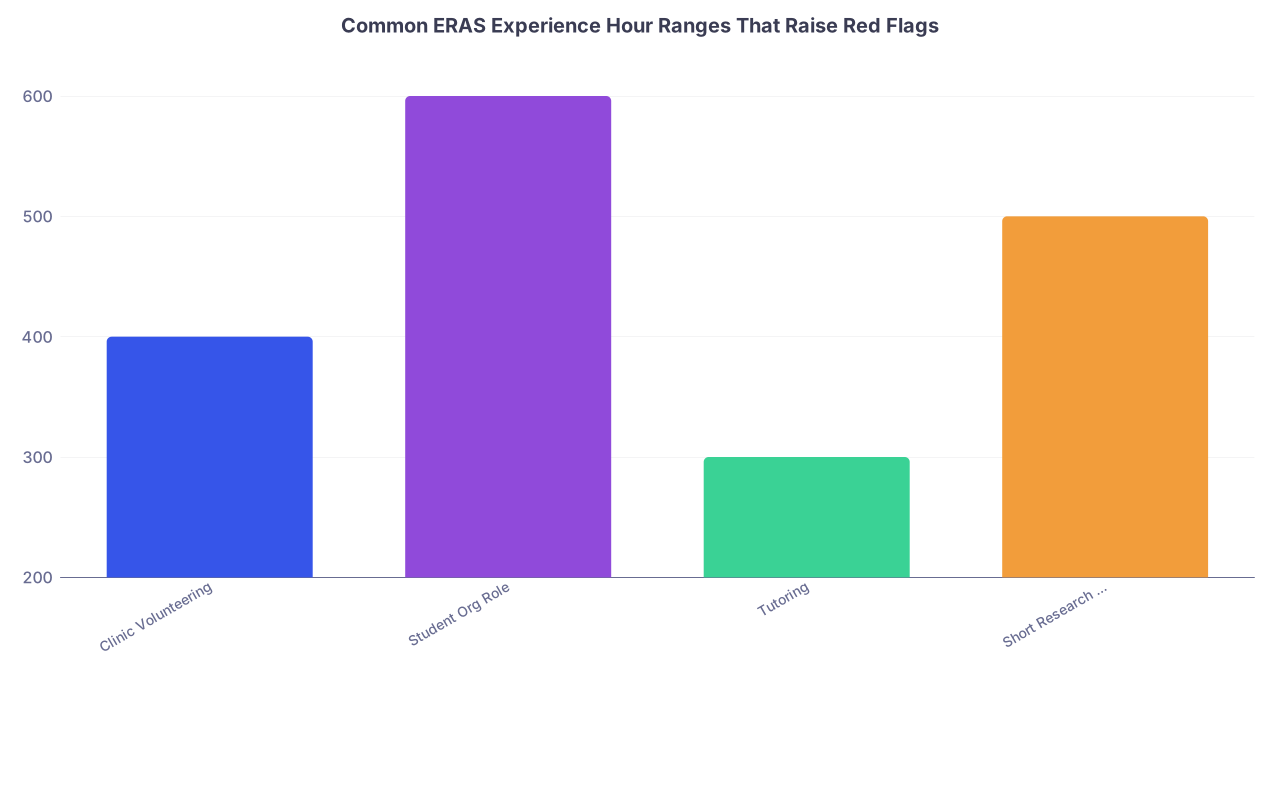
| Category | Value |
|---|---|
| Clinic Volunteering | 400 |
| Student Org Role | 600 |
| Tutoring | 300 |
| Short Research Project | 500 |
I’ve seen applicants list 1,500+ hours for something that clearly could not fit next to a full medical school schedule. Reviewers are not naïve. They were med students too. They know what’s humanly possible.
Red flag ranges (rough guide, not commandments):
- Longitudinal community work during med school: 50–300 hours is common, 400–600 is intense but plausible, 1,000+ is suspect.
- Leadership roles: 100–400 hours is standard. 800+ starts to look like wishful math.
- Research: Can be high, but if you’re claiming 2,000 hours and have one poster and no PI letter, that mismatch looks bad.
You don’t get extra credit for big numbers. You do get downgraded if they don’t make sense.
2. Vague, Overblown Descriptions That Smell Like Padding
The second dishonesty trap: hiding behind big words and no details.
This kind of thing:
“Played a critical role in managing clinic operations and improving patient care outcomes.”
Sounds fancy. Means nothing.
Program directors read this and think either:
- You did not actually do much, or
- You’re trying to make something minor sound major.
Both hurt you.
The anatomy of a suspicious description
Descriptions look dishonest when:
- Every verb is grandiose: “spearheaded,” “revolutionized,” “transformed”—with no specifics.
- You say you “led” something but never say who you led or what changed.
- You list “quality improvement” but have zero concrete metrics or outcomes.
Compare these:
Dishonest-feeling:
“Led major quality improvement initiatives that significantly reduced wait times and improved patient satisfaction.”
Plausible and honest:
“Created and tracked a new triage sign-in sheet at the free clinic; average intake-to-room time dropped from roughly 60 to 40 minutes over 3 months.”
Notice the second is smaller but more powerful. It sounds real because it is measurable and specific.
Your rule: if someone asked, “How exactly did you do that?” and you’d stumble, your description is probably too inflated.
3. Title Games: Upgrading Yourself Into Suspicion
Another mistake that quietly brands you as dishonest: upgrading your title.
Students do this constantly:
- “Volunteer” becomes “Coordinator”
- “Member” becomes “Director”
- “Shadowing” becomes “Clinical Internship”
- “Tutor” becomes “Lead Teaching Faculty” (yes, I’ve seen versions of this)
Here’s the problem: people at these institutions also apply. Program directors recognize the titles. They know the difference between “Clinic Volunteer” and “Clinic Coordinator” because they’ve seen both.
If you weren’t formally given the title, don’t claim it.
You can, however, describe added responsibility accurately:
Bad (inflated):
Title: Clinic Coordinator
Description: Managed all clinic operations and volunteer schedules.
Better (honest):
Title: Clinic Volunteer
Description: Over time, took on extra responsibilities, including training new volunteers on EMR use and tracking supply shortages for the coordinator.
One sounds like you’re stealing a line from your CV template. The other sounds like real life.
4. The “Too Perfect” Application: Everything Is Leadership, Everything Is Impact
Here’s a subtle dishonesty signal: your entire ERAS reads like a superhero comic.
Every experience is:
- “President”
- “Founder”
- “Director”
- “Lead…”
Every activity “improved outcomes,” “changed culture,” or “transformed” something. Nothing is ordinary. Nothing is just “I showed up consistently and did the work.”
That’s not how real life looks.
Program directors actually expect some experiences to be basic:
- Straightforward volunteering
- Just showing up to interest groups
- Simple peer tutoring
- Low-level research help
If you transform every experience into a dramatic leadership narrative, you look like you’re performing, not reporting.
Let one or two things just be plain:
“Served monthly meals and helped with basic kitchen prep at a local shelter. Had recurring conversations with a small group of guests over two years.”
Not big. But believable, grounded, human. This tone builds trust, which then makes your genuinely big things more credible.
5. Shadowing and “Clinical Experience” Misrepresentation
Nothing tanks trust like trying to repackage shadowing as hands-on clinical work.
Red-flag wording:
- “Helped manage patients”
- “Participated in patient care decisions”
- “Performed procedures” (when you’re a preclinical or basic med student without documentation)
You can observe. You can assist in minor ways. You cannot manage.
If you were basically just watching most of the time, call it that.
Bad:
“Independently managed patient follow-up calls and coordinated care between services.”
Better:
“Observed outpatient visits in a family medicine clinic; occasionally assisted with room setup and documentation under direct supervision.”
Your ego hates that second one. Program directors do not. They like accuracy more than flash.
The worst version: shadowing experiences listed as “Employment” or “Work” when you were neither paid nor responsible. Labeling categories incorrectly looks sneaky.
Use “Volunteer,” “Extracurricular,” or “Other” when appropriate. Don’t upgrade category labels to sound more clinical than you were.
6. Research Exaggerations: From “Data Entry” to “Co-Principal Investigator”
Research is infamous for this. People slide up the ladder in their descriptions:
- “Helped with chart review” becomes “Designed retrospective study.”
- “Entered survey data” becomes “Led data analysis.”
- “Joined late” becomes “Initiated and drove project from conception to publication.”
And then—here’s the killer—there’s no matching letter from the PI backing that narrative.

Program directors cross-check:
- Does your name appear in the right spot on posters/papers?
- Do your research descriptions match your letters?
- Do the timelines line up?
If you claim a central role but your letter sounds like, “They helped with data collection for a few months,” your credibility takes a hit.
Honest hierarchy:
- “Assisted with…” – data collection, chart review, basic stats
- “Contributed to…” – study design discussion, manuscript drafting
- “Led…” – only if you truly drove design, coordination, writing, and/or submission
If you’re not sure if you “led,” you didn’t.
7. Copy-Paste, Template Language, and AI-Sounding Nonsense
Another subtle dishonesty signal isn’t content—it’s tone. When your experiences all sound copied from a corporate brochure, you sound less human and more manufactured.
Common offenders:
- Every sentence starts with “I…” or “Responsibilities included…”
- Overuse of phrases like “in order to,” “in terms of,” “I had the opportunity to…”
- Generic filler like “enhanced my communication and teamwork skills” with zero examples.
You might not think this is dishonesty. But to a reader, it can feel like you’re hiding reality behind vague, overpolished language.
Better approach: short, specific, concrete.
Instead of:
“This experience allowed me to hone my leadership, communication, and time management skills.”
Say:
“Coordinated monthly sign-ups for 25+ volunteers and dealt with last-minute cancellations.”
The second sentence shows your skills instead of asserting them. That’s what honest writing looks like.
And yes, people are on high alert now for AI-sounding text. If every description reads like a machine wrote it—overly formal, robotic structure, no real-world grit—you’ll trigger suspicion, even if your facts are true.
8. Misaligned Timelines and Overlapping Commitments From Hell
Another way to look dishonest without intending to: impossible timelines.
Things like:
- 6 concurrent “20 hours/week” roles
- “Full-time research” overlapping with “Full-time clinical rotations”
- Activities continuing during “dedicated Step 1/2 study” listed as high intensity
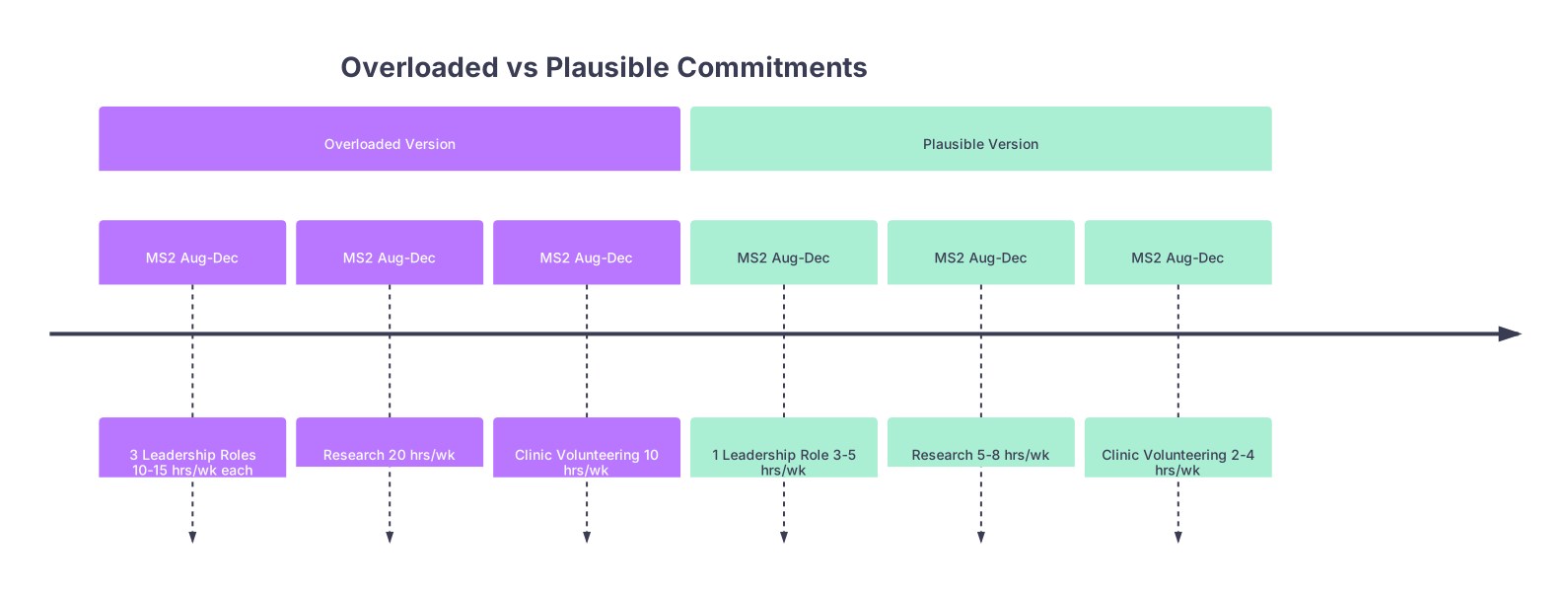
| Period | Event |
|---|---|
| Overloaded Version - MS2 Aug-Dec | 3 Leadership Roles 10-15 hrs/wk each |
| Overloaded Version - MS2 Aug-Dec | Research 20 hrs/wk |
| Overloaded Version - MS2 Aug-Dec | Clinic Volunteering 10 hrs/wk |
| Plausible Version - MS2 Aug-Dec | 1 Leadership Role 3-5 hrs/wk |
| Plausible Version - MS2 Aug-Dec | Research 5-8 hrs/wk |
| Plausible Version - MS2 Aug-Dec | Clinic Volunteering 2-4 hrs/wk |
No one believes you were working 60+ extracurricular hours per week on top of school and studying and sleep and being a functioning human.
Program directors know when you did:
- Dedicated Step studying
- Core clerkships
- Sub-Is and away rotations
If during those exact windows you list extreme hours in multiple roles, it doesn’t read as “wow, impressive.” It reads as “this person padded everything.”
Rule of thumb: if you add up your self-reported weekly hours and the total looks absurd, fix it. Even if each one individually seems fine, the total picture matters.
9. Over-Claiming Impact on Marginalized Communities
This one is touchy, but it needs to be said.
There’s a pattern that rubs selection committees the wrong way: exaggerated moral hero narratives around work with underserved populations.
Red flags:
- Writing as if a short-term volunteer stint “transformed” a community.
- Centering yourself heavily when your role was minimal or brief.
- Using emotionally heavy language without depth or specificity.
For example:
“I brought hope to an underserved population and significantly improved access to care through my volunteer work.”
You didn’t. A system did. A clinic did. A long-term team did. You participated. That’s valuable. It’s just not heroic at scale.
A more honest—and more respected—approach:
“Joined a long-standing free clinic team and saw many of the same patients over two years. I mostly helped with intake and vitals, but over time I got to know specific families and watched how structural issues repeatedly interrupted their care.”
Notice the difference. You’re not claiming you “fixed” anything. You’re showing that you noticed something real.
Nothing makes you sound more dishonest than appropriating someone else’s suffering to make yourself look noble.
10. Faking Consistency: “Ongoing” Activities That Quietly Stopped
Another quiet credibility leak: marking everything as “ongoing” to look dedicated, when half those things ended a year ago.
Program directors are used to seeing:
- Activities that ramp up, then down
- Things that end around Step 1 or clerkships
- Priorities that shift when clinical demands increase
That’s normal. What’s not normal is seeing everything still listed as active, at the same intensity, for years.
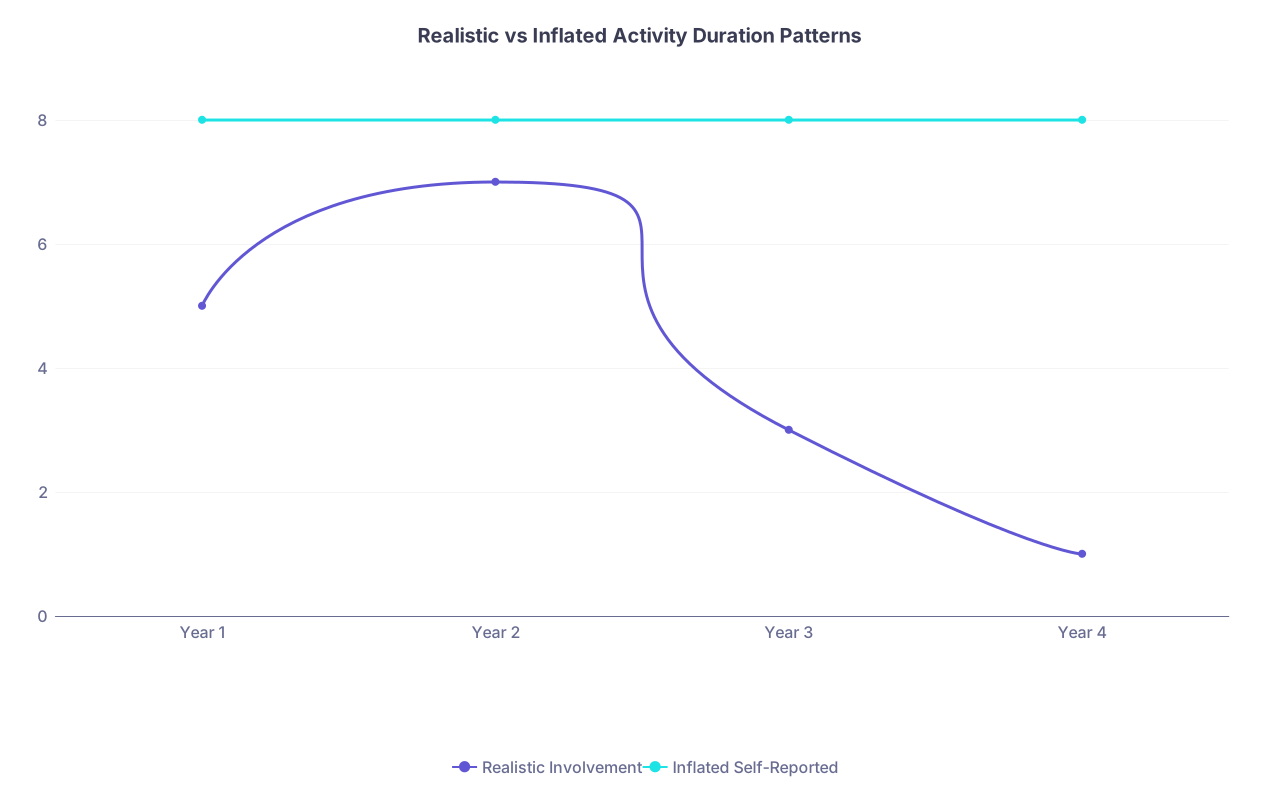
| Category | Realistic Involvement | Inflated Self-Reported |
|---|---|---|
| Year 1 | 5 | 8 |
| Year 2 | 7 | 8 |
| Year 3 | 3 | 8 |
| Year 4 | 1 | 8 |
Be honest about end dates and shifting time:
- If you did something intensely for one year then rarely after, don’t mark it as long-term consistent.
- If you stopped before clinicals or Step, own that.
- If you restarted later, clarify that in the description.
Example:
“Tutored MS1 students weekly during my MS2 year; during core clerkships this decreased to a few sessions per block as schedule allowed.”
That level of nuance reads honest. Flat, unchanging commitment across four chaotic years of med school does not.
11. The “I, Me, My” Problem: Taking Credit for Team Work
Final big honesty trap: taking solo credit for what was clearly a team effort.
If your description reads like you alone ran an entire clinic, built a program, or managed a study, it signals ego at best and dishonesty at worst.
Watch for language like:
- “I ran…”
- “I organized all…”
- “I was responsible for every aspect of…”
But the reality was more like: you were one of several. Which is normal. That’s how most things in medicine work.
Shift from “I did everything” to “here’s what specifically I did within the team.”
Dishonest-sounding:
“I ran the student-run clinic and ensured operations ran smoothly every week.”
Honest:
“As one of four student leaders, I created weekly volunteer schedules and sent reminder emails; I was also the point person when we were short-staffed and had to adjust roles last minute.”
You’re still showing initiative. You’re just not erasing everyone else. Program directors like team players who can describe their role precisely without inflating their importance.
Quick Comparison: Honest vs Dishonest-Sounding Entries
| Aspect | Inflated / Dishonest-Sounding | Honest / Credible Version |
|---|---|---|
| Hours | 1,200+ hrs for vague clinic role | 150–300 hrs with clear weekly estimate |
| Title | “Coordinator” without formal appointment | “Volunteer” with description of added tasks |
| Role | “Led major initiatives” with no details | Specific, small-scale, measured contributions |
| Timeline | 5 roles at 10–20 hrs/wk each simultaneously | Adjusted hours during exams/clinicals |
| Impact | “Transformed care for underserved patients” | Noticed patterns, contributed in defined ways |
FAQs
1. Is it better to underestimate my hours so I don’t look dishonest?
Slight underestimation is safer than overestimation, yes. But do not randomly slash numbers. Use a reasonable weekly average, subtract time for exams and breaks, and round down modestly. The point is plausibility, not artificially tiny numbers.
2. What if my PI really did let me lead most of the project, but it sounds exaggerated?
Then anchor your description in verifiable specifics: “Drafted the initial protocol,” “Coordinated weekly team meetings,” “Wrote first draft of the manuscript.” Ask your PI if they’re comfortable reflecting your role similarly in their letter. If your ERAS and their letter match, it will sound much more credible.
3. Can I combine similar small experiences into one entry?
You can, but don’t merge unrelated roles just to hide low hours. Combining multiple short-term community service events into one “Community Outreach” entry is fine if you’re clear in the description. What looks dishonest is lumping a one-day event with a longitudinal clinic to inflate total hours.
4. How do program directors actually spot dishonesty in ERAS?
They look for patterns: inflated hours, impossible overlaps, overblown titles, vague descriptions, and mismatches between your application, your letters, and what you say on interview day. They’ve read hundreds or thousands of applications. The outliers jump out quickly.
5. Is using AI to help with wording in the Experience section considered dishonest?
Using tools to clean up grammar or help you phrase something more clearly is fine. Dishonesty comes when the tool fabricates details, inflates your role, or gives you generic, overpolished language that no longer reflects what you actually did. If you couldn’t defend every sentence out loud in an interview, you’ve gone too far.
Remember three things. First, inflated hours and titles don’t impress; they expose you. Second, vague, grandiose language sounds more dishonest than a small, specific, humble description. Third, your whole ERAS has to form one coherent, believable story—timeline, roles, letters, and interview all aligning. If something wouldn’t pass the straight-face test with your own classmates, it won’t pass with a program director either.