
It is 8:47 p.m. on rank list certification day. You are on your couch, half in scrubs, half in panic, clicking “certify” on your NRMP rank order list while your co-resident group chat is exploding with screenshots and last‑minute changes.
You get the green check mark. Certified. Relief…for about five seconds.
Then your stomach drops.
You realize the program you actually love is below a “safety” you never wanted. Or worse, your partner’s program is missing from your couples list. You try to log back in. Too late. The deadline passed three minutes ago.
This article is about avoiding that moment. Because once the NRMP deadline hits, almost all mistakes are permanent. And some of them are brutal.
(See also: How Program Directors Really Read ERAS: Line-by-Line Breakdown for a detailed look at what reviewers notice.)
Let me walk you through the errors I have seen students make again and again—and what you need to do before the deadline to protect yourself.
The First Non‑Negotiable: Your Rank List After the Deadline Is Locked
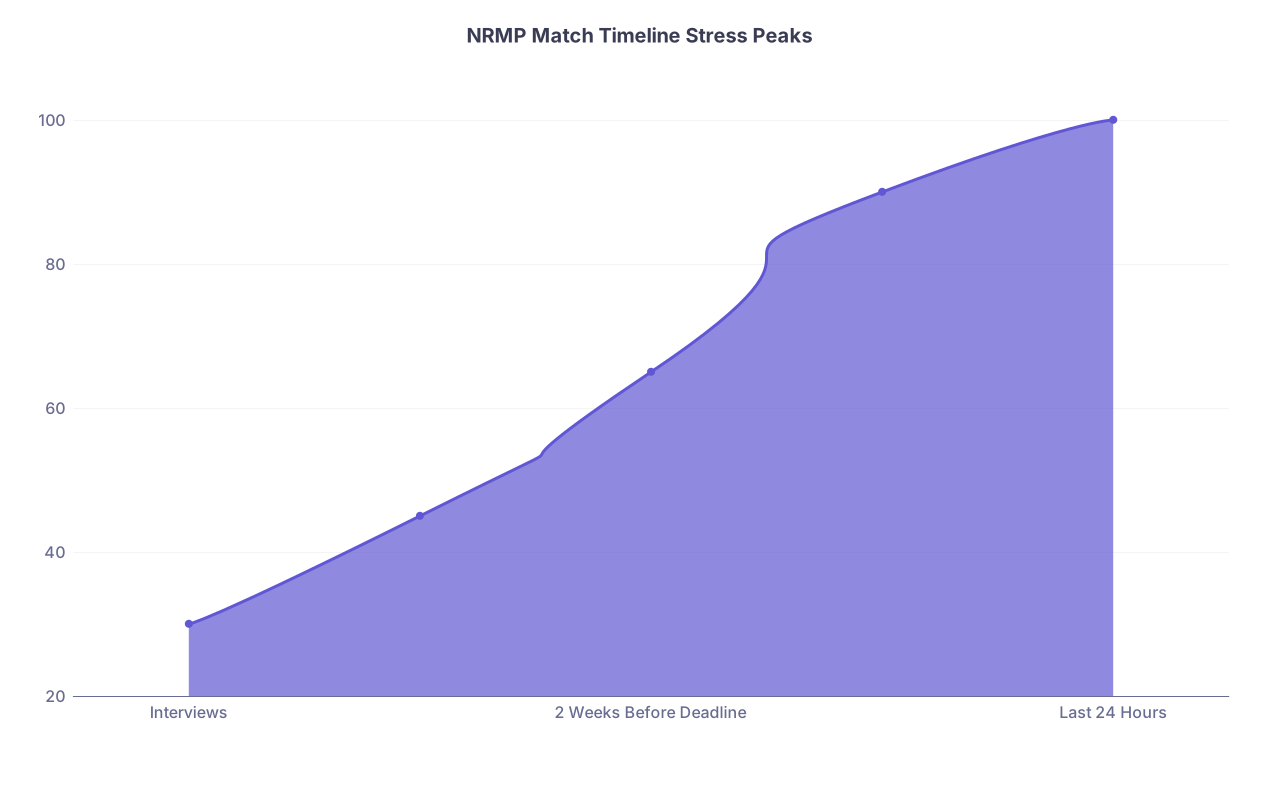
| Category | Value |
|---|---|
| Interviews | 30 |
| Rank List Open | 45 |
| 2 Weeks Before Deadline | 65 |
| Deadline Week | 90 |
| Last 24 Hours | 100 |
NRMP is very clear: after the rank order list certification deadline, you cannot change your list. Not by emailing. Not by calling. Not by begging.
I have watched people try:
- “Can you please move Program X above Program Y? I just realized—”
- “I accidentally certified the wrong list.”
- “I thought I uploaded the new version.”
The answer is the same: the system uses the last certified list before the deadline. No edits. No “obvious” corrections. No exceptions because of “honest mistakes.”
So your operating assumption must be:
If I would be devastated to live with this list exactly as it is, I am not done.
You are not finished when you enter your rank list. You are finished when you have:
- Entered it correctly
- Verified it line by line
- Confirmed it is certified
- Confirmed it is the right version
Miss any of those, and the consequences are on you.
Fatal Structural Errors People Only Notice After It’s Too Late
These are not small preference tweaks. These are structural mistakes that can blow up your match outcome.
1. Getting the Order Backwards
Yes, this still happens.
You intend:
- Dream academic program
- Strong mid-tier
- Geographic backup
You accidentally type them in backward or drag‑and‑drop incorrectly and certify:
- Geographic backup
- Strong mid-tier
- Dream academic program
The NRMP algorithm assumes your list is your true preference. It will happily match you to #1 if possible. It will not “assume” you mixed them up.
How this happens:
- Copying a “practice” list into NRMP and not reordering
- Rapid click‑dragging while distracted
- Last‑minute rearranging with no second person double‑checking
How to avoid it:
- Print your draft list or write it in a notes app first, numbered in your true preference order.
- When you enter it in NRMP, compare each line to the written list.
- Read it out loud line by line:
“If I could have any program on this list, would I pick #1 first? If #1 rejected me, would I pick #2 over every program below it?” - Have a trusted friend or partner read it with you. Fresh eyes catch dumb mistakes.
The mistake is rarely complex. It is usually fatigue + time pressure + overconfidence.
2. Leaving Programs Off the List Entirely
Omission might be the most painful error because it is so stupidly avoidable.
Common version:
You interviewed at 15 programs. You only rank 11. You realize after the deadline that you somehow left off four places where you would have happily matched over being unmatched.
In competitive specialties, that can be the difference between:
- Matching somewhere you do not love
- Not matching at all
- Or having far fewer options than you thought you had
Reasons I have seen:
- Using an old spreadsheet that did not include late interview invites
- Assuming “I will remember them all”
- Sorting your list by city / strength and accidentally hiding rows in Excel
- Not scrolling far enough down the NRMP list when checking
Avoid it by doing a cross‑check:
- Pull up your interview calendar or emails
- Make a complete list of all programs where you interviewed
- Cross‑check each one with your NRMP rank list
- You should be able to say: “If I did not rank it, it is because I chose not to, not because I forgot it existed.”
If you realize after the deadline that you never ranked a “solid backup,” no one can add it for you. You simply cannot match there.
3. Ranking Programs You Never Interviewed At
This one is sneaky.
You see the program name in the NRMP list. You remember emailing them. You click “add.” But you never interviewed there.
You cannot match to a program without an interview → rank order list or not.
Consequences:
- It wastes a line on your list
- It gives you a false sense of security (“I have 15 programs ranked”) when in reality maybe only 12 are viable
- It makes your “spread” look better than it actually is
If your list has programs you never set foot in, remove them. They are dead space. And they distort your risk assessment.
Surgical vs. Dermatology vs. Family Med: Specialty‑Dependent Ranking Traps

(See also: Common Interview Day Behaviors That Quietly Get You Ranked Lower for tips on avoiding interview pitfalls.)
Some mistakes are universal. Others depend heavily on how competitive your specialty is and how strong your application actually is.
| Specialty Type | Typical Mistake | Risk Level |
|---|---|---|
| Ultra-competitive | Too few programs | Extreme |
| Moderately competitive | Overweighting prestige | High |
| Less competitive | Ranking location only | Moderate |
| Transitional/Prelim | Ignoring advanced spot | Extreme |
4. Ranking Too Few Programs for Your Risk Category
I see this constantly in competitive fields: dermatology, ortho, neurosurgery, plastics, ENT.
Scenario:
Applicant with average board scores, no home program, and mixed interviews ranks 8–10 programs. They feel “good” about 3 of them. They do not want to “settle.”
They go unmatched.
NRMP publishes data on how many ranks are “safe” by specialty and applicant type (US MD vs DO vs IMG). People ignore it because they think they are an exception. They rarely are.
You do not get extra credit for a short list of “only programs I love.” The algorithm does not care how you feel about being unmatched.
If you match at #12, you still matched.
If you do not rank #12 because of ego and end up SOAPing, that is on you.
Mistake to avoid:
- Under‑ranking relative to competitiveness
- Confusing “places I would love” with “places I am willing to train”
If you would rather train there than not match, it belongs on your list. Period.
5. Overweighting Prestige Against Your Real Preferences
Opposite problem: the prestige‑chasing applicant.
They put every brand‑name program at the top because “I might regret not shooting my shot,” even when:
- They disliked the residents
- The city made them miserable
- The training style did not fit them at all
Then they match there. And they are stuck for 3–7 years.
You cannot call NRMP and say, “Actually, I hated my interview day and want to go to #5 instead.” You told the algorithm the top ranked program was your dream. It believed you.
Reality check: Prestige matters, but it is not magic. A prestigious place that breaks you is not better for your career than a solid program where you thrive.
Your list should reflect where you believe you will:
- Learn the most
- Be supported
- Function as a healthy human
Not just the name that sounds best on Instagram.
The Couples Match: Where Mistakes Multiply

| Step | Description |
|---|---|
| Step 1 | Each partner creates solo rank list |
| Step 2 | Convert to paired combinations |
| Step 3 | Check for missing combinations |
| Step 4 | Align true joint preferences |
| Step 5 | Enter combined list in NRMP |
| Step 6 | Both verify each pair line by line |
If you are couples‑matching, your exposure to catastrophic errors just doubled. I have watched couples “break” their match opportunities in ways that could have been avoided with one disciplined review session.
6. Mis‑aligned Paired Lists
Common fatal pattern:
- Partner A thinks “we prioritized geography”
- Partner B thinks “we prioritized program quality”
- Their combined rank list is a mess of mutually incompatible priorities and missing realistic combinations
What goes wrong:
- You forget to rank some pairs where one partner is at their #1 and the other is at a “still acceptable” backup
- You overweight pairings where one partner is miserable but did not fully speak up
- You misunderstand how the algorithm works and assume “it will find us something decent”
No. The algorithm only looks at the exact pair combinations you rank. If a pair is not on your list, you cannot match to it. Even if both individuals ranked those programs highly on their solo lists.
You must:
- Sit down together with your individual program preference lists
- Explicitly talk through all reasonable combinations
- Decide your joint priorities (city vs prestige vs proximity vs backup scenarios)
- Check that your couples list reflects that logic
7. Missing “One Matches / One Doesn’t” Backup Scenarios
This part hurts, but ignoring it is worse.
Couples often fail to include options like:
- One person matches at their dream program
- The other matches at a less ideal but still acceptable spot in the same region
- Or one matches and the other plans to reapply or pursue research nearby
They assume:
“We either match together or we do not want it at all.”
Then March hits. They both go unmatched. When they could have at least had one partner matched in a strong program and a year to reset strategically.
It is not romantic, but it is honest. You are planning your lives, not a Hallmark movie.
If, in your heart, you know that one partner matching at a great program while the other regroups is better than both scrambling in SOAP, your rank list must include those combinations.
Once the deadline passes, your couples strategy is frozen. The algorithm will follow it blindly.
Technical NRMP Mistakes That Will Wreck You Quietly

These are the boring, administrative errors that feel too dumb to worry about—until you are the one who made them.
8. Not Actually Certifying Your List
You think you certified. You did not.
You rearranged programs. You clicked “save.” You believe that is enough. It is not. The system needs you to explicitly certify the list. That is a separate step.
On Match Week, you discover NRMP is using an older certified version. Or worse, an empty list. I have seen this happen. No, they will not switch to your “intended” list.
Before the deadline, you must:
- Log in
- Confirm you see the green “certified” indicator
- Confirm the certification date and time are correct and after your last changes
- Take a screenshot for your own sanity
If the list is not certified, it is not real.
9. Editing After Certification and Forgetting to Re‑Certify
This is the hidden trap.
You certify your list. Then you make a last‑minute change. The NRMP system silently revokes certification until you re‑certify. You are now sitting on an uncertified list.
You mean to go back and click certify again. You get distracted. Or you assume the system auto‑certified. It does not.
At the deadline, the system uses the last certified version, which may be missing your latest edits.
Every time you touch your list after certification, treat it as if you just broke it. Because you did—until you re‑certify.
Workflow you should follow:
- Make all your edits
- Stop
- Click certify
- Confirm date/time updated
- Then stop touching it
If you are obsessively tinkering in the final 2 hours, you are begging for this mistake.
10. Name / Program Confusion (Wrong City or Wrong Track)
Some programs:
- Have very similar names in different cities
- Have multiple tracks: categorical, prelim, primary care, research, etc.
I have seen applicants:
- Rank a prelim instead of the categorical program
- Rank the affiliated community track when they meant the academic track
- Rank the wrong campus in a multi‑site system
This is not a soft error. You can absolutely match to the wrong track for an entire year—or longer.
How to protect yourself:
- Cross‑check ACGME or NRMP program codes with your interview list
- Pay attention to the exact wording of “categorical,” “preliminary,” “advanced,” “primary care,” etc.
- If you do not fully understand which track you are ranking, stop and clarify with the program or your dean’s office well before deadline week
Once certified, if you realize you ranked the wrong program code, you are done. The match algorithm will use exactly what you entered.
SOAP, Advanced, and Prelim: Special Cases That Blow Up Quietly
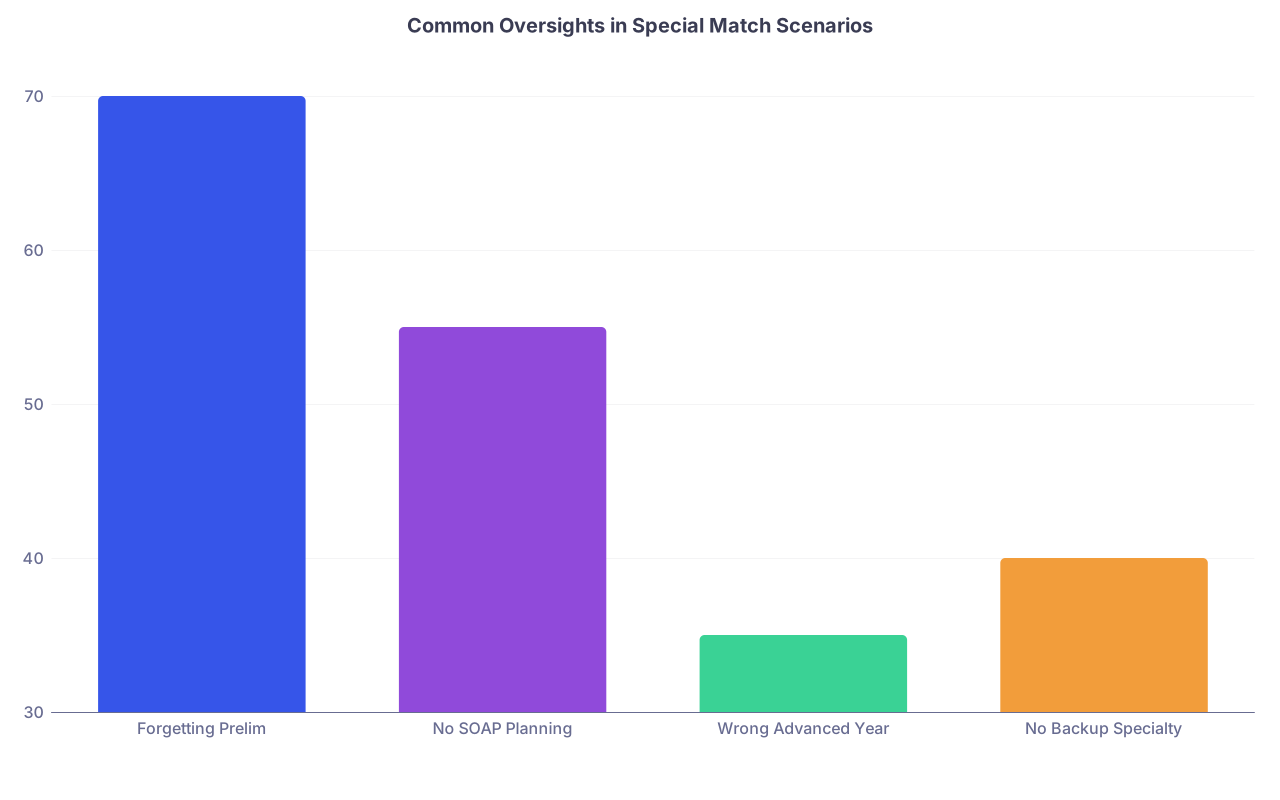
| Category | Value |
|---|---|
| Forgetting Prelim | 70 |
| No SOAP Planning | 55 |
| Wrong Advanced Year | 35 |
| No Backup Specialty | 40 |
11. Not Pairing Advanced and Preliminary Positions Properly
For fields like anesthesia, radiology, derm, ophtho (SF Match, but same principle for advanced PGY‑2), you often need:
- An advanced PGY‑2 position
- A preliminary (PGY‑1) year: medicine, surgery, transitional
People make these errors:
- Ranking advanced programs without enough prelim options
- Forgetting to rank prelim programs at all
- Assuming they will “figure out the prelim year later”
If you do not match into a prelim year, you have nowhere to work PGY‑1. That is a major problem.
Your strategy needs to include:
- Sufficient prelim / transitional programs ranked, in multiple locations if needed
- A clear sense of what is acceptable versus truly impossible for you
- Attention to whether your advanced and prelim locations are realistically compatible for your life
Once the list is locked, you cannot retroactively add prelims you forgot.
12. Ignoring SOAP Risk Completely
Some people should plan for SOAP as a real possibility. Not because they are failures, but because their specialty and profile carry risk.
They do not. They:
- Rank too few programs
- Refuse to rank less prestigious options they would still attend
- Do not review SOAP timelines or requirements
- Do not talk honestly with their dean
Then on Monday of Match Week, they get: “You did not match to any position.” And they are starting their SOAP strategy from zero.
You cannot fix a poorly constructed rank list with SOAP. You can only try to salvage what is left. Better to build in appropriate backups now, when you still have control.
How to Audit Your Rank List Before It Is Too Late

You can dramatically reduce your risk of irreversible errors by doing one thorough, systematic review.
Use this as a checklist the day before the deadline:
List integrity
- Does every program you interviewed at appear?
- If not, is it an intentional omission, not an oversight?
- Are there any programs you never interviewed at? Remove them.
Order sanity check
- For each position, ask: “If I could have any program from this line down, would I truly choose this one?”
- Are you putting prestige above your lived experience in a way you will regret?
- Are any “safeties” accidentally above programs you actually like more?
Specialty and risk alignment
- How many programs are you ranking relative to NRMP data for your specialty and applicant type?
- Are you under‑ranking for a competitive field?
- Have you included all programs where you would rather train than go unmatched?
Couples match review (if applicable)
- Do your pairings truly reflect your joint priorities?
- Have you included reasonable “one matches / one regroups” scenarios if you are genuinely open to that?
- Are there missing combinations that you would choose over both being unmatched?
Technical NRMP check
- Are you ranking the correct program codes (categorical vs prelim vs advanced vs primary care)?
- Have you recently edited your list? If yes, did you re‑certify?
- Do you see the green certified status with the correct timestamp?
Take 30–60 minutes. No phone. No group chat noise. Just you, your list, and ruthless honesty.
FAQ (Exactly 4 Questions)
1. Can I change my NRMP rank list after the certification deadline if I made an obvious mistake?
No. Once the deadline passes, your last certified list is final. NRMP does not correct “obvious” errors, and there is no appeal process for rearranging programs, adding missing ones, or swapping tracks. The best you can do is learn from it, but for this cycle, you are locked.
2. What if I realize I did not actually certify my list?
If the certification deadline has already passed, there is nothing you can do. NRMP will use the last certified version it has on file, which might be an older list or no list at all. Before the deadline, log in and look explicitly for the “certified” status and timestamp; saving changes does not equal certification.
3. How many programs should I rank to avoid going unmatched?
It depends on your specialty, your competitiveness, and whether you are a US MD, DO, or IMG. NRMP publishes data on match outcomes versus number of ranks for each group. A common and dangerous mistake is ranking too few programs in competitive fields. As a rule, if you would rather train at a program than go unmatched, that program belongs somewhere on your list.
4. Should I leave off programs I disliked so I do not risk matching there?
Yes—if you truly would prefer to go unmatched and enter SOAP rather than train at that program. Your rank list should only include places you are realistically willing to attend. The key is not confusing “not my dream” with “unacceptable.” Ego drives people to leave off viable programs and they later regret it when they do not match. Be brutally honest with yourself about which category a program belongs to.
Key points to walk away with:
- After the NRMP deadline, your rank list is fixed. No edits. No rescues.
- Most catastrophic errors are boring: wrong order, missing programs, wrong track, uncertified list. You prevent them with one disciplined review.
- Build a list that reflects your true preferences and actual risk profile, not your ego or anxiety. Then certify it, verify it, and stop touching it.