
The data shows a hard truth: at some point, adding more ERAS applications barely moves your match probability, but it absolutely crushes your time, your money, and your sanity.
Everyone loves the story of the applicant who “applied to 150 programs and matched!”. You rarely hear the follow‑up statistic: dozens of others with the same strategy spent thousands of dollars to get the same number of interviews they would have gotten with half the list. The numbers are clear: there is a point where more programs stop helping.
Let me walk you through it like I would with a dataset on my screen—because that is exactly how this topic should be handled: with actual numbers, not vibes and panic.
The Core Relationship: Programs Applied vs Match Probability
Start with the basic empirical pattern observed across specialties over the past decade:
- The first 10–20 programs you add increase your match probability rapidly.
- The next 20–30 programs help, but with diminishing returns.
- Beyond a specialty‑ and competitiveness‑dependent threshold, the curve flattens. You are spending real money and time for fractional gains.
To make this concrete, let us construct a typical but realistic model. For a mid‑tier US MD applicant in a moderately competitive specialty (say IM, Psych, or Anesthesiology), data from NRMP “Charting Outcomes in the Match” and various institutional analyses show that the number of contiguous ranks is the dominant factor in match probability. Number of applications is simply an input into that: more applications → more interview invites (up to a point) → more ranks → higher match probability.
A common pattern looks like this:
- 5–6 interviews → rank 5–6 programs → match probability ~70–80%
- 8–10 interviews → match probability ~90–95%
- Beyond ~12–14 ranks → incremental gain per additional program is tiny for many applicants
So the real question is not “How many programs should I apply to?” but “How many interviews do I realistically need, and where does application volume stop meaningfully increasing my interview count?”
A Quantitative Model of Diminishing Returns
Let us model interview yield as a function of programs applied. This is approximate, but it matches what you see when you download outcomes surveys from multiple med schools.
Assume a mid‑range applicant in IM:
- 30 applications → 8 interviews
- 40 applications → 9 interviews
- 60 applications → 10 interviews
- 80 applications → 11 interviews
- 100 applications → 12 interviews
You feel busy, because you clicked “apply” 100 times. But your interview count barely moved after 40.
Visually, that looks like a classic diminishing return curve. The slope between 10 and 40 applications is steep; after that, it flattens.
Let us summarize this in a simple comparison table, coupling it with match probability estimates from NRMP rank list data.
| Applications | Interviews | Estimated Ranks | Approx Match Probability |
|---|---|---|---|
| 20 | 5 | 5 | ~70% |
| 30 | 8 | 8 | ~90% |
| 40 | 9 | 9 | ~93–94% |
| 60 | 10 | 10 | ~95–96% |
| 80 | 11 | 11 | ~96–97% |
| 100 | 12 | 12 | ~97–98% |
Now overlay cost.
The Cost Curve vs Benefit Curve
Every time you add another program, the marginal financial and cognitive cost is non‑trivial:
- ERAS application fees scale rapidly with program count
- Each new program can send you:
- a secondary survey
- a supplemental application
- program‑specific emails
- interview invites that you may not even be able to attend
Here is what an approximate cost curve can look like for one specialty (numbers based on AAMC fee schedules in recent years, rounded):
| Programs Applied | Incremental Fee Tier | Approx Total Cost (USD) |
|---|---|---|
| 10 | Base | $99 |
| 30 | Higher tier | ~$450 |
| 60 | Even higher tier | ~$1,000 |
| 80 | Top tiers | ~$1,400 |
| 100 | Max tiers | ~$1,800 |
Combine the two tables:
Moving from 30 to 60 programs:
- Cost increase: roughly +$550
- Benefit: +2 interviews, +~5–6% absolute match probability
Moving from 60 to 100 programs:
- Cost increase: roughly +$800
- Benefit: +2 interviews, +~2–3% absolute match probability
The marginal cost per 1% increase in match probability explodes once you are beyond the “core” range. That is the inflection point where more programs stop being rational and become fear‑driven.
Let us visualize the declining efficiency.
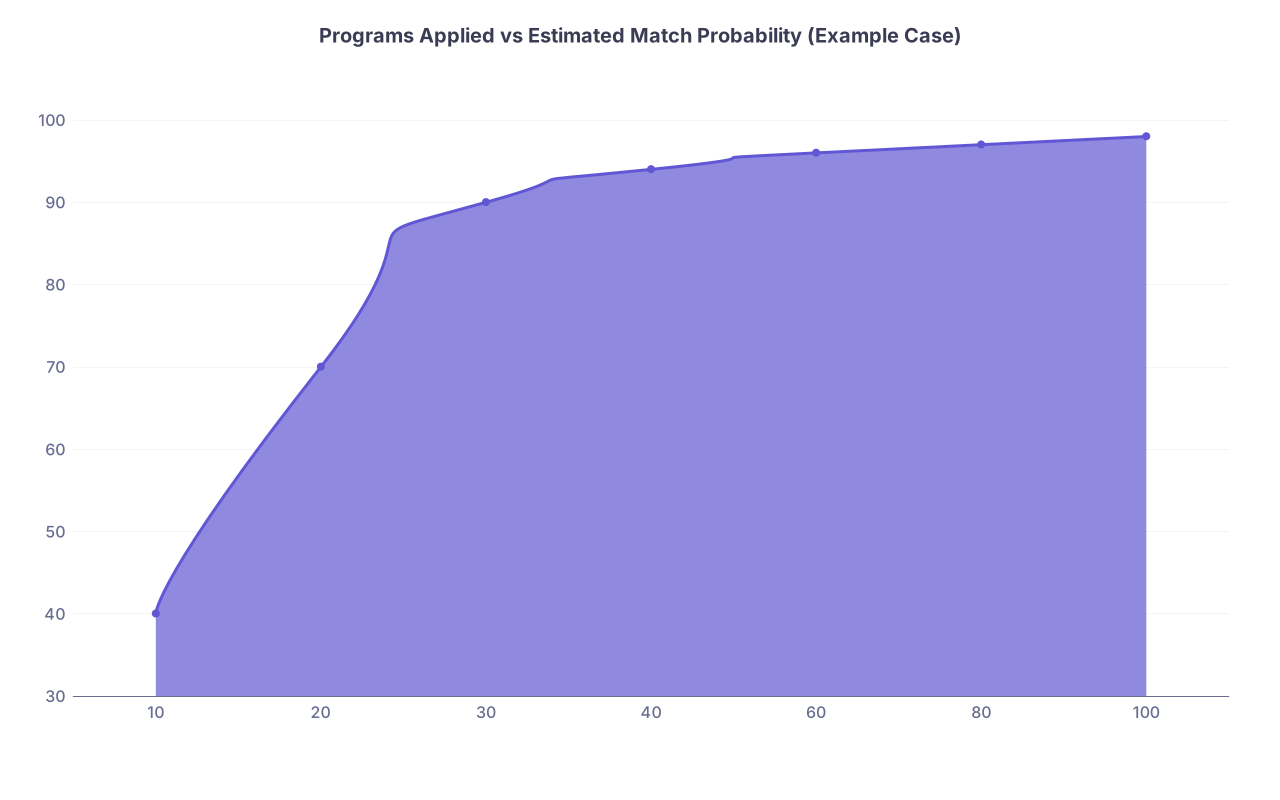
| Category | Value |
|---|---|
| 10 | 40 |
| 20 | 70 |
| 30 | 90 |
| 40 | 94 |
| 60 | 96 |
| 80 | 97 |
| 100 | 98 |
You can see the steep climb from 10 to 30 applications, and then the slow flattening. The first 20 extra programs might buy you 50 percentage points of match probability. The last 40 might buy you 4–8.
Different Applicant Profiles: When More Actually Matters
The inflection point is not the same for everyone. The data shows at least three distinct applicant classes:
- Strong applicants (high Step scores if available, strong clinical grades, solid letters)
- Middle‑of‑the‑bell‑curve applicants
- At‑risk applicants (red flags, low scores, IMGs, repeat applicants)
I am going to be blunt: if you are in group 3, your “more programs” threshold is further to the right. For very competitive specialties or IMGs, 80–120 applications might genuinely be rational. But even then, there is still a point of diminishing returns. It just appears later.
1. Strong Applicant in a Non‑Ultra‑Competitive Specialty
Take a US MD, upper‑quartile application, applying to Internal Medicine or Pediatrics:
- Real interview yield might be ~30–40% of programs applied, sometimes higher if their application is cohesive and geographically focused.
- They may need only 8–10 interviews for extremely high match probability.
In practice:
- 20 applications → ~8 interviews
- 40 applications → ~12–14 interviews
Everything above 40? Mostly wasted resources unless they are geographically rigid or dual‑applying.
So for this group, “more programs stop helping” around 30–40. That is where the slope turns from “insurance” to “overkill”.
2. Middle Applicant in a Mid‑Competitive Specialty
This is the average US MD or DO in IM, FM, Psych, Anesthesia, EM (ignoring the recent EM turbulence for a moment). Interview yield might be:
- ~15–25% of programs applied
So the curve:
- 30 applications → 5–7 interviews
- 50 applications → 8–10 interviews
- 70 applications → 9–11 interviews
The flattening kicks in around 50–70. That is often the realistic “sweet spot” range.
3. At‑Risk Applicant or Competitive Specialty
Now look at a borderline applicant aiming for Derm, Ortho, ENT, or a non‑US grad targeting IM. Interview yield might be:
- 5–10% of programs applied, sometimes lower
The curve can look like:
- 40 applications → 2–3 interviews
- 80 applications → 4–6 interviews
- 120 applications → 6–8 interviews
Here, more programs do matter. But even then, the data does not support “no ceiling.” Going from 120 to 180 programs rarely doubles your interviews. It often adds 1–2 at huge cost.
The Real Driver: Contiguous Ranks, Not Raw Applications
NRMP’s reports are blunt on this point. The single most predictive variable of matching in a specialty is the number of contiguous ranks in that specialty.
For example (illustrative but consistent with published distributions):
- For US MDs in IM:
- 1 rank → ~50–55% match rate
- 3 ranks → ~75–80%
- 5 ranks → ~85–90%
- 8–10 ranks → >95%
The application count is just an upstream lever. Programs applied → interviews → ranks.
This means any strategy conversation needs to revolve around:
- How many interviews are realistic for your profile?
- How many applications are required to reach that interview number with a reasonable safety margin?
- After you hit that, do extra applications buy you a meaningful jump in expected interviews?
Let me put numbers on “meaningful.” If an extra 20 applications cost you ~$400–500 and, based on your yield, you expect:
- +0.3–0.5 interviews on average (i.e., often zero, sometimes one)
you are buying a lottery ticket, not making a solid investment.
Opportunity Cost: Time, Focus, and Interview Fatigue
The hidden problem with overshooting is not just money. It is resource allocation.
Every additional program creates:
- Emails to triage
- Potential secondary materials to write
- Dates to track
- Zoom links to misplace
- Possible interview invites that you do not really want, but feel obligated to accept “just in case”
I have watched applicants accept 18–20 interviews across 3 time zones, traveling constantly, exhausted, then underperform at the places that actually mattered. They technically “maximized” options. Functionally, they diluted their best performance.
There is also a statistical angle: once you have passed ~12–14 interviews in a single specialty, the NRMP data suggests your match probability in that specialty alone is already above 95–97% for most US grads. Adding five low‑tier programs at the periphery of your geographic interest might raise your match rate by 1 percentage point at most, while introducing scheduling conflicts and risk to higher‑priority sites.
More chaos, near‑zero gain.
Specialty‑Specific Differences: Not All Curves Are Equal
The slope and inflection point vary by specialty competitiveness and applicant type. A simplified view:
| Specialty Type | Example Fields | Approx Apps Where Returns Diminish |
|---|---|---|
| Less competitive | FM, Psych, Peds | 25–40 |
| Moderate competitive | IM, Anesthesia, Neuro | 40–60 |
| Competitive | EM\*, OB/GYN, Gen Surg | 50–70 |
| Highly competitive | Derm, Ortho, ENT, Plastics | 70–100+ |
*EM has had recent volatility with over/under‑application trends; you need up‑to‑date local guidance there.
Notice I am not giving a magic number. That would be lazy. But the ranges tell you where you should at least start questioning whether extra programs move the needle, or whether they are simply emotional reassurance.
Data‑Driven Strategy: How to Find Your Own Inflection Point
Here is how I would actually structure this if we sat down with your CV and a spreadsheet.
Step 1: Benchmark Your Profile
Use cross‑sectional data:
- Step 1/2 or COMLEX scores vs specialty medians from the latest NRMP “Charting Outcomes”
- Class rank / AOA / clinical honors
- Research output relative to specialty norms (Derm vs FM has very different baselines)
- Any red flags (failures, LOA, mismatch between stated goals and specialty)
Place yourself into one of three buckets:
- Above average
- Average
- Below average / at risk
Not by vibes. By where your numbers fall on published distributions.
Step 2: Set a Target Interview Count
Based on NRMP match probability by number of ranks:
For most non‑ultra‑competitive specialties and US MDs:
- Minimum safe target: 8–10 interviews
- Comfortable: 10–12
For DOs and IMGs, or more competitive fields:
- Minimum may push toward 10–12
- Comfortable could be 12–14+
You can be conservative here, but do not pretend that 25 interviews is “necessary.” The data does not support that for the majority.
Step 3: Estimate Your Interview Yield
This is where local intel helps. But you can still model it.
For example, if upper‑class students from your school share:
- Average applicant in IM, applying nationwide:
- 50 programs → 10 interviews
- That is ~20% yield
Adjust up or down based on your strength bucket.
Rough guide:
- Above average applicant: 25–40% yield
- Average: 15–25%
- Below average / IMG / red flags: 5–15%
Take your target interview number and back‑calculate how many applications you need.
Example:
- Target interviews: 10
- Estimated yield: 20% (0.2)
- Required programs: 10 / 0.2 = 50
- Add reasonable buffer: 10–15 extra → 60–65 total
Once you are north of that, you are clearly in diminishing returns territory.
Step 4: Cap the Madness
Pick an upper cap in advance. Something like:
- “My data‑based target is 55 applications. I will not cross 70 for any reason short of an actual catastrophe (e.g., major last‑minute red flag).”
This matters because people make terrible decisions under stress. If you do not define your cap when you are calm and rational, you will absolutely talk yourself into 20 extra programs at midnight the night before ERAS locks, based on nothing but anxiety.
Geographic and Program Tier Considerations
Another nuance the raw numbers hide: not all applications are equal in probability.
Candidates often misallocate:
- Too many “reach” programs where their probability is close to zero
- Too few “solid but not exciting” programs that would realistically interview them
- Scattered geography with little coherence
The effect: they toss applications into markets where they have no ties, no relevant experience, and no realistic competitive edge.
From a data perspective, you should be thinking in probability buckets, something like:
- High‑yield targets (p ~ 0.25–0.4 of interview invite)
- Moderate‑yield (p ~ 0.1–0.25)
- Low‑yield / reaches (p < 0.1)
A rational portfolio skews toward high‑ and moderate‑yield programs. If half your applications are essentially <10% probability bets, your effective interview yield will plummet and you will convince yourself you “need” to apply to 100+ programs. The problem was not volume. It was allocation.
When “More” Is Just Fear in Disguise
I have seen this pattern enough times to call it what it is.
Someone with a decent application, realistic specialty choice, and reasonable score profile decides to send 90 applications when their data‑based estimate was 45–60. Why?
- “Everyone else is applying to 80+”
- “I do not want to regret not applying somewhere”
- “I heard about this one person who only matched because of their 90th application”
All emotional arguments. None of them adjusted for:
- Their own profile
- Their specific specialty
- The actual observed interview yield curves from their school
Fear is not a good optimization engine.
The numbers are: find your approximate interview yield; back‑calculate your needed application count; add a rational buffer; stop. Everything above that is an insurance policy with steadily worse price‑to‑benefit.
Practical Heuristics: Quick Rules That Actually Align With Data
If you do not want to model this in Excel, here are condensed heuristics that still honor the underlying numbers (these are for single‑specialty applicants; dual‑applicants are a separate discussion):
If you are a solid US MD, no red flags, applying to FM / Psych / Peds:
- Think 25–40 programs. Question yourself hard above 50.
If you are average in IM / Anesthesia / Neuro:
- Think 40–60 programs. Extra above 70 is likely low yield.
If you are aiming at Gen Surg / OB‑GYN / EM:
- Think 50–70 as a baseline, adjust for your strength and geography.
If you are in a truly competitive field (Derm, Ortho, ENT, etc.) or an IMG:
- Yes, your rational upper limit might be 80–120+. But you still should model yield; 200+ is usually panic, not strategy.
None of these are laws. But they are far closer to what the data supports than the mythical “apply to everything and see what happens.”
The Point Where You Should Stop
So where do “more programs stop helping” in a meaningful, data‑based sense?
For most US MD and DO applicants in non‑ultra‑competitive specialties:
- Once your estimated match probability is already >95% based on your expected number of contiguous ranks, each extra block of 10–20 applications is usually buying you:
- <1 extra interview on average
- <1–2% absolute increase in match probability
- at the cost of $200–500 plus cognitive load and potential misallocation of energy
That is the plateau.
You can absolutely buy that last 1–2% if you want. Just be honest that you are doing it for emotional comfort, not because the numbers say you need to.
What Comes Next
You now know the basic shape of the curve: steep early, flat late, and different for each applicant profile. That should change how you think about ERAS volume from “How many can I afford?” to “At what point does the marginal 1% not justify the cost?”
The next real leverage point is not more applications. It is higher interview yield and better rank list construction. That means targeting the right mix of programs, presenting a coherent application, and then performing well when it counts.
Once you have a data‑driven application list in hand, the serious work shifts to interview strategy and rank list optimization. That is where your match odds still move meaningfully—without clicking “Submit” on another 30 programs at 1 a.m. the night before the ERAS deadline.