
The mythology around “reach vs safety” in residency applications is badly calibrated. The data show something much simpler and more brutal: program size and rank list length drive your match probability far more than prestige hand‑wringing or clever “strategy.”
If you understand the math, you stop guessing and start optimizing.
1. The core math: why size and length dominate
Let me strip this down to first principles.
For any single program on your rank list, at a high level your chance of matching there can be approximated as:
Probability(match at that program) ≈ probability(getting ranked by them) × probability(they still have an open spot when the algorithm reaches you)
The second term is where program size quietly does most of its work.
A 30‑position internal medicine program behaves very differently from a 3‑position dermatology program, even if both like you equally. Larger programs:
- Interview more applicants
- Rank more applicants
- Have more “shots” for you to land in one of their open positions as the algorithm iterates
From the applicant side, the full probability of matching somewhere on your list is:
1 − Probability(matching nowhere)
And if you (very roughly) treat programs as independent events—this is an approximation, but a useful one—you get:
Probability(match somewhere) ≈ 1 − Π (1 − pᵢ)
where pᵢ is the probability you match at program i, given you ranked it.
This is where rank list length starts crushing anxious “gut feelings.” If your per‑program match probability is modest but non‑trivial, adding more realistic programs drives down that product Π(1 − pᵢ) fast.
Here is a concrete toy calculation.
Say you have a 5% chance to match at each program that ranks you (pᵢ = 0.05), and you have N such programs on your rank list.
- N = 5 → match somewhere ≈ 1 − (0.95)⁵ ≈ 22.6%
- N = 10 → ≈ 1 − (0.95)¹⁰ ≈ 40.1%
- N = 15 → ≈ 1 − (0.95)¹⁵ ≈ 53.7%
- N = 20 → ≈ 1 − (0.95)²⁰ ≈ 64.2%
The data point is obvious: with small, competitive programs (low pᵢ), a short list is statistical sabotage.
Now combine that with program size: pᵢ is not the same across programs. A 25‑slot community IM program where you interviewed early is NOT the same pᵢ as a 2‑slot prestige fellowship‑factory that interviewed you reluctantly.
2. What NRMP data actually show about rank list length
Let me anchor this in real numbers, not just algebra.
NRMP’s Charting Outcomes and the “Results and Data: Main Residency Match” reports publish the key relationship every year: match rate vs. number of ranks. The pattern is the same each cycle.
For U.S. MD seniors in categorical internal medicine (representative, not unique):
- Having ≤5 programs ranked is associated with roughly coin‑flip odds
- Match rates climb steeply to about 10–12 ranks
- Beyond ~15 ranks, gains continue but with diminishing returns
For competitive specialties (derm, ortho, plastics), you often see:
- Substantial risk of not matching with <10–12 ranks
- Noticeable improvement through 15–20+ ranks
- Still non‑zero unmatched rates even with long lists
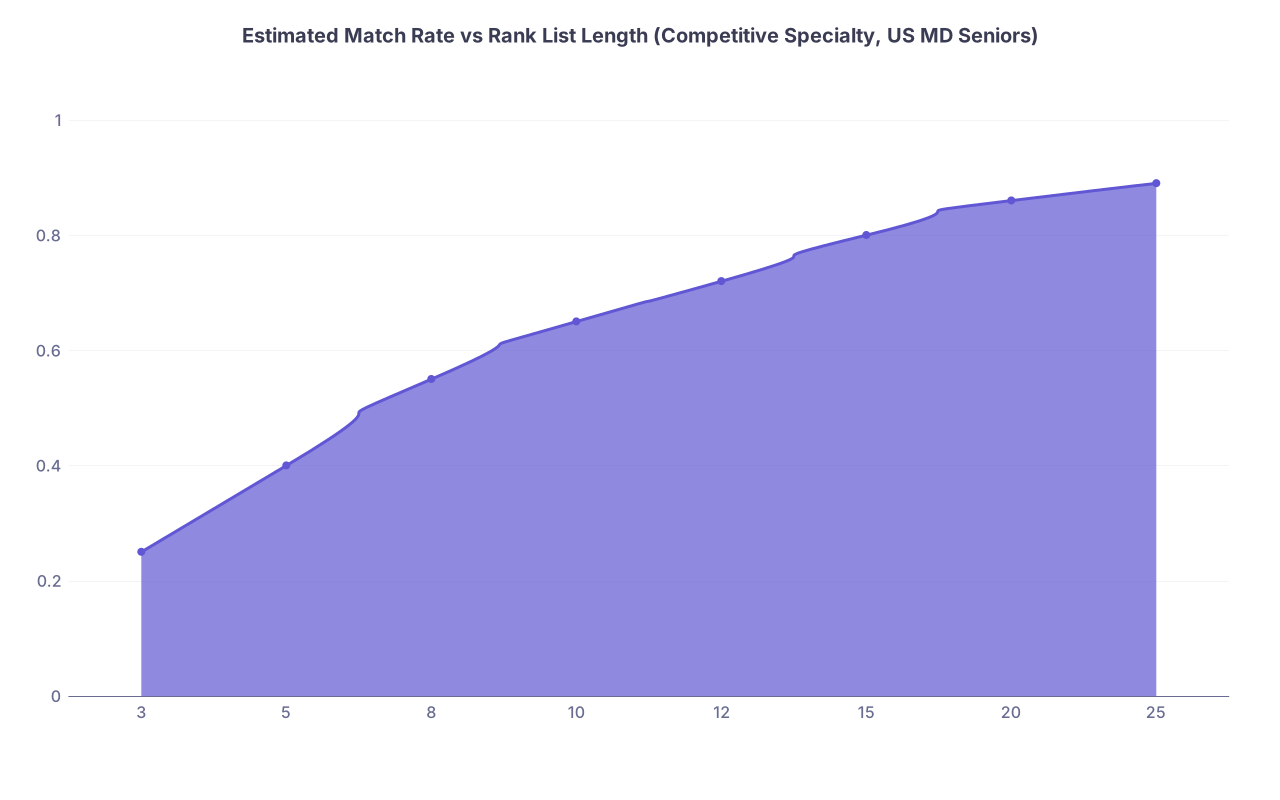
To make this more concrete, here is a stylized version of the match rate vs. rank count curve for a moderately competitive specialty (this is representative, not exact for every year):
| Category | Value |
|---|---|
| 3 | 0.25 |
| 5 | 0.4 |
| 8 | 0.55 |
| 10 | 0.65 |
| 12 | 0.72 |
| 15 | 0.8 |
| 20 | 0.86 |
| 25 | 0.89 |
You can argue about the exact percentages by specialty, but you cannot argue the shape: a sharp early rise, then a slower climb with longer lists.
For less competitive fields or those with many large programs (FM, IM, Peds), the curve is shifted up and saturates earlier. But the directional effect is the same—more realistic programs ranked → lower unmatched probability.
Two practical points that I have repeated to anxious MS4s in November:
- Going from 5 to 10 programs on your rank list is a huge increase in safety.
- Going from 20 to 25 is often comfort more than substance, unless you have serious red flags.
3. How program size changes your odds
Now let us talk program size explicitly.
You can think of program size as the number of “slots” you have to land in within that program’s preference list. The matching algorithm is applicant‑optimal, but it cannot manufacture positions. If a program has 3 categorical spots and fills them with people ranked above you, that is it.
The rough logic:
- Larger programs (20–40+ categorical spots): More total calls in the algorithm where they might tentatively place you. More churn as higher‑ranked applicants match elsewhere, opening positions that can cascade down their list.
- Medium (8–20 spots): Still reasonable “surface area” for you to be tentatively placed and then either stick or be bumped.
- Very small (1–3 spots): You basically need to be at or near the very top of their rank list to have any meaningful probability.
NRMP does not directly publish your per‑program pᵢ, but you can approximate patterns using program fill data and typical rank list lengths.
For illustration, consider three program types:
- Program A: 30 positions (large IM)
- Program B: 10 positions (mid‑sized general surgery)
- Program C: 3 positions (small, competitive specialty site)
Assume each program interviews ~10 applicants per position and ranks ~8 per position (not exact, but common ballpark).
| Program | Positions | Approx. Applicants Ranked | Approx. Rank Depth per Position |
|---|---|---|---|
| A (large IM) | 30 | 240 | ~8 |
| B (mid GS) | 10 | 80 | ~8 |
| C (small competitive) | 3 | 24 | ~8 |
Now imagine your position on each program’s rank list:
- At Program A, if you are 90th: they have 30 slots; if about 3 candidates per slot rank them highly and actually land there, you are still in striking range. The stochastic churn of the algorithm can absolutely reach someone in the 70–110 band.
- At Program B, 30th: similar story. Ten slots, so 30th is plausibly reachable.
- At Program C, 30th: you are essentially dead in the water. Three slots. The algorithm is unlikely to get anywhere near that depth unless there is massive bidirectional overreach.
This is why people “surprisingly” match at big, solid university‑affiliated community programs and constantly whiff on tiny, super‑selective ones. It is not mystery. It is just position/slot math.
The data pattern across NRMP reports backs this up indirectly:
- Large categorical programs in IM, FM, Peds have very high fill rates with U.S. seniors and IMGs combined, and they typically rank deep to do so.
- Small, high‑prestige programs in competitive specialties report short rank lists and very tight match funnels.
Approximate pᵢ by size and competitiveness
If you want numbers to think with, a rough (and intentionally conservative) heuristic I use when modeling for students:
- Large, non‑extreme competitiveness programs where you interviewed and felt “average”: per‑program match probability on the order of 5–10% if you rank them realistically.
- Medium size: 3–7%.
- Very small or very competitive: often closer to 1–3% unless something in your app is clearly exceptional for that field.
So an applicant with 10 interviews at mostly large/medium programs might effectively be running 10 draws with pᵢ ≈ 0.05–0.08. That is not “guaranteed” by any stretch, but the combined probability of matching somewhere is quite high.
Let me run a simple comparative:
Scenario 1: 8 interviews, all small competitive programs (pᵢ ≈ 0.02)
- Match somewhere ≈ 1 − (0.98)⁸ ≈ 14.8%
Scenario 2: 8 interviews, all large less‑competitive programs (pᵢ ≈ 0.08)
- Match somewhere ≈ 1 − (0.92)⁸ ≈ 49.1%
Same interview count, wildly different outlook. This is why obsessing over “number of interviews” without context can be misleading. Size and competitiveness change the slope of your odds.
4. Combined effect: rank list length × program size
You do not match to “an interview count.” You match to a specific, ordered list of programs, each with its own size and competitiveness profile. So the real question is: how does the composition of that list interact with its length?
You can think of three levers:
- Number of programs ranked (length)
- Average program size
- Distribution of competitiveness / where you sit in their rank bands
The efficient frontier is obvious: a long list skewed toward larger programs where you are a reasonable fit.
To make this tangible, consider three hypothetical applicants.
Applicant X: prestige‑heavy, small programs, short list
- 7 total interviews
- All at small, very competitive academic programs (2–4 spots each)
- Estimates: pᵢ ≈ 0.02–0.03 each
- Adds all 7 to rank list
Approximate match probability:
Take pᵢ = 0.025 for simplicity.
- Match somewhere ≈ 1 − (0.975)⁷ ≈ 16.5%
This is the person who looks “impressive” on paper but is actually walking a thin statistical tightrope.
Applicant Y: mixed list, reasonable length
- 12 total interviews
- 4 small competitive programs (pᵢ ≈ 0.02–0.03)
- 8 medium/large solid programs (pᵢ ≈ 0.06–0.08)
- Ranks all 12
Approximate match probability (very rough two‑group model):
- Competitive set: say p = 0.025 → 1 − (0.975)⁴ ≈ 9.6%
- Larger set: say p = 0.07 → 1 − (0.93)⁸ ≈ 44.6%
- Combine: 1 − (prob match none in comp) × (prob match none in larger) = 1 − (0.904) × (0.554) ≈ 1 − 0.501 ≈ 49.9%
Very different profile from Applicant X, purely by list composition and length.
Applicant Z: long, size‑weighted list
- 18 total interviews
- 4 small competitive (pᵢ ≈ 0.02–0.03)
- 14 medium/large (pᵢ ≈ 0.06–0.08)
- Ranks all 18
Approximate:
- Competitive set (4): none ≈ 0.904 (as above)
- Larger set (14) with p = 0.07 → none ≈ (0.93)¹⁴ ≈ 0.366
- Combined none ≈ 0.904 × 0.366 ≈ 0.331
- Match somewhere ≈ 66.9%
Same applicant, same personal competitiveness. Only the shape and size of the list changed.
This is exactly why NRMP’s regression analyses repeatedly show that:
- Number of contiguous ranks is a strong independent predictor of matching
- Specialty competitiveness and exam performance matter, but long lists at appropriate programs buffer risk significantly
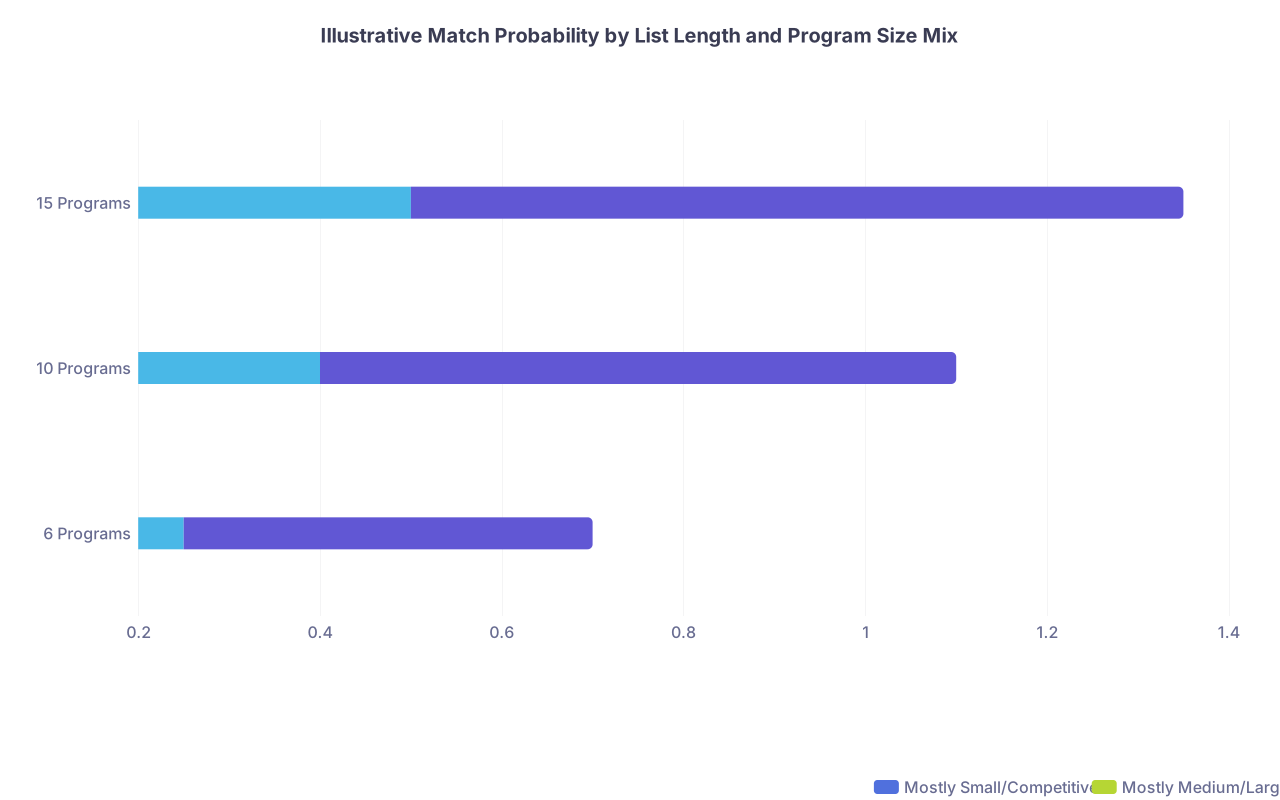
One more way to visualize the interaction:
| Category | Mostly Small/Competitive | Mostly Medium/Large |
|---|---|---|
| 6 Programs | 0.25 | 0.45 |
| 10 Programs | 0.4 | 0.7 |
| 15 Programs | 0.5 | 0.85 |
Again, these are stylized numbers, but the directional message holds: length helps; length plus size‑aware targeting helps more.
5. Strategic implications: how to build a statistically sane rank list
Now, the part you actually care about: what to do with this information.
I will be blunt. The worst mistakes I have seen were not about where someone ranked #1 vs #2. They were about:
- Too few realistic programs
- Overweighting tiny, hyper‑competitive programs
- Under‑ranking large solid fits because “I just did not vibe”
Some data‑driven rules of thumb:
1. Know the typical rank list length in your specialty
NRMP publishes median and interquartile range (IQR) of contiguous ranks by matched vs unmatched applicants by specialty. Read it.
As a very rough pattern for U.S. MD seniors:
- Family Medicine / IM / Peds: Many matched applicants rank 10–13 programs; unmatched often rank far fewer.
- EM / Anesthesia / General Surgery: You commonly see matched medians around 12–15, with unmatched skewing down.
- Derm / Ortho / ENT / Plastics: Matched medians push higher (teens to 20s); unmatched often have shorter, more top‑heavy lists.
If you are sitting below the median contiguous ranks for matched applicants in your specialty, you are choosing a higher risk path. Maybe you accept that tradeoff. But do it consciously.
2. Weight your list towards programs where the math favors you
All else equal, a 25‑slot program where you felt like a normal, engaged interviewee will usually give you more statistical security than a 3‑slot prestige site where you sensed lukewarm interest.
This does not mean you should not rank the small competitive places you love. It does mean:
- Do not let 5 tiny, ultra‑competitive programs dominate the top and middle of a short list.
- Use the middle and bottom of your list to accumulate large/medium programs that fit your profile and would be acceptable to attend.
I have literally sat with applicants who had 8 interviews and tried to rank 5 tiny “dream” programs above 3 solid, larger options—then were surprised by their unmatched risk. The data do not care about dream vs backup. They care about pᵢ.
3. Do not artificially truncate your list
The match algorithm is applicant‑favorable. Ranking more programs that you would actually attend cannot hurt you. It only gives the algorithm more attempts before it returns “unmatched.”
Common self‑sabotage patterns:
- “If I do not get one of my top 8, I would rather just SOAP.” Statistically foolish. You have essentially decided some outcomes are so emotionally unpleasant that you prefer a chaotic, lower‑information scramble. The algorithm would have given you a clean shot at them with no penalty.
- “I did not like the vibe at that big community program, so I will leave it off completely,” when the alternative is a serious unmatched risk. Sometimes this is justified. Often it is pride dressed up as “fit.”
Use a simple test: If SOAP in your specialty is unlikely for your profile and you would definitely apply to this program in SOAP, it probably belongs on your primary rank list.
4. Adjust expectations by program size
When calibrating your personal odds at a specific program, at least account for:
- Number of categorical positions
- Whether they typically fill mostly with U.S. grads vs IMGs
- Your sense of how well the interview went relative to others you have done
A 15‑slot mid‑tier university program where half the residents each year are IMGs and DOs is a very different statistical animal from a 3‑slot “top 10” program that fills with home students and away rotators.
You may not have exact pᵢ values, but you can categorize into “high, medium, low personal probability” and weight larger/medium programs heavier in your safety band.
6. How timing and program behavior interact with size
Rank lists and size do not live in a vacuum. Programs have their own strategies, especially around how deep they rank.
Two quick observations from reading program‑side data and talking to PDs:
- Larger programs are less “afraid” to rank deep. They know they can fill with a wide slice of the interview pool.
- Smaller programs often rank conservatively, especially highly competitive ones. They have a strong sense of who they want and can often fill high on their list.
This lines up with NRMP’s “program fill” analyses: big programs in broad specialties sometimes rank several hundred applicants to fill 30+ spots. Small competitive programs may rank 20–40 and still easily fill.
A compact way to think about it:
- If you received an interview at a large program that overall interviews 300+ applicants, your being on their list at all gives you some non‑trivial shot of reaching rank depth where positions exist.
- If a small, elite program interviewed 40 people for 3 spots and has a strong local pipeline, the expected rank depth of filled positions is very shallow. You need to be near their top to matter.
That should affect how you interpret your interviews. The same fuzzy “it went fine” has far more value at a big, broad‑recruiting program than at a tiny flagship.
7. The emotionally uncomfortable part the numbers expose
The data are not subtle about value tradeoffs:
- If you insist on only ranking small, elite programs in a competitive specialty, you are accepting non‑trivial odds of not matching.
- If you want to drive unmatched probability toward the floor, you will rank more programs, including some that are less prestigious, larger, and maybe not Instagram‑worthy.
There is no algorithmic trick around that. Rank order is about your preferences; probability is about the structure of the market—program sizes, specialty competitiveness, and how many realistic shots you give yourself.
I have seen people tweak their 1–5 ordering for hours and spend almost no time on 8–20. That is backwards. For your expected outcome, the decisions around:
- “Do I rank this big non‑prestige program at all?”
- “Do I add 5 more realistic programs beneath these small high‑reach ones?”
are far more consequential than agonizing between ranking #1 vs #2 among places where you will almost certainly match somewhere in that top cluster if you are going to match at all.
Key points
- Rank list length and program size are not “soft” factors; they are major determinants of your match probability, especially once you have cleared basic competitiveness bars.
- Long lists skewed toward medium and large programs where you realistically fit dramatically reduce unmatched risk compared with short, prestige‑heavy lists of tiny programs.
- The match algorithm rewards honest breadth. Ranking more acceptable programs, particularly larger ones, is almost always statistically superior to keeping your list short and aspirational.