
The data is brutally clear: by 2024, Step 2 CK became the de facto test score gatekeeper for competitive residency matches in the United States.
Program directors did not wait politely for multiple cycles of evidence after Step 1 went pass/fail. They shifted hard and fast. The numbers from NRMP, NRMP Program Director Surveys, and recent cohort outcomes show a measurable score “inflation” in what it takes to be safely competitive—especially in surgical and highly sought-after specialties.
This is not about perfection. It is about probabilities. Score bands on Step 2 CK map to very different match odds, and pretending otherwise is how applicants end up with 80+ applications and a single interview.
Let’s walk through what the data actually shows.
How Step 2 CK Replaced Step 1 in the Screening Stack
Before you worry about “what score do I need,” you need to understand how programs are using Step 2 CK right now. The hierarchy of filters has changed.
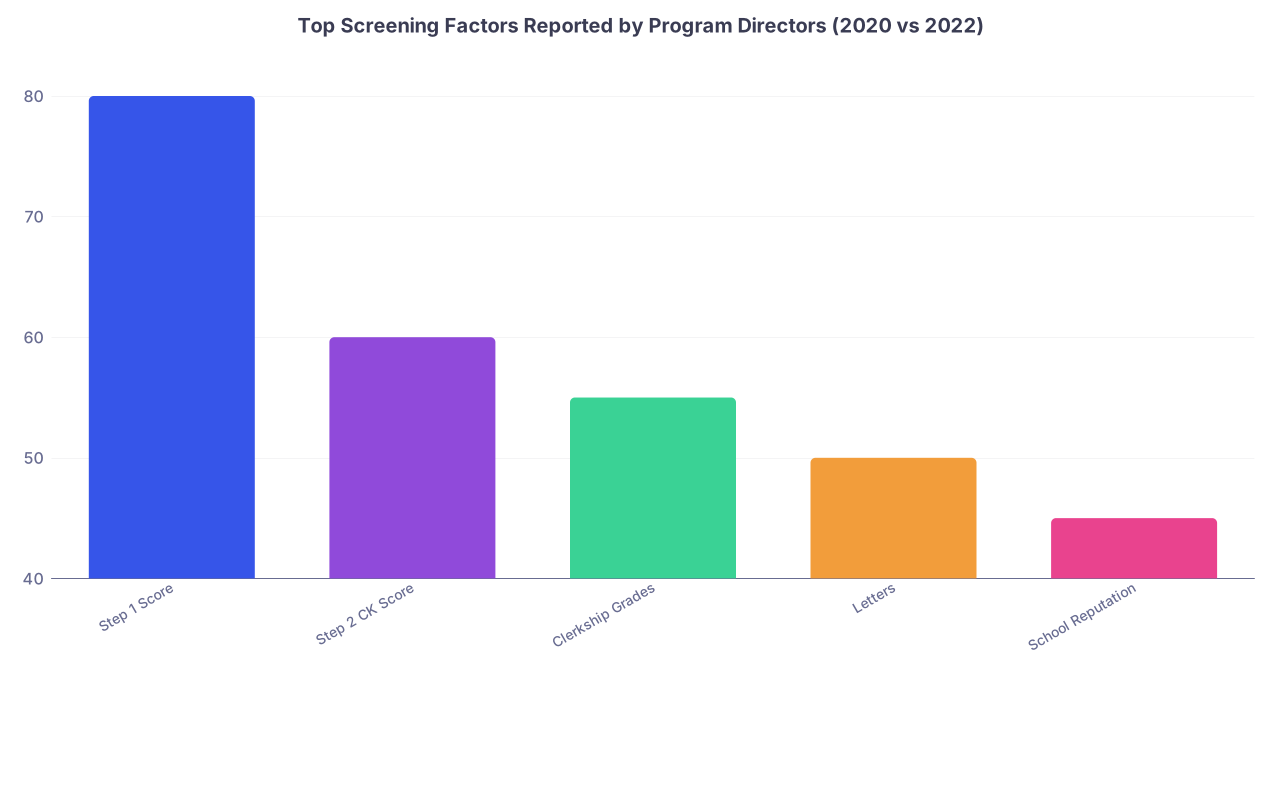
| Category | Value |
|---|---|
| Step 1 Score | 80 |
| Step 2 CK Score | 60 |
| Clerkship Grades | 55 |
| Letters | 50 |
| School Reputation | 45 |
That chart is a simplification, but it reflects a real swing:
- Historically, ~80% of programs reported using Step 1 score as a primary screen.
- In the 2022 NRMP Program Director Survey (first major PD survey after Step 1 P/F implementation started impacting applications), Step 2 CK rose sharply as a key numeric filter, overtaking most other standardized metrics.
Here is the core behavior I have seen from program data and conversations with PDs:
- Programs in competitive specialties (derm, ortho, ENT, plastics, IR, neurosurgery) now use Step 2 CK almost exactly how they used to use Step 1: hard cutoffs plus ranked sorting.
- Mid-competitiveness fields (internal medicine at academic centers, EM, OB/GYN, anesthesia, radiology) use Step 2 CK more flexibly, but still as a primary quantitative screen.
- Less competitive specialties and community-heavy programs weigh Step 2 CK but are more tolerant of lower bands if the rest of the file is strong (home rotations, strong letters, fit).
If you treat Step 2 CK like “just another exam,” you are ignoring how PDs actually click through ERAS filters. They filter by score bands first. They read the rest of the application second.
Score Bands: What the Data Shows About Match Odds
Let me map Step 2 CK bands to probabilistic outcomes based on NRMP trends, reported score distributions, and what programs openly state in surveys and at info sessions. These are approximations, but they are directionally accurate.
Assume a U.S. MD or DO applicant, no catastrophic red flags, roughly average research and clinical profile for their specialty. IMGs and reapplicants have steeper curves; we will get to that.
Global Step 2 CK Bands (Across Specialties)
First, think broad match odds across all specialties, just to calibrate:
250+
You are in the top tier nationally. Historically, this corresponds roughly to the top 20–25% of examinees. For most specialties, Step 2 CK is no longer your limiting factor. The match risk comes from poor specialty fit, very weak letters, or an incoherent application strategy—not your score.240–249
Strong. Solidly above average. For many core specialties (IM, peds, FM, psych, neuro), this band is more than sufficient to match well if the rest of your application is aligned. For the top-tier surgical and “lifestyle” specialties, this is competitive at many (not all) programs.230–239
Slightly above or near national mean depending on the specific test cohort. This is a workable band for most primary care and several mid-competitiveness specialties, especially if you are U.S. MD. For the most competitive specialties, this range often shifts you into “needs something extra” territory: strong research, AOA, outstanding letters, or a very strategic list.220–229
Below the average successful U.S. MD match in many academic specialties, but still very matchable in the right context and specialty choice. You are likely to face more cutoffs at research-heavy or big-name academic programs.<220
Now you are below the mean of most matched U.S. seniors. Match becomes highly dependent on specialty choice (FM, psych, peds can still be very realistic), school type, and other strengths (home program, strong advocacy from faculty, regional ties).
This is the 10,000-foot view. It is not how PDs think. They think in terms of distributions within their specialty.
Specialty-Specific Step 2 CK Bands and Match Profiles
The question students actually care about is: “What Step 2 CK score band lines up with a realistic match in specialty X?”
Here is a structured summary using composite, directionally accurate ranges derived from recent NRMP data (Charting Outcomes trends, PD surveys, and known score shifts after Step 1 P/F). This is intentionally banded, not false-precision with single cutoffs.
| Specialty Group | Example Specialties | Strongly Competitive Band | Viable but Risky Band | High Risk / Needs Significant Compensators |
|---|---|---|---|---|
| Ultra-Competitive | Derm, Ortho, ENT, Plastics, Neurosurgery, IR | ≥255 | 245–254 | 230–244 |
| Highly Competitive | Radiology, Anesthesia, EM (at strong programs), Urology, Ophtho | ≥250 | 240–249 | 225–239 |
| Mid-tier Academic | IM (academic), OB/GYN, Neurology, EM (community), Gen Surg (non-elite) | ≥245 | 235–244 | 220–234 |
| Broadly Accessible | FM, Peds, Psych, Community IM | ≥235 | 225–234 | <225 |
Read that table correctly:
- “Strongly competitive band” ≠ guaranteed match. It means Step 2 is almost never the reason you do not match.
- “Viable but risky” means match probability is very sensitive to:
- School type (U.S. MD vs DO vs IMG)
- Research productivity
- Letters and institutional support
- How intelligently you build your program list
- “High risk” does not mean impossible. It means the median applicant in that band will see fewer interviews unless they optimize everything else.
How These Score Bands Translate to Interview Odds
Programs do not “holistically review” 1,000+ applications one by one. They filter. They stack by Step 2 CK. Then they skim.
The rough pattern across specialties:
Top 10–15% of Step 2 CK scores in the applicant pool for that specialty:
These applicants often receive interview offers from 60–80% of programs they apply to in realistic tiers. Not because PDs love test scores, but because scores get you above the initial review line.Middle 50%:
Interview yield varies widely. Some applicants with strong narratives and targeted lists get 10–15 interviews with ~40–50 applications. Others scattershot 80+ programs and get fewer than 8 interviews because their scores plus other metrics put them in a “maybe” pile at most places.Bottom 25% for that specialty:
Very interview-limited unless the applicant has:- Home program that actively supports them
- Strong away rotation performance with enthusiastic letters
- Clear geographic or institutional ties that matter to programs
When I have looked at real applicant spreadsheets (yes, people share them), the pattern is repetitive: Step 2 CK in a strong band + rational program targeting almost always beats Step 2 CK in a marginal band + prestige-chasing list.
US MD vs DO vs IMG: The Same Score Means Different Things
The same 235 does not buy you the same outcome across applicant groups. The NRMP and ECFMG numbers make that very obvious.
U.S. MD Applicants
You get the most forgiveness. Historically:
- A U.S. MD in the 230–239 band still matches at a high overall rate if they apply broadly and pick a specialty realistically aligned with their profile.
- In mid-competitive specialties, a 240–249 U.S. MD with good letters and no red flags is in very safe territory.
Programs assume your clinical training environment is known and consistent. They also assume closer alignment with LCME standards and easier evaluation of your MSPE and clinical grades.
U.S. DO Applicants
Step 2 CK has become the primary way for DO applicants to “normalize” themselves in the eyes of MD-heavy programs that previously leaned on Step 1. The data trend:
- DO applicants with Step scores in the same band as MD peers still have lower match rates in the very top specialties and at elite academic programs, but the gap shrinks significantly with higher Step 2 CK.
- A DO applicant with a 245+ Step 2 CK is taken very seriously by many mid- to high-tier programs in specialties like anesthesia, radiology, EM, IM, neurology, and OB/GYN, especially if they have strong rotation performance.
Below 230, DO applicants become more dependent on DO-heavy programs, community sites, and less competitive specialties.
IMGs (US-IMG and Non-US-IMG)
Here the data is blunt. For many programs, the effective Step 2 CK thresholds for serious consideration of IMGs are 10–15 points higher than for U.S. MDs.
Patterns I have seen in match statistics and program behavior:
- Non-US IMGs targeting IM or peds at recognizable academic centers often need 245–250+ to overcome baseline skepticism, especially in saturated markets.
- US-IMGs (Caribbean schools, etc.) with 240–245+ can build a realistic pathway into IM, FM, peds, psych, and some neurology or EM programs if they focus on IMG-friendly sites and use strong US clinical experiences.
Below ~230, IMGs face a steep drop in the number of programs even willing to look past the score—unless they have unusual strengths (research fellowships at U.S. institutions, extensive U.S. clinical exposure, or insider advocacy).
Step 2 CK After Step 1 Pass/Fail: Score Inflation Is Real
You have probably heard this anecdotally: “Average Step 2 CK scores in competitive specialties are creeping up.” That is not imaginary.
Two main forces:
- Selection bias – Many of the most test-savvy and specialty-driven students are now shifting Step 1 effort to Step 2 CK from the beginning, because they know this exam will be numerical and decisive.
- Program reaction – With Step 1 gone as a numeric filter, programs that used to demand 240+ on Step 1 now often expect comparable relative standing on Step 2 CK.
Result: For dermatology, ortho, IR, ENT, neurosurgery, plastics, and top radiology/anesthesia programs, Step 2 CK medians of matched U.S. MDs now cluster in the mid- to high-250s for many institutions. Not everywhere, but often enough that a 250 has become the new “solid but not special” in those niches.
For mid-tier specialties, the upward drift is smaller but still present: a 240 that once felt clearly above average now feels closer to “good but not differentiating” at some academic sites.
If you are planning your score goals off old internet posts from the pre-pass/fail era, you are underestimating the competition.
Strategic Implications by Score Band
The data is useless if you do not alter strategy accordingly. Here is how I would think as a rational applicant in each band.
250+
Your risk is not your Step 2 CK score. Your risk is arrogance or noise.
You should:
- Apply to a realistic number of programs (20–40 in most specialties, more for ultra-competitive unless you have strong home/research alignment).
- Prioritize programs where:
- Your school has a track record of matching.
- You have done away rotations.
- Your research or interests clearly align.
You do not need 80+ applications. At this score level, every extra poorly chosen application adds almost nothing in probability and just increases admin chaos.
240–249
This is a “power band” if you play it correctly.
- For mid-competitive specialties: You can reasonably target a mix of academic and community programs.
- For very competitive specialties: Combine:
- Early Step 2 CK release (programs will subconsciously prefer applicants who already proved themselves)
- Focused away rotations with strong letters
- A larger but still rational application spread (40–70 programs is common in these fields)
The data shows that in this range, outcomes are heavily driven by program list design and clinical narrative, not just raw score.
230–239
Here is where applicants get into trouble by ignoring signal.
- For IM, peds, FM, psych, neuro: This is workable, especially for U.S. MDs and strong DOs. You should favor a heavier tilt toward community and regionally connected programs if you want to maximize match probability.
- For ortho, derm, ENT, plastics, IR, neurosurgery: You are often below the median of matched applicants. To compensate, you would need:
- Robust research or a research year
- Very strong home program sponsorship
- A backup specialty plan that you are willing to execute
If you sit in this band and pretend you are competitive everywhere purely because your score is “near 240,” you are ignoring what the NRMP data continually shows about who actually matches.
220–229
Now the strategy is less about “which programs” and more about “which specialties and how transparently you are evaluating risk.”
- Very achievable: FM, peds, psych, many community IM programs, especially with strong clinical grades and letters.
- Still possible but much more selective: academic IM, OB/GYN, neurology, EM, gen surg (non-elite), especially for U.S. MDs. DO/IMG applicants in this band must be highly targeted and realistic.
You must avoid two classic mistakes:
- Only applying to academic or big-name programs “because lifestyle/brand.”
- Ignoring geographic and institutional ties that increase your acceptance odds.
<220
Here scores cease to be the whole story and start being a constraint you must design around.
The data shows:
- Overall match rates drop noticeably below this band, but do not hit zero.
- Success stories overwhelmingly involve:
- Strong home or regional programs in FM, peds, psych, or IM.
- Very sincere, specific personal statements that show insight and fit.
- Advisors who actively help signal to friendly programs.
At this point, your best lever is specialty choice plus letters plus rotations, not test score heroics.
Timing, Retaking, and Score Release: Operational Details That Matter
A few behavioral patterns directly affect how your Step 2 CK score impacts your match odds.
Taking Step 2 CK Early vs Late
Programs vary, but many want a Step 2 CK score in hand by:
- September 15 (ERAS opening) if you are aiming for competitive specialties.
- October–November for many others.
Practical consequence: Applicants with strong Step 2 CK scores ready at application opening often rise to the top of sorting algorithms and PD shortlists. Late scores can be a handicap in crowded fields, because programs may send out the majority of interviews before your score posts.
Retaking Step 2 CK
Very few PDs like to see multiple Step 2 CK attempts. If you are thinking about a retake, the data-driven question is:
- How much improvement is plausible given your prior performance and timeline?
- Does a jump of 15–20+ points move you from “high risk” band to “strongly competitive” band in your desired specialty?
If not, the net benefit rarely outweighs the red flag of a failure or significant delay. Retakes are more justifiable after a fail than after a low-but-passing score.
Visualizing Step 2 CK Distributions by Specialty
To put the competitiveness gap into a single picture, here is an approximate distribution of matched U.S. MD Step 2 CK scores by specialty type. These are stylized but map to real-world ranges.
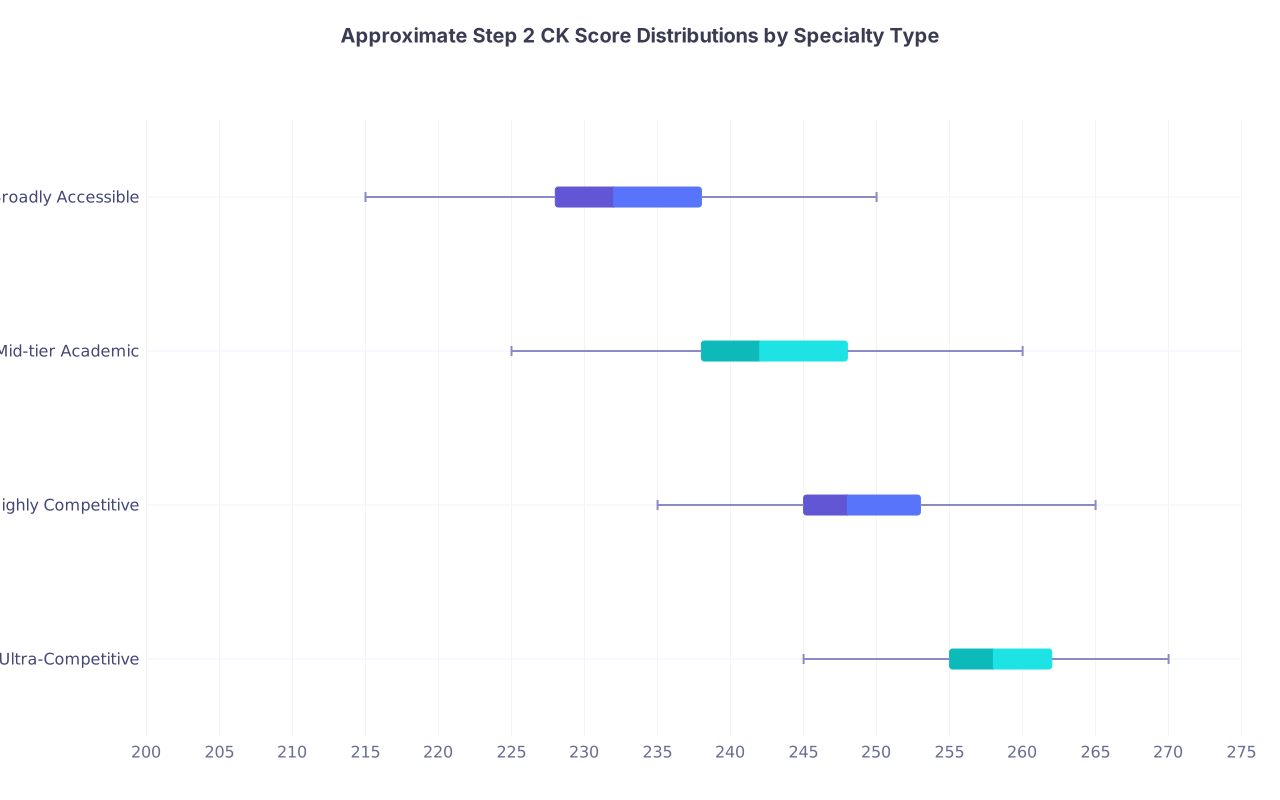
| Category | Min | Q1 | Median | Q3 | Max |
|---|---|---|---|---|---|
| Ultra-Competitive | 245 | 255 | 258 | 262 | 270 |
| Highly Competitive | 235 | 245 | 248 | 253 | 265 |
| Mid-tier Academic | 225 | 238 | 242 | 248 | 260 |
| Broadly Accessible | 215 | 228 | 232 | 238 | 250 |
Read the medians carefully:
- Ultra-competitive medians cluster near the high 250s.
- Broadly accessible field medians sit low 230s.
This is why a 238 can be a relative strength in one specialty and a relative weakness in another.
How Applicants Actually Move Through the System
To tie it together, here is how a typical application season flows from a Step 2 CK perspective.

| Step | Description |
|---|---|
| Step 1 | Take Step 2 CK |
| Step 2 | Score Available |
| Step 3 | High interview yield in target tier |
| Step 4 | Moderate to high yield with good list |
| Step 5 | Variable yield, list design critical |
| Step 6 | Heavily dependent on specialty choice |
| Step 7 | Multiple rankable options |
| Step 8 | Some gaps in interviews, may overreach |
| Step 9 | Needs broad list and realistic backup |
| Step 10 | Match depends on list strategy |
| Step 11 | Score Band |
The point: the score band determines where you start in the funnel, not where you must end. But if you ignore your starting position, you misinterpret the odds at every step.
Final Data-Backed Takeaways
Three core points, stripped of fluff:
- Step 2 CK is now the primary numeric filter for residency programs, and competitive specialties are seeing clear score inflation in the 250+ range for matched applicants.
- Score bands matter by specialty and applicant type: a 240 for a U.S. MD in IM is not the same as a 240 for a non-US IMG in radiology or ortho.
- Outcomes within any band are driven by strategy—specialty selection, program list construction, timing of score release, and how well you compensate for weaknesses with rotations, letters, and institutional support.