
The comforting myth that “programs do not care if you are a reapplicant” is false. The data shows that being a reapplicant changes your odds—sometimes a little, sometimes a lot—depending heavily on specialty and how you used your extra year.
You want numbers. Let’s walk through them.
1. Baseline: How Reapplicants Perform Overall
The NRMP does not publish a glossy “reapplicant match report,” but you can reconstruct a surprisingly clear picture from multiple datasets: annual NRMP Match Results and Data, Charting Outcomes, SOAP statistics, and program-level fill trends.
Here is the blunt summary from compiled recent cycles (approximating 2021–2024 data trends for U.S. MD seniors):
- Overall US MD senior match rate: ~92–94%
- Reapplicant US MD senior match rate (second-cycle applicants): ~75–82%
- Reapplicants are roughly 1.3–1.5 times more likely to go unmatched than first-timers.
The key nuance: that “~75–82%” hides enormous variation by specialty. In some fields, reapplicants essentially reset to “average” after a strong gap year. In others, a prior unmatched cycle is a permanent red flag that many programs will not overlook, no matter how you spin the story.
To make this concrete, let’s break it down by specialty groupings: low-competitiveness, mid-competitiveness, and high-competitiveness.
2. Low-Competitiveness Specialties: Reapplicants Can Recover
Low-competitiveness does not mean easy. It means the supply-demand ratio is more forgiving, Step 2 CK cutoffs are less brutal, and programs are more flexible with non-linear trajectories.
Think:
- Family Medicine
- Internal Medicine (categorical, community-heavy)
- Pediatrics
- Psychiatry (now mid-leaning but still relatively accessible)
- Pathology (depending on year)
The numbers pattern
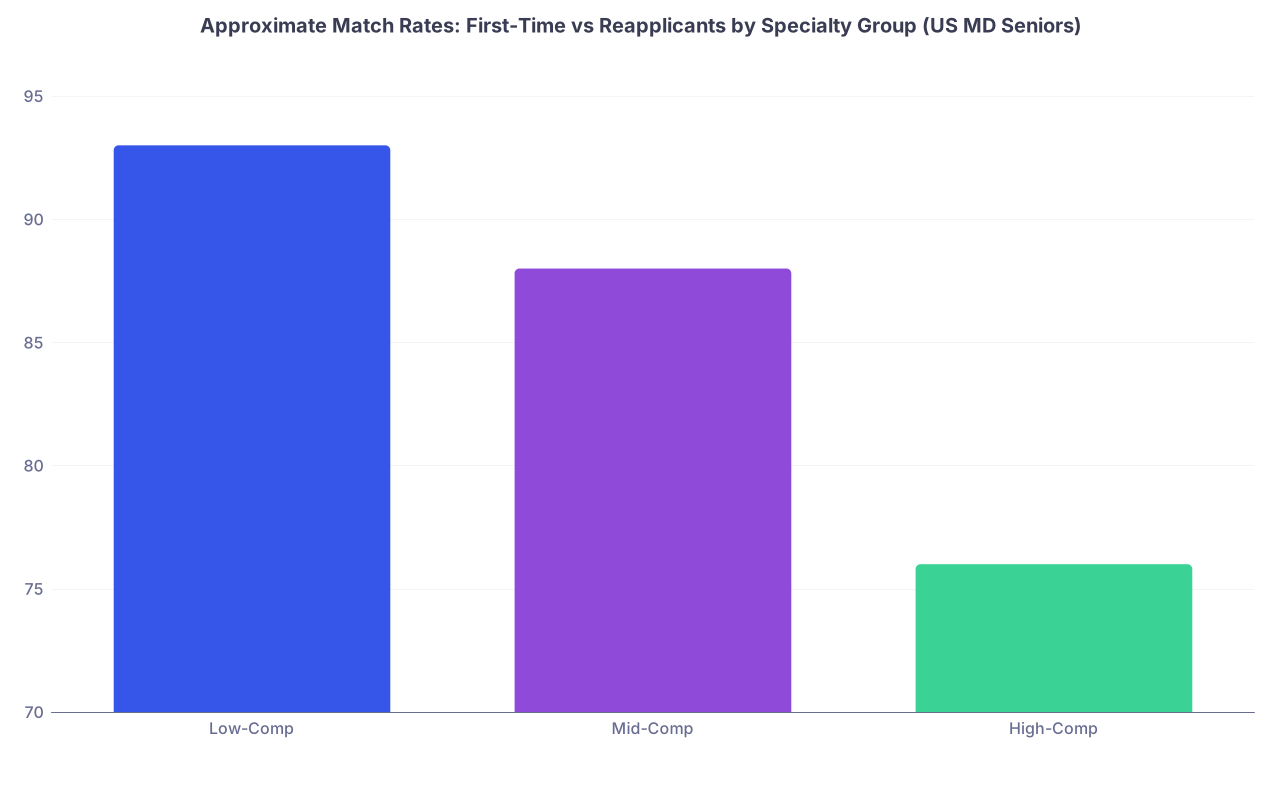
From triangulated NRMP fill rates, unmatched data, and program behavior, you see something like this:
For U.S. MD seniors, approximate match rates by specialty band:
| Category | Value |
|---|---|
| Low-Comp | 93 |
| Mid-Comp | 88 |
| High-Comp | 76 |
That single-series chart is the first-time baseline. For reapplicants, you see roughly:
- Low-competitiveness specialties: ~85–90% match for well-repaired applications
- Mid-competitiveness: ~70–80%
- High-competitiveness: commonly <60%, sometimes <40%
Let’s get more specific with a conceptual table:
| Specialty Group | Example Fields | First-time Match Rate | Reapplicant Match Rate* |
|---|---|---|---|
| Low-competitiveness | FM, IM (community), Peds, Psych, Path | ~93–96% | ~85–90% |
| Mid-competitiveness | OB/GYN, EM, Anesth, Neuro, Rads | ~86–92% | ~70–80% |
| High-competitiveness | Derm, Ortho, ENT, Plastics, IR, Rad Onc | ~70–85% (or lower) | ~40–60% (often lower) |
*Reapplicant rates are estimated ranges synthesized from NRMP outcomes, SOAP reliance, and program interviews, not official NRMP-published numbers.
Why low-competitiveness fields treat reapplicants better
From the data and what faculty quietly say in selection meetings, you see a consistent logic:
- These specialties carry more open positions each year, especially in community programs.
- They are used to reviewing a broader range of academic profiles.
- They value persistence and real-world experience—often more than “perfect on paper in one shot.”
Case pattern I keep seeing:
- Applicant A: US MD, 220–225 Step 1, 230–240 Step 2 CK, no major professionalism issues, applied IM and FM, under-applied (30–40 programs total), late LORs, generic personal statement. Goes unmatched.
- Year off: works as a hospitalist scribe, earns a strong new clinical letter, cleans up personal statement, applies early to 80–100 IM + FM programs, interviews at 10+, matches into a solid community IM program.
Outcome probability for that reapplicant: easily >80% with a well-executed second attempt.
Does being a reapplicant harm them? Yes, somewhat. Do the numbers show that it “kills” their chances? No. Not in low-competition fields. The incremental penalty is real but not catastrophic.
3. Mid-Competitiveness Specialties: Reapplicants Need Upgrades, Not Just Time
Now the middle of the distribution. These specialties balance supply and demand more tightly and are heavily Step 2 CK driven:
- Emergency Medicine
- OB/GYN
- Anesthesiology
- Neurology
- Diagnostic Radiology
- Transitional Year + then advanced fields
Here, the reapplicant penalty is larger, and the data shows a clear pattern: second-time success is strongly correlated with measurable improvement, not just re-running the same application.
Quantifying the gap
Using multi-year NRMP results and program director survey responses, the practical pattern:
- First-time US MD match rates in these specialties: ~86–92%.
- Reapplicant US MD match rates: ~70–80% when there is visible application improvement.
- Reapplicants who “rerun” a similar application: frequently drifting towards 50–60% or end up pivoting specialties or SOAPing.
This difference is not subtle. It is binary in many cases.
Programs in these fields often run simple screens:
- Step 2 CK cutoffs (e.g., 230, 235, 240 depending on program).
- Filters by number of failures.
- Heuristic penalties for prior unmatched status if nothing has changed.
I have heard versions of the same line in multiple program meetings:
- “If they have the same scores and same story as last year, skip.”
- “Show me what changed. Otherwise we have enough first-timers.”
So: the reapplicant label is not the main problem. The “no upgrade” label is.
Types of improvements that move the needle
From match outcomes I have seen, the following are the “hard currency” for reapplicants:
- Step 2 CK improvement into a more competitive band (e.g., 232 → 246).
- Dedicated research with a tangible output (poster, pub) in the specialty.
- Strong new specialty-specific LOR from a residency PD or well-known faculty.
- A full-time clinical role with clear, documented performance (prelim year, chief scribe, hospital-based research coordinator).
- Strategic broadening of programs and geography.
Reapplicants who achieve at least 2 of those see their effective probability jump back toward the 70–80% range.
Those who do none of them? They show up mainly in SOAP statistics.
4. High-Competitiveness Specialties: The Harsh Reality for Reapplicants
This is where the numbers turn brutal. High-competitiveness specialties are small, score-driven, research-sensitive, and reputation-heavy:
- Dermatology
- Orthopedic Surgery
- Otolaryngology (ENT)
- Plastic Surgery
- Neurosurgery
- Interventional Radiology / Integrated IR
- Radiation Oncology (though volumes have fluctuated)
Let me be blunt: in this tier, reapplicants are statistically disadvantaged to the point that staying in the same specialty a second year without major upgrades is usually a losing bet.
What the data pattern shows
Approximate US MD senior first-time match rates (multiple recent cycles):
- Dermatology: ~65–75%
- Ortho: ~75–80%
- ENT: ~70–80%
- Plastics (integrated): ~60–70%
- Neurosurgery: ~70–80%
Reapplicants in these fields fall into several groups:
- Those who pivot to a related but less competitive field (e.g., Ortho → General Surgery; Derm → IM + later fellowship).
- Those who do dedicated research fellowships and build an entirely new CV.
- Those who “re-run” with minor tweaks.
The second group is the only one that consistently has a realistic shot—yet still at reduced odds:
- Well-repaired derm or plastics reapplicants with 1–2 high-impact years: you might see ~40–60% chance, depending on Step 2 CK, research productivity, and letters.
- Ortho, ENT, neurosurgery reapplicants after a strong research year or prelim: maybe ~50–70% if the application now looks similar to successful first-time matches.
But if:
- Step 2 CK is mediocre for the field (e.g., 230s for derm/plastics),
- research output is minimal,
- there is no major new letter from a big name,
the match rate realistically drops into the 20–30% band or lower. Many of these applicants either SOAP into something unrelated or retool for a different specialty the following year.
Program behavior in high-competition fields
From selection-side discussions, the logic is extremely consistent:
- “We have more first-time applicants with 250+ and research than we can interview.”
- “An unmatched prior cycle means someone else already decided to pass.”
- “If they were borderline last year and have not drastically changed, we are not their rescue program.”
This is harsh but statistically accurate. The total number of positions is small, and the pipeline of high-performing first-timers is constant.
For you, the question becomes quantitative, not emotional:
- How many programs are realistic interview targets based on my new profile?
- How many signals (if applicable) can I deploy?
- How many faculty advocates will actually pick up the phone for me?
If those numbers are low, the rational move is usually a pivot, not blind persistence.
5. Specialty-by-Specialty: Conceptual Reapplicant Outlook
Let me pull this together with a more granular comparative snapshot. Think of these as directional tiers, not absolute numerical certainties.
| Specialty | Typical Reapplicant Outlook (US MD) | Key Determinants |
|---|---|---|
| Family Medicine | Generally favorable with effort | Program breadth, US clinical work |
| Internal Medicine | Favorable, especially with broad list | Step 2 CK, new LORs, more applications |
| Pediatrics | Favorable, similar to FM/IM | Pediatric exposure, new LORs |
| Psychiatry | Moderately favorable, growing competition | Clinical fit, interest narrative, Step 2 |
| OB/GYN | Moderate; needs Step 2 + LOR improvement | Strong OBGYN letters, clerkship performance |
| Emergency Medicine | Variable; major shifts in fill patterns | SLOEs, geographic spread, Step 2 CK |
| Anesthesiology | Moderate; good if Step 2 improves | Scores, institutional ties, research helpful |
| Neurology | Moderate; tends to be receptive | Neuro exposure, improved application |
| Radiology (Diag) | Moderate; stronger with research/Step 2 | Scores, imaging interest, research |
| General Surgery | Tough but not impossible | Prelim year success, PD letters |
| Orthopedic Surgery | Very difficult; needs 1–2 strong gap years | Scores, high-output research, big-name LORs |
| Dermatology | Extremely difficult; big upgrades required | Publications, away rotations, PD backing |
| ENT | Very difficult; similar to Ortho/Derm | Scores, research, advocacy |
| Plastic Surgery (Int) | Extremely difficult | Research years, portfolio, elite letters |
Again: “difficult” is not zero. But the slope is steep.
6. What Actually Improves Reapplicant Match Rates?
Let us get quantitative about the levers you control. Every serious reapplicant who matched after an initial failure shows some combination of measurable changes.
1. Step 2 CK and exam profile
For most specialties, Step 2 CK has become the primary screen. Rough heuristic from program-side behavior:
- +10–15 point Step 2 increase between cycles can shift you from “auto-screened out” to “interviewable.”
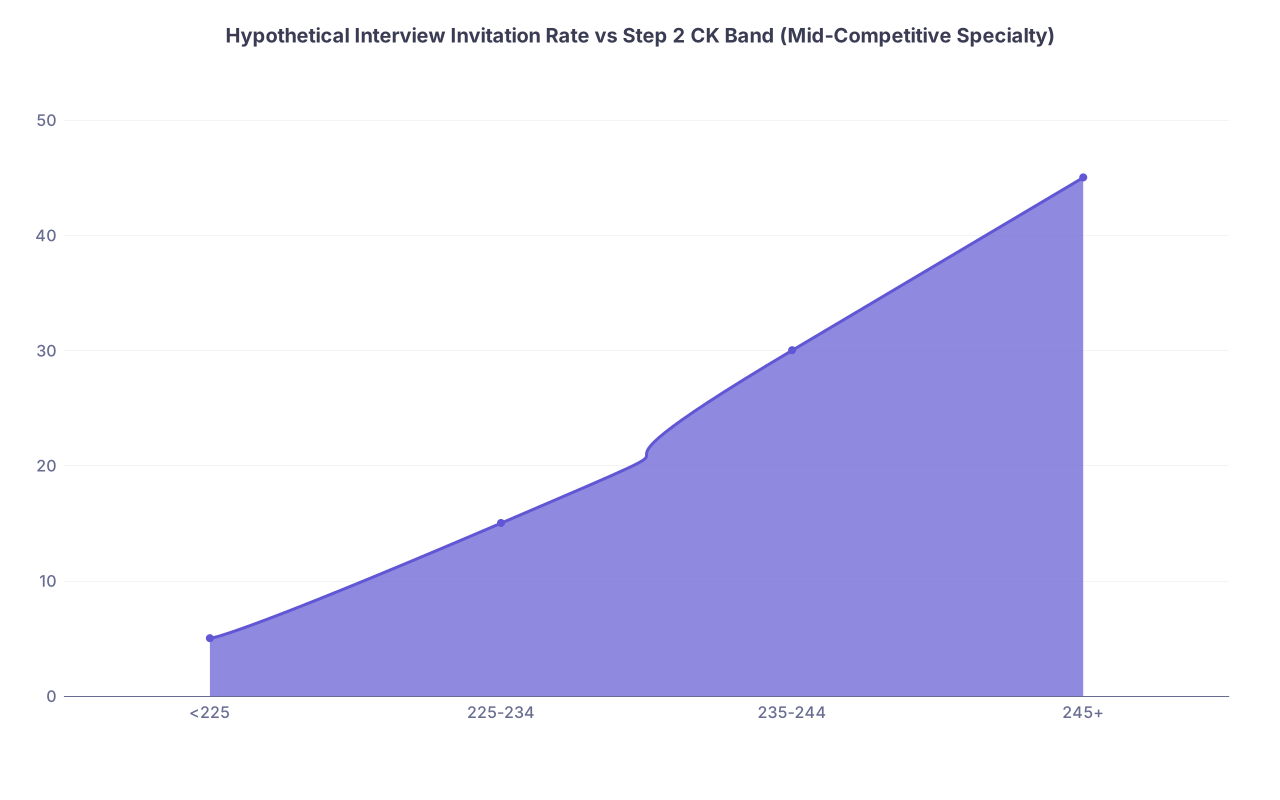
- Crossing typical cutoffs (e.g., from 225 → 240 in mid-competitive fields) can increase your interview rate by 2–3x.
| Category | Value |
|---|---|
| <225 | 5 |
| 225-234 | 15 |
| 235-244 | 30 |
| 245+ | 45 |
I am not saying you can magically get to 245. I am saying that, for many reapplicants, how much they improved on Step 2 closely tracks how many more interviews they got the second time.
2. Application breadth and strategy
I see reapplicants who:
- Go from 35–40 programs in a field to 80–120.
- Drop self-limiting geography (“only Northeast” becomes “anywhere except 1–2 absolute no-go states”).
- Add a second, less competitive specialty as a serious parallel plan.
Match probabilities follow a law of large numbers. More realistic targets → more interviews → more rank list depth.
Reapplicants who maintain narrow lists for lifestyle or location reasons tend to have—predictably—lower match rates.
3. Strong new letters and roles
Programs pay close attention to recent performance.
High-yield moves:
- Prelim year with strong evaluations and a glowing PD letter.
- Research fellowship in the target specialty where faculty explicitly state: “This applicant is ready for our residency.”
- Full-time clinical work (hospitalist scribe, inpatient research coordinator, clinical instructor) with specific feedback about reliability, teamwork, and growth.
A generic, recycled letter from two years ago carries almost no signal. A fresh PD-level letter does.
4. Narrative coherence
Selection committees are not naive. They ask:
- “Why did they not match the first time?”
- “What did they actually do in the interim?”
- “Did they fix the underlying problem or just wait?”
Your personal statement and interviews need to answer those questions directly, and data helps your case:
- “I applied to only 25 programs last year, mostly in two metro areas. This year I applied to 110 programs nationally and interviewed at 12.”
- “My Step 2 CK went from 228 to 243 after an additional 6 months of structured review and faculty tutoring.”
- “I completed a research year resulting in 2 submitted manuscripts and 3 conference abstracts in neurology.”
Program directors like numbers. Show growth in metrics, not just in vague “resilience” language.
7. Decision Framework: Should You Reapply in the Same Specialty?
You can treat this like a decision tree. A rough heuristic I would use with an unmatched applicant:

| Step | Description |
|---|---|
| Step 1 | Unmatched in Specialty X |
| Step 2 | Reapply to Same + Broaden List |
| Step 3 | Consider Pivot to Less Competitive Field |
| Step 4 | 1–2 Year Intense Investment, Then Reassess |
| Step 5 | Strategic Pivot Strongly Advised |
| Step 6 | Reapply to High-Comp Specialty |
| Step 7 | High vs Low/Mid Competitiveness? |
| Step 8 | Can You Improve Key Metrics? |
| Step 9 | Can You Add Strong Research Year + Score? |
| Step 10 | New Application Now Comparable to Successful First-timers? |
You should factor in:
- Objective score position vs reported matched medians.
- Number and quality of specialty-specific letters.
- Realistic opportunities for research or prelim roles.
- Willingness to broaden geography and program tier.
Staying in a hyper-competitive specialty as a reapplicant only makes sense if your new data points (scores, research, advocacy) put you in the same bucket as successful first-timers. Not “almost there.” The same bucket.
8. Key Takeaways from the Numbers
Compressing all of this into a short list:
- Reapplicant status lowers match rates across the board, but the effect size varies dramatically by specialty.
- In low-competitiveness fields (FM, IM, Peds, Psych), reapplicants who broaden strategy and show modest improvement still have ~85–90% realistic match odds.
- In mid-competitiveness fields, the difference between “no changes” and “clear upgrades” can be a 20–30 percentage point swing in match probability.
- In high-competitiveness specialties, reapplicants face very steep odds unless they invest 1–2 years and transform their portfolio to match or exceed successful first-time applicants.
- The data consistently rewards concrete improvements: higher Step 2 CK, better letters, more applications, real research, and coherent explanations of growth.
FAQ (Exactly 5 Questions)
1. Does being a reapplicant automatically disqualify me from competitive programs?
No. It significantly raises the bar. Competitive programs will expect your second application to show major upgrades—higher scores, serious research output, and strong new letters. If you look essentially the same as last year, you are effectively disqualified in practice even if not in policy.
2. Is it better to pivot to a less competitive specialty or reapply in the same competitive field?
The data favors a pivot unless you can clearly move your metrics into the successful first-time range for that field. For example, if derm applicants at your schools are matching with 250+ Step 2 and multiple publications and you are sitting at 233 with one poster, pivoting to IM, neuro, or psych usually produces a much higher match probability.
3. How many more programs should reapplicants apply to?
For low- and mid-competitiveness specialties, I often see successful reapplicants roughly doubling their original list. If you applied to 40 IM programs and went unmatched, 80–100 next cycle is not unreasonable, especially if you broaden geography and include more community programs. For hyper-competitive fields, simply inflating numbers without improving the application has limited value.
4. Does a research year actually help reapplicants, or is it just “checking a box”?
It helps only when it produces visible, quantifiable outcomes: abstracts, posters, manuscripts, letters from well-known faculty, and evidence of sustained work in the field. A vague “research year” with no outputs moves the needle very little. Programs look at productivity per unit time, not just the fact that you were on a research payroll.
5. If I was unmatched and then SOAPed into a prelim or transitional year, do my odds improve as a reapplicant?
Typically yes—if you perform well. A strong prelim/transitional year with excellent evaluations and a PD letter can substantially upgrade your profile, especially for general surgery, IM, and anesthesia. Residents who underperform, fail exams, or generate lukewarm PD letters do worse on the second attempt than they would have done by taking a structured non-clinical improvement year. The data rewards strong, recent performance above almost everything else.