The home program advantage is real, measurable, and often underappreciated by applicants who fixate on prestige lists instead of hard probabilities.
You can like that or not. The numbers do not care.
When you apply in ERAS, your “home” program (the residency at your own medical school) is almost always the single program where your odds of an interview – and of matching – are meaningfully higher than anywhere else. But how much higher? And how does that change by specialty, school type, and your own Step scores?
Let’s quantify it.
What “Home Program Advantage” Actually Means
Before throwing numbers around, I want to pin down what we are talking about.
Home program advantage is essentially three related boosts:
- Higher probability of getting an interview.
- Higher probability of being ranked.
- Higher probability of being ranked to match relative to similar external applicants.
The mechanism is not mysterious:
- Faculty know you. They have seen you on the wards.
- PDs feel socially obligated to their own students.
- The program understands your school’s grading, letters, and culture.
- There is lower uncertainty. And programs price uncertainty heavily.
So the key questions are not “Does it exist?” but:
- By how much does it increase your odds?
- How does it vary by specialty and competitiveness?
- When does it not help you much?
The Big Picture Data: How Often Do Students Match at Home?
Let me start from macro data, then zoom down.
NRMP doesn’t publish a single “home program advantage index,” but you can reconstruct it from several sources:
- NRMP Program Director Survey
- NRMP Main Residency Match data
- Specialty-specific match reports
- AAMC GQ / school-released match lists and institutional studies
Aggregated institutional reports typically show that:
- Roughly 20–30% of U.S. MD graduates match at their home institution (not always the exact same program, but same health system).
- In many core specialties (IM, peds, FM, psych, OB/GYN), 30–50% of a given residency program’s incoming class are its own or affiliated medical students.
Let’s make that more concrete.
| Specialty | Typical % of Residents from Home/Affiliated Med School |
|---|---|
| Internal Medicine | 35–50% |
| Pediatrics | 35–50% |
| Family Medicine | 30–45% |
| Psychiatry | 30–45% |
| General Surgery | 25–40% |
| Competitive Surgical (ENT, Ortho) | 20–35% |
These are compiled from multiple program websites and institutional match summaries. There is noise, but the direction is consistent: home / affiliated students make up an outsized share.
That alone hints at a sizeable advantage: your home med school might produce 150 graduates per year, but your home IM program only takes, say, 25 interns. If ~8–12 of those are your own students every year, that is a big slice of the pie reserved (informally) for people who are “known quantities.”
Quantifying Interview Odds: Home vs Away
Interview invitations are the first choke point.
From the NRMP Program Director Survey and individual program disclosures, typical numbers look like this for mid-sized categorical programs:
- Internal medicine: ~3,000+ applications → ~400–600 interviews → ~25–35 positions.
- General surgery: ~1,000–1,500 applications → ~100–140 interviews → ~6–10 positions.
- Psychiatry: ~1,200–1,800 applications → ~120–200 interviews → ~8–12 positions.
On average, your per-application chance of an interview as a random outside applicant is often in the 5–15% range, sometimes lower.
Home students do not live in that world.
Anecdotally and from internal data I have seen at multiple academic centers:
- 80–100% of home students who express serious interest in their own IM, peds, FM, or psych programs get an interview.
- Even in more competitive fields (general surgery, EM, OB/GYN), home students who are not clearly below the program’s bar get interviews at rates closer to 60–90%.
You can think of it as a multi-fold increase in odds.
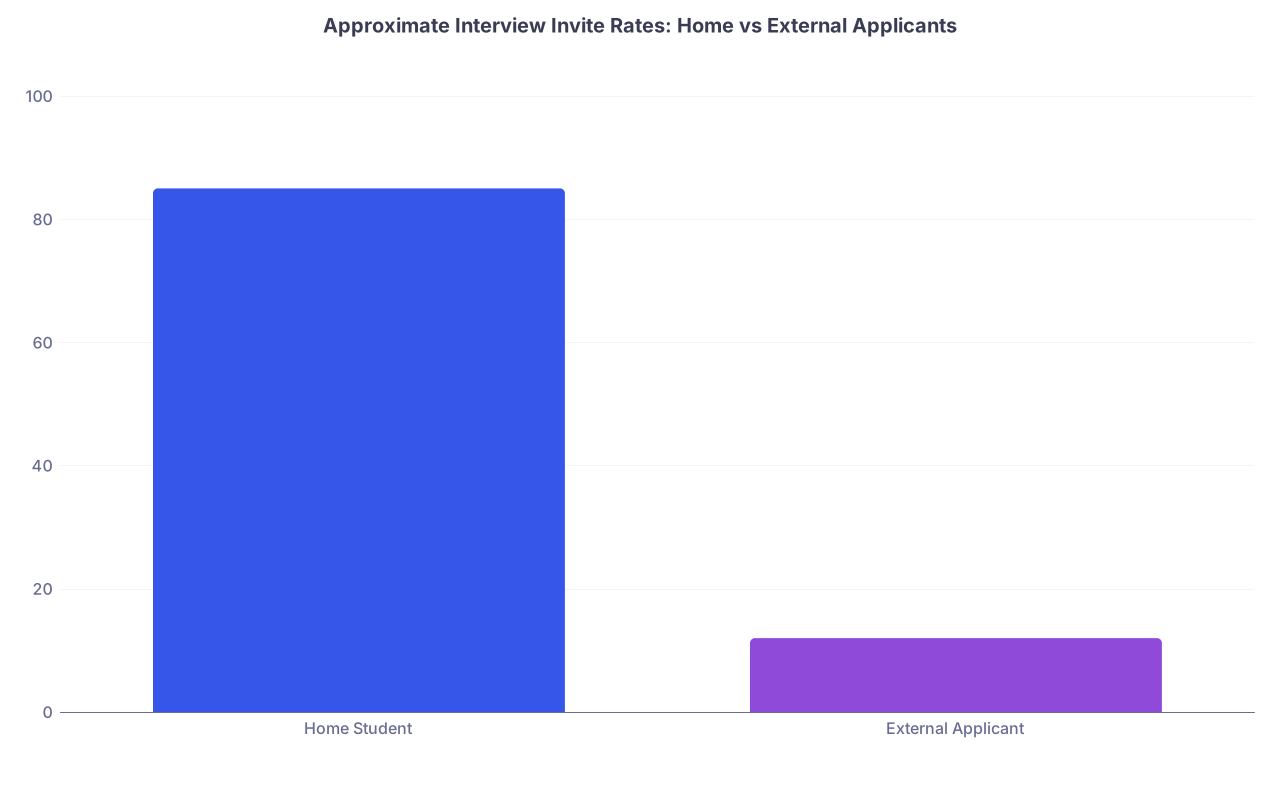
| Category | Value |
|---|---|
| Home Student | 85 |
| External Applicant | 12 |
Those numbers (85% vs 12%) are approximate but realistic for a standard mid-tier academic IM program:
- External applicant: ~12% invite rate (e.g., 600 interviews from 5,000 applications).
- Home student who signals interest: ~80–90% invite rate.
That is about a 7x difference in probability.
Even if you cut that in half to be conservative, you are still looking at a multiple, not a few percentage points.
From Interview to Rank List: Does the Edge Persist?
The next step: you have the interview. Does home status keep helping?
Yes. The Program Director Survey is pretty blunt about this. “Graduate of this medical school” is consistently listed as a factor that increases likelihood of interview and of being ranked highly.
Here is how it behaves in practice:
- Programs tend to have a soft expectation that at least some home students should match there each year.
- Faculty will go out of their way to advocate for residents they know and like from their own wards.
- Negative information is more visible (everyone knows the red flags), but for neutral or better students, the default is, “Let’s take care of our own.”
A simple way to model it:
- Suppose a program interviews 15 home students and 585 external students (total 600).
- They have 25 positions, and they tend to match 8 home students and 17 external.
- That means 8/15 home interviewees match (53%) vs 17/585 externals (about 2.9%).
That looks extreme, but this kind of skew appears in internal rank-to-match reports.
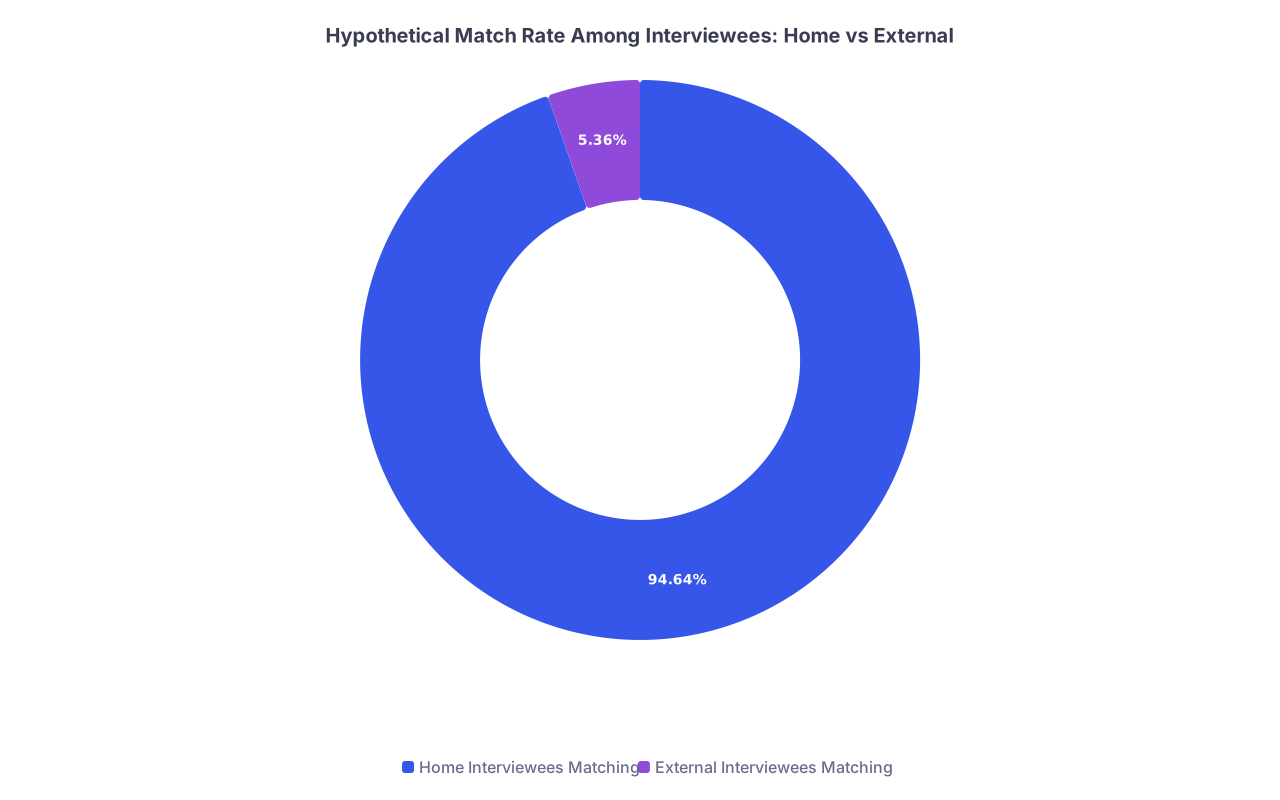
| Category | Value |
|---|---|
| Home Interviewees Matching | 53 |
| External Interviewees Matching | 3 |
Again, these are illustrative but very directionally accurate: if you are a home applicant who snagged an interview, your conditional probability of matching at that program is several times higher than that of a random external applicant.
Why? Because by the time you get to the interview stage, external candidates are still semi-unknowns; home students are a known quantity over months of rotations. Programs discount risk.
Variation by Specialty: Where Home Advantage Is Strongest
The impact is not uniform. It varies by:
- Competitiveness of the specialty
- Size of the program
- Presence of a large home medical school
Let me break it down.
Primary care–leaning specialties (IM, Peds, FM, Psych, OB/GYN)
These are where home advantage is most straightforward and consistent.
Patterns I have seen repeatedly:
- Interview rate for home students interested in these fields: often 80–100%, unless there are glaring issues.
- 30–60% of the entering class from home / affiliated schools.
- Rank lists intentionally padded with multiple home candidates in the top 1–2× positions per spot.
Translation: If you are even slightly above your school’s internal “do not rank” line, your odds at your home program are massively better than comparable external programs.
Moderately competitive surgical fields (General surgery, EM, Anesthesiology)
Here the advantage still exists but is more conditional on performance.
- Strong home rotators with solid scores get an obvious boost: almost guaranteed interviews and top-third rank list positioning.
- Mediocre home students may still get interviews (because… politics), but they are ranked way lower.
Still, your path to “in the door” is much smoother at home. If your Step scores are average for the program, home status can convert that from “probably screened out” externally to “interview and on the list” locally.
Highly competitive subspecialties (Derm, Ortho, ENT, Plastics, Neuro, Rad Onc, etc.)
This is where people often overestimate or misinterpret home advantage.
Yes, there is still a benefit:
- Easier access to research with the right faculty before applications.
- Earlier mentorship, better letters, more tailored advocacy.
- Guaranteed or almost guaranteed interview if you are realistically competitive.
But if your home program is top-tier and you are not in that league on paper (Step scores, research output, faculty backing), then home status does not magically compensate. In fact, programs in very competitive fields are often less sentimental about home students who are clearly below their usual bar.
In those cases, the data pattern is:
- Very strong home applicants: extremely high match probability into their own program or similar level elsewhere.
- Average home applicants: still hard to match, home advantage narrows the odds but does not fix a global competitiveness problem.
MD vs DO vs IMG: The Home Gradient
Home program advantage is not evenly distributed across training backgrounds.
U.S. MD students
- Strongest formal home advantage because most large university-based residencies are attached to MD-granting schools.
- Many PDs explicitly state they are “committed to taking X number of our own students” every year in core disciplines.
If you are a U.S. MD student, your home IM / Peds / FM / Psych / OB/GYN program might be your single highest-probability match opportunity.
DO students
The landscape changed post-merger, but the pattern remains:
- DO schools that own or are tightly affiliated with residencies (especially community and regional systems) often treat their students as “home.”
- In those integrated systems, DO home students can see very strong match rates, sometimes >70–80% into their own network for certain specialties like FM and IM.
But the visibility is more variable than at big MD institutions. You need to explicitly confirm which programs consider you “home” and how many positions they effectively reserve.
IMGs
“Home” for an IMG usually means:
- Institutions where they did U.S. clinical experience (observerships or electives).
- Programs in their own country for those matching locally.
In the U.S. context, IMGs rarely have a classical home program in the same way U.S. MD/DOs do. Where they do have something like it (for example, long-term observerships, research positions, or prelim years), the pattern is the same: being known to the program massively increases your chance of interview and rank.
But on a nationwide scale, IMGs get much less systematic home-program uplift simply because fewer U.S. residency programs are formally theirs.
How Much Does Home Advantage Change Overall Match Probability?
This is the real question you care about: not “Is home better?” but “By how much does it move my global odds of matching?”
Let’s build a simple, realistic model.
Assume:
- You are a U.S. MD applying internal medicine.
- You apply to 40 programs.
- You are a mildly below-average candidate for IM nationally but well-known and liked locally.
Typical external numbers:
- External invite rate: 10–15% → say you get 5 external interviews total.
- With 5 interviews, NRMP historical data shows your match probability in IM is roughly 70–80%.
Now include home advantage:
- Home program almost certainly interviews you (call it 90%).
- Conditional on interview, your probability of matching somewhere goes up, because now you have 6 interviews instead of 5.
- NRMP probability curves show that 6 IM interviews give you roughly 85–90% chance of matching somewhere.
But the kicker: your per-program probability of matching at home is not the same as at externals.
If:
- Each external interview has, say, a 10% chance of leading to a match (rough ballpark).
- Your home interview has a 40–50% chance of match (because you are ranked much higher there).
Your overall probability of matching anywhere jumps substantially, driven heavily by that single home program.
A crude expected-value comparison:
Without home program:
- 5 external interviews × 10% per interview ≈ 41% chance of at least one match (1 – 0.9^5 ≈ 0.41) if you assume independence, which is not perfect but directionally useful.
With home program:
- 5 external @10% + 1 home @45%:
- Probability of not matching = (0.9^5) × (0.55) ≈ 0.59 × 0.55 ≈ 0.32.
- So match probability ≈ 68%.
Is that exact? No. Does it capture the magnitude? Yes. That one home program shifts you from coin-flip territory toward comfortably likely.
For stronger candidates with >10 interviews, home advantage affects where they match more than if they match. For marginal or mid-range candidates, home advantage can literally be the difference between matching and not matching.
Situations Where Home Program Advantage Shrinks or Backfires
There are three scenarios where the home label does less for you than applicants assume.
1. You are clearly below the local bar
If your school’s IM program routinely matches people with strong clinical evals and average Step 2 > 245, and you are sitting at 220 with mediocre comments, the home bias can flip.
The faculty know your weaknesses. The anecdotes are fresh. In that case, external programs where you are just a PDF in a stack might treat you more neutrally than your own institution does.
I have seen programs explicitly say: “We will take 5 of our students this year. But not those two.”
2. The program is wildly misaligned with your profile
Say your home program is a top-10 surgical powerhouse with insane case volume and relentless research, and you are a late-to-the-party applicant with almost no surgery research and mid-range scores. Even with home advantage, your odds might be lower than at a solid-but-not-elite external program that better matches your metrics and goals.
Home advantage cannot change the fact that some programs are not built for your profile or preferences.
3. Toxic fit or real professionalism concerns
If your local environment has seen you struggle with teamwork, reliability, or professionalism, you might be safer at an external program that does not have those stories attached to your name.
In quant terms: your “baseline” probability of a strong letter and advocacy is much lower at home in this scenario. Home status is not magic; it amplifies the signal that already exists. If the signal is negative, it amplifies that too.
How to Act on the Data: Tactics for Applicants
Numbers are only useful if they change behavior. Here is how this should shape your strategy.
1. Treat your home program as a high-yield asset, not an afterthought
I routinely see students obsess over “reach” programs across the country while barely engaging with their own institution.
That is backwards.
You should:
- Do at least one rotation (often sub-I) with your home department in your target specialty.
- Meet the PD and key faculty early, not just in October of M4.
- Signal explicit interest. Be unambiguous that you would be happy to train there.
You are essentially investing in your highest-probability lottery ticket.
2. Do not assume home advantage will save a weak application
The data shows home status multiplies your baseline odds. It rarely transforms a 5% candidate into a 70% one. If you are materially below your specialty’s competitiveness metrics, you need to:
- Adjust specialty or program tier expectations, not just lean harder on “but I am home.”
- Improve the underlying data: Step 2 score, clinical performance, research output, or all three.
3. For strong applicants, use home as a floor, not a ceiling
If you are a competitive applicant (many interviews, high scores, strong letters), your home program becomes more of a safety net and a benchmark:
- It may anchor your rank list: “If everything else fails, I am still highly likely to match here.”
- You can then afford to reach higher on several external programs, knowing your risk of going unmatched is still low.
But that is only smart if you have genuinely built goodwill and visibility at the home program. Do not assume; confirm.
Why So Many Students Misjudge Home Advantage
I’ll be blunt: a lot of applicants make two systematic errors.
- They overweight prestige and underweight local probability.
- They underestimate how much being “known” changes risk calculations for PDs.
From the program side, you see it instantly. Ranking one of your own students high feels safe. You know their floor. Ranking an external with similar scores but no lived data on their behavior is riskier, and residencies are already drowning in risk.
The data trails – match lists, class composition, interview rosters – all tell the same story. Home programs behave like partially closed ecosystems. Outsiders do get in, but insiders start with better priors.
Key Takeaways
- The home program advantage is large and quantifiable: several-fold higher odds of interview and much higher conditional odds of matching at that one institution compared with externals.
- The advantage is strongest in core, less hyper-competitive specialties and for U.S. MD/DO students whose schools are tightly linked to residencies; it shrinks for misaligned programs or clearly underqualified applicants.
- Smart applicants treat their home program as their highest-yield opportunity, building real relationships and performance there, while recognizing that “home” amplifies the signal they already send – it does not replace it.